

Here is something that happens to almost every AZ-700 candidate.
You study for weeks. You watch videos. You read through Microsoft docs. You take notes on every Azure networking service you can find. You feel ready.
Then you open your first practice test.
And the questions feel nothing like what you studied.
You know what Azure VPN Gateway is. You know what ExpressRoute does. But the exam is not asking you to explain these things. It is giving you a real-world business problem and asking you to solve it.
That is the shift most candidates miss. And once you understand it, your entire approach to AZ-700 exam preparation changes completely.
If you are here with the question, “how to prepare for the AZ-700 exam?”, this guide covers everything you need. The full AZ-700 syllabus, the exam pattern, exam difficulty, skills measured, a step-by-step preparation roadmap, the service comparisons the exam loves to test, common mistakes to avoid, career outcomes, and practical AZ-700 exam tips that will actually help you on test day.
Let’s walk through it together.
Is the AZ-700 Exam Right for You?
Before you invest weeks of preparation, it is worth making sure the AZ-700 certification is the right fit for where you are right now.
This exam is built for professionals who are responsible for networking in Azure environments. If you are a Network Engineer, Azure Administrator, Cloud Engineer, Infrastructure Engineer, Solution Architect, or Security Engineer, this one is squarely aimed at you.
If you currently work with traditional on-premises networks and want to move into cloud networking, AZ-700 is one of the most direct paths you can take. It bridges exactly the gap between traditional networking knowledge and what Azure environments actually demand.
Here is the key thing to keep in mind: the Microsoft Azure Network Engineer Associate exam is not just about knowing Azure tools. It is about using them correctly in real situations. Knowing how BGP works is a starting point. Knowing how BGP behaves inside an ExpressRoute deployment is what the exam actually tests.
What Should You Know Before You Start?
There are no hard rules about what you need before taking the AZ-700 exam. But Microsoft recommends you come in with knowledge in these areas:
- Basic networking concepts like DNS, routing, firewalls, VPN, subnetting, and load balancing
- A basic understanding of Azure services like virtual machines and storage
- Some experience with Azure networking tools like Virtual Networks, VPN Gateway, and ExpressRoute
If networking basics feel unclear right now, take time to learn them first. Jumping into Azure networking without this foundation is like trying to build a house without a base; it will slow you down more than you expect.
If you are completely new to Azure, starting with AZ-900 or AZ-104 is a smart move. Neither is required, but both give you a foundation that makes AZ-700 significantly more approachable.
What Is the AZ-700 Exam Format and Passing Score?
Before you build a study plan, you need to understand what you are preparing for.
Here are the key details:
| Exam Detail | Information |
| Exam Code | AZ-700 |
| Certification | Microsoft Azure Network Engineer Associate |
| Time Allowed | About 120 minutes |
| Passing Score | 700 out of 1000 |
| Question Types | Multiple choice, case studies, scenario-based |
| How to Take It | Online proctored or at a test centre |
| Level | Intermediate to advanced |
The most important thing to understand is the question type.
This exam does not ask you to memorise definitions. It gives you a situation with a company with a specific problem and asks you to choose the best solution. You might see something like:
“A company needs a secure, fast, private connection between their office and Azure. What should they use?”
That kind of question needs you to think, not just remember. That is exactly why so many people find the AZ-700 exam difficulty higher than they expected going in.
What Skills Does the AZ-700 Exam Actually Test?
Before you start studying, you need to know exactly what Microsoft expects you to demonstrate. These are the official AZ-700 exam objectives based on the latest Microsoft blueprint.
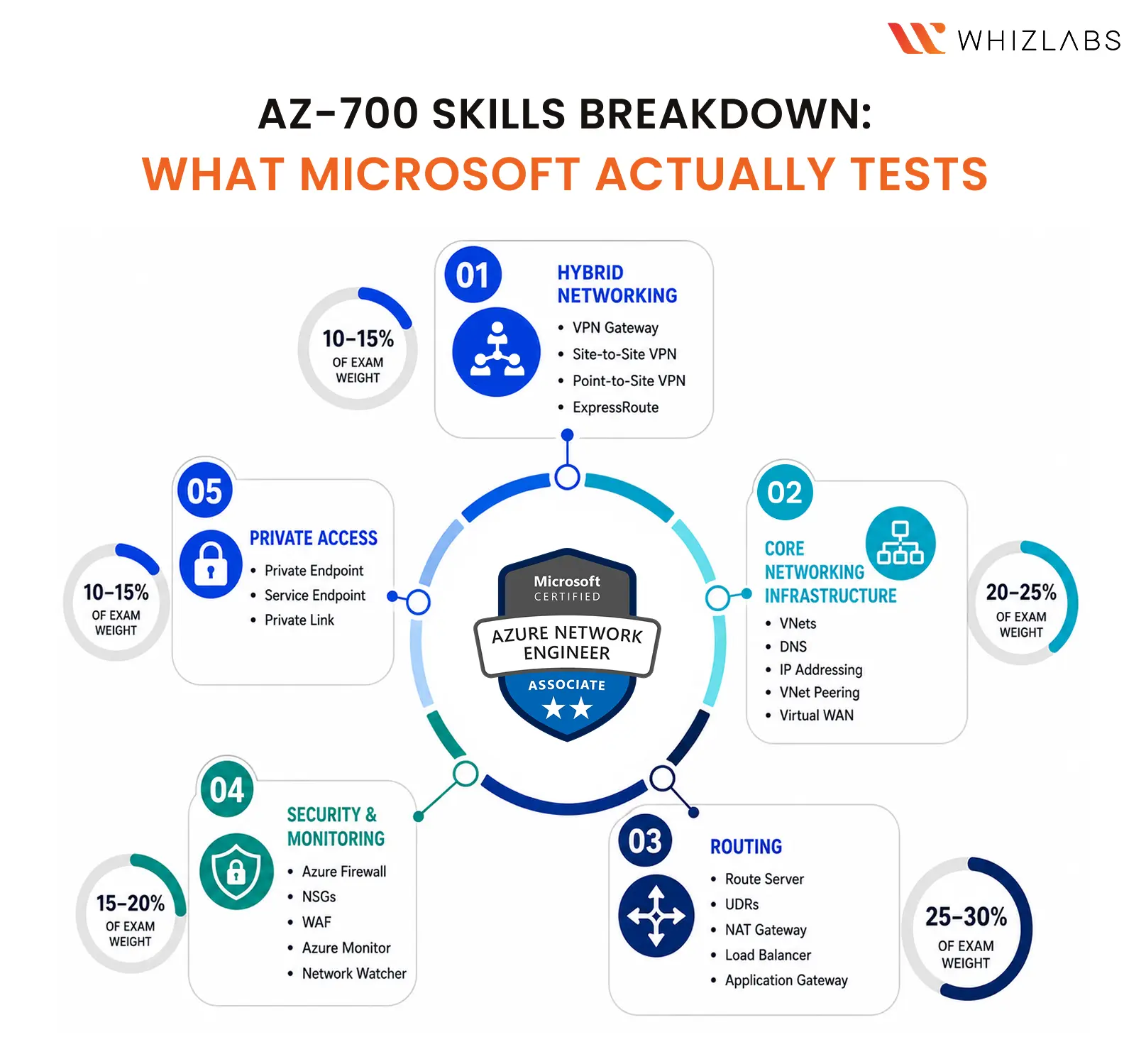
The exam measures your ability across five core skill areas:
Design, implement, and manage hybrid networking This includes planning and deploying Site-to-Site VPN, Point-to-Site VPN, Azure VPN Gateway, and ExpressRoute connections. You are expected to understand when each solution is appropriate and how to configure them correctly.
Design and implement core networking infrastructure This covers building and managing Azure Virtual Networks, configuring IP addressing, setting up Azure DNS, implementing VNet peering, and working with Azure Virtual WAN at scale.
Design and implement routing This is the most heavily tested skill area. It includes configuring User-Defined Routes, deploying Azure Route Server, setting up NAT Gateway, and understanding how Azure Load Balancer and Application Gateway route traffic across your environment.
Secure and monitor networks This measures your ability to implement Azure Firewall, configure Network Security Groups, deploy Web Application Firewall, use Azure Monitor for network insights, and troubleshoot issues using Network Watcher.
Design and implement private access to Azure services This covers deploying Private Endpoints, configuring Service Endpoints, implementing Azure Private Link, and integrating services into your VNet securely.
Understanding these AZ-700 domains tells you exactly where to focus your energy. The skills measured section is also the clearest indicator of what kinds of scenario questions you will face on exam day.
How Difficult Is the AZ-700 Exam?
This is one of the most common questions candidates ask before they register. Here is an honest answer.
The AZ-700 exam is moderately to highly difficult. It is not the hardest Microsoft certification exam, but it consistently challenges candidates who underestimate its depth.
Here is what makes AZ-700 hard:
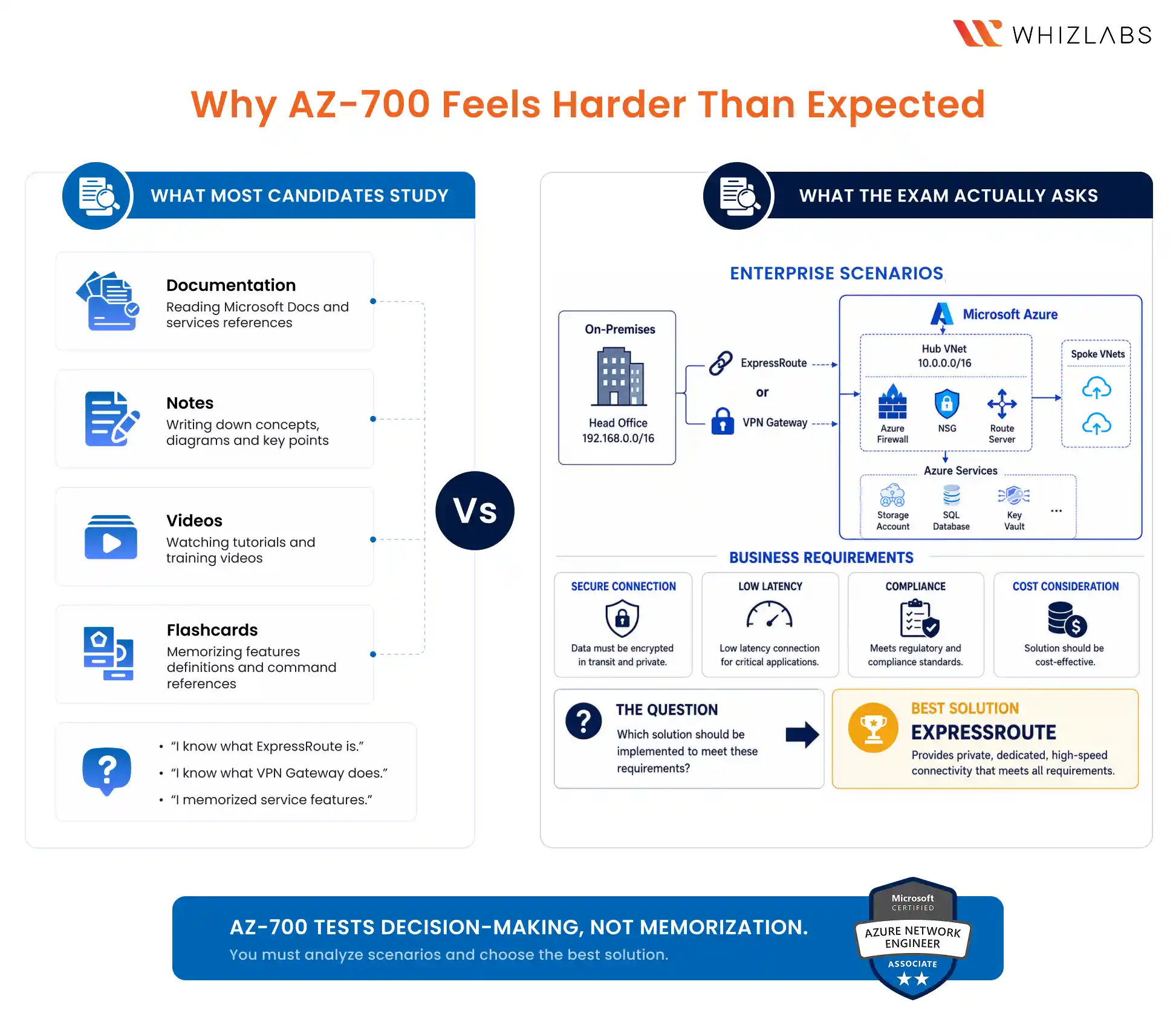
It tests decision-making, not recall. Most questions put you inside a business scenario with specific constraints cost, performance, security, compliance and ask you to choose the right solution. If you have only memorised what services do, you will struggle with these questions.
The routing domain is genuinely complex. User-Defined Routes, Azure Route Server, and multi-hop traffic scenarios involve a lot of moving parts. Many candidates who feel confident elsewhere lose significant marks here.
Service comparisons trip people up. Knowing the difference between a Private Endpoint and a Service Endpoint in theory is one thing. Choosing the right one under exam conditions, when both seem like valid answers, is something different.
However, AZ-700 is very passable with the right preparation.
Candidates with a solid networking background and hands-on Azure experience consistently find the exam manageable. The difficulty is not in the complexity of the concepts, it is in being asked to apply them under real-world conditions rather than just describe them.
Most candidates who prepare for 4 to 8 weeks, complete serious lab work, and practise scenario-based questions pass on their first attempt.
“The AZ-700 exam is not about how much you know. It is about how well you can apply what you know to solve a real networking problem.”
The AZ-700 Syllabus: What Deserves Most of Your Study Time?
The AZ-700 syllabus covers five sections. Knowing how much each one counts helps you study smarter, not just harder.
Design, Implement, and Manage Hybrid Networking (10–15%)
This section is about connecting Azure to the outside world Site-to-Site VPN, Point-to-Site VPN, Azure VPN Gateway, and ExpressRoute.
Most candidates learn what each tool does and stop there. That is not enough. What the exam really wants to know is whether you can decide between them when given a real-world scenario.
Your study focuses here: Stop memorising features and start thinking about trade-offs. When does ExpressRoute justify its cost over a Site-to-Site VPN? When is Point-to-Site the better call? Build your notes around decisions, not definitions.
Design and Implement Core Networking Infrastructure (20–25%)
This is the base that everything else sits on. It covers Azure Virtual Networks, IP addressing, Azure DNS, VNet peering, and Azure Virtual WAN. If your understanding of these Azure virtual network concepts is shaky, you will feel it across every other section.
Your study focus here: Get into a lab and build. Create multiple VNets, configure peering between them, test name resolution, break things and fix them. Reading about VNet peering is useful. Actually configuring it is what makes it stick.
Design and Implement Routing (25–30%)
This is the biggest section on the exam and the one where most people lose the most marks. It covers Azure Route Server, User-Defined Routes, NAT Gateway, Azure Load Balancer, and Application Gateway.
Routing is not always intuitive, and Microsoft loves to test it through complex, multi-step scenarios.
Your study focuses here: Draw diagrams showing how network traffic moves. For every routing scenario you study, trace exactly where packets go at each hop. This one habit changes how you approach routing questions completely.
Secure and Monitor Networks (15–20%)
This section covers Azure Firewall, Network Security Groups (NSGs), Web Application Firewall (WAF), Azure Monitor, and Network Watcher.
The mistake most people make is studying each tool on its own as if they are separate products. They are not. The exam tests how they work together as one layered security system. Knowing what Azure Firewall does is not the same as knowing when to use it instead of, or alongside, an NSG.
Your study focus here: Build combined scenarios. Layer NSGs with Azure Firewall. Add WAF to the mix. Understand when each layer adds value and when it becomes redundant.
Design and Implement Private Access to Azure Services (10–15%)
This section covers Private Endpoints, Service Endpoints, Azure Private Link, and VNet Integration. These tools all solve similar connectivity problems through different mechanisms, and many candidates mix them up.
Your study focus here: Set up a Private Endpoint in a lab. Then set up a Service Endpoint. Compare how they behave differently. Seeing them in action side by side makes the difference very clear.
The Service Comparisons You Must Know
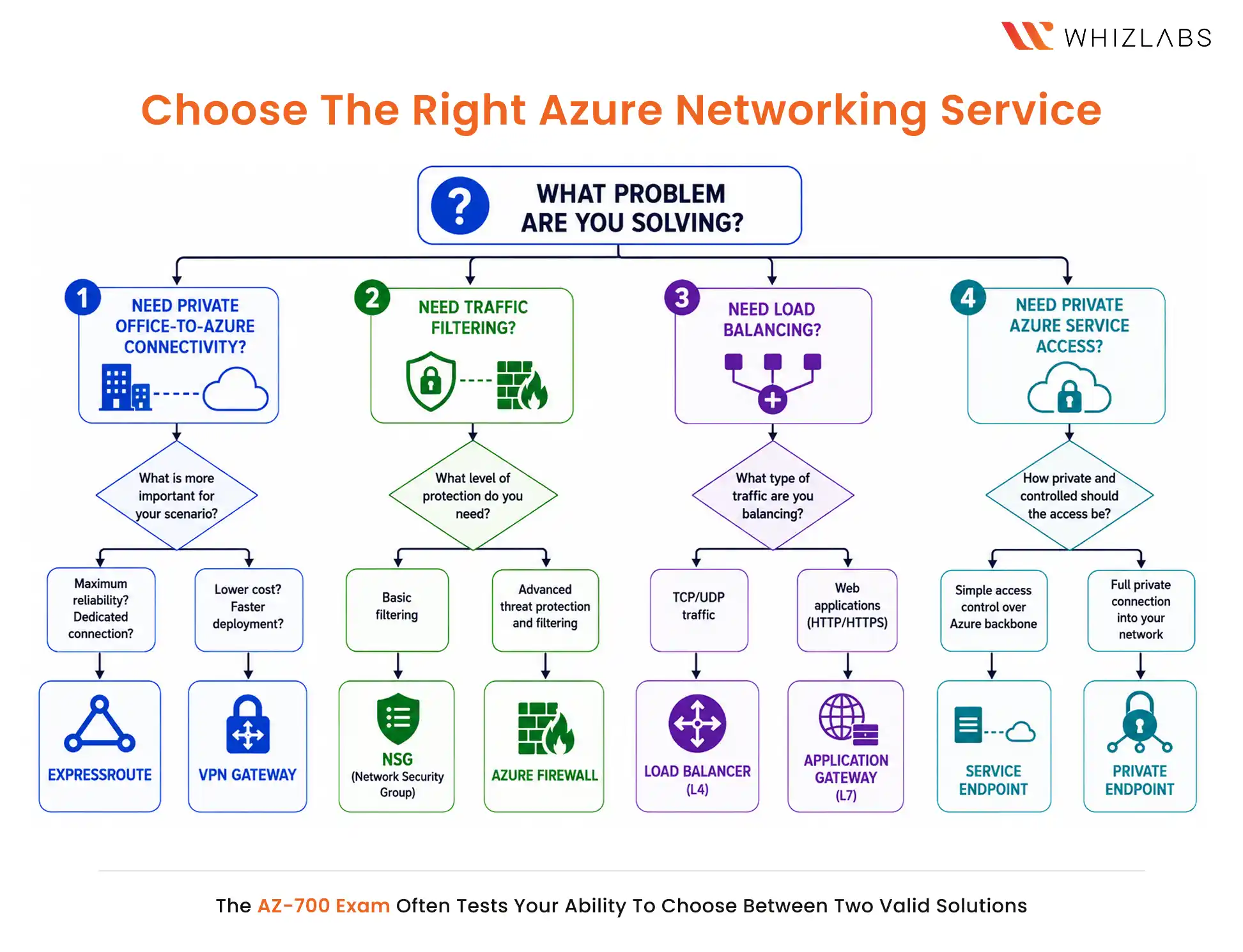
If there is one thing you should know about the AZ-700 exam, it is this: Microsoft loves giving you two services that could both work and asking you to pick the right one. Mastering these comparisons is one of the best things you can do during your preparation.
ExpressRoute vs VPN Gateway
| Feature | Express Route | VPN Gateway |
| Connection Type | Private, dedicated line | Goes through the internet |
| Cost | More expensive | Less expensive |
| Speed and Reliability | Fast and stable | Can vary |
| Max Bandwidth | Up to 100 Gbps | Up to 10 Gbps |
| Time to Set Up | Several weeks | A few hours |
| Best For | Large companies with strict requirements | Small businesses and remote offices |
NSG vs Azure Firewall
| Feature | NSG | Azure Firewall |
| Works At | Network level (Layer 4) | Network and app level (Layer 4 and 7) |
| Threat Detection | No | Yes |
| Can Filter by Website Name | No | Yes |
| Central Management | Limited | Yes |
| Cost | Free | Paid |
| Best For | Basic traffic filtering | Full enterprise security |
Azure Load Balancer vs Application Gateway
| Feature | Azure Load Balancer | Application Gateway |
| Works At | Layer 4 (TCP/UDP) | Layer 7 (HTTP/HTTPS) |
| SSL Termination | No | Yes |
| Route by URL | No | Yes |
| Built-in WAF | No | Yes |
| Best For | Non-web traffic, basic load balancing | Web apps and sites |
Service Endpoint vs Private Endpoint
| Feature | Service Endpoint | Private Endpoint |
| Traffic Path | Microsoft network but uses public IP | Private IP inside your network |
| Who Can Access | Only from your VNet | From your VNet, connected networks, and on-premises |
| DNS Changes Needed | No | Yes |
| Cost | Free | Paid |
| Best For | Simple access control | Full private connection |
How to Prepare for the AZ-700 Exam?
Here is the preparation structure that actually works. Not because it covers the most ground, but because it builds knowledge in the right order.
Step 1: Lock Down Your Networking Basics First
Before you touch a single Azure service, make sure you are comfortable with the fundamentals DNS, IP routing, firewalls, load balancing, subnetting, and VPN technologies. These are the building blocks. If they feel uncertain, slow down here. Rushing past shaky foundations will cost you more time later than fixing them now.
Step 2: Follow a Structured AZ-700 Course
Studying randomly kills momentum. Jumping between YouTube videos, documentation pages, and blog posts without a clear path means you end up covering some things twice and missing others completely.
A good AZ-700 course gives you a clear path from start to finish. Look for one that explains concepts clearly, shows real architecture examples, includes practice scenarios, and has hands-on labs built in. Whizlabs puts all of this in one place so you are not spending half your study time hunting for separate resources.
Step 3: Spend Serious Time in Labs
This is the most important step, and it is the one most people cut short.
Reading about an Azure service and actually deploying it are two completely different experiences. The exam is written for people who have done both. If you have only read about these services, you will feel the gap when you hit the harder scenario questions.
Here is what you should be practising in a real Azure environment:
- Azure VPN Gateway both Site-to-Site and Point-to-Site
- ExpressRoute setup and configuration
- VNet peering across multiple networks
- Azure Firewall with custom rule sets
- Application Gateway and Load Balancer
- Private Endpoints and Service Endpoints
- Azure DNS with private zones
- Network Watcher for diagnostics and troubleshooting
The best way to get this practice without setting up your own Azure environment from scratch is through guided hands-on labs. These labs walk you through real Azure networking scenarios step by step, so you build genuine practical experience in the exact areas the exam tests.
If you want even more flexibility, the Whizlabs Sandbox environment gives you a live Azure environment you can use freely to experiment, break things, and rebuild them which is exactly the kind of unguided practice that builds real confidence before exam day.
Most candidates who pass the AZ-700 exam spend at least 40 to 60 hours in hands-on practice environments. That is a real commitment, but it reflects what the exam actually requires.
Step 4: Use Practice Tests to Find Your Weak Spots
An AZ-700 practice test is not a shortcut to passing. It is a diagnostic tool that shows you where your gaps are. Do not take one at the very beginning of your preparation.
After you finish a solid chunk of studying, take a full practice test. When you review your results, do not just count how many you got right. Go through every question you got wrong and ask yourself honestly, was this a knowledge gap, a misread scenario, or a misunderstood trade-off? That reflection is where the real improvement happens.
The Whizlabs AZ-700 practice tests come with detailed explanations for every answer, which makes this review process significantly more useful than working through questions without context.
A Practical 4-Week AZ-700 Study Plan

If you have four weeks to prepare, here is a simple and effective plan to follow:
| Week | What to Focus On | What to Do |
| Week 1 | Basics + Hybrid Networking | Review networking fundamentals, practice VPN Gateway setup, study ExpressRoute architecture |
| Week 2 | Core Infrastructure + Routing | VNet peering labs, DNS configuration, User-Defined Routes, Route Server, NAT Gateway |
| Week 3 | Security + Private Access | Azure Firewall rules, NSG layering, WAF setup, compare Private Endpoint vs Service Endpoint |
| Week 4 | Review + Practice Tests | Full-length practice exams, revisit weak areas, go through Microsoft Learn documentation |
If you have more than four weeks, use the extra time on routing and more lab practice. These two areas give you the biggest improvement for the time you put in.
Mistakes That Will Cost You on Exam Day
These are the most common reasons people do not pass on their first attempt. Knowing them now means you can avoid them entirely.
Memorising instead of understanding. The AZ-700 exam is built to catch this. If you cannot explain why a service is the right choice in a given situation, memorising its name and features will not save you.
Skipping the labs. Routing and private access concepts especially need hands-on time. No matter how much you read, it does not replace the experience of actually deploying and observing these services.
Not practising service comparisons. Many questions give you two valid options. If you have not practised choosing between them, you end up guessing and guessing on a 700-point passing threshold is a risky strategy.
Underestimating the routing section. At 25 to 30% of the exam weight, this domain will define your result more than any other. Many candidates underestimate it and pay the price. Make it your number one priority.
Studying security tools separately. NSGs, Azure Firewall, and WAF are not three separate topics to tick off your list. They work together as one layered security system, and the exam tests them that way.
Not reviewing wrong answers after practice tests. Taking a practice test and moving straight to the next one is one of the most common and costly mistakes in AZ-700 exam preparation. Every wrong answer is a signal. Follow it.
Exam Tips That Actually Help
Read the scenario details carefully. Every AZ-700 question gives you clues about cost limits, performance needs, compliance rules, or connection requirements. These details are not background noise. They point you to the right answer. Do not skip them.
Always ask why, not just what. When you study any Azure networking service, do not stop at knowing what it does. Ask yourself why you would choose it over another option. That is exactly what the exam asks you to do.
Keep the official Microsoft AZ-700 certification page open while you study. The documentation has important details about service limits and best practices that show up directly in exam questions. Use it regularly throughout your preparation, not just the night before.
Manage your time deliberately during mock exams. If a question is taking too long, mark it and move on. Come back to it after you have answered everything else. Running out of time on easy questions because you got stuck on a hard one is an entirely preventable mistake.
Do not ignore Network Watcher. Most people focus heavily on building and securing networks but forget about the monitoring tools. Network Watcher questions come up more often than you would expect. Know what it does, when to use it, and what output it gives you.
“The AZ-700 exam does not test whether you know Azure networking services. It tests whether you can choose the right networking solution for a business requirement.”
What Can You Do After Passing AZ-700?
Passing the AZ-700 exam does not just give you a credential. It opens doors to some of the fastest-growing and best-compensated roles in cloud technology.
Job Roles Available After AZ-700
The Microsoft Azure Network Engineer Associate certification directly qualifies you for roles including:
- Azure Network Engineer Designing and managing Azure networking infrastructure for enterprise organisations
- Cloud Infrastructure Engineer Building and maintaining hybrid and cloud-native network environments
- Cloud Network Architect Leading network design decisions across large Azure deployments
- Senior Network Engineer Taking on cloud networking responsibilities within traditional infrastructure teams
- Cloud Security Engineer Specialising in secure Azure networking architectures including firewall, private access, and compliance
- Solutions Architect Advising organisations on Azure networking design as part of broader cloud strategy work\
Why AZ-700 Certification Helps Your Career
The cloud networking market is growing rapidly. Organisations across every industry are migrating workloads to Azure, expanding hybrid connectivity, and building secure cloud-native architectures. The demand for professionals who can design and manage these environments is significantly outpacing supply.
Here is what the AZ-700 certification specifically does for your career:
It validates a specialised skill set. General Azure certifications are common. An Azure networking specialist certification is far less common and far more valued by hiring managers looking to fill specific roles.
It demonstrates practical ability. Because AZ-700 tests scenario-based decision-making rather than memorisation, employers know a certified candidate can actually solve networking problems not just describe solutions.
It increases earning potential. Azure Network Engineers and Cloud Network Architects consistently command above-average salaries in the cloud technology market. Specific salary figures vary by region and experience level, but the AZ-700 credential is widely recognised as a qualifier for senior-level compensation.
It keeps your skills current. The annual renewal model means AZ-700 certified professionals stay updated as Azure networking services evolve which is a meaningful signal to employers in a field that changes quickly.
Whether you are looking to move into cloud networking from a traditional networking role, advance within your current organisation, or qualify for senior positions in cloud architecture, the AZ-700 certification is one of the most direct and credible ways to demonstrate you have the skills employers need.
Key Takeaways for Your AZ-700 Preparation
Here are the most important things to carry with you into your preparation:
- The exam tests decision-making, not memorisation. Focus on understanding, not just reading.
- Routing is the biggest section at 25 to 30%. Make it your top priority.
- Plan for at least 40 to 60 hours of hands-on lab practice. There is no shortcut around this.
- Scenario-based questions dominate the exam. Practice picking between services, not just describing them.
- The key comparisons VPN Gateway vs ExpressRoute, NSG vs Azure Firewall, Private Endpoint vs Service Endpoint come up again and again. Know them cold.
- Most people are ready in 4 to 8 weeks with consistent daily study.
- AZ-700 opens doors to high-demand, well-compensated Azure networking roles.
Frequently Asked Questions
How long should I study for AZ-700? Most candidates need 4 to 8 weeks, studying one to two hours daily. Those with strong networking backgrounds may be ready sooner.
1. Is AZ-700 good for beginners? No. AZ-700 is an intermediate to advanced exam. Build basic networking and Azure knowledge first before attempting this certification.
2. How hard is the AZ-700 exam? AZ-700 is moderately to highly difficult. It tests real-world decision-making, not memorisation. Candidates with hands-on networking experience find it more manageable.
3. What score do I need to pass AZ-700? You need 700 out of 1000 to pass. The exam uses scaled scoring, so different questions carry different weights.
4. How many questions are on the AZ-700 exam? Most AZ-700 exam attempts include 40 to 60 questions covering multiple choice, case studies, and scenario-based formats. Numbers vary per attempt.
5. Which AZ-700 section should I study most? Prioritise routing. It carries 25 to 30% of the exam weight and is where most candidates gain or lose the most marks.
6. Do I really need hands-on labs for AZ-700? Yes. AZ-700 scenario questions require practical experience. Candidates who only study theory consistently struggle. Labs are essential, not optional.
7. When should I take an AZ-700 practice test? Take your first practice test after covering most of the syllabus. Use results to identify gaps, not to measure readiness too early.
8. What jobs can I get after passing AZ-700? AZ-700 qualifies you for roles including Azure Network Engineer, Cloud Infrastructure Engineer, Cloud Network Architect, and Solutions Architect positions.
9. Why do most people find AZ-700 hard? Routing complexity and service comparison questions challenge most candidates. Both require applying knowledge to real scenarios, not simply recalling definitions.
10. What are the AZ-700 exam prerequisites? No formal prerequisites exist. Microsoft recommends solid knowledge of DNS, routing, firewalls, VPN, subnetting, and basic Azure networking services.
11. What is the AZ-700 certification validity period? AZ-700 certification is valid for one year. Free annual renewal is available through a short online assessment on Microsoft Learn.

- AZ-305 Worth It in 2026? Salary, ROI & Career Benefits - September 30, 2026
- AWS Cloud Certification Trends: MLOps & GenAI in 2026 - September 30, 2026
- Cisco AITECH (810-110) Study Guide & Exam Prep 2026 - September 24, 2026
- NVIDIA NCP-AIN Exam Prep & Practice Tests | Whizlabs - September 18, 2026
- SC-500 Exam Prep 2026: Study Guide & 5-Week Plan - September 7, 2026
- AI-200 Study Guide: 6-Week Exam Prep Plan - September 4, 2026
- AB-731 Exam Preparation: Domains & Study Guide - August 31, 2026
- How to Build AI Agents on Azure: AI-103 Guide - August 21, 2026