

You’ve probably seen it already. Every role in the cloud now quietly expects Azure administration skills. The kind of skills that are beyond knowledge, where systems don’t just run; they stay secure, scalable, and cost-efficient. That’s exactly where the AZ-104 certification comes in.
The Microsoft Azure Administrator certification (AZ-104) course preparation isn’t just another badge. It’s the proof that you can actually operate cloud environments. And in 2026, with AI accelerating deployments and enterprises doubling down on cloud governance, that skill is only getting more critical.
This blog: AZ-104 Certification Complete Guide is built for you if you’re:
- Starting your cloud career
- Moving from basics to hands-on Azure roles
- Or trying to stay relevant as cloud + AI evolves
Here’s what you’ll get: AZ-104 certification complete guide for the exam, skills you gain, career impact, preparation strategy, and what it really means in today’s job market. If you’re serious about building real Azure capability, this is the only AZ-104 guide you’ll need before preparing.
Preparing for the AZ-104 Certification?
Build your Azure Administrator skills with Whizlabs AZ-104 practice tests, hands-on labs, video lessons, and cloud sandbox access. Prepare for the exam with practical learning and scenario-based questions.
Why AZ-104 Certification Matters in the AI Era?
There’s a growing assumption that AI will replace cloud administration. It won’t. What it will do is remove repetitive work and raise the bar for decision-making. That’s exactly why the AZ-104 certification is becoming more relevant in 2026, not less.
1. What AI Is Actually Automating in Cloud Operations?
AI is already handling parts of cloud operations that used to take hours:
- Resource provisioning suggestions
- Anomaly detection in logs and metrics
- Automated alerts and basic remediation
- Routine monitoring and diagnostics
This reduces operational friction. Systems are faster to deploy and easier to monitor. But here’s the catch: AI can assist with execution, not ownership. It doesn’t decide architecture. It doesn’t take accountability for cost, compliance, or failure.
2. What AZ-104 Certifies That AI Cannot Replace
The AZ-104 isn’t testing if you can click buttons in the Azure portal. It validates whether you can make the right decisions in complex environments.
That includes:
- Designing identity and access strategies (RBAC, Entra ID)
- Balancing cost vs performance vs security
- Managing governance, policies, and compliance requirements
- Handling real-world failure scenarios
These are judgment calls. And judgment is where humans still lead.
AI increases demand for credentialed Azure governance professionals, but it does not replace them.
3. Why Enterprise Demand for AZ-104 Is Accelerating in 2026
AI doesn’t run in isolation. It runs on cloud infrastructure. And Azure is one of the primary platforms powering that shift.
Every AI workload still depends on:
- Secure identity and access control
- Scalable compute and networking
- Monitoring, logging, and cost governance
Which means someone has to manage the layer underneath. Right now, there’s a clear gap:
- Cloud adoption is accelerating
- AI workloads are increasing
- But certified Azure administrators are still limited
The more AI grows, the more valuable strong cloud administrators become.
Who Should Take the Microsoft Azure Administrator Exam?
Let’s be clear, the AZ-104 isn’t for everyone. And that’s exactly why it holds value.
This certification is designed for people who are either already working with infrastructure or are serious about moving into hands-on cloud roles. If your goal is to operate Azure environments, not just understand them, you’re in the right place.
Here’s who typically benefits the most:
- Cloud professionals (1–3 years of experience)
If you’ve worked with Azure services, virtual machines, or basic networking(AZ-104 networking concepts), AZ-104 helps formalise and deepen your operational skills. - IT Administrators transitioning to cloud roles
System admins, Windows/Linux admins, and network engineers moving from on-prem to Azure will find this a natural next step. - System Engineers entering Azure-native environments
If your role involves deployment, configuration, or infrastructure support, AZ-104 aligns directly with your day-to-day responsibilities. - Developers needing infrastructure credibility
Especially backend or full-stack developers working with cloud deployments, this certification helps you understand what runs behind your code. - Career switchers targeting cloud administration
If you’re coming from IT support or related roles, AZ-104 provides a structured path into cloud operations.
AZ-104 isn’t about learning Azure. It’s about proving you can run it in the real world.
AZ-104 Exam Format, Question Types, Passing Score and Fees
The AZ-104 certification exam isn’t theory-heavy. It’s built to test how you think in real Azure scenarios, not just what you remember.
1. AZ-104 Exam Question Format and Types
Here’s how the exam is typically structured
| Format | Description | Approx. Share |
| Multiple Choice (Single) | Best-practice and concept decisions | ~40% |
| Multiple Choice (Multi-select) | Identify all correct steps in a solution | ~15% |
| Case Study | Real-world scenario-based reasoning | ~20% |
| Drag & Drop / Ordering | Sequence steps, map services correctly | ~15% |
| Hot Area / Yes-No | Validate configurations against requirements | ~10% |
What this means: Rather than answering questions, you’re making decisions like an Azure Administrator would in real environments
2. Azure Administrator Exam Duration, Passing Score and Delivery
- Exam duration: 100 minutes
- Number of questions: 40 and 60 (the exact number varies per session)
- Passing score: 700 out of 1000
- Delivery options: Online proctored exam or Pearson VUE test centre
The AZ-104 exam has a passing score of 700 out of 1000 and evaluates candidates across five Azure administration domains. The exam duration is 100 minutes, while the number of questions may vary.
3. AZ-104 Exam Fees by Region
- USA: ~$165 USD
- India: ~₹4,800 INR
- UK: ~£115 GBP
- Other regions: Pricing may vary slightly; check Microsoft’s official certification page for exact details.
4. AZ-104 Certification Validity and Renewal
- Validity: 1 year
- Renewal: Free annual assessment via Microsoft Learn
- Renewal Window: Opens 6 months before expiry
No need to retake the full exam; just stay updated and renew online.
The AZ 104 exam is designed to simulate real-world Azure decision-making. If your preparation is only theoretical, it won’t be enough.
Prerequisites and Prior Experience Required to Take AZ-104 Certification
Let’s get this straight: there are no formal prerequisites to take the AZ-104 exam. But realistically, going in without the right foundation is a setback. This certification assumes you already understand how cloud environments behave, not just what services exist.
What Experience Is Recommended for AZ-104?
- 6+ months of hands-on Azure experience
Working with resources like virtual machines, storage, networking, and identity. - Exposure to real-world scenarios
Even basic tasks like deploying a VM, configuring access, or monitoring resources matter here.
Core Technical Prerequisites for Azure Administrator
To be comfortable with AZ-104, you should have working knowledge of:
- Azure tools: Azure Portal, Azure CLI, and PowerShell basics
- Networking fundamentals: TCP/IP, DNS, VPN concepts, firewalls
- Virtualisation: Virtual machines, disks, and compute concepts
- Identity and access basics: Active Directory, Entra ID, MFA, RBAC
- Backup and disaster recovery: High availability, failover, and recovery strategies
You don’t need to be an expert, but you should recognise and apply these concepts.
Is AZ-900 Certification mandatory before attempting the AZ-104 exam?
- Not mandatory
- Strongly recommended if you’re new to the cloud
AZ-900 builds foundational clarity. AZ-104 builds execution.
If You’re Below the Recommended Experience Level
You still have a path, just don’t rush it.
- Start with AZ-900 (Azure Fundamentals)
- Spend time in hands-on labs and sandbox environments
- Practice real tasks: deploy, configure, monitor, troubleshoot
AZ-104 isn’t about memorising Azure services. It’s about knowing what to do when something actually breaks.
AZ-104 Certification Complete Guide to Domains and Weightage
If you are preparing for the AZ-104 exam, this is where you keep coming back: the AZ-104 exam blueprint. The classifications are not random here. They are structured around five core domains that reflect what Azure Administrators actually do in production environments. Understanding this blueprint helps you study smarter, not longer.
AZ-104 Exam Domains Overview
|
Domain |
Weightage |
| Manage Azure Identities and Governance |
20–25% |
|
Implement and Manage Storage |
15–20% |
| Deploy and Manage Azure Compute Resources |
20–25% |
| Implement and Manage Virtual Networking |
15–20% |
| Monitor and Maintain Azure Resources |
10–15% |
Identity + Compute together make up nearly half the exam. Prioritise accordingly.
Domain 1: Manage Azure Identities and Governance (20–25%)
This is the foundation of everything in Azure. If identity is wrong, everything breaks.
Key topics you’ll be tested on:
- Microsoft Entra ID (Azure AD)
Users, groups, roles, and directory synchronisation - Role-Based Access Control (RBAC)
Assigning roles, least privilege access, scope management - Azure Policy and Governance
Policy definitions, compliance enforcement, tagging strategies - Management Groups and Subscriptions
Hierarchy design and access control across environments
Domain 2: Implement and Manage Storage (15–20%)
Storage isn’t just about saving data; it’s about performance, cost, and access control.
Key topics include:
- Storage Accounts Configuration
Blob, File, Queue, and Table storage types - Blob Storage & Access Tiers
Hot, Cool, Archive tiers and lifecycle management - Secure Access Mechanisms
Shared Access Signatures (SAS), access keys, identity-based access - Data Lifecycle and Replication
Redundancy (LRS, GRS), backup strategies, lifecycle policies
Domain 3: Deploy and Manage Azure Compute Resources (20–25%)
This is where applications actually run and where most real-world issues happen.
You’ll be tested on:
- Virtual Machines (VMs) and Scale Sets
Deployment, sizing, availability sets, scaling - Containers and App Services
Azure App Service, container instances, basic AKS awareness - Infrastructure as Code (IaC)
ARM templates and Bicep for automated deployments - Compute Configuration and Troubleshooting
Extensions, disks, boot diagnostics
Domain 4: Implement and Manage Virtual Networking (15–20%)
Networking is where most candidates struggle and where real admins spend a lot of time.
Key focus areas:
- Virtual Networks (VNets)
Subnets, peering, address spaces - Network Security
Network Security Groups (NSGs), Azure Firewall - Connectivity Solutions
VPN Gateway, ExpressRoute basics - DNS and Private Access
Azure DNS, Private Endpoints, service endpoints
Domain 5: Monitor and Maintain Azure Resources (10–15%)
This is where operations maturity shows, keeping systems stable and visible.
You’ll need to understand:
- Azure Monitor and Log Analytics
Metrics, logs, queries (KQL basics) - Alerts and Diagnostics
Action groups, alert rules, diagnostic settings - Backup and Disaster Recovery
Azure Backup, Recovery Services Vault, Site Recovery - Performance and Health Monitoring
Resource health, uptime tracking, troubleshooting
This blueprint is a real Azure administration working mechanism. If you can operate confidently across these five domains, you’re not just exam-ready; you’re job-ready.
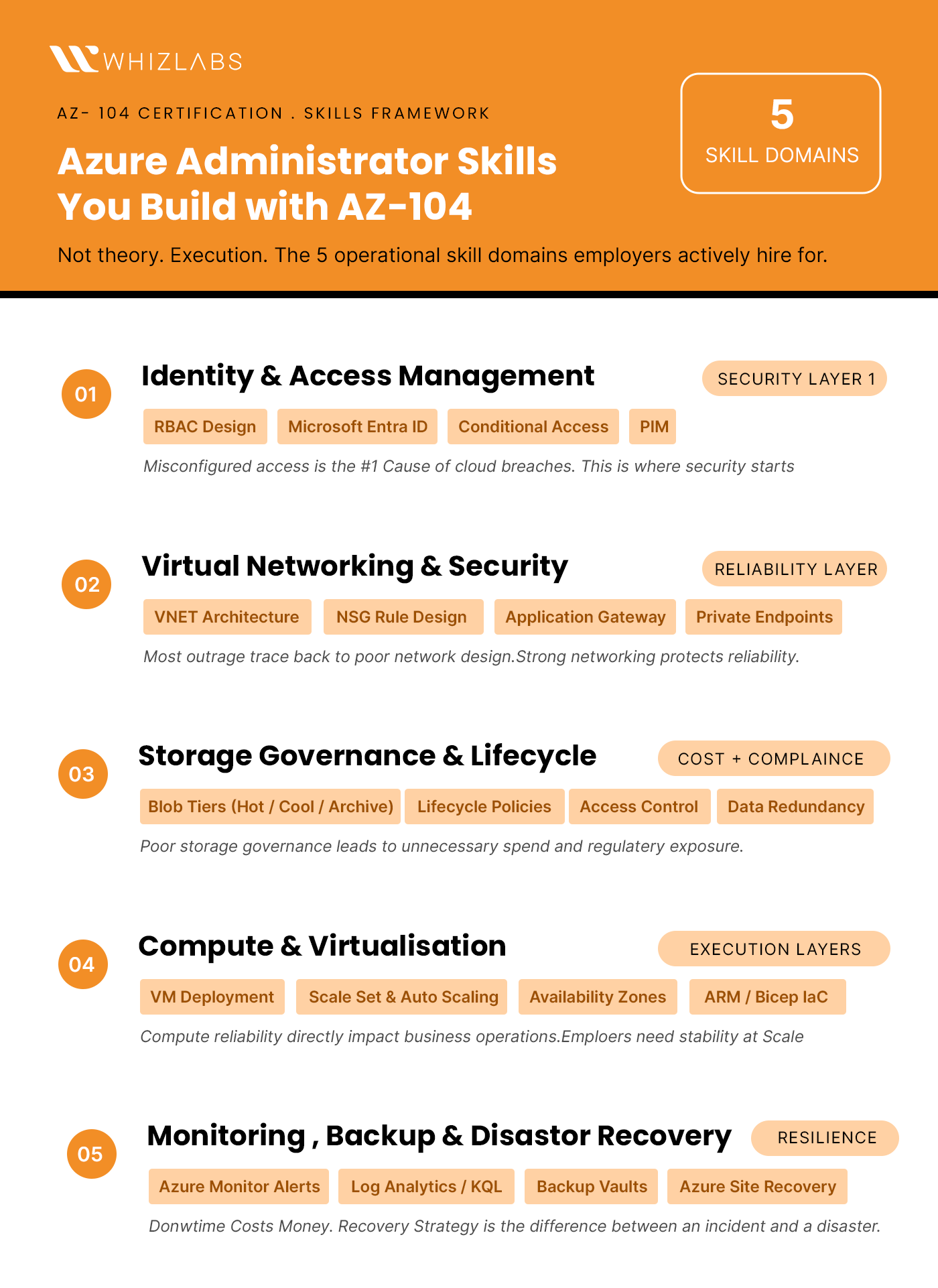
What are the Azure Administrator Skills You Build with AZ-104 Certification?
The AZ-104 certification isn’t just about passing an exam. It builds the exact operational skills employers expect from an Azure Administrator in 2026. This is where the certification connects directly to real job performance, not theory, but execution.
1. Identity and Access Management
You learn how to control who gets access to what and under what conditions. You build Core capabilities like
- RBAC design and role assignments
- Microsoft Extra ID (Azure AD) objects – users, groups, service principals
- Conditional Access policies
- Privileged Identity Management (PIM)
Identity is the first layer of security. Misconfigured access is one of the biggest causes of breaches in cloud environments.
2. Virtual Networking and Security
This is where you design how systems communicate — securely and efficiently.
Core capabilities:
- Virtual Network (VNet) architecture and subnet design
- Network Security Group (NSG) rule configuration
- Application Gateway and load balancing basics
- Private Endpoints and secure service access
Most real-world outages and security incidents come from poor network design. Strong networking skills directly impact reliability and protection.
3. Storage Governance and Lifecycle
You learn how to manage data, not just store it.
Core capabilities:
- Access control and encryption strategies
- Blob storage tiers (Hot, Cool, Archive)
- Lifecycle management and automation policies
- Data redundancy and replication choices
Storage decisions affect both cost and compliance. Poor governance leads to unnecessary spending and regulatory risks.
4. Compute and Virtualisation
This is the execution layer, where applications actually run.
Core capabilities:
- Virtual Machine deployment and configuration
- Scale sets and auto-scaling strategies
- High availability architecture (availability sets/zones)
- Infrastructure as Code (ARM templates, Bicep)
Compute reliability directly impacts business operations. Employers need professionals who can deploy and maintain stable environments at scale.
5. Monitoring, Backup and Disaster Recovery
This is where you ensure systems don’t just run; they stay resilient.
Core capabilities:
- Azure Monitor and alert configuration
- Log Analytics and basic KQL queries
- Backup policies and Recovery Services Vault
- Disaster recovery planning with Azure Site Recovery
Downtime costs money. Strong monitoring and recovery strategies are critical for maintaining uptime and business continuity.
AZ 104 doesn’t just teach Azure services. It builds decision-making ability across security, cost, performance, and reliability, the exact combination employers are actively hiring for in 2026.
Azure Administrator Role and Responsibilities After AZ-104 Certification
Clearing AZ-104 doesn’t just validate knowledge. It positions you for real operational ownership in Azure environments.
This is what the role actually looks like in practice.
What Does an Azure Administrator Do Day-to-Day?
A certified Azure Administrator is responsible for keeping cloud environments secure, stable, and efficient. Typical responsibilities include:
- Deploying and managing Azure resources (VMs, storage, networking)
- Configuring identity and access (RBAC, Entra ID)
- Monitoring system performance and resolving incidents
- Implementing backup and disaster recovery strategies
- Optimising costs and resource usage
- Enforcing governance and compliance policies
This isn’t a passive role. You’re the person teams rely on when systems need to work without failure.
How This Role Connects with Other Teams
Azure Administrators don’t work in isolation. They sit at the centre of cloud operations.
- With DevOps teams:
Support deployments, manage infrastructure, enable CI/CD environments - With Security teams:
Implement identity controls, monitor threats, enforce compliance - With Architects:
Execute infrastructure designs and ensure scalability
You’re the bridge between design and execution.
Enterprise vs SMB Roles: What Changes?
1. Enterprise environments
- Work with complex, multi-region architectures
- Strong focus on governance, compliance, and security
- More specialisation (networking, identity, monitoring)
SMBs / startups:
- Broader responsibilities across the stack
- Faster deployments, fewer layers of approval
- More hands-on troubleshooting and decision-making
How AZ-104 Maps to Real Job Descriptions?
Most Azure Administrator job descriptions include responsibilities like:
- Manage and monitor Azure infrastructure and services
- Configure and maintain identity and access management (IAM)
- Implement backup, disaster recovery, and high availability solutions
- Troubleshoot performance and networking issues in Azure environments
- Ensure compliance with security and governance policies
If you look closely, these map almost exactly to the AZ 104 exam domains. AZ 104 doesn’t prepare you for a role in theory. It aligns directly with what companies are already hiring for.
AZ-104 Salary, Job Market and Growth in 2026 (India, USA, UK)
Let’s talk about the real reason most people consider AZ-104: career growth and salary impact. The demand is clear. But more importantly, the premium for certified professionals is measurable.
AZ-104 Salary Benchmarks by Region
| Region | Non-Certified | AZ-104 Certified | Premium |
| USA | $85K–$95K | $110K–$135K | +25–30% |
| UK | £45K–£55K | £60K–£75K | +25% |
| India | ₹6–10 LPA | ₹12–20 LPA | +40–60% |
AZ-104-certified Azure Administrators earn significantly more than non-certified peers across every major market in 2026.
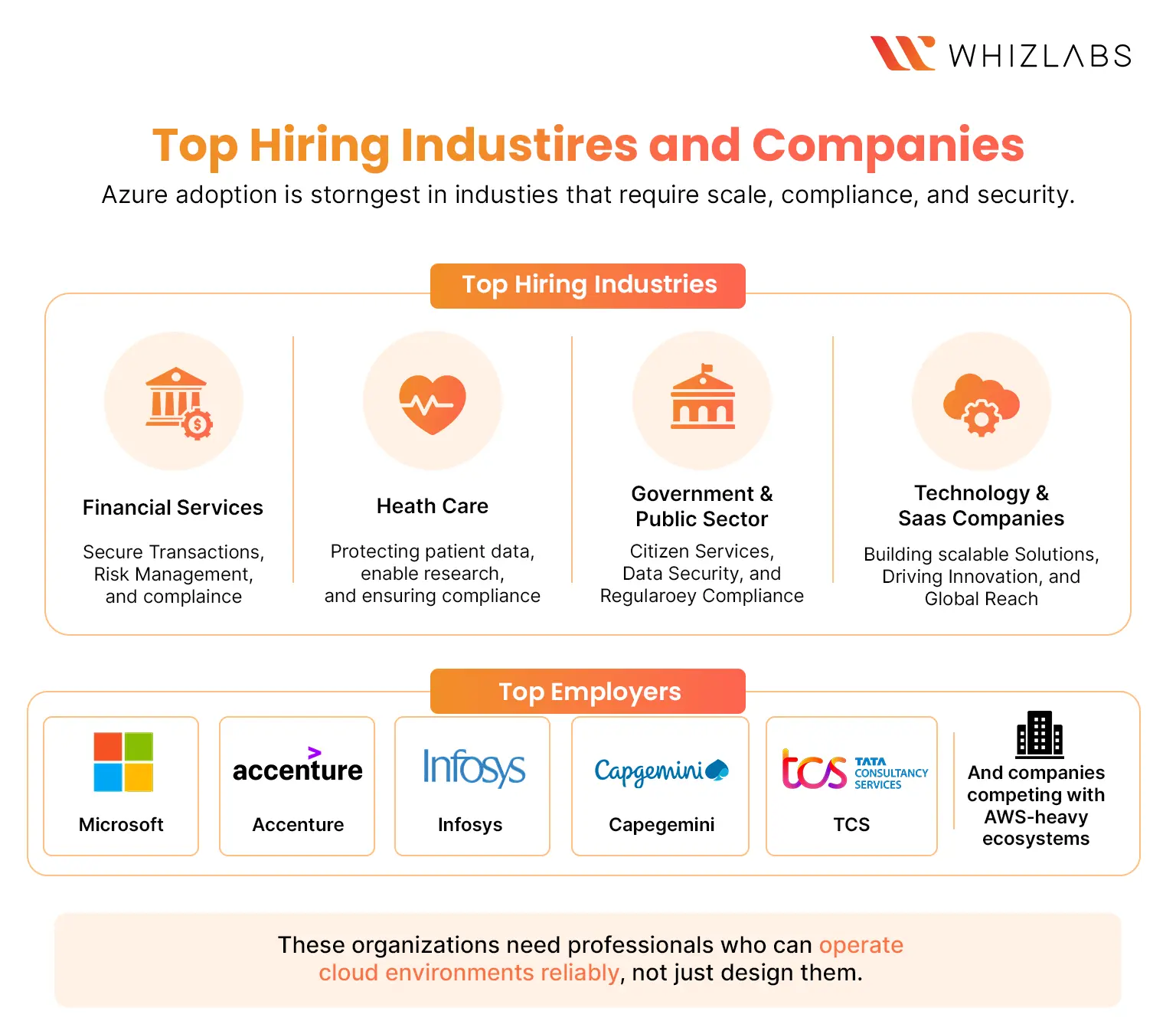
Top Hiring Industries and Companies
These organisations need professionals who can operate cloud environments reliably, not just design them.
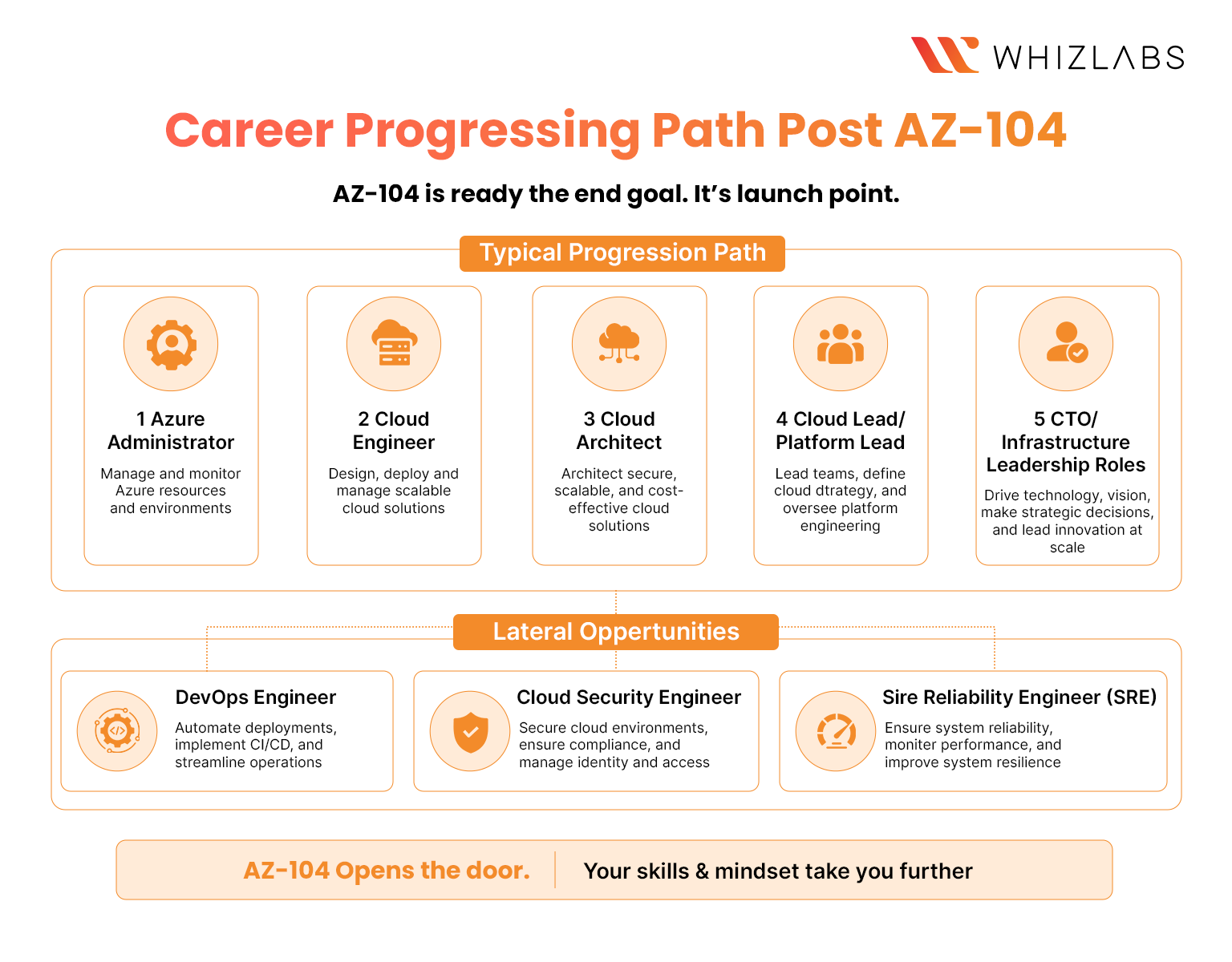
Career Progression Path Post-AZ-104
AZ-104 certification doesn’t just improve your resume. It expands your career direction and earning potential.
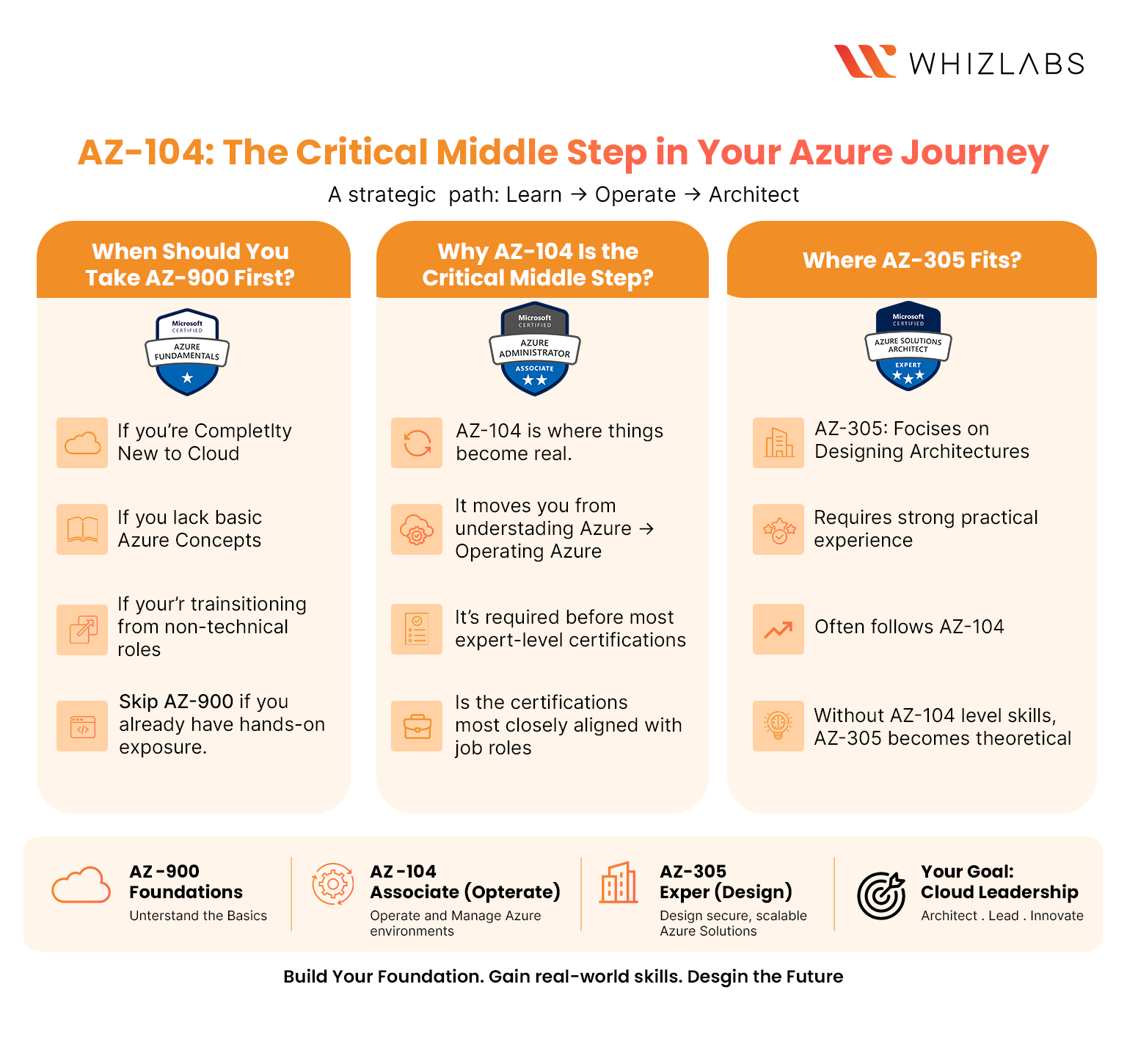
AZ-104 vs AZ-900 vs AZ-305: Which Azure Certification Is Right for Your Career Stage?
One of the most common questions is simple: Where does AZ-104 actually fit compared to other Azure certifications? Here’s a clear breakdown:
Azure Certification Comparison
| Factor | AZ-900 | AZ-104 | AZ-305 |
| Level | Fundamentals | Associate | Expert |
| Target | Beginners, non-tech roles | Cloud administrators | Senior architects |
| Technical Depth | Conceptual | Hands-on operational | Solution design |
| Prerequisites | None | 6 months of experience | AZ-104 recommended |
| Salary Impact | Low | High | Very High |
What Hiring Managers Actually Look for in Candidates Today?
- Proof of hands-on capability
- Experience with real Azure environments
- Certifications that validate execution, not awareness
In most cases, AZ 104 checks all three
If AZ-900 is awareness and AZ-305 is strategy, AZ 104 is execution and that’s what gets you hired.
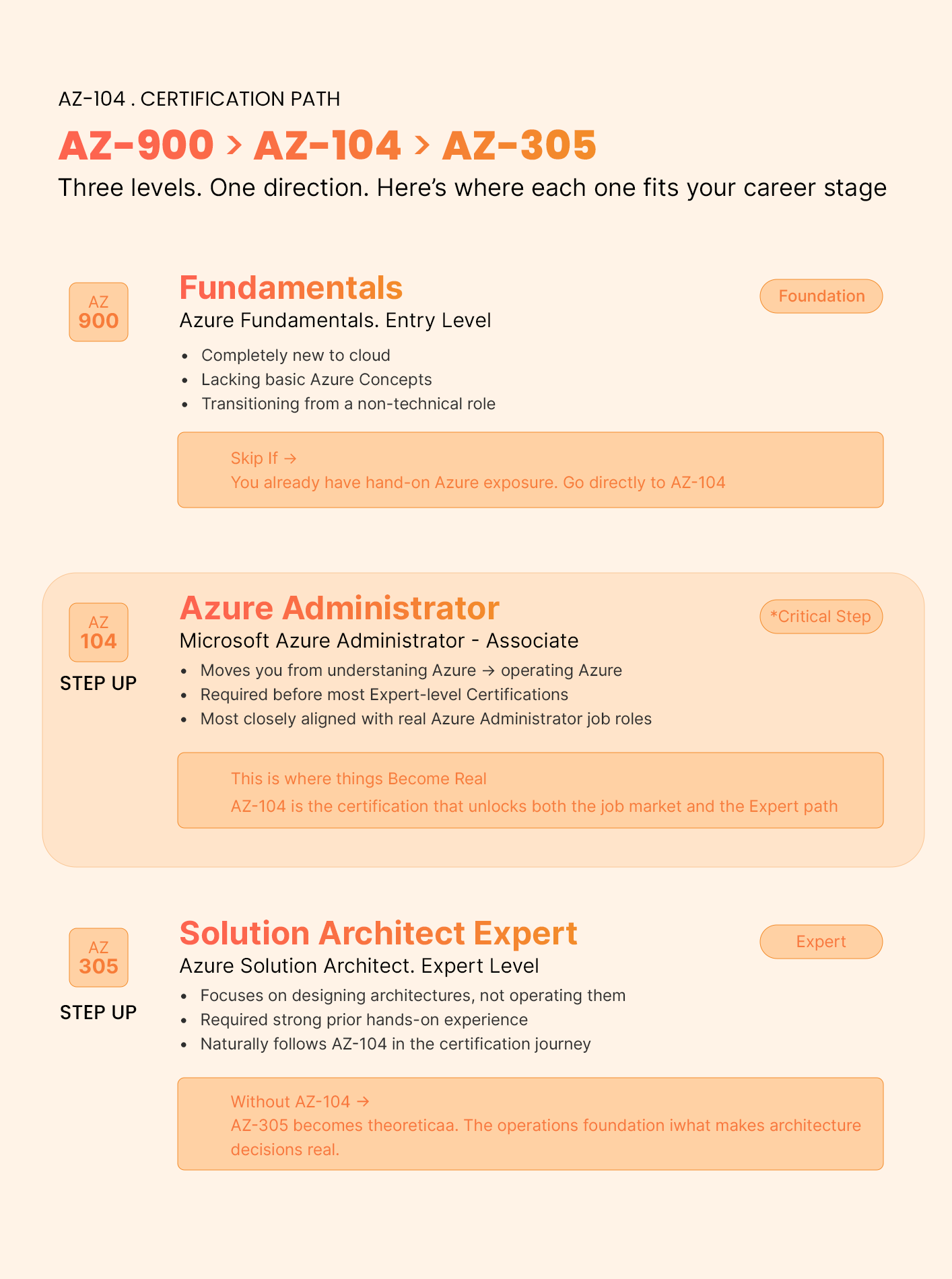
The Microsoft Azure Certification Path: Where AZ-104 Fits in Your Cloud Journey
AZ-104 exam isn’t a standalone certification. It’s part of a structured learning and career progression path within Azure. Understanding this path helps you plan beyond just one exam.
The Azure Certification Framework
Microsoft certifications follow a clear structure:
- Fundamentals (Beginner): AZ-900 for cloud concepts and Azure basics
- Associate (Core Skills): AZ-104 for Azure Administrator (hands-on operations)
- Expert (Advanced Roles): AZ-305 Solutions Architect, AZ-400 DevOps Engineer
- Specialty (Focused Domains): AZ-500 Security Engineer and AI certifications AI-102, AI-103
Why AZ-104 Is the Core Certification?
AZ-104 sits at the centre of this ecosystem.
- It’s required or recommended for most advanced paths
- It builds foundational operational skills
- It prepares you for real-world cloud environments
Without AZ-104, most advanced certifications lack practical grounding.
What Comes Before and After AZ-104?
| Before |
After |
| AZ-900 (optional but recommended)
Basic hands-on Azure experience |
AZ-305 → Architecture roles
AZ-400 → DevOps and automation AZ-500 → Security specialization |
A Smarter Learning Approach for AZ 104 Certification
Instead of treating certifications as isolated steps:
- Build foundation → execution → specialization
- Combine theory with hands-on labs
- Practice real-world scenarios, not just exam questions
This is where platforms like Whizlabs fit naturally, helping you move from learning to doing.AZ 104 isn’t just a certification. It’s the pivot point in your Azure career, where learning turns into capability.
How Long Does It Take For AZ-104 Preparation? A Realistic Timeline
One of the most common questions: how long will AZ-104 Preparation actually take?
The honest answer depends on your starting point, but here’s a realistic breakdown.
Recommended Preparation Time by Experience Level
| Experience Level | Recommended Prep Time |
| Beginner (< 6 months Azure) | 12–16 weeks |
| Intermediate (6–12 months Azure) | 6–8 weeks |
| Experienced (1+ year Azure) | 3–4 weeks |
What Actually Affects Your Preparation Time?
It’s not just about experience. These factors matter more than people expect:
- Your technical background (networking, infra basics)
- Study consistency (hours per week > total duration)
- Access to hands-on labs
- How you study: passive vs active learning
Two people with the same experience can have completely different timelines depending on how they prepare.
The Most Common Mistake(AZ-104 Exam Mistakes) (That Slows You Down)
Most candidates try to shortcut preparation by avoiding labs.
It backfires.
- Reading ≠ doing
- Watching ≠ troubleshooting
- Memorizing ≠ decision-making
Studying without hands-on practice doesn’t save time. It adds more of it later.
Your preparation time depends less on how fast you study, and more on how effectively you practice.
Best AZ-104 Study Resources: Practice Tests, Hands-on Labs and Video Courses
Preparing for AZ-104 isn’t about collecting resources. It’s about using the right combination. Each resource solves a different problem, and missing one creates gaps.
1. AZ-104 Exam Practice Tests
Understanding how the exam actually asks questions.
- Scenario-based questions or az-104 sample questions (not memory-based)
- Detailed explanations for every answer
- Alignment with the latest 2026 exam blueprint
Whizlabs Practice Tests:
- 500+ practice questions covering AZ-104 exam objectives
- Full-length timed practice exams and domain-wise quizzes
- Detailed explanations to understand correct and incorrect answers
- Scenario-based practice to strengthen exam readiness
Built to train your decision-making, not just recall
→ Explore the Whizlabs Azure Administrator practice test
2. AZ-104 Hands-on Labs and Azure Sandbox
Turning concepts into real execution.
- AZ 104 tests what you would do, not what you’ve read
- Most failure comes from lack of real-world exposure
Whizlabs AZ-104 Hands-on Labs:
- 164 guided hands-on labs covering Azure administration scenarios
- Practical exercises involving virtual machines, storage, networking, identity, and monitoring
- No personal Azure subscription required for guided labs
- Azure Cloud Sandbox available for additional experimentation
Learn by deploying, breaking, and fixing, safely.
→ Explore Whizlabs AZ-104 Hands-on Labs
3. AZ-104 Video Course
Building structured understanding across all domains.
- Domain-by-domain explanation
- Real Azure demos
- Service comparisons and workflows
Whizlabs Video Course:
- Fully aligned with the 2026 blueprint
- Covers all five domains with practical context
→ Explore Whizlabs Microsoft Azure Administrator Associate Course
4. Official Microsoft Learn Paths
Foundational documentation and conceptual clarity. Best used for:
- Reinforcing concepts
- Microsoft Learn Community discussions
- Understanding official exam scope
But on its own, it’s not enough for exam readiness.
Hands-on Azure lab practice combined with scenario-based practice tests is the most effective AZ-104 preparation method.
How to Prepare for the AZ-104 Exam?
Make sure to thoroughly know the exam objectives.
- Go through the syllabus properly.
- Schedule an AZ-104 study plan(AZ-104 Study Guide) and stick to it.
- Be aware of prerequisite skills and experience expectations.
- Early recognise where you are weakest.
- Nail those areas with labs, practice tests, and revision.
AZ-104 Certification FAQs
- What is the AZ-104 exam all about?
The AZ-104 exam validates your ability to manage Azure environments, including identity, networking, storage, compute, and monitoring. It focuses on real-world administrative tasks and decision-making, ensuring candidates can operate and maintain cloud infrastructure effectively. - What is the passing score for AZ-104?
The AZ-104 exam requires a passing score of 700 out of 1000. Microsoft uses a scaled scoring system, and the exam evaluates your ability to manage Azure identities, storage, compute, networking, and monitoring. - How much does the AZ-104 exam cost?
The AZ-104 exam costs approximately $165 USD globally. In India, the cost is around ₹4,800, while in the UK it is approximately £115. Prices may vary slightly depending on region and local taxes. - How many questions are in the AZ-104 exam?
The AZ-104 exam usually consists of 40 to 60 questions. These include multiple-choice, case studies, drag-and-drop, and scenario-based formats that test practical Azure administration skills. - How long is AZ-104 certification valid for?
The AZ-104 certification is valid for one year. Candidates can renew it for free by completing an online renewal assessment through Microsoft Learn before the certification expires. - Is AZ-104 worth it in 2026?
Yes, AZ-104 remains highly valuable in 2026 as Azure adoption continues to grow across industries. It validates hands-on cloud administration skills, which are in high demand as enterprises scale cloud and AI workloads. - What is the difference between AZ-104 and AZ-900?
AZ-900 focuses on foundational cloud concepts and is suitable for beginners, while AZ-104 is a hands-on certification that validates real Azure administration skills. AZ-104 is more aligned with job roles and operational responsibilities. - How many times can you retake the AZ-104 exam?
You can retake the AZ-104 exam multiple times if needed. After the first attempt, a 24-hour waiting period applies. Subsequent retakes may require longer waiting periods as per Microsoft’s exam retake policy. - Is AZ-104 hard to pass?
AZ-104 is considered moderately challenging because it tests real-world scenarios rather than theoretical knowledge. Candidates with hands-on experience and structured preparation have a much higher success rate. - Do I need AZ-900 before AZ-104?
AZ-900 is not mandatory but is recommended for beginners. It helps build foundational cloud knowledge, making AZ-104 preparation smoother and more structured.
Conclusion
The AZ-104 certification is more than a stepping stone; it’s a validation of real-world Azure capability in a cloud-first, AI-driven landscape. As enterprises continue to scale infrastructure and demand operational excellence, the Microsoft Azure Administrator certification remains one of the most practical and career-relevant(AZ-104 career opportunities) credentials in 2026.
Preparing for the AZ-104 exam requires a combination of technical knowledge, hands-on experience, and scenario-based practice. Whizlabs brings these resources together through AZ-104 practice tests, guided hands-on labs, video courses, and Azure Cloud Sandbox access.
Strengthen your Azure Administrator skills and prepare confidently for your certification.
Explore Whizlabs AZ-104 Course
The cloud isn’t waiting. Neither should your certification.
Get started today, and we are here to guide and direct you in yoru certification success.
For personalised assistance, reach out at: [email protected]

- AWS Certified AI Business Strategist AIB-C01 Exam Overview - September 10, 2026
- How does FinOps Certified Practitioner Scale Financial & Tech Careers? - July 20, 2026
- What Is Generative AI for Azure Cloud Engineers? - July 13, 2026
- From Cloud Certification Ready To Building Real Capabilities - July 2, 2026
- How to Pass AWS SOA-C03 CloudOps Engineer Associate Exam? - June 12, 2026
- Claude Certified Architect – Foundations CCA-F Exam Guide - June 4, 2026
- DP-700 Master Content Guide Microsoft Fabric Explained for Data Engineers - May 28, 2026
- DP-700 Microsoft Fabric Data Engineer Career Roadmap - May 19, 2026