

There comes a point in many technology careers when experience alone no longer feels like enough.
You’ve probably been working with data for years, never feeling the need to upgrade yourself. But the job market has become so competitive that you need some kind of a certification to stay relevant in the long run.
If you are searching for an entry point to upskill yourself, Microsoft Azure Data Fundamentals DP-900 is a great place to begin the journey. This certification for beginners and professionals offers you the basic understanding of data and its use in Azure.
Of course, passing the exam requires more than simply learning definitions. A strategic and time-bound preparation helps you focus on understanding concepts and perform well.
In this guide, we’ll break down the DP-900 exam, explore the syllabus, highlight common preparation mistakes, and help you build a realistic study plan.
What Does the DP-900 Exam Test?
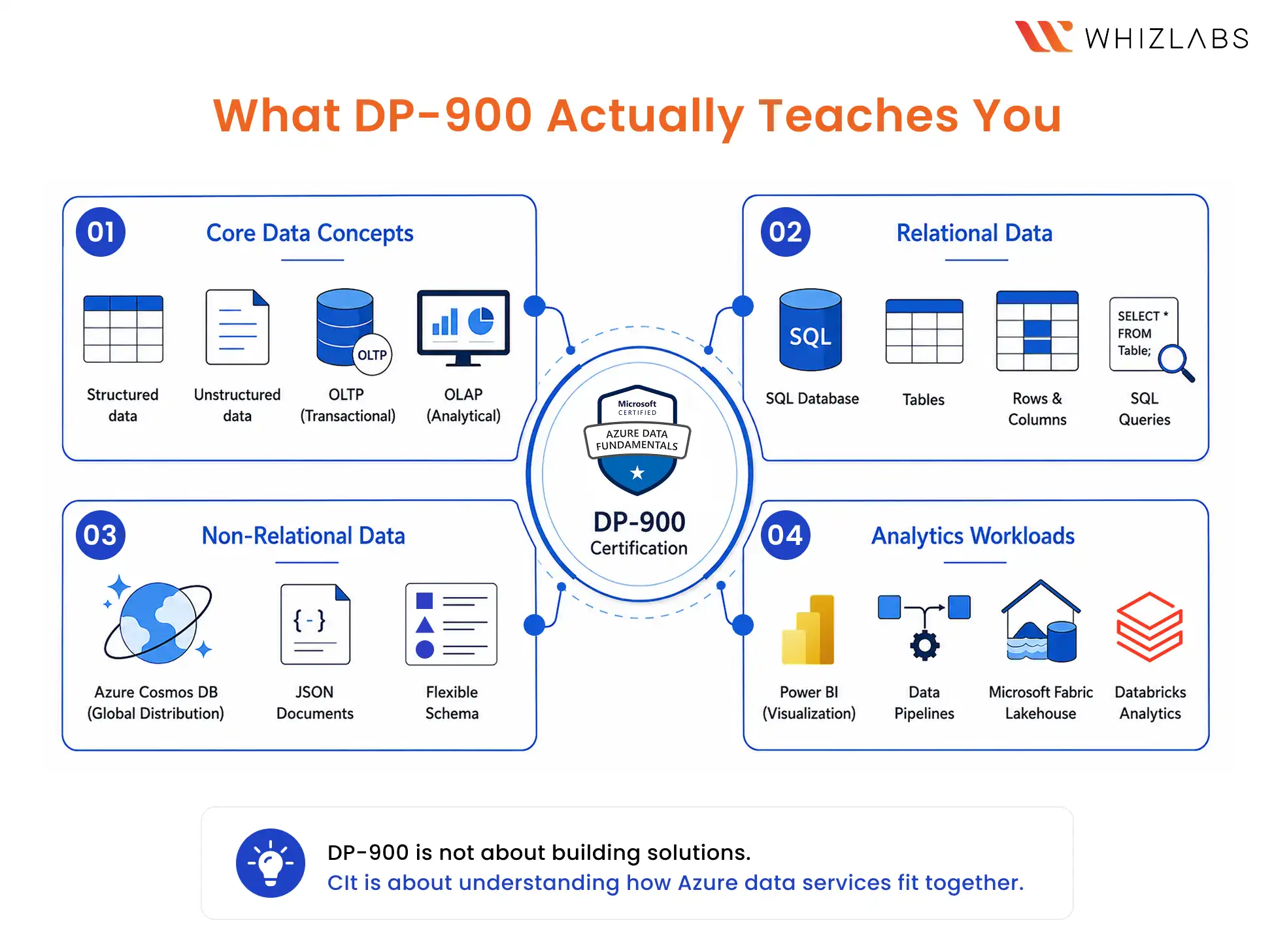
“The DP-900 is not a test of how well you can use Azure. It is a test of how well you understand data concepts within the Azure ecosystem.”
A common misconception is that the Azure Data Fundamentals certification tests whether you can work with Azure services or not. But Microsoft isn’t expecting you to know that from the beginning. Here is what it actually checks with the entry-level exam:
Your Basic Concept Clarity
At the initial stage, the certification assesses if you understand how data works inside the cloud platform. For example:
- Do you know the difference between structured and unstructured data?
- Can you distinguish between relational vs non-relational data in Azure?
- Are you familiar with the comparison of transactional vs analytical workloads?
This Azure data certification for beginners focuses on your understanding of the concepts that support complex data pipelines.
Your Familiarity with Azure Data Services
The DP-900 certification only gives you the Azure data services overview. However, you don’t have to memorise its every feature and advantage. This entry-level credential only expects you to recognise which service solves what kind of a problem.
In a nutshell, think of DP-900 as a test of your data knowledge and not technical expertise. If you know how data works and where it fits in the Azure ecosystem, you can attempt the certification exam confidently.
Who Should Take the DP-900 Certification?
The certification tests your understanding of the Azure data fundamentals concepts. That being said, it is not necessarily suitable for every professional working with datasets. But it is a good progression path for anyone developing a strong foundation in data concepts within Azure.
The certification can be valuable if you are one of the following:
-
Aspiring Data Professional
DP-900 certification introduces you to databases, workloads, core services, and their use within Azure. So, if you are planning a career as a data engineer or a cloud computing expert, it familiarises you with concepts you will use throughout your career.
-
Experienced Professional Shifting to Azure
Have you been working as a traditional data professional but want to switch to Azure now? This certification is the ideal entry point, introducing you to data and analytics concepts. It strengthens your base and makes you competent enough to pursue specialisation certifications in the future.
-
Working Professional Exploring Cloud Technologies
IT professionals generally work with database and reporting tools in a traditional manner. Their exposure to cloud-based services is still limited (or none in some cases). Azure data certification for beginners builds the foundation for these concepts and their use within the Azure environment.
-
Developers and Software Engineers
If you are a developer or software engineer working with databases and storage solutions, your knowledge scope would be limited. Certification helps strengthen your foundation of Azure data services and storage specifics so you can stay updated and be a valuable asset to the company.
Azure DP-900 Syllabus: An Exam Structure Breakdown
Familiarise yourself with the Microsoft DP-900 course before you start preparing so you know how much time to dedicate to which domains. While some sections carry a higher weightage, others hold comparatively lower value.
| Domain | Weightage |
| Core Data Concepts | 25 to 30% |
| Relational Data on Azure | 20 to 25% |
| Non-Relational Data on Azure | 15 to 20% |
| Analytics Workloads on Azure | 25 to 30% |
Here is a closer look at what each domain covers:
Describe Core Data Concepts
The domain tests if you have clarity of the data concepts that form a part of the Azure platform:
- Can you describe how to represent data in different ways?
- Can you identify different options for data storage?
- Can you describe the various features of transactional and analytical workloads?
- Do you understand the roles and responsibilities of data engineers, analysts, and administrators?
Identify Considerations for Relational Data on Azure
The second-most important domain checks your knowledge of how relational data works within Azure:
- Can you describe the various concepts of relational data, including normalisation, SQL statements, and common database objects?
- Are you familiar with the relational data services, such as Azure SQL Database, Azure SQL Managed Instance, and SQL Server?
- Can you identify the suitable Azure database services for open-source database systems?
Describe Considerations for Working With Non-Relational Data on Azure
The domain validates if you are familiar with the key considerations to follow when working with non-relational data:
- Are you aware of Azure Blob, File, and Table storage?
- Can you identify the use cases of Azure Cosmos DB?
Describe An Analytics Workload On Azure
The domain focuses on your understanding of the analytics workload and its use cases within Azure:
- Are you familiar with the common large-scale analytics services such as Azure Databricks and Microsoft Fabric?
- Can you identify the differences between streaming and batch data?
- Are you aware of the Power BI capabilities and the data model features within?
- Can you identify the correct data visualisation elements?
Which DP-900 Domains Carry the Most Weight?
“Candidates who focus on understanding use cases consistently outperform those who simply memorize Azure service names.”
The domains have almost identical weightage, making it important to dedicate your time responsibly to all of them. Many candidates end up spending the majority of their time on core services and remembering product names. They fail to figure out how data fundamentals support them.
Following a balanced study approach and dedicating time to every concept increases your chances of passing the exam.
Azure Data Services You Must Know for the DP-900 Exam
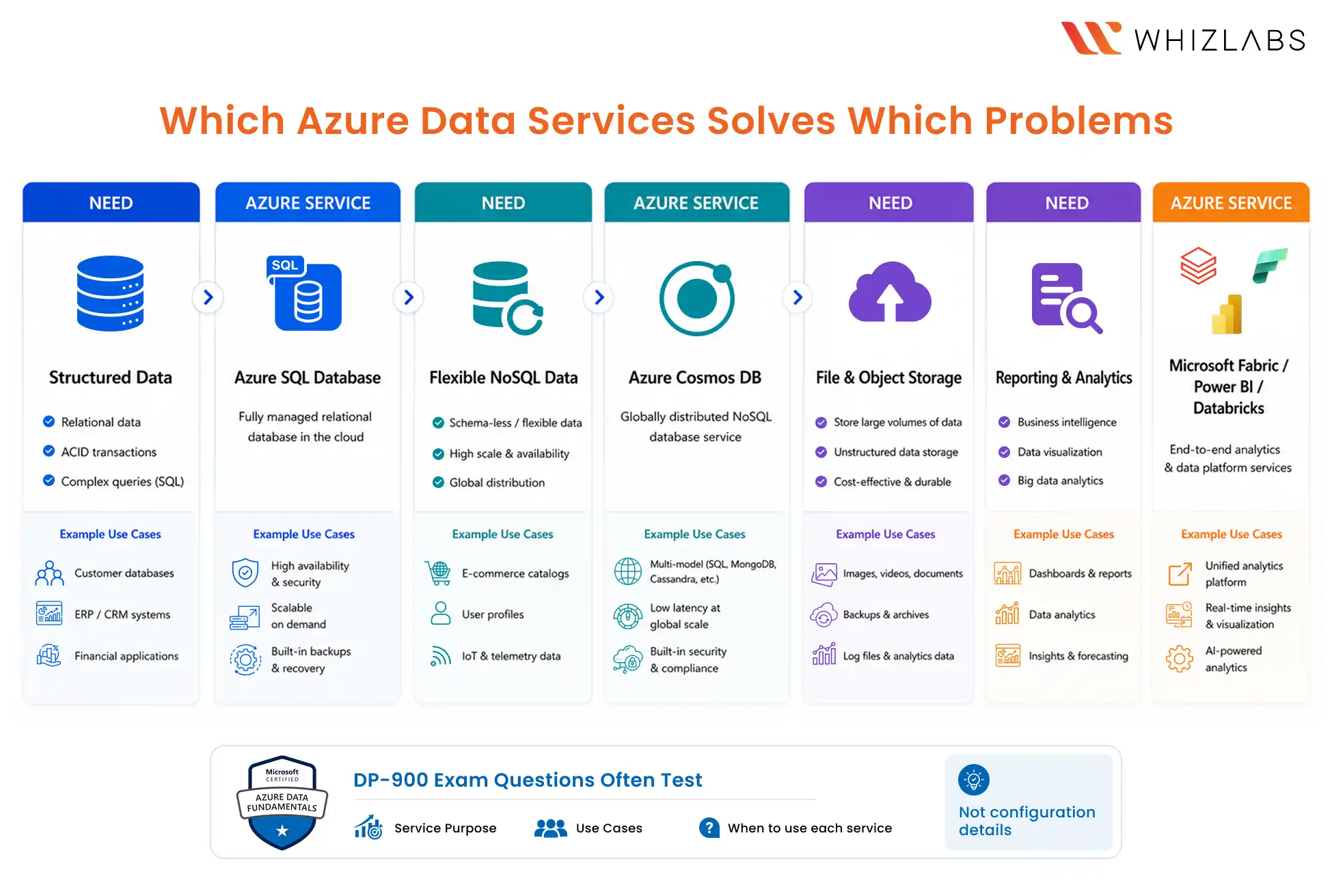
The easiest way to get overwhelmed by the syllabus is assuming that you have to master everything at once. But that isn’t what the Azure Data Fundamentals certification expects from you.
This foundational exam only focuses on whether you understand the Azure data services and their purpose or not. If you are well aware of how similar-sounding services offer different advantages, you are on the right track.
Below is a quick list of the Azure services that you should get familiar with before attempting the exam:
-
Azure SQL Database Basics
One of the commonly used relational services is the Azure SQL Database. When studying about it, focus on the following:
- Relational database concepts
- Tables, rows, and columns
- Structured data storage
- Use cases
Azure Cosmos DB
Contrary to SQL, Cosmos DB is the non-relational service available on the Azure platform. Learn about its key areas, including:
- NoSQL database concepts
- Flexible schema design
- Global distribution capabilities
- High scalability requirements
Azure Storage
Learn about the different ways you can store data on the Azure cloud platform. Focus on the following methods:
- Blob Storage
- File Storage
- Queue Storage
- Table Storage
Azure Analytics Services
Explore the Azure services commonly used for data reporting and analysis. Focus on the following when learning:
- Azure Synapse Analytics basics
- Microsoft Fabric concepts (if included in the current skills outline)
- Azure Databricks
- Power BI
In my honest opinion, focus less on experimentation and more on clearing your fundamental concepts. At the initial stage, you want to know how Azure services work, not master their application.
4-Week DP-900 Study Plan
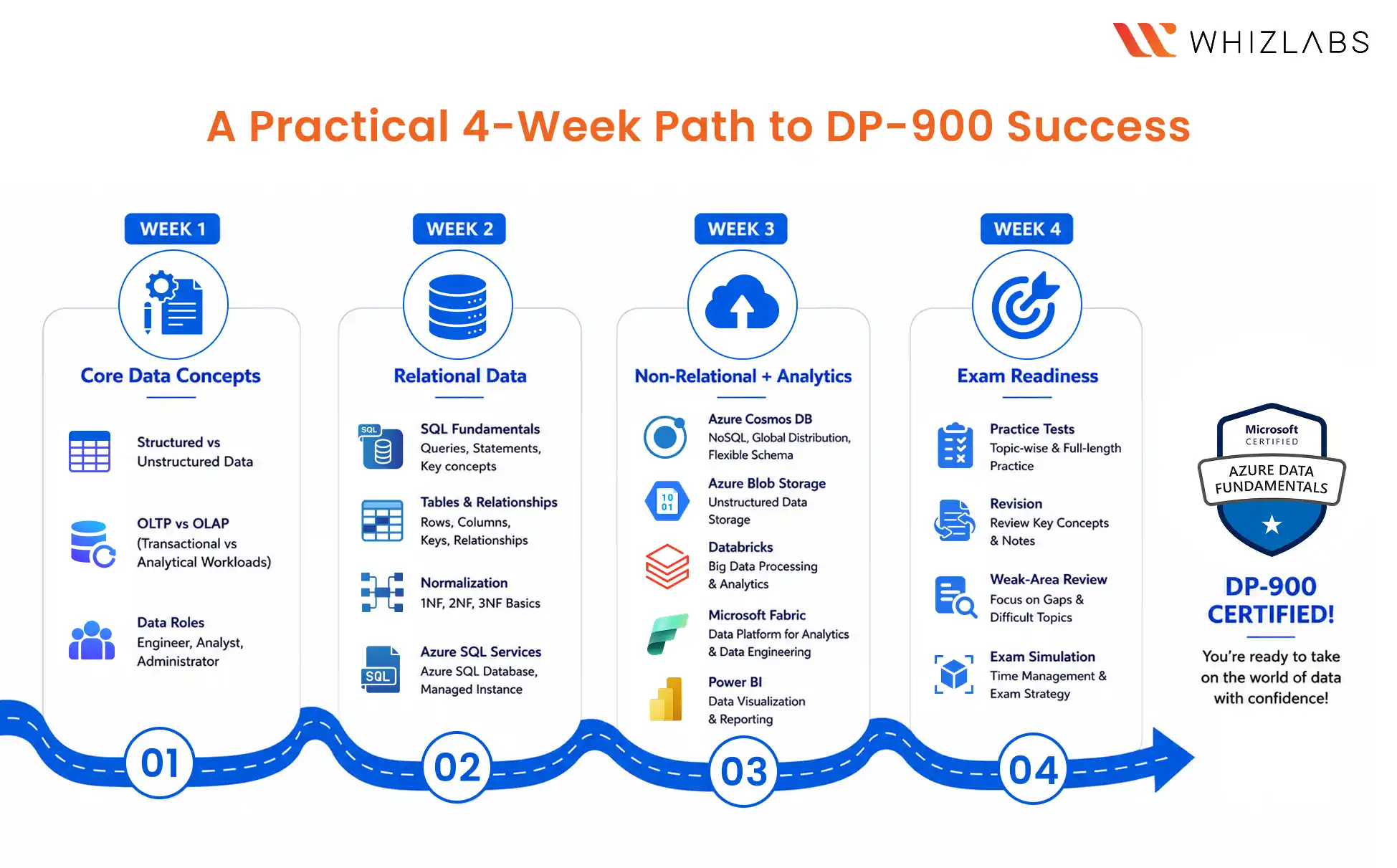
“Passing DP-900 is rarely about studying more. It is usually about studying the right concepts in the right order.”
| Week | Focus Area | Activities |
| Week 1 | Core Data Concepts | Study structured vs unstructured data, OLTP vs OLAP, data roles |
| Week 2 | Relational Data on Azure | Learn SQL concepts, Azure SQL services, normalization basics |
| Week 3 | Non-Relational Data + Analytics | Study Cosmos DB, Azure Storage types, Synapse, Power BI, Fabric |
| Week 4 | Practice Exams + Revision | Full timed practice tests, flashcard review, weak area reinforcement |
For IT professionals with existing data experience: Compress Week 1 and Week 2 content into a single week. Most relational and storage concepts will already be familiar, allowing you to direct more energy toward Azure-specific services and analytics tools.
For complete beginners: Add a preliminary week to review general database concepts before starting the plan above. Entering Week 1 with baseline familiarity accelerates retention considerably across all four domains.
5 Common DP-900 Preparation Mistakes That Cause Candidates to Fail
A lot of times, the certification confusion can cost you time and effort. You end up preparing for something that wasn’t even expected from you.
If you are spending excessive time learning about configuration and deployment, stop and take a step back. Remember that these topics are for specialisation certifications, not the DP-900 exam preparation.
Before you make any more mistakes, let’s give you a heads up:
Memorising More than the Azure DP-900 Syllabus
Focus only on what’s expected of you. Instead of trying to learn your way around Azure services applications, get a complete understanding of how those services work. Remember that the exam will only test if you understand storage and SQL, not write complex codes from scratch.
Ignoring Time Management
Managing your time is as important as knowing the answer to every question. If your speed is not up to the mark, you will end up attempting questions that were simple for you. As a result, you lose scores and reduce your chances of passing on your first attempt.
Cramming Instead of Understanding
There’s a fine line between memorising each and every concept and actually understanding it. If you only focus on memorising every line in the textbook, then you will forget it by the time the question paper comes. But gaining concept clarity will go a long way in teaching you the basics of Azure and retaining that knowledge.
Depending on Self-Study Only
Learners also believe that they can study themselves and get clarity on every topic. But self-studying only helps so far, and you need a subject matter expert to help you out. They break down complex terminology into simple language so you can understand and retain it for longer.
That’s why it is always recommended to follow a structured study plan to prepare for a cloud-based certification like DP-900.
How to Prepare for DP-900: A Step-by-Step Learning Path
Curious how to create a study plan that actually works? Here is a structured learning path that will prepare you confidently for the certification exam:
- Learn from Online Videos: Start seeking help from subject experts who can break down the most complex topics and make them simple to understand. Since you will get recorded sessions, you can study at your own pace and not rush to catch up.
- Attempt DP-900 Practice Tests: Learning is just the beginning, but the exam is what shows your actual preparedness. You can take up as many mock tests as you want to understand where you are lacking and the areas you are already excelling in.
- Practice with Hands-On Labs: If you want a broader look at what lab-based learning covers across certifications, the Whizlabs Labs catalog is a good starting point.
- Practice with Sandbox: Reading and watching will only take you so far. Whizlabs Sandbox Labs gives you a real Azure environment to explore data services without needing your own subscription, a practical way to reinforce what you have been studying conceptually.
DP-900 Exam Tips and Strategy That Actually Work
While preparation is one thing, implementing smart strategies can increase your chances of clearing the exam on the first attempt. Here’s what can help you:
- Go through the past-year DP-900 exam questions to identify the general pattern and what the certification exam generally expects.
- Take up the easiest questions first and flag the most difficult or lengthy questions. Keep them for the last and attempt them when you have answered the rest successfully.
- Make an educated guess and eliminate the obviously wrong answers first.
- Use the cheatsheet by Whizlabs, a last-minute prep hack, so you can quickly revise before the exam begins.
What Certification Should You Take After DP-900?
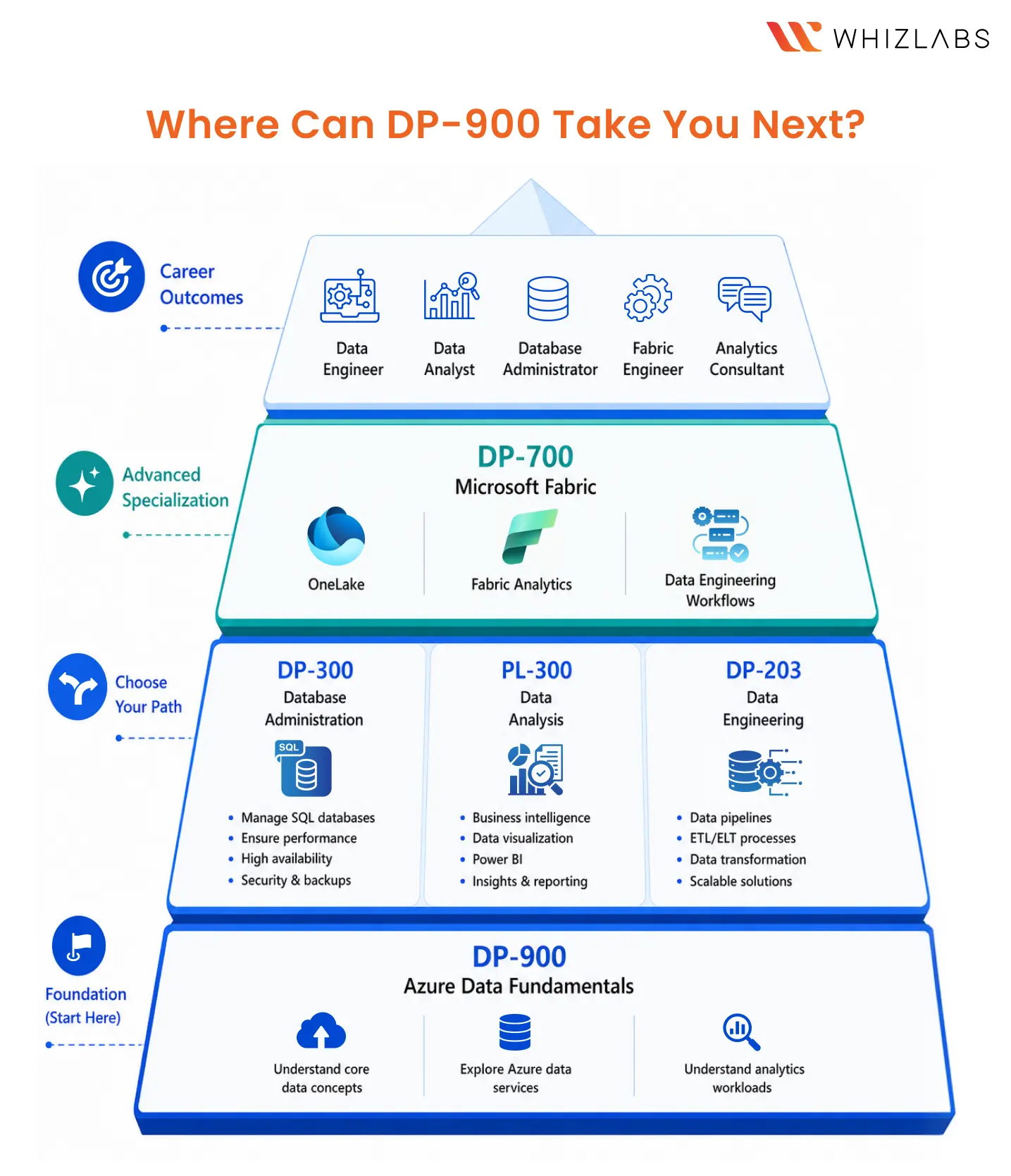
The DP-900 is a starting point, not a destination. Once you have successfully earned the credential, your next step depends on where you want to specialize within the Azure data ecosystem.
| Career Direction | Recommended Certification |
| Microsoft Fabric | DP-700: Implementing Data Engineering Solutions Using Microsoft Fabric |
| Database Administration | DP-300: Azure Database Administrator Associate |
| Data Analysis and Reporting | PL-300: Microsoft Power BI Data Analyst |
| Broader Cloud Foundation | AZ-900: Azure Fundamentals |
Most candidates pursuing a data engineering career follow the path: DP-900 → DP-203 → DP-700. Those focused on analytics and reporting typically move toward DP-900 → PL-300. Choose the direction that aligns with the role you are building toward, and let the certification path follow naturally from there.
Final Thoughts: Is DP-900 Worth It?
The Microsoft Azure Data Fundamentals DP-900 builds your foundation about databases and their use cases within Azure. But it is only the beginning, and you would want to specialise in Azure to build a secure and growth-focused career path. Once you have successfully earned the credential, you can figure out the next steps. Do you want to focus on data pipelines or move towards relational databases? You can choose between the certification options accordingly.
Start your journey with Whizlabs, a certified and trusted online learning platform for professionals.
FAQs
1. What is the DP-900 certification cost for examination?
The cost for the DP-900 certification exam is $99.
2. Is the DP-900 an open-book exam?
No, any certification exam is not an open-book exam and only gives access to an on-screen calculator.
3. How long will it take to complete the DP-900 exam preparation?
The time taken for the preparation depends on your experience and study speed. If you are a beginner, you take at least 1 to 1.5 months to clear your concepts. But if you are an IT professional already, then you can prepare in even 1 to 2 weeks.
4. Is DP-900 a tough exam for beginners?
Not ideally; the DP-900 is generally considered a beginner-friendly exam and does not require any prior experience. It is a good entry point if you are new to Azure.
5. Does DP-900 include practical questions?
No, the DP-900 is a foundational-level certification and does not include practical questions. It completely focuses on theoretical concepts.

- AZ-305 Worth It in 2026? Salary, ROI & Career Benefits - September 30, 2026
- AWS Cloud Certification Trends: MLOps & GenAI in 2026 - September 30, 2026
- Cisco AITECH (810-110) Study Guide & Exam Prep 2026 - September 24, 2026
- NVIDIA NCP-AIN Exam Prep & Practice Tests | Whizlabs - September 18, 2026
- SC-500 Exam Prep 2026: Study Guide & 5-Week Plan - September 7, 2026
- AI-200 Study Guide: 6-Week Exam Prep Plan - September 4, 2026
- AB-731 Exam Preparation: Domains & Study Guide - August 31, 2026
- How to Build AI Agents on Azure: AI-103 Guide - August 21, 2026