

Updated Microsoft Azure Certifications Path 2026
In 2026, learning Azure is not going to be “just another cloud skill”. It’s evolving to be the operating layer for enterprise applications, which builds and scales. As we still talk about infrastructural evolution in the cloud, it’s quietly evolving towards AI, Data intelligence and automation for day-to-day business flows. That’s why Azure learning paths are no longer about learning services in isolation. Instead, they are preparing for roles where cloud, AI, and decision-making intersect.
As the shift happens: Hybrid environments, regulated industries, Fortune 500 adoption, and now at AI-driven transformation. The main reason is Learning Azure, and the Azure certification path in 2026 is designed to meet the enterprise reality. This immersive, progressive evolution in the cloud-first market is accelerating with AI.
If you want to stay relevant and move ahead in 2026 in Cloud and advancements, the Microsoft Azure Learning path is what aligns better with your career positioning, beyond just being a certification chase.
Why Azure is a Smart Career Bet for 2026?
Here is a list of Clear indicators that Azure’s momentum is beyond theory.
Azure’s Market Position Is Enterprise-Strong
- Azure holds ~20% of the global cloud infrastructure market.
- 95% of Fortune 500 companies use Azure services in some capacity.
- Over 480,000 organisations globally rely on Azure across healthcare, finance, manufacturing, and government
- 81% of enterprises run a hybrid cloud, where Azure has a structural advantage
Cloud investments are a true sign of Progress and acceleration
- The global cloud market is projected to grow from $738B in 2026 to $1.6T by 2030.
- Microsoft invested $55.7B in cloud and AI infrastructure in FY2024, signaling long-term commitment
- Azure data centre and AI expansion continue to scale year over year.
Azure Skills Translate Directly to Jobs
- Azure skills appear in 40% of cloud job postings.
- In India alone, there are 5,000+ active Azure job openings at any given time.
- Cloud roles are projected to grow 15%+ through 2031, well above average job growth.
Certifications Deliver Measurable Career Upside
- Azure-certified professionals earn 8–15% higher salaries than non-certified peers
- Certification holders report an average $10,000 salary premium
- 63% of professionals report promotions or role expansion after certification
AI Is Reshaping Azure Careers
- AI-driven services now account for a growing share of Azure revenue
- GenAI-based cloud offerings saw 140–180% growth in 2025
- Azure professionals with AI + cloud skills command 40–50% salary premiums
- AI-focused certifications like AI-900, AI-102, and emerging leadership tracks are gaining traction fast
Multi-Cloud Reality Makes Azure Even More Valuable
- 92% of enterprises operate in multi-cloud environments
- Azure certifications pair well with AWS and GCP, especially for architects, security, and AI roles
- Hybrid and regulated workloads continue to favour Azure’s ecosystem
To put it together,
Learning Azure today is about aligning with how enterprises actually operate: hybrid, regulated, AI-assisted, and data-driven. The certifications are role-based, match AI integration and the certs are optimised with career ROI. You also get the opportunity to scale from Beginner to Expert in Azure. For this reason, Azure learning paths remain one of the most resilient, future-proof strategies for long-term cloud careers.
How to Choose the Right Azure Certification Path in 2026?
Before starting with it, we need to understand that 2026 isn’t about collecting badges and accumulating certificates. But it’s aligning with your goal, choosing the right track that converts and grows long-term with relevance. This needs to be validated as Azure services are embedded with AI.
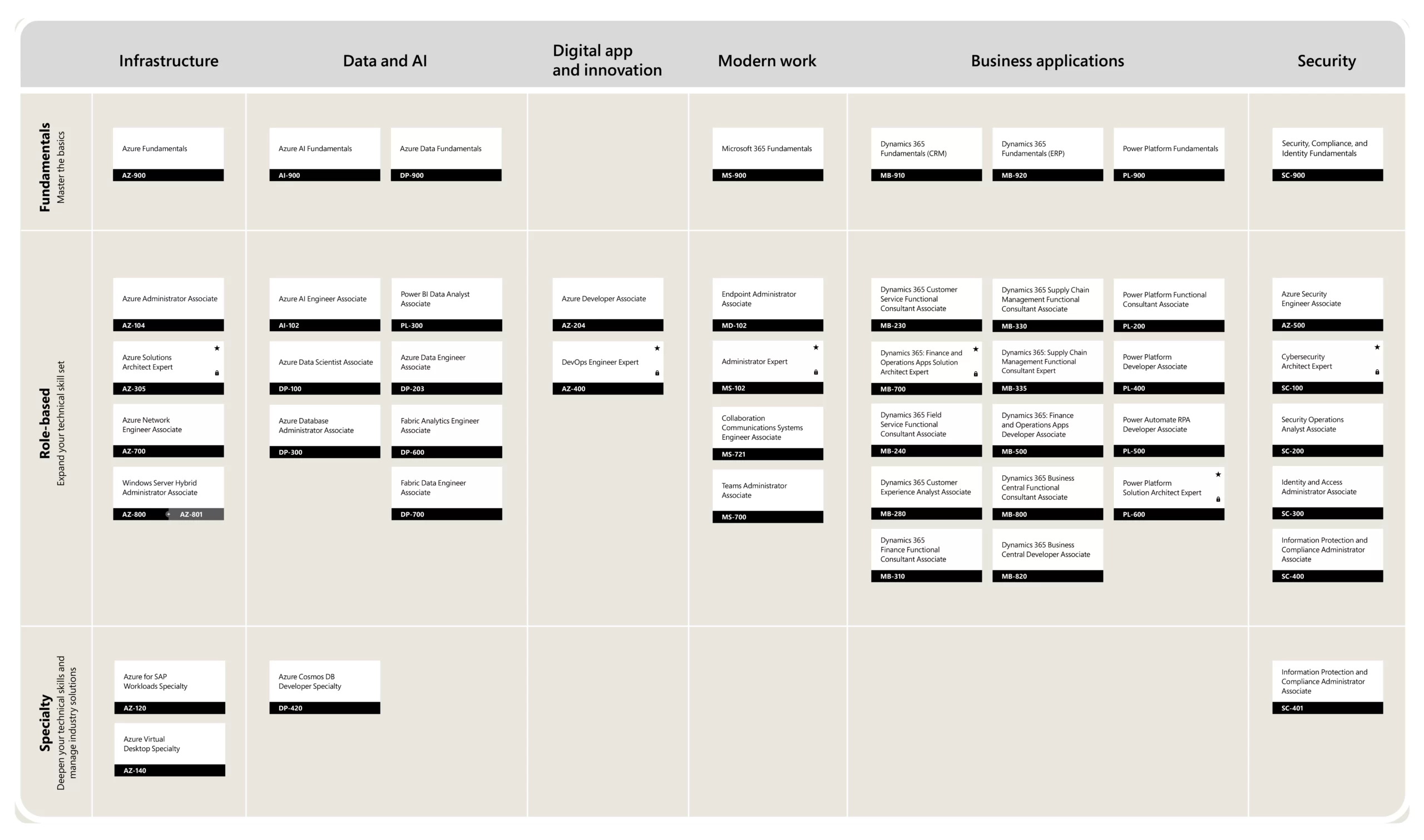
There is an absolute distinction between the Azure Certification Path & Azure Learning Path.
- An Azure certification path shows you what exams to take.
- An Azure learning path shows you how skills compound over time.
And today, Microsoft’s role-based models need to align into two. Certification validates job readiness and theoretical knowledge. Based on this, the Azure 2026 learning paths are layered as Firstly Cloud Fundamentals, then Role Specific depth, and AI Literacy.
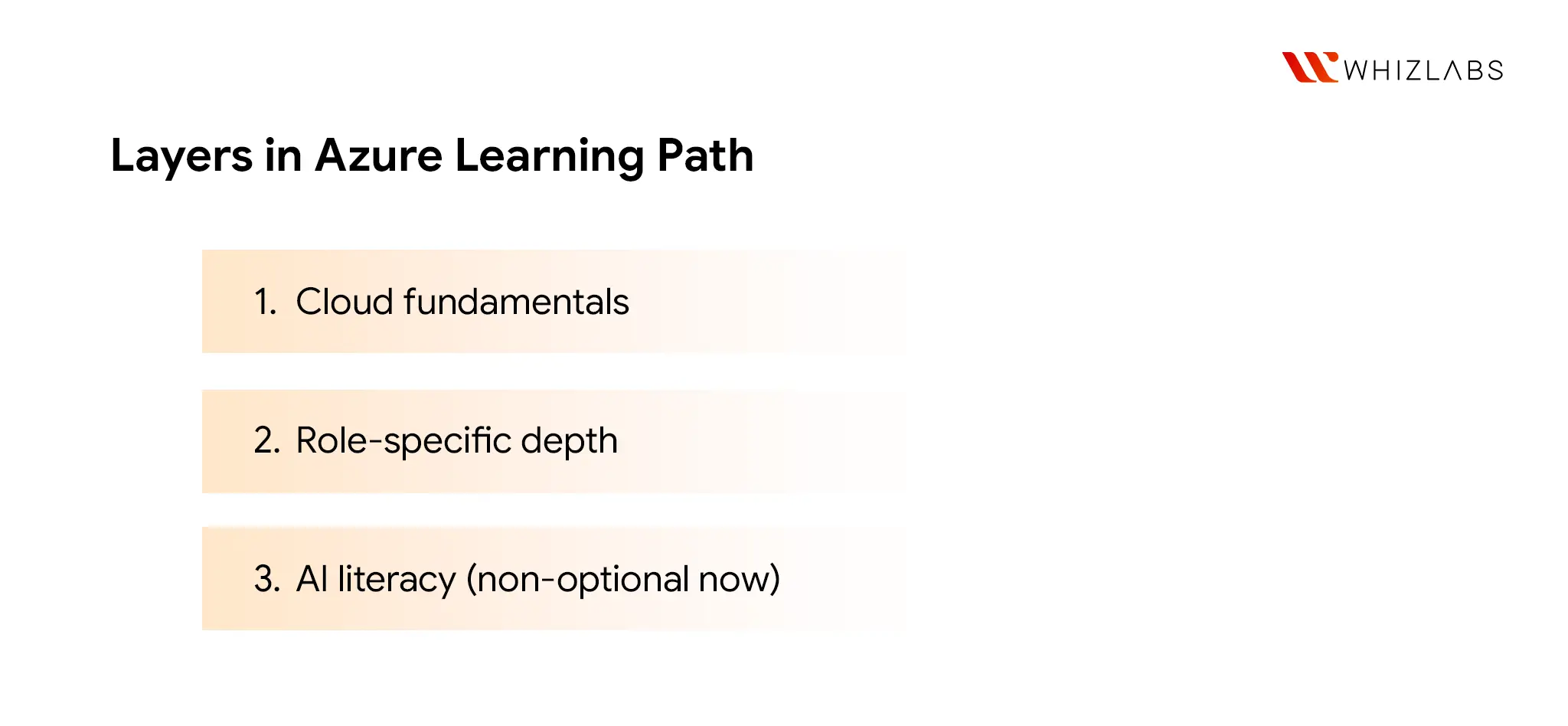
Most professionals succeed when they follow this three-layer structure:
1. Foundation (Cloud + AI Literacy)
This is where you eliminate blind spots.
- AZ-900 (Azure Fundamentals): Builds cloud fluency across compute, storage, networking, pricing, and governance
- AI-900 (Azure AI Fundamentals): Adds AI awareness, use cases, responsible AI, and business impact.
This is now the baseline for both technical and non-technical Azure roles.
2. Role-Based Specialisation
This is where your Azure learning path becomes role-specific.
| Administration & Infrastructure | AZ-104 → AZ-305 |
| Development | AZ-204 |
| AI & Machine Learning | AI-900 → AI-102 |
| Security | SC-900 → AZ-104 → AZ-500 |
| Data Engineering | DP-900 → DP-203 |
| DevOps | AZ-104 → AZ-400 |
These associate-level certifications are hands-on, scenario-driven, and hiring-aligned. They test decision-making, not memorisation.
3. Advanced and Expert Roles
This layer is crucial to niche down and expand your growth.
- AZ-305 (Solutions Architect Expert) for the highest ROI Azure certification in job postings
- AZ-400 (DevOps Engineer Expert) provides a strong demand in platform and delivery teams
Where does AI come in the Azure Learning Path?
Unlike before, AI literacy is woven into every Azure role today.
- AZ-104, AZ-305, AZ-500, and security certifications now include AI topics
- Employers increasingly expect AI-aware cloud professionals, even outside AI roles
Note: If you already have an Azure certification and don’t have AI-900 yet, add it soon.
Who should Choose What Azure Learning Path?
- If you are New to cloud or non-technical: AZ-900 → AI-900
- Azure Administrator: AZ-900 → AZ-104 → AZ-305
- To become a Azure Developer: AZ-900 → AZ-204 (+ AI-900)
- Career as an AI Engineer in Azure: AI-900 → AI-102
- If you have an interest in Security Engineer: SC-900 → AZ-104 → AZ-500
- To become a DevOps Engineer: AZ-104 → AZ-400
Let’s move into a deeper and detailed lens onAzure certification path for 2026, which helps in your learning and preparation journey. This learning path gives you direction from a career/role point of view.
Role-based Azure Cloud Learning Path 20026
1. Cloud Administrator → Solutions Architect Journey (Azure Certification Path 2026)
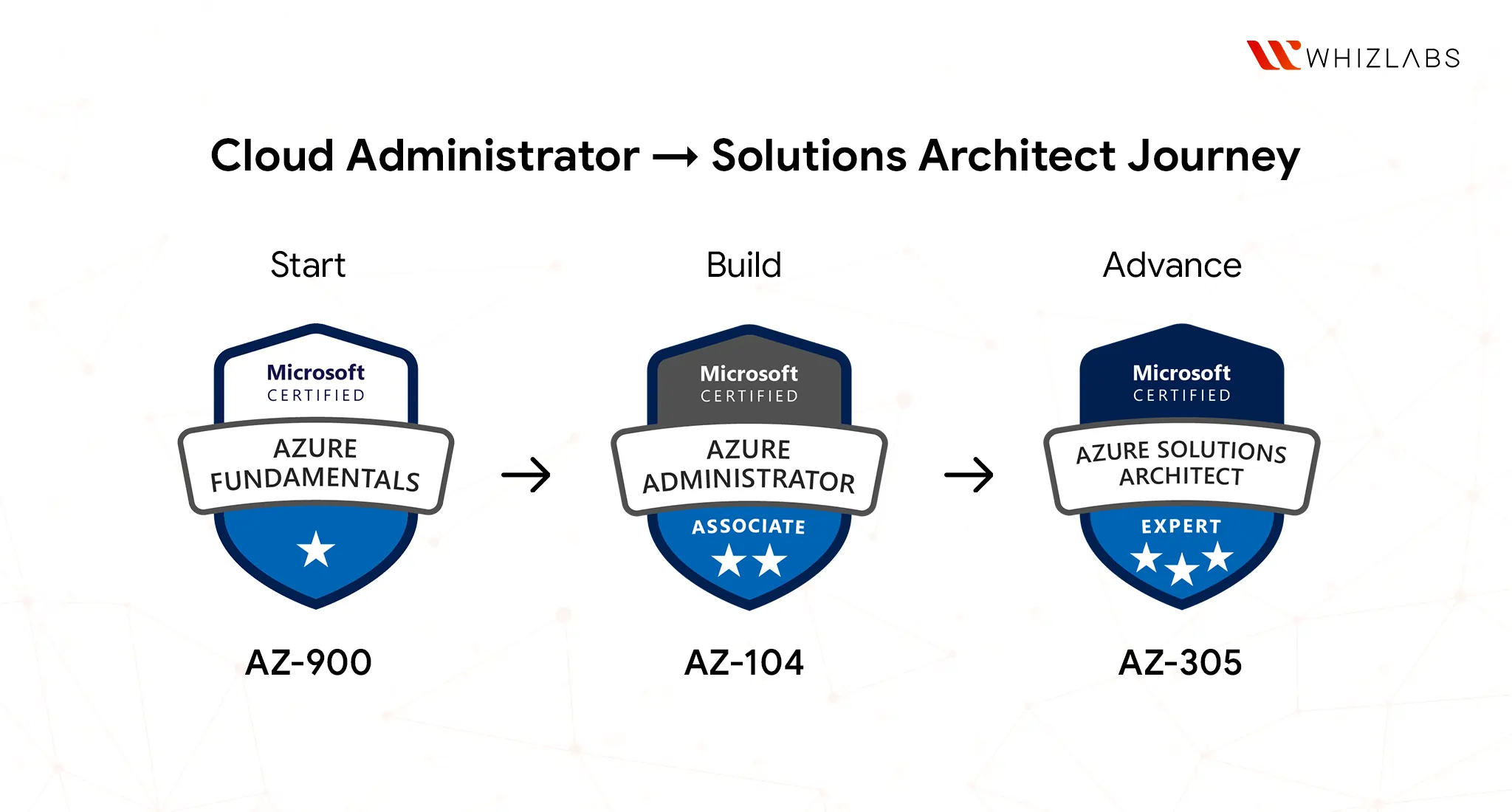
This is one of the most reliable, highest-ROI Azure learning paths in 2026. If you want a career that starts hands-on, scales into decision-making, and stays relevant as Azure evolves with AI, security, and hybrid cloud, the Cloud Administrator to Solutions Architect Journey is the one.
This journey takes you from operating Azure to designing Azure. At the end, you don’t just execute tasks, you decide what should be built, why, and how it should scale safely and cost-effectively on Microsoft Azure.
| 1. Cloud Administrator → Solutions Architect Journey | |||
| Stage | Category | Exam Code | Certification Name |
| Start | Fundamental | AZ-900 | Microsoft Azure Fundamentals |
| Build | Associate | AZ-104 | Microsoft Azure Administrator Associate |
| Advance | Expert | AZ-305 | Microsoft Azure Solutions Architect Expert |
Stage 1: AZ-900 Microsoft Azure Fundamentals (Foundation)
AZ-900 is your stepping stone to cloud literacy; you understand Azure well enough to make correct decisions.
Primary Domains and what AZ 900 covers?
- What Azure is (and what it is not)
- Cloud concepts (IaaS, PaaS, SaaS)
- Core Azure services (compute, storage, networking)
- Azure management, governance, pricing, and compliance
- When to use compute vs storage vs networking services
- Cloud pricing models, SLAs, and shared responsibility
- Core Azure architecture and governance concepts
Candidates with AZ 900 enter Job titles like Cloud Support Associate, Junior Cloud Engineer, IT Support transitioning to cloud and Business or operations roles working with Azure teams.
The 900 certification Career Impact & Market Value
The certifications act as a gateway to a cloud career and advanced certifications. Reducing the learning friction for every advanced Azure certification. Therefore, it improves shortlisting for entry-level cloud roles. The global average entry-level roles range between $55,000–$75,000.
With no formal Prerequisites for the Az 900 certification, makes it an ideal choice for beginners, career switchers, and non-technical professionals to start their cloud journey.
Stage 2: AZ-104 Microsoft Azure Administrator Associate (Build)
This is the certification recruiters look for when they want someone who can actually operate Azure. AZ-104 certification is where theory ends, and real Azure work begins. Where you’re responsible for:
- Running Azure environments
- Fixing issues when things break
- Securing resources
- Keeping workloads available and performant
Primary Domains Covered
- Azure identity and governance (Entra ID, RBAC, policies)
- Virtual machines, storage, and networking
- Monitoring, backup, and disaster recovery
- Security basics for workloads and data
Prerequisites for Az 104 Certifications
- Strongly recommended: AZ-900 and 6+ months of hands-on Azure experience.
- Familiarity with Azure Portal, CLI / PowerShell and Networking basics
A professional with Az 104 certifications is qualified to aim forAzure Administrator, Cloud Engineer, Infrastructure Engineer, and Platform Support Engineer.
The Az 104 is one of the most in-demand Azure certifications, which is frequently listed as a requirement in job descriptions. And a for sure prerequisite for the architect and DevOps expert roles.
The average salary for an AZ 104 certified Professional, from the global lens range between $90,000–$140,000. A high demand across enterprises and system integrators.
Stage 3: AZ-305 Microsoft Azure Solutions Architect Expert (Advanced)
The AZ-305 is a certification validating professionals ability to design the right solution before anyone writes code or deploys infrastructure. Basically, translating business requirements into Azure architecture. As a Solutions Architect, you decide:
- How systems scale
- How secure are they are
- How much do they cost
- How do they survive failures
Primary Domains Covered in AZ 305
- Identity, governance, and monitoring design
- Data storage and database architecture
- Business continuity and disaster recovery
- End-to-end infrastructure design
What are the prerequisites for AZ 305 certification?
- Mandatory: AZ-104 (Azure Administrator Associate)
- 2+ years of experience working with Azure workloads
- Strong understanding of Networking, Security, Cost optimization, and High availability design
With the AZ 305 certification, you get to unlock Job Roles such as Azure Solutions Architect, Cloud Architect, Senior Cloud Engineer, Technical Architect, and Pre-sales / Consulting Architect.
This certification is frequently associated with leadership and consulting roles, and its global average salary range is between $130,000–$200,000+; it has the highest ROI among Azure certifications. It has a strong credibility with leadership and stakeholders, moving you from execution to decision-making.
Why does the Cloud Administrator to Solutions Architect Azure Learning Path work well in 2026?
- Enterprises need people who can operate today and design for tomorrow.
- AI, security, and hybrid cloud make architecture skills more valuable than ever.
As this journey builds from fundamentals → operations → architecture. It aligns perfectly with real enterprise roles, keeping you relevant even as Azure services evolve. This is a long-term, high-value Azure career that compounds.
DevOps Engineer / Platform Engineer Journey
This is your build and scale path in Azure. If your goal is to stop doing manual deployments, reduce outages, ship faster, and run Azure like a well-oiled, good-conditioned machine even after a long year, this is for you. In 2026, companies basically want engineers who can automate, standardise, and govern the cloud at scale.
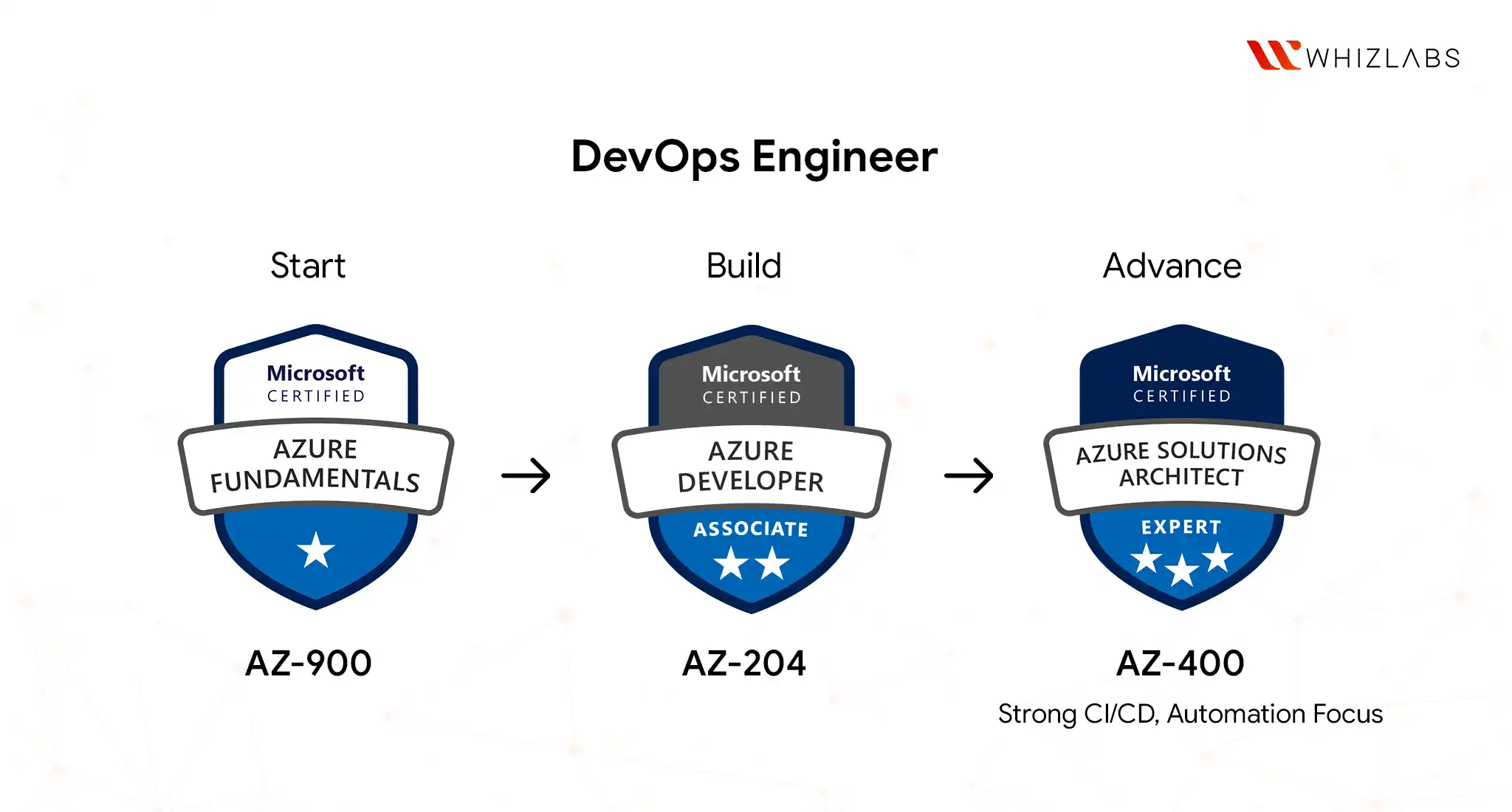
This DevOps learning path splits into two high-value roles:
- DevOps Engineer → CI/CD, automation, developer velocity
- Platform Engineer → infrastructure foundations, governance, reliability
| 2. DevOps Engineer / Platform Engineer Journey | |||
| Stage | Category | Exam Code | Certification Name |
| Start | Fundamental | AZ-900 | Microsoft Azure Fundamentals |
| Build | Associate | AZ-104 | Microsoft Azure Administrator Associate |
| Build | Associate | AZ-204 | Microsoft Azure Developer Associate |
| Advance | Expert | AZ-400 | Microsoft DevOps Engineer Expert |
Stage 1: AZ-900 — Microsoft Azure Fundamentals (Start)
Before you get started with automating anything, you need to understand what you’re automating. For that, you are going to start with AZ-900, which gives you clarity on:
- Azure services and deployment models
- Shared responsibility between the cloud provider and the customer
- Cost models and governance basics
- Where DevOps and Platform engineering fit in the cloud lifecycle
This prevents you from making the biggest DevOps mistakes: Automating the wrong architecture.
Stage 2: AZ-104 Microsoft Azure Administrator Associate (Build – Infra Core)
The AZ-104 turns you into someone who can run Azure reliably. Which makes it a critical requirement for Platform Engineers, DevOps engineers responsible for infra stability, and teams building internal platforms on Azure.
Stage 3: AZ-204 — Microsoft Azure Developer Associate (Build – App & CI/CD Core)
AZ-204 teaches you how developers build on Azure, which is a non-negotiable skill for DevOps engineers. Here you get to learn:
- Application lifecycles
- APIs and integrations
- Containers and app hosting
- How CI/CD pipelines interact with real apps
This is the point where DevOps stops being just an infra-only tool and becomes an end-to-end delivery tool. The AZ 204 certification focuses on
- Azure compute and app services
- Storage and data integration
- Authentication and authorization
- Monitoring and troubleshooting apps
Candidates will need Programming experience (C#, JavaScript, Python recommended) and Basic Azure knowledge (AZ-900 or AZ-104 helps a lot) to attempt AZ-204 certifications.
Once you pass the certification, you are capable of roles like DevOps Engineer, Cloud Application Engineer and Platform Engineer (developer-facing platforms)
From the global market survey, the salary range is between $100,000–$150,000+. The AZ 204 certification is a strong differentiator for DevOps roles, which makes you effective in CI/CD, not just pipeline setup. It bridges the gap between development and operations teams.
Stage 4: AZ-400 — Microsoft DevOps Engineer Expert (Advanced)
The AZ-400 is the control room of Azure engineering. This is where DevOps and Platform Engineering mature. They decide how
- Code moves to production
- Infrastructure is defined as code
- Security and compliance are enforced automatically
- Monitoring and feedback loops work at scale
The Primary Domains covered in AZ 400 certification are
- CI/CD pipelines (Azure DevOps, GitHub)
- Infrastructure as Code (ARM, Bicep, Terraform concepts)
- Security, compliance, and governance
- Monitoring, logging, and reliability engineering
Prerequisites for AZ 400 certification
Candidates must mandatorily have AZ-104 or AZ-204 certification. And a strong understanding of: Git, CI/CD concepts and Azure infrastructure and app services.
The certification provides Expert-level credibility, enabling leadership in cloud delivery teams. Eventually, there is a high demand across enterprises and SaaS companies for DevOps engineers with validations. This demand is a concrete base for the salary of DevOps engineers, ranging from $130,000 to $180,000+ in the global market.
DevOps vs Platform Engineer: How the Path Diverges
| DevOps Engineer Focus |
Platform Engineer Focus |
|
AZ-204 + AZ-400 |
AZ-104 + AZ-400 |
|
|
Almost a similar path, but a different direction and different working priorities.
Why is the DevOps/Platform engineer Azure Path Is Powerful in 2026?
Today, enterprises are standardising platforms, and AI workloads demand automation and governance over manual workloads. This journey makes you the person who builds reusable platforms, Automates reliability and keeps Azure fast, secure, and predictable.
Azure AI Engineer Journey (Cloud + AI-Native)
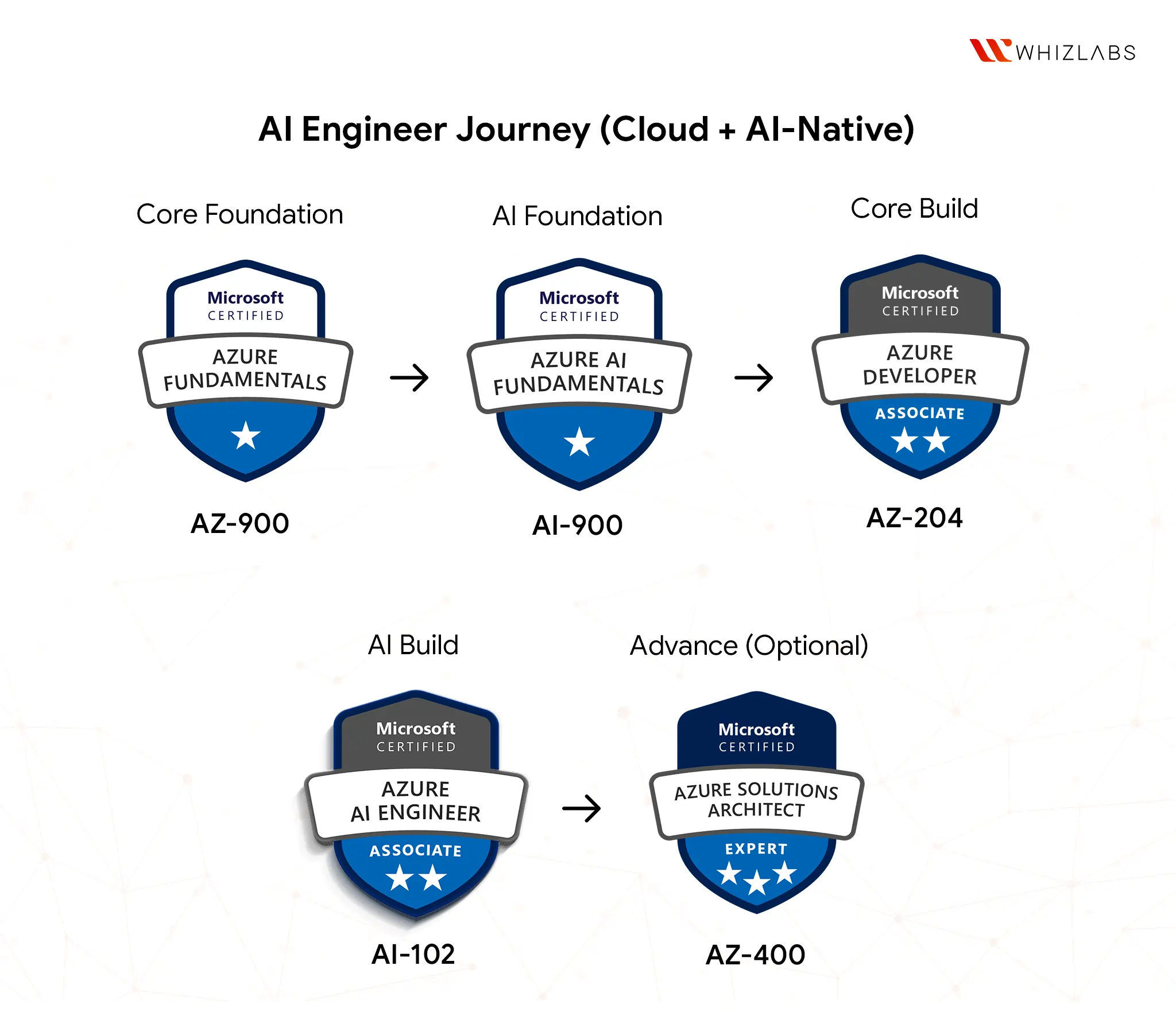
Cloud engineering meets real AI production. Today, companies are not hiring AI engineers to just experiment with models; they want professionals who can design, deploy, scale, secure, and govern AI systems in the cloud.
That is exactly what this Azure AI Engineer learning path prepares you for.
This journey is a blend of Cloud fundamentals, Application engineering, Enterprise AI services, and Responsible and agentic AI practices.
If you aim to work on production-grade AI systems on Azure, then this is the most relevant Azure certification path.
| 3. AI Engineer Journey (Cloud + AI-Native) | |||
| Stage | Category | Exam Code | Certification Name |
| Core Foundation | Fundamental | AZ-900 | Microsoft Azure Fundamentals |
| AI Foundation | Fundamental | AI-900 | Microsoft Azure AI Fundamentals |
| Core Build | Associate | AZ-204 | Microsoft Azure Developer Associate |
| AI Build | Associate | AI-102 | Microsoft Azure AI Engineer Associate |
| Advance (Optional) | Associate | DP-100 | Microsoft Azure Data Scientist Associate |
| Advance (Optional) | Expert | AZ-400 | Microsoft DevOps Engineer Expert |
Stage 1: AZ-900 Microsoft Azure Fundamentals (Core Cloud Foundation)
AI doesn’t run ideally. The models live inside cloud architectures. And for which the foundation always points to the AZ 900 certification. It helps you understand
- Where AI services sit within Azure
- How do compute, storage, networking, and security support AI workloads
- Why cost, scalability, and governance matter before model selection
This protects you from making the most common AI mistakes: building models without cloud context.
Stage 2: AI-900 Microsoft Azure AI Fundamentals (AI Foundation)
AI-900 builds AI literacy, and it doesn’t focus much on the coding depth. This certification aligns with enterprise AI decision-making perfectly. Candidates get to learn:
- What ML, NLP, computer vision, and generative AI actually do
- When to use prebuilt AI services vs custom models
- Where AI fails: bias, hallucinations, data leakage
The following are the Primary Domains covered in the AI 900 certifications
- AI workloads and use cases
- Machine learning basics
- Computer vision and NLP concepts
- Generative AI fundamentals
Not many Prerequisites. If you know basic cloud or programming concepts, it would be helpful in the process. You can target Job Roles like AI Engineer (Entry-Level), AI Business Analyst and AI Solution Consultant.
With strong demand due to enterprise AI adoption, the AI 900 certification is frequently paired with AI-102 for credibility. And together earn between $70,000–$95,000, say market standards.
Stage 3: AZ-204 Microsoft Azure Developer Associate (Core Build)
Most AI solutions fail after the model, basically during integration. This is where AI engineering becomes real engineering with AZ 204 certification. You get to explore how to
- Build cloud-native applications
- Integrate AI services via APIs
- Deploy AI workloads using containers and app services
- Monitor and troubleshoot AI-powered applications
Stage 4: AI-102 Microsoft Azure AI Engineer Associate (AI Build Core)
The AI-102 certification validates your ability to design and implement enterprise AI solutions on Azure. Where you get to work with Azure AI Services, Azure OpenAI, Microsoft Foundry, and Agentic AI and orchestration patterns.
This is one of the most important certifications in the Azure AI learning path that focuses on the following domains.
- Designing AI solutions
- Computer vision, NLP, and document intelligence
- Generative AI and conversational AI
- Responsible AI and security considerations
The Prerequisites for AI 102 certification are
- Programming experience (Python or C# recommended)
- AI-900 strongly recommended
With the certification, you can get access to Job Roles like Azure AI Engineer, Generative AI Engineer, Conversational AI Engineer and Applied AI Engineer. Whose salary ranges between $120,000–$180,000+ and is one of the high in demand certification for its Gen AI adoption.
Stage 5: DP-100 Azure Data Scientist Associate (Optional Advanced ML)
If you are aiming to build and train custom models, DP-100 adds serious depth. Basically
- Train, evaluate, and tune ML models
- Use Azure Machine Learning pipelines
- Deploy models into production safely
This DP 100 Azure data certification is an advanced-level certification, which is optional. The primary domains covered are
- Data preparation and feature engineering
- Model training and evaluation
- Deployment and retraining pipelines
You will need Python and ML fundamentals, the ability to understand statistics and data science concepts, as the prerequisites for the DP 100 certification.
Data Scientist, Applied ML Engineer, and Research-focused AI Engineer are a few high-level roles you are eligible for and the salary ranges between $130,000–$200,000+.
Stage 6: AZ-400 DevOps Engineer Expert (Optional MLOps & Scale)
This is where AI becomes production-ready. AZ-400 helps you Build MLOps pipeline, Automate training, deployment, and monitoring and Govern AI systems at scale. This is an ideal scale-up for a Senior AI Engineer.
CI/CD pipelines, Infrastructure as Code and Monitoring, security, and governance are a few primary domains covered.
With AZ 400, you are capable of Job Roles like Senior AI Engine, MLOps Engineer, and AI Platform Engineer, with a salary ranging between $140,000 and $200,000+.
Why can this Azure AI engineer Path be a win for you in 2026?
The Azure AI Engineer journey prepares you for Enterprise-grade AI systems, Generative and agentic AI adoption, Responsible AI and governance and Cloud-native scalability.
Where you can move from demos to actually ship AI to production. This is a great Azure AI learning path with the strongest career investments you can make.
Azure Data Learning Path for 2026: Data Analyst → Data Engineer → Data Architect Journey
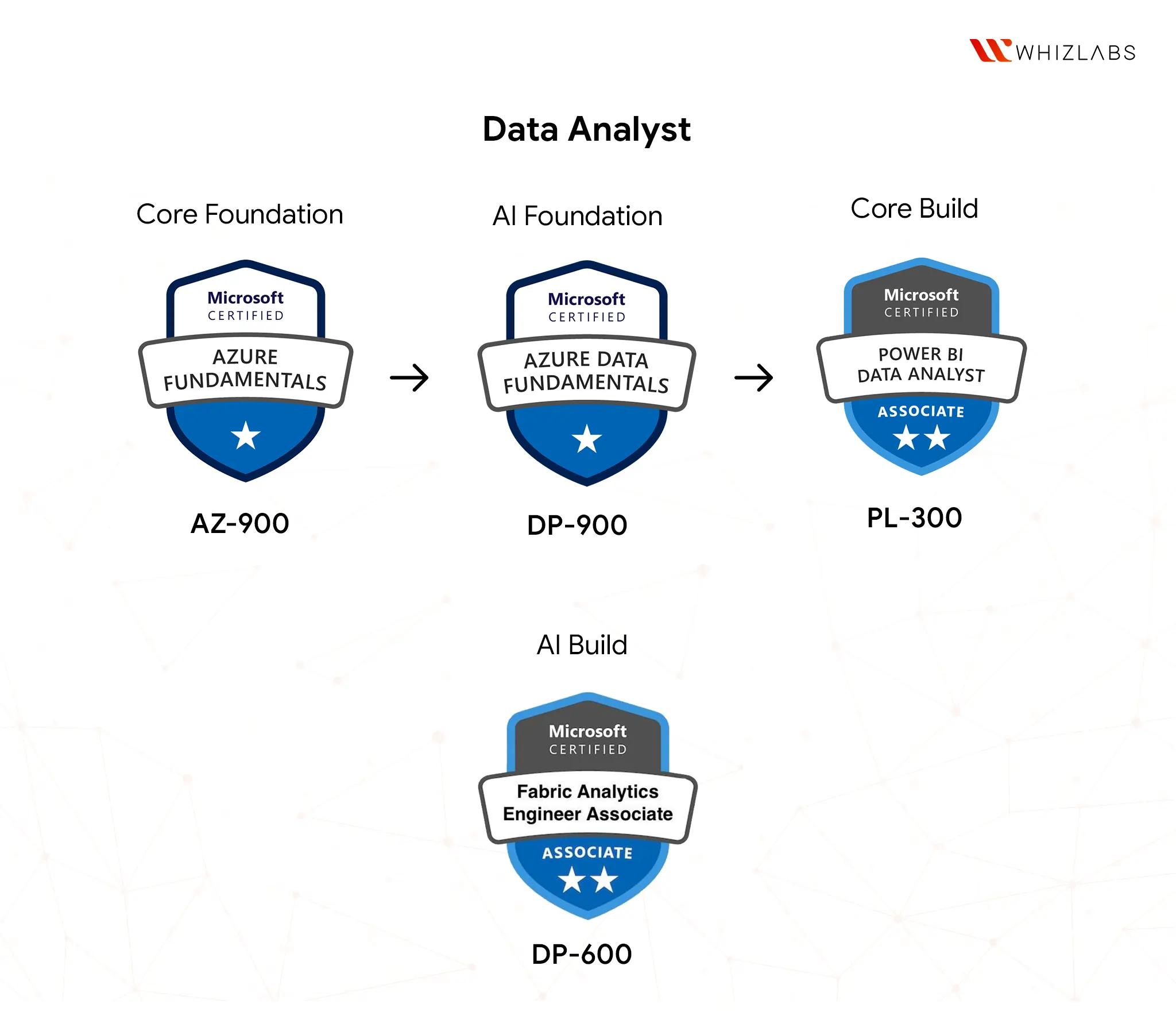
Organisations today don’t just want dashboards. They want trusted data pipelines, governed lakehouses, and architectures that scale with AI. This Azure learning path takes you from business-facing analytics to deep engineering and finally to enterprise data architecture. It is one of the most future-proof data career paths on Azure.
This progressive journey starts with insights, moves into data engineering and ends with architecture and governance.
| 4. Data Analyst → Data Engineer → Data Architect Journey | ||||
|
Stage |
Category | Exam Code | Certification Name |
Primary Learning Focus |
| Core Foundation | Fundamental | AZ-900 | Microsoft Azure Fundamentals | Understand Azure, cloud concepts, and where data services live. |
| Data Foundation | Fundamental | AI-900 | Microsoft Azure Data Fundamentals | Understand relational vs analytical data and basic data workloads. |
| Build | Associate | PL-300 | Microsoft Power BI Data Analyst | Model data and deliver insights using Power BI, DAX, and semantic models. |
| Build | Associate | DP-300 | Azure Database Administrator Associate | Design, optimise, and operate SQL databases for performance and reliability. |
| Analytics | Associate | DP-600 | Microsoft Fabric Analytics Engineer Associate | Build lakehouse-based analytics using Microsoft Fabric (OneLake, Spark, Warehouses, Pipelines). |
| Advance | Associate | DP-700 | Microsoft Fabric Data Engineer Associate | Design enterprise-scale Fabric architectures, governance, and multi-workload analytics. |
| Advance | Expert (Optional) | AZ-305 | Microsoft Azure Solutions Architect Expert | Design end-to-end, secure, scalable data architectures aligned with business requirements. |
Stage 1: AZ-900 Microsoft Azure Fundamentals (Core Cloud Foundation)
Before entering data tools, you must understand where data lives in Azure. The AZ 900 teaches you Core cloud concepts, Azure data services landscape, Cost, security, and governance basics that shape data decisions. This prevents tool-first thinking and builds architectural awareness early.
The AZ-900 certification is a mandatory foundation for all Azure data roles and certifications like DP-900, PL-300, DP-300, and Fabric certifications.
Stage 2: DP-900 Microsoft Azure Data Fundamentals (Data Foundation)
DP-900 gives you data literacy, not engineering depth. It is an important step. Candidates learn Relational vs non-relational data, OLTP vs analytics workloads and when to use SQL, NoSQL, or analytics services.
This helps analysts and engineers speak the same data language. For which the DP 900 certification focuses on the following primary domains
- Core data concepts
- Relational and non-relational data
- Analytics workloads
There are no particular Prerequisites for taking the DP 900 certification. And with the cert, you can explore Job Roles like Data Analyst (Entry-Level), BI Associate and Junior Data Engineer. The global market states the salary range between $70,000–$95,000.
This is an essential accreditation for analytics and engineering paths and a very common prerequisite for enterprise data roles.
Stage 3: PL-300 Microsoft Power BI Data Analyst (Analytics Build)
The PL-300 is where data becomes decisions. You get to understand how Model data uses Power BI, write DAX, build semantic models and deliver executive-ready dashboards.
This certification is highly valued because it connects data to business outcomes. Focusing on the Primary Domains such as
- Data modeling
- DAX calculations
- Visualisation and reporting
- Analytics governance
You will need Basic data concepts and familiarity with Excel or reporting tools to take this certification.
Job Roles like Data Analyst, Business Intelligence Analyst and Reporting Analyst are applicable with a salary range between $85,000–$120,000+, which is possible.
Stage 4: DP-300 Azure Database Administrator Associate (Data Platform Core)
Understanding databases deeply makes you far more effective as a data engineer. The DP 300 certification is the bridge from analytics to engineering, which teaches you how to:
- Design and manage SQL databases
- Optimize performance
- Implement security, backup, and HA/DR
The certification’s Primary focus is
- Database design and deployment
- Security and access control
- Performance tuning
- High availability and disaster recovery
SQL knowledge and Basic Azure experience are recommended as prerequisites for the DP 300 certification.
Database Administrator, Data Engineer (Junior), and Data Platform Engineer roles are applicable with DP 300 with a salary ranging between $95,000–$140,000+.
This DP 300 certification is an in-demand and highly valuable certification for hybrid and enterprise environments. And it’s a key stepping stone to data engineering roles.
Stage 5: DP-600 Microsoft Fabric Analytics Engineer Associate (Modern Analytics)
DP-600 reflects the biggest shift in Microsoft’s data strategy and aligns directly with modern data platforms. Here, you get to explore how to build
- Build lakehouse architectures
- Use OneLake, Spark, Warehouses, and Pipelines
- Deliver analytics at scale using Microsoft Fabric
The Primary Domains of DP 600 Certifications are
- Lakehouse architecture
- Data ingestion and transformation
- Analytics pipelines
- Governance and security in Fabric
Prerequisites include
- PL-300 or DP-300 recommended
- Understanding of analytics workflows
Analytics Engineer, Fabric Engineer and Modern BI Engineer are the roles you can march to with DP 600 certification, with a salary ranging between $110,000–$160,000+.
This highly in-demand certification has an impact on your profile for its Fabric adoption, and it strongly aligns with AI and GenAI analytics.
Stage 6: DP-700 Microsoft Fabric Data Engineer Associate (Enterprise Data Engineering)
With DP 700 certification, engineering gets more serious; it validates your ability to design enterprise-grade data systems. End-to-end data lifecycle management. This is the core data engineering certification in the Azure ecosystem.
The major focus of the certification lies on
- Multi-workload Fabric architectures
- Governance and security
- Performance at scale
DP 700 Primary Domains
- Enterprise data architecture
- Governance and security
- Performance optimization
- Multi-domain analytics workloads
Prerequisites for DP 700
- Strong data engineering fundamentals
- Experience with Fabric or Azure data services
Data Engineer, Senior Analytics Engineer and Platform Data Engineer are the roles you get with DP 700.
This is one of the highest-paying data certifications (salary range between $130,000–$190,000+), with a strong demand across AI-first organisations.
Stage 7: AZ-305 Azure Solutions Architect Expert (Optional Data Architect)
If you want to design data platforms, not just build them, AZ-305 completes the journey. The certification explores
- Design secure, scalable data architectures
- Balance cost, performance, and governance
- Align data platforms with business strategy
Whose Primary Domains focus on Architecture design, Security and governance, Reliability and scalability and Cost optimisation
Data Architect, Cloud Architect and Enterprise Solutions Architect are a few roles you unlock with a salary between $150,000–$220,000+.
Azure Data Learning Career Mapping Summary
- Data Analyst: AZ-900 → DP-900 → PL-300 → DP-600 (Optional)
- Data Engineer: DP-900 → DP-300 → DP-700
- Data Architect: DP-900 → DP-600 → DP-700 (+ AZ-305 optional)
Why Azure Data Path can be your learning choice in 2026?
This learning path aligns with Microsoft Fabric adoption, gets you AI-ready analytics platforms, meets Enterprise data governance needs, and it’s obviously one of the High-paying, long-term data roles.
If your goal is to stay relevant as data, analytics, and AI converge, this Azure data learning path is one of the smartest investments you can make.
Data Scientist Journey
Enterprises today don’t just hire data scientists to experiment. They expect production-ready models, governed ML workflows, and real business impact. This Azure Data Scientist learning path is built for just one thing: turning data into deployable intelligence.
You move from data fundamentals → machine learning → real-world ML deployment on Azure.
| 5. Data Scientist Journey | ||||
| Stage | Category | Exam Code | Certification Name | Primary Learning Focus |
| Start | Fundamental | AZ-900 | Azure Fundamentals | Cloud concepts and where data & ML workloads run in Azure |
| Start | Fundamental | DP-900 | Azure Data Fundamentals | Relational vs non-relational data, analytics vs transactional workloads |
| Build | Fundamental (Optional but made value) | AI-900 | Azure AI Fundamentals | Core ML, NLP, computer vision concepts; prebuilt vs custom models |
| Build | Associate | DP-100 | Azure Data Scientist Associate | Train, evaluate, tune, and deploy ML models using Azure Machine Learning |
| Advance | Associate (Optional but made value) | AZ-204 | Azure Developer Associate | Package models into APIs, integrate ML into applications |
| Advance | Expert (Optional) | AZ-400 | DevOps Engineer Expert | MLOps, CI/CD for ML, monitoring, retraining pipelines |
Stage 1: AZ-900 Azure Fundamentals (Cloud Foundation for Data Science)
Before building models, you must understand where ML runs, scales, and costs money. This certification has no prerequisites, but the foundation for Data and ML roles. It also helps non-cloud data scientists transition to Azure.
Stage 2: DP-900 Azure Data Fundamentals (Data Literacy)
With strong data intuition, you get to lead better feature engineering and model design. DP-900 sharpens your data intuition. Deep dives and clarifications between Relational and non-relational data, Transactional and analytics workloads and when to use SQL, NoSQL, or analytics platforms.
The Primary Domains focused on the DP 900 area
- Core data concepts
- Relational and non-relational data
- Analytics workloads
There is no Prerequisite for this certification.
Candidates get to explore Job Roles like Data Analyst, Junior Data Scientist and ML Support Engineer with a salary range between $70,000 and $95,000
This certification is often expected in enterprise ML roles. It improves collaboration with data engineers.
Stage 3: AI-900 Azure AI Fundamentals (Optional but High-Value)
AI-900 builds the conceptual ML clarity, and not coding depth. You get to understand
- Machine learning fundamentals
- NLP and computer vision use cases
- Prebuilt AI services vs custom ML models
This helps you choose the right ML approach, not just train models blindly. The Primary Domains include
- AI workloads
- Machine learning principles
- Computer vision, NLP, generative AI basics
With the certification, you land in job roles like AI Analyst, ML Associate, and AI Product Support Roles with a salary between $80,000–$110,000.
This certification is a strong signal of AI literacy, and it’s helpful for business-facing data scientists.
Stage 4: DP-100 Azure Data Scientist Associate (Core ML Certification)
This is the Heart of the Data Scientist Path. DP-100 is the defining Azure Data Scientist certification. Here you learn how to:
- Prepare data for ML
- Train, evaluate, and tune models
- Use Azure Machine Learning
- Deploy and monitor models in production
It proves you can operationalise ML, not just experiment, focusing on the Primary Domains.
- Data preparation and feature engineering
- Model training and evaluation
- Azure Machine Learning workflows
- Model deployment and monitoring
Python knowledge, ML fundamentals and Familiarity with data science workflows are the prerequisites.
Data Scientist, Machine Learning Engineer (Junior) and Applied AI Engineer are a few job roles you get to access with a salary of $120,000–$180,000+
This is one of the most respected ML certifications on Azure and is frequently listed in enterprise job descriptions.
Stage 5: AZ-204 Azure Developer Associate (Optional but Powerful)
AZ-204 teaches you to ship ML models as products. Here you learn how to:
- Build APIs around models
- Integrate ML into applications
- Use containers, services, and authentication
This step separates research data scientists from production-ready ML engineers.
Primary Domains include
- Application development
- APIs and services
- Containers and deployment
- Security and monitoring
Prerequisites include Programming experience (Python, C#, or JavaScript) and Azure basics.
Job Roles with AZ 204 certification
- Machine Learning Engineer
- Applied Data Scientist
- AI Application Developer
Makes you cross-functional and harder to replace. The global market standards claim a salary range between $130,000–$190,000+.
Stage 6: AZ-400 DevOps Engineer Expert (Optional)
AZ-400 is applicable for data scientists who want scale and reliability. Professionals get access to Premium roles with leadership responsibility, which is in high demand in AI-first organisations.
Career Progression in the Data Scientist Journey
- Entry-Level Data Scientist: AZ-900 → DP-900 → AI-900
- Applied Data Scientist: DP-100
- ML Engineer: DP-100 → AZ-204
- Senior / MLOps Engineer: DP-100 → AZ-204 → AZ-400
Why Does the Azure Data Scientist Path Work for You?
As your data scientist goal aligns with Enterprise-grade ML expectations, Azure Machine Learning adoption, AI governance and compliance and Production-focused data science roles.
If your goal is to move to become a high-impact, production-ready data scientist, this Azure learning path is exactly where you should invest.
Microsoft Identity & Security Engineer Career Path
Microsoft’s Identity & Security track is built around Zero Trust architecture, Microsoft Entrance ID, Defender suite, Purview, and Azure security services. This roadmap moves from foundational understanding to enterprise-level cybersecurity architecture. Each stage builds on real-world implementation skills.
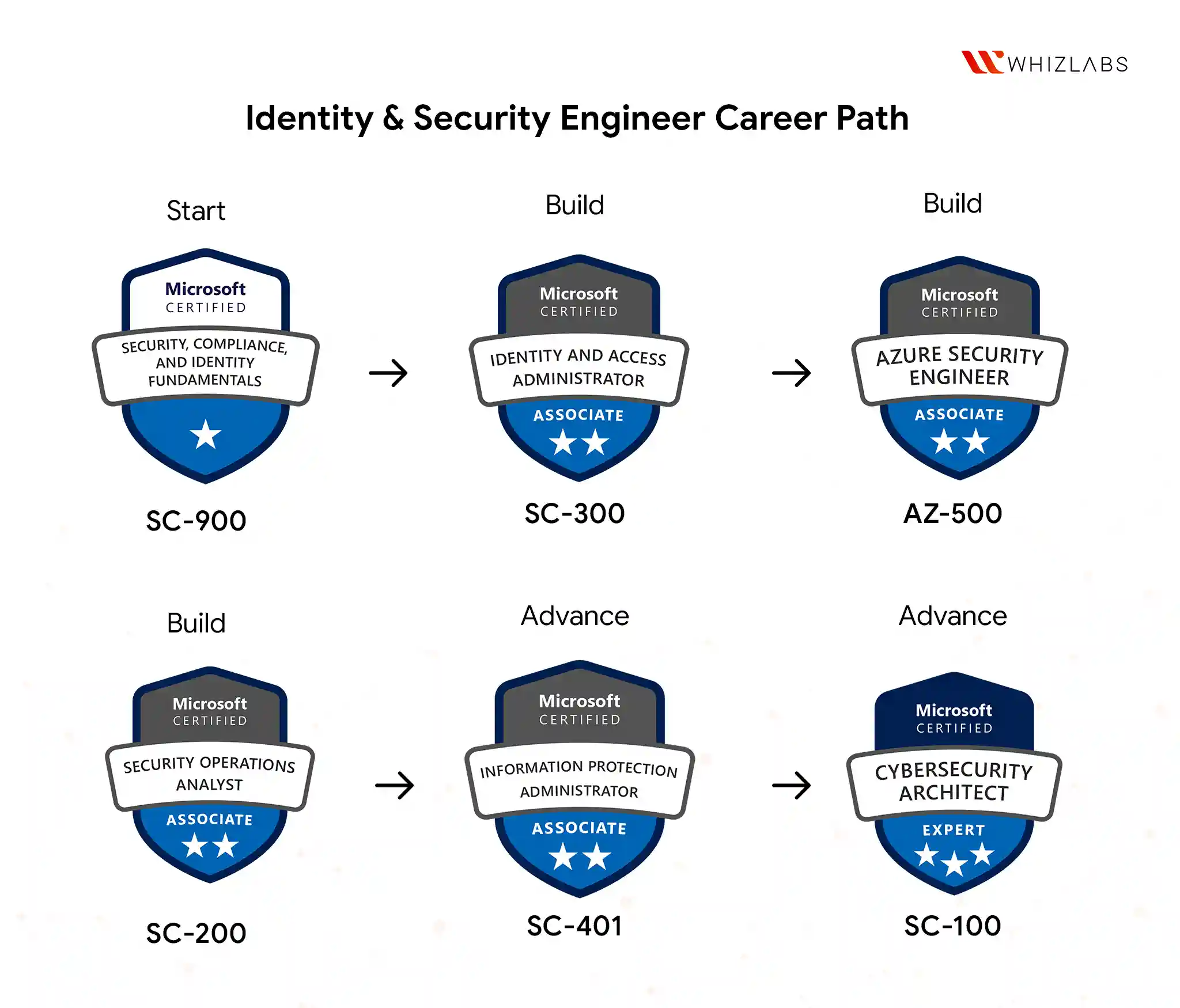
| 6. Identity & Security Engineer Career Path | ||||
|
Stage |
Category | Exam Code | Certification Name |
Primary Focus / Products |
| Start | Fundamental | SC-900 | Microsoft Security, Compliance & Identity Fundamentals | Zero Trust concepts, identity, security, and compliance across the Microsoft cloud |
| Build | Associate | SC-300 | Microsoft Identity & Access Administrator Associate | Entra ID, Conditional Access, MFA, PIM, Identity Governance |
| Build | Associate | AZ-500 | Microsoft Azure Security Engineer Associate | Defender for Cloud, Key Vault, NSGs, Azure Firewall, workload & data security |
| Build | Associate | SC-200 | Microsoft Security Operations Analyst Associate | Microsoft Sentinel, Microsoft Defender, threat detection & incident response |
| Advance | Associate | SC-401 | Microsoft Information Protection & Compliance Administrator Associate | Microsoft Purview, DLP, sensitivity labels, insider risk |
| Advance | Expert | SC-100 | Microsoft Cybersecurity Architect Expert | End-to-end security architecture, Defender, Purview, Zero Trust strategy |
Stage 1: SC-900 Microsoft Security, Compliance & Identity Fundamentals
Builds conceptual clarity around identity-first security. This certification establishes credibility in Microsoft cloud security discussions.
Primary Domains Covered in Security Foundations (SC-900)
- Zero Trust principles
- Microsoft Entrance ID fundamentals
- Security, compliance, and governance in the Microsoft cloud
- Microsoft Defender basics
- Identity protection concepts
No formal prerequisite. This SC 900 certification is designed for beginners or non-technical stakeholders entering cloud security.
IT Support Engineer, Security Analyst (Entry-level), Cloud Administrator (Junior) and Governance/Compliance Associate are job openings with salaries between $65,000–$85,000 annually (entry-level roles) for candidates with SC 900 certification.
Zero Trust adoption across enterprises adds up to the demand, and this certification is often a must-have baseline certification for Microsoft security roles.
Stage 2: SC-300 – Microsoft Identity & Access Administrator Associate
This certification moves you from conceptual knowledge to real IAM enforcement. Validates your skillset to take up hands-on management of enterprise access controls.
Primary Domains Covered in Identity & Access Control (SC-300)
- Microsoft Entra ID administration
- Conditional Access policies
- Multi-Factor Authentication (MFA)
- Privileged Identity Management (PIM)
- Identity Governance & lifecycle management
SC-900 is recommended but not mandatory all the time. However, basic knowledge of Azure Active Directory and cloud identity concepts is required.
Target Job Roles include
- Identity Administrator
- IAM Engineer
- Azure Identity Specialist
- Security Administrator
With a salary range between $85,000–$115,000 (Identity/IAM roles)
Identity is the control plane of modern security. SC-300 is considered one of the most job-aligned Microsoft certifications.
Stage 3 – AZ-500 Microsoft Azure Security Engineer Associate
The certification validates your ability to secure cloud workloads at scale.
Primary Domains Covered in Cloud Security Engineering (AZ-500)
- Microsoft Defender for Cloud
- Azure Key Vault
- Network Security Groups (NSGs)
- Azure Firewall
- Workload and data protection
- Cloud threat mitigation
Hands-on Azure experience with a strong understanding of Azure fundamentals is a must.
AZ-500 Certification moves your career into high-responsibility cloud security roles like Azure Security Engineer, Cloud Security Engineer and DevSecOps Engineer. With a salary ranging between $100,000–$130,000+
These roles are critical for companies migrating workloads to Azure. The Certification is directly aligned with cloud adoption growth.
Stage 4: SC-200 Microsoft Security Operations Analyst Associate
This certification prepares professionals for real-time detection and response roles. Moves you into operational security environments.
Primary Domains Covered in Security Operations & Detection (SC-200)
- Microsoft Sentinel (SIEM)
- Microsoft Defender suite
- Threat detection & incident response
- Log analytics & KQL
- Security automation workflows
Security fundamentals + familiarity with Entra ID and Defender is a good prerequisite.
This certs better targets Job roles like SOC Analyst, Security Operations Engineer and Threat Hunter with a salary ranging between $95,000–$120,000.
There is a good market and demand for the increasing ransomware and AI-driven attack vectors in 2025.
Stage 5: SC-401 Microsoft Information Protection & Compliance Administrator Associate
This certification aligns with security and regulatory frameworks (GDPR, HIPAA, ISO). Critical for enterprises handling sensitive data.
Primary Domains in Information Protection & Compliance (SC-401)
- Microsoft Purview
- Data Loss Prevention (DLP)
- Sensitivity labels
- Insider risk management
- Data governance
To attempt this certification, you must have experience in compliance, governance, or security operations.
This certification takes you to roles like Compliance Administrator, Data Protection Officer and Information Governance Analyst with a salary ranging between $100,000–$135,000.
This accreditation is rapidly growing with AI data governance challenges and compliance enforcement in the market.
Stage 6: SC-100 Microsoft Cybersecurity Architect Expert
Get to position yourself as a decision-maker, validating your ability to design enterprise-scale security frameworks with SC 100
Cybersecurity Architecture Leadership (SC-100) covers the following Domains.
- End-to-end security architecture
- Defender + Purview integration
- Zero Trust design strategy
- Identity-first security models
- Multi-cloud security alignment
This expert certification requires Associate-level security certifications (SC-300, AZ-500, SC-200) strongly.
The cert provides you with the opportunity to earn between $130,000–$180,000+, in job roles like Cybersecurity Architect, Enterprise Security Architect, Security Strategy Lead and CISO Track Candidate.
Extremely high in demand as of 2026, as organisations shift toward Zero Trust and AI-driven security governance.
Why Does the Security Career Path in Azure Matter in 2026?
Microsoft’s security ecosystem (Entra ID, Defender, Sentinel, Purview) is deeply integrated. This path:
- Builds identity-first security expertise
- Covers detection, governance, and architecture
- Aligns with Zero Trust strategy
- Supports enterprise cloud transformation
- Prepares professionals for AI-augmented security roles
Microsoft Cybersecurity Learning Path
Cybersecurity in 2026 is about going beyond perimeter defence. It is identity-first, cloud-native, AI-aware, and Zero Trust-driven.
The Microsoft Security certification path is a structured learning path for professionals, from foundational security awareness to enterprise-level cybersecurity architecture. It covers identity, cloud workloads, threat detection, compliance, and AI risk management.
| 7. CyberSecurity Learning Path | ||||
|
Stage |
Category | Exam Code | Certification |
Primary Learning Focus |
| Core Foundation | Fundamental | SC-900 | Microsoft Security, Compliance & Identity Fundamentals | Security concepts, Zero Trust principles, identity, compliance, and risk awareness |
| Build | Associate | SC-300 | Microsoft Identity & Access Administrator Associate | Secure identities using Entra ID, Conditional Access, MFA, PIM, and identity governance |
| Build | Associate | AZ-500 | Microsoft Azure Security Engineer Associate | Secure Azure workloads: Defender for Cloud, Key Vault, network security, data protection |
| Build | Associate | SC-200 | Microsoft Security Operations Analyst Associate | Threat detection, investigation, and response using Microsoft Sentinel and Defender |
| Advance | Expert | SC-100 | Microsoft Cybersecurity Architect Expert | Design end-to-end Zero Trust security architecture across identity, cloud, data, endpoints, and AI |
| Advance | Associate (Optional) | SC-401 | Microsoft Information Protection & Compliance Administrator Associate | Data classification, DLP, insider risk, eDiscovery, compliance controls |
Foundation → Identity Security → Cloud Security → Security Operations → Architecture
Stage 1 – SC-900 Microsoft Security, Compliance & Identity Fundamentals
This certification introduces security from a strategic lens. It focuses on understanding how identity, compliance, and risk interconnect in modern cloud environments.
Primary Domains Security & Identity Fundamentals (SC-900)
- Zero Trust security model
- Identity & access management fundamentals
- Microsoft Defender ecosystem overview
- Compliance, risk, and governance basics
- Security across Microsoft 365 and Azure
No technical prerequisite. This certification is Ideal for beginners, business professionals, IT support staff, or career switchers entering cybersecurity.
Candidates with this certificate canTarget Job Roles like
- Security Support Associate
- IT Administrator
- Risk & Compliance Analyst
- Cloud Support Engineer
SC-900 builds foundational credibility. It signals awareness of Zero Trust and Microsoft’s security ecosystem, which is essential for anyone entering cloud security roles. For entry-level roles, the salary ranges between $65,000–$85,000. We should also account for the market value, which is growing as more organisations mandate security literacy across IT teams.
Stage 2 –SC-300 Microsoft Identity & Access Administrator Associate
Identity is the new perimeter. SC-300 prepares professionals to secure digital identities, manage role-based access, and enforce access control policies.
Primary Domains in Identity & Access Security Specialist (SC-300)
- Microsoft Entra ID (Azure AD) architecture
- Conditional Access policies
- Multi-Factor Authentication (MFA)
- Privileged Identity Management (PIM)
- Identity Governance & lifecycle management
Basic understanding of Azure and Microsoft 365 administration is helpful, and SC 900 certification is recommended.
IAM specialists remain one of the most stable and future-proof roles in cybersecurity. Along with that
- Identity & Access Administrator
- IAM Engineer
- Entra ID Specialist
- Security Operations Engineer (Identity-focused)
There are a few job roles you can land with SC 300 certification, whose salary can range between $90,000–$120,000.
The SC-300 certification is highly valuable because identity breaches are the most common entry point for cyberattacks. This certification positions professionals in high-demand IAM roles.
Stage 3: AZ-500 Microsoft Azure Security Engineer Associate
This certification focuses on protecting Azure environments in instances like workloads, applications, storage, and networking layers.
SC-300 knowledge enhances understanding of identity integration, so experience with Azure administration is recommended.
Primary Domains in Azure Workload Security Engineer (AZ-500)
- Microsoft Defender for Cloud
- Azure Key Vault and encryption
- Network Security Groups (NSGs) & Azure Firewall
- Workload security & cloud-native threat protection
- Data security & secure infrastructure design
Explore Job roles as follows with AZ 500 certification, and earn between $100,000–$135,000
- Azure Security Engineer
- Cloud Security Engineer
- DevSecOps Engineer
- Cloud Infrastructure Security Specialist
AZ-500 validates real cloud security capability. Cloud security engineers are critical to workload protection and regulatory compliance. As multi-cloud adoption accelerates, Azure security engineers are in consistent demand.
Stage 4: SC-200 Microsoft Security Operations Analyst Associate
The SC-200 certification prepares professionals to detect, investigate, and respond to security incidents using Microsoft’s security operations ecosystem.
Primary Domains in Security Operations & Threat Detection (SC-200)
- Microsoft Sentinel (SIEM)
- Microsoft Defender XDR
- Threat detection and hunting
- Incident response workflows
- Security analytics and automation
Have a better understanding of identity and cloud security fundamentals, recommended (SC-300, AZ-500).
Targeted Job Role Includes
- SOC Analyst
- Threat Hunter
- Incident Response Engineer
- Security Operations Specialist
This certification builds real-world SOC skills. As cyber threats grow more AI-driven, security analysts with automation knowledge are increasingly valuable.
Stage 5 – SC-100 – Microsoft Cybersecurity Architect Expert
SC-100 is the expert-level certification that validates your ability to design comprehensive security architectures across hybrid and cloud environments.
Primary Domains in Cybersecurity Architect (SC-100)
- Zero Trust enterprise architecture
- Identity, cloud, data, and endpoint security integration
- Microsoft Defender and Purview strategy
- AI risk governance and compliance
- End-to-end enterprise security design
Real-world architecture experience with Associate-level certifications (SC-300, AZ-500, SC-200) are the prerequisites for this certification
With this certification, you can target high-profile roles whose salary ranges between $140,000–$190,000+.
- Cybersecurity Architect
- Enterprise Security Architect
- Chief Security Architect
- Cloud Security Strategy Lead
This certification elevates professionals into strategic architecture roles. It signals the ability to design security across identity, cloud, data, endpoints, and AI.
Stage 6 – SC-401 Microsoft Information Protection & Compliance Administrator Associate
Data governance and compliance expertise are becoming mandatory in enterprise AI and cloud adoption strategies. This is an option; the certificate focuses on protecting sensitive data and managing regulatory compliance.
Primary Domains in Compliance & Data Protection Specialization (SC-401)
- Microsoft Purview
- Data Loss Prevention (DLP)
- Sensitivity labels
- Insider risk management
- eDiscovery and compliance controls
SC-900 recommended. Experience with Microsoft 365 compliance tools is beneficial.
Target Job Roles like
- Compliance Administrator
- Data Protection Officer
- Information Governance Specialist
- Risk & Audit Analyst
The salary ranges between $95,000–$130,000 for professionals with SC 401.
With the expanding regulatory frameworks globally, compliance-focused security professionals are increasingly valuable.
Why Does This Cybersecurity Path Matter Today?
Cybersecurity is evolving towards Identity-first architecture, AI-aware threat detection, Cloud-native workload protection, Compliance-driven governance, and Zero Trust enterprise strategy.
Organisations are prioritising professionals who can secure Identities (Entra ID), Cloud workloads (Azure), Security operations (Sentinel), Data governance (Purview) and Enterprise architecture (SC-100).
This roadmap chronologically builds that capability.
Microsoft Power Platform Engineer / Architect Career Path
The Microsoft Power Platform ecosystem, including Power Apps, Power Automate, Power BI, Dataverse, and Copilot integrations. It is evolving into a core enterprise automation and AI-enabled stack.
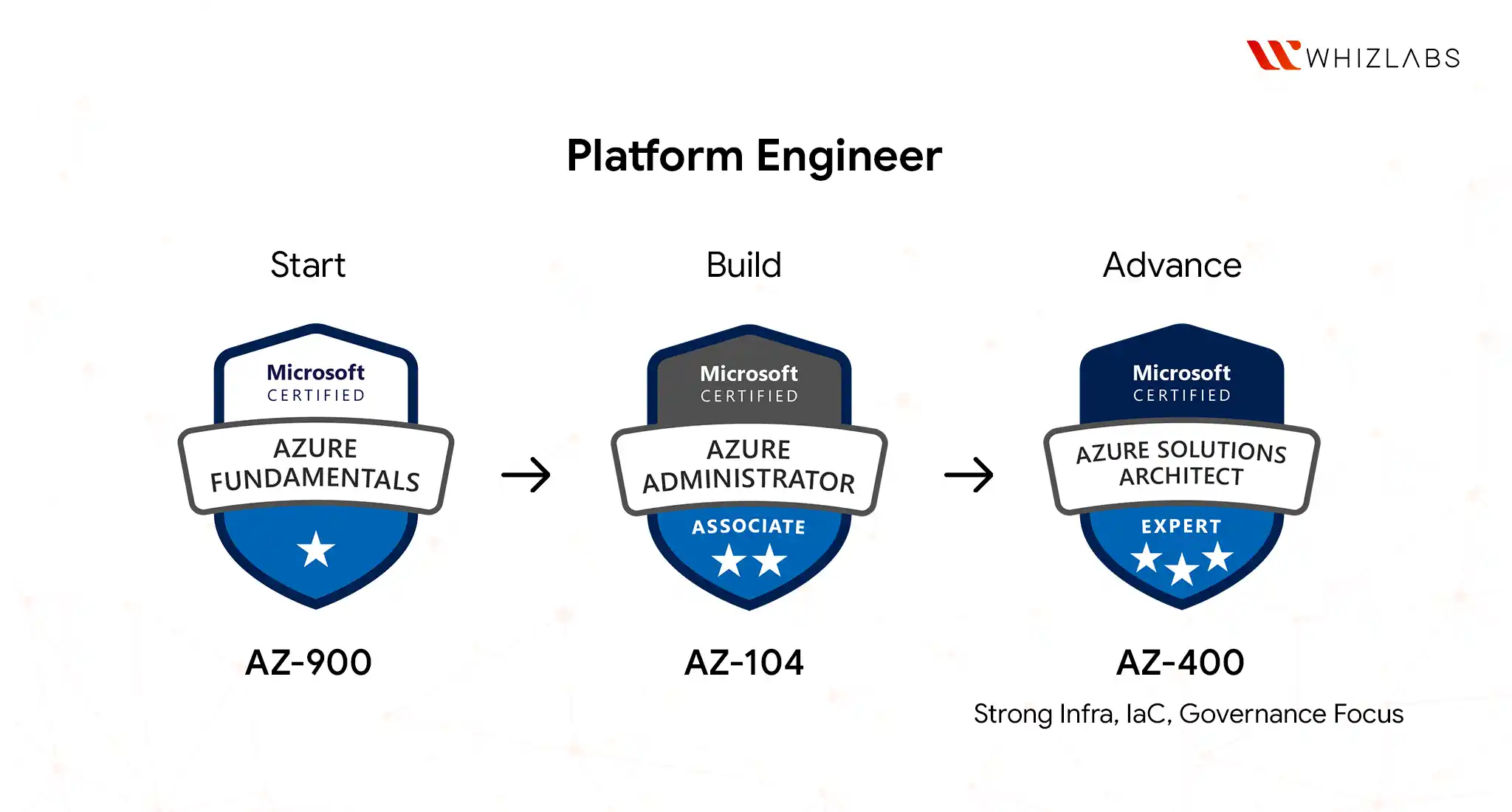
This shared roadmap takes you from fundamentals to enterprise-level solution architecture.
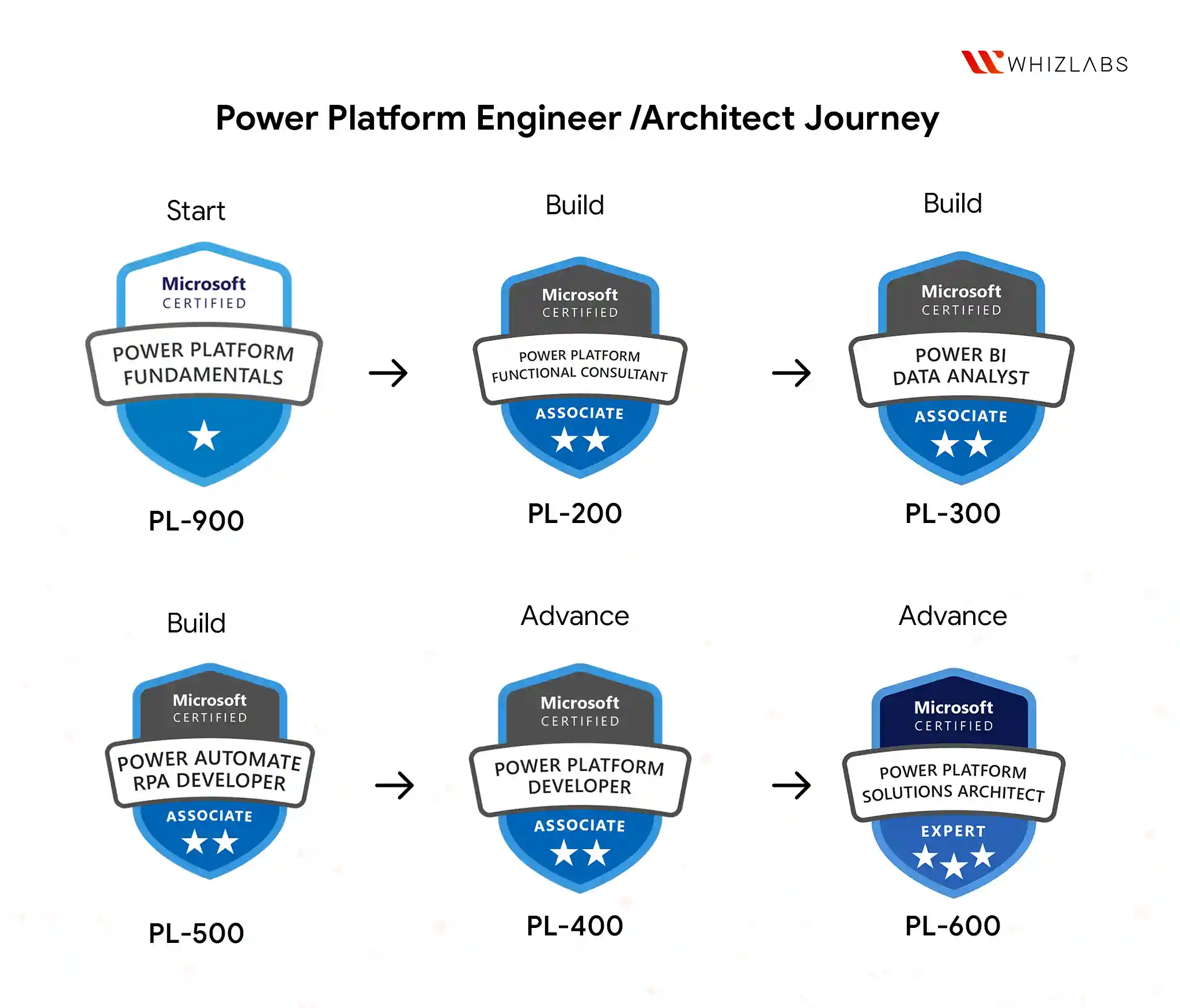
| 8. Power Platform Engineer /Architect Journey | ||||
|
Stage |
Category | Exam Code | Certification Name |
Primary Learning Focus |
| Start | Fundamental | PL-900 | Microsoft Power Platform Fundamentals | Power Apps, Power Automate, Power BI, Dataverse basics and business use cases |
| Build | Associate | PL-200 | Power Platform Functional Consultant Associate | Translate business requirements into Power Platform solutions using Dataverse |
| Build | Associate | PL-300 | Power BI Data Analyst Associate | Data modelling, DAX, reports, dashboards, and analytics |
| Build | Associate | PL-500 | Power Automate RPA Developer Associate | Build desktop flows, attended/unattended RPA, and legacy system automation |
| Advance | Associate | PL-400 | Power Platform Developer Associate | Extend Power Platform with code (C#, JavaScript, plugins, custom connectors) |
| Advance | Expert | PL-600 | Power Platform Solution Architect Expert | Enterprise solution design, governance, security, ALM, integrations |
Stage 1: PL-900 Microsoft Power Platform Fundamentals
The Pl 900 certifications build a foundational understanding of how low-code platforms drive digital transformation and AI-assisted workflows.
The Foundation Level PL-900 exam focuses on the following Primary Domains
- Power Apps (Canvas vs Model-driven apps
- Power Automate basics
- Power BI fundamentals
- Dataverse overview
- Business automation use cases
- Copilot capabilities across Power Platform
There is no prerequisite for PL 900 certification. It is suitable for beginners, business analysts, and IT professionals entering low-code automation.
This certification navigates you to roles like Business Analyst, Citizen Developer, Junior Power Platform Developer and Process Automation Associate with a salary ranging between $65,000–$85,000.
Microsoft 365 + Copilot integration adoptions are high across SMBs and Enterprises, creating high demand for professionals with credible Microsoft Power Platform skills.
Stage 2: PL-200 Power Platform Functional Consultant Associate
The certification enables professionals to translate business requirements into scalable Power Platform solutions.
Primary Domains covered in Functional Solution Design (PL-200)
- Requirements gathering
- Dataverse table design
- Business process flows
- Security roles & governance
- Integration with Microsoft 365 & Azure services
PL-900 is recommended before taking PL 200, which gives you a better understanding of Dataverse and automation workflows.
The certification helps you align with job roles like Power Platform Functional Consultant, Low-Code Solution Designer and Automation Consultant with a salary of $85,000–$110,000.
Enterprises are shifting to low-code automation to reduce development backlog, and this certification is the best way for you to log your capabilities in this niche.
Stage 3: PL-300 Power BI Data Analyst Associate
The PL 300 certification establishes your credibility in enterprise analytics and data-driven decision-making.
The Data & Analytics Specialist (PL-300) collides the following Primary Domains
- Data modelling & star schema
- DAX (Data Analysis Expressions)
- Data ingestion & transformation
- Report & dashboard design
- Governance & workspace security
You will need prior experience with data analysis, recommended, and PL-900 is helpful but not mandatory.
This combination certification earns you roles like Power BI Developer, Data Analyst and Business Intelligence Engineer, whose salary range between $90,000–$120,000 as Power BI is one of the in-demand Microsoft tools today.
Stage 4: PL-500 Power Automate RPA Developer Associate
RPA + AI automation demand continues to rise as companies want to reduce operational costs. The PL 500 certification positions you as a specialist in robotic process automation for enterprise operations.
Primary Domains Automation & RPA Specialist (PL-500)
- Desktop flows (attended/unattended RPA)
- Legacy system automation
- AI Builder integration
- Process optimization
- Automation governance
Basic understanding of Power Automate and basic scripting is good to have. And with the certification, you can target roles like
RPA Developer, Automation Engineer and Process Optimisation Specialist whose salary ranges between $95,000–$125,000.
Stage 5: PL-400 Power Platform Developer Associate
Move beyond configuration to development-level customisations and enterprise integration with PL 400 certification.
The Primary Domains covered in Developer-Level Extension (PL-400)
- C# plugins
- JavaScript customization
- Custom connectors
- API integrations
- ALM (Application Lifecycle Management)
- Advanced Dataverse configurations
The certification requires Hands-on Power Platform development experience.
You can target job roles like
- Power Platform Developer
- Low-Code Engineer
- Integration Engineer
This is a critical role n in larger enterprises and secure integration is required, and a salary range between $100,000–$135,000.
Stage 6: PL-600 Power Platform Solution Architect Expert
The Enterprise Architecture Leadership (PL-600) certification covers Primary Domains such as
- Enterprise solution design
- Governance & security architecture
- Data strategy with Dataverse
- Integration patterns (Azure, Dynamics 365)
- ALM strategy
- Compliance and scalability planning
Associate-level certifications like PL-200, PL-400, and PL-300 are recommended.
You can target job roles like Power Platform Solution Architect, Enterprise Automation Architect and Digital Transformation Architect whose salary can scale from $130,000 to $180,000+.
This certification validates leadership-level expertise in designing secure, scalable, enterprise-grade Power Platform solutions.
Why does the Microsoft Power Platform Engineer career path matter in 2026?
Power Platform is gone, just being“low-code.” Its abilities are wider and can now integrate Microsoft Copilot, AI Builder, Azure services and Enterprise governance frameworks.
The future skillset is not just building apps but designing secure, scalable, AI-augmented automation ecosystems.
2026 Hiring Trends for Power Platform Professionals
- Low-code developers are the fastest-growing tech roles.
- Enterprises prioritise governance-first automation.
- Copilot integration is increasing the demand for AI-aware architects.
Business + AI Leader Certification Path
AI leadership in 2026 is all about understanding cloud economics, AI governance, Copilot orchestration, risk management, and enterprise automation strategy.
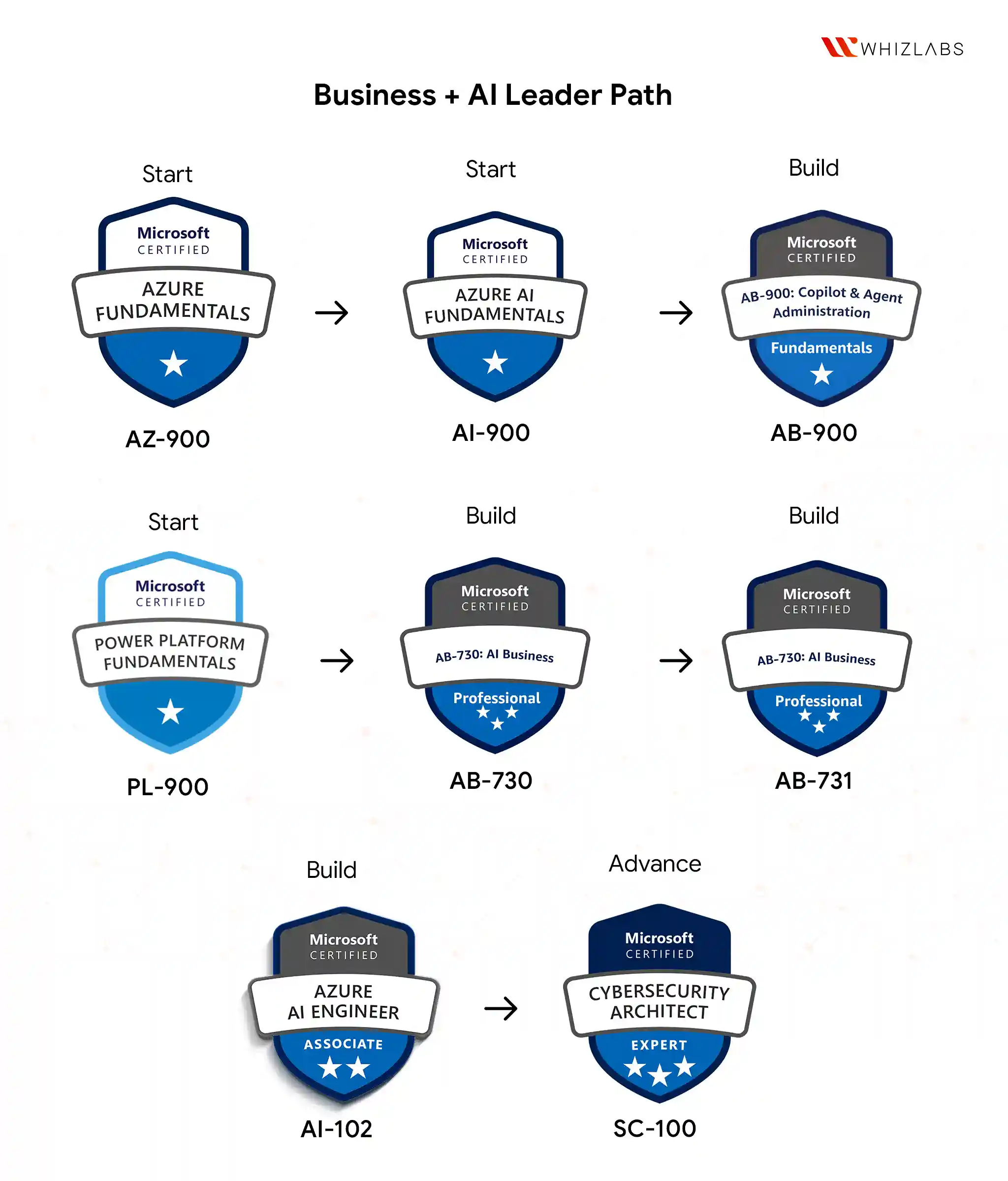
This roadmap is specifically designed for:
- CIOs & IT Directors
- Digital Transformation Leaders
- AI Product Managers
- Enterprise Architects
- Business Technology Leaders
This transitions professionals from:
Cloud Awareness → AI Literacy → Copilot Strategy → Enterprise AI Governance
Building leadership credibility in one of the fastest-growing domains in enterprise technology.
| 9. Business + AI Leader Path | ||||
| Stage | Category | Exam Code | Certification | Primary Learning Focus |
| Start | Fundamental | AZ-900 | Azure Fundamentals | Cloud concepts, cost models, scalability, and business value of cloud |
| Start | Fundamental | AI-900 | Azure AI Fundamentals | AI, ML, and Generative AI concepts; business use cases and limitations |
| Build | Fundamental | AB-900 | Microsoft 365 Copilot Fundamentals | Copilot concepts, productivity scenarios, and AI-assisted work |
| Start | Fundamental | PL-900 | Power Platform Fundamentals | Low-code apps, automation, analytics, and business process digitisation |
| Build | Associate | AB-730 | Microsoft Copilot Studio Fundamentals | Understand Copilot Studio, copilots vs chatbots, extensibility concepts, business use cases |
| Build | Associate | AB-731 | Microsoft Copilot Studio in a Day / Advanced Concepts | Copilot customisation patterns, plugins, connectors, and governance considerations |
| Build | Awareness | AI-102 (Conceptual) | Azure AI Engineer Associate | How AI solutions are designed, deployed, integrated, and governed (no deep coding focus) |
| Advance | Strategy | SC-100 (Conceptual) | Cybersecurity Architect Expert | Enterprise security architecture, AI risk management, governance, and compliance |
Stage 1: Foundational Cloud & AI Literacy
These certifications build the foundation and executive-level understanding of cloud and AI impact.
1. AZ-900 Microsoft Azure Fundamentals
As high Cloud cost optimisation and architecture alignment remain executive priorities. This provides financial and operational understanding of cloud-driven business transformation.
2. AI-900 Azure AI Fundamentals
Organisations evaluate GenAI ROI and AI governance, which builds credibility in AI-driven decision-making without requiring deep technical coding knowledge.
3. PL-900 Power Platform Fundamentals
Low-code adoption is accelerating across enterprises globally, and with PL-900, leaders can now drive automation initiatives without heavy engineering dependencies.
Stage 2: Copilot & AI Productivity Strategy
This is the transitioning phase for leaders from understanding AI to operationalising AI.
1. AB-900 Microsoft 365 Copilot Fundamentals
The certification positions leaders to oversee Copilot deployment across enterprise environments. With basic Microsoft 365 understanding, you will be able to cover the following topics in M65 Copilot fundamentalsCopilot architecture.
- Microsoft Graph & data grounding
- Enterprise productivity scenarios
- Security & access boundaries
- Responsible AI in productivity tools
You get to explore roles like AI Adoption Manager, Productivity Transformation Leader and M365 Strategy Consultant.
2. AB-730 Microsoft Copilot Studio Fundamentals
It provides the ability for leaders to design enterprise copilots aligned to business workflows. The AB 730 certification focuses on
- Copilot Studio architecture
- Copilots vs traditional chatbots
- Plugins & connectors
- Extensibility basics
- Business automation use cases
AB-900 is a mandatory prerequisite.
And you can explore roles like AI Workflow Strategist, Copilot Product Owner and Automation Architect with the certification.
3. AB-731 Copilot Studio Advanced Concepts
The certification validates strategic-level Copilot implementation knowledge. The following are the primary domains covered,
- Customization patterns
- Governance frameworks
- Connector security
- Plugin lifecycle management
- Enterprise rollout strategies
For which you will need Hands-on Copilot Studio exposure.
AI Platform Strategist, Enterprise Copilot Architect, AI Governance Lead, etc are a few roles you can soar up with this certification.
Stage 3: Conceptual AI Architecture & Security Strategy
This phase elevates leaders into enterprise AI governance and risk management roles.
1. AI-102 (Conceptual Awareness)
Builds the architectural awareness of how AI systems are deployed, monitored, and governed. Eventually, the market is also seeing an increasing demand for leaders who understand AI infrastructure without coding.
2. SC-100 (Conceptual Strategy)
This certification positions professionals as enterprise-level AI governance strategists. Which is extremely valuable in terms of the AI regulatory frameworks and global compliance requirements.
2026 Market Trends Driving Business + AI Leader Path
- Copilot enterprise adoption is accelerating globally
- AI governance is becoming today’s board-level priority
- Regulatory pressure around AI transparency is alive
- Executive demand for AI-literate leadership
- AI strategy becoming part of digital transformation mandates
Why is Business + AI Leader Path Matters in 2026?
The shift from experimentation to governance-first execution with AI adoptions creates a requirement among organisations to
- Align AI to business objectives
- Manage Copilot deployments responsibly
- Govern AI risk and compliance
- Design enterprise AI ecosystems
- Translate AI investment into measurable ROI
This roadmap builds that strategic capability seamlessly.
Agentic AI Business Solutions Learning Path
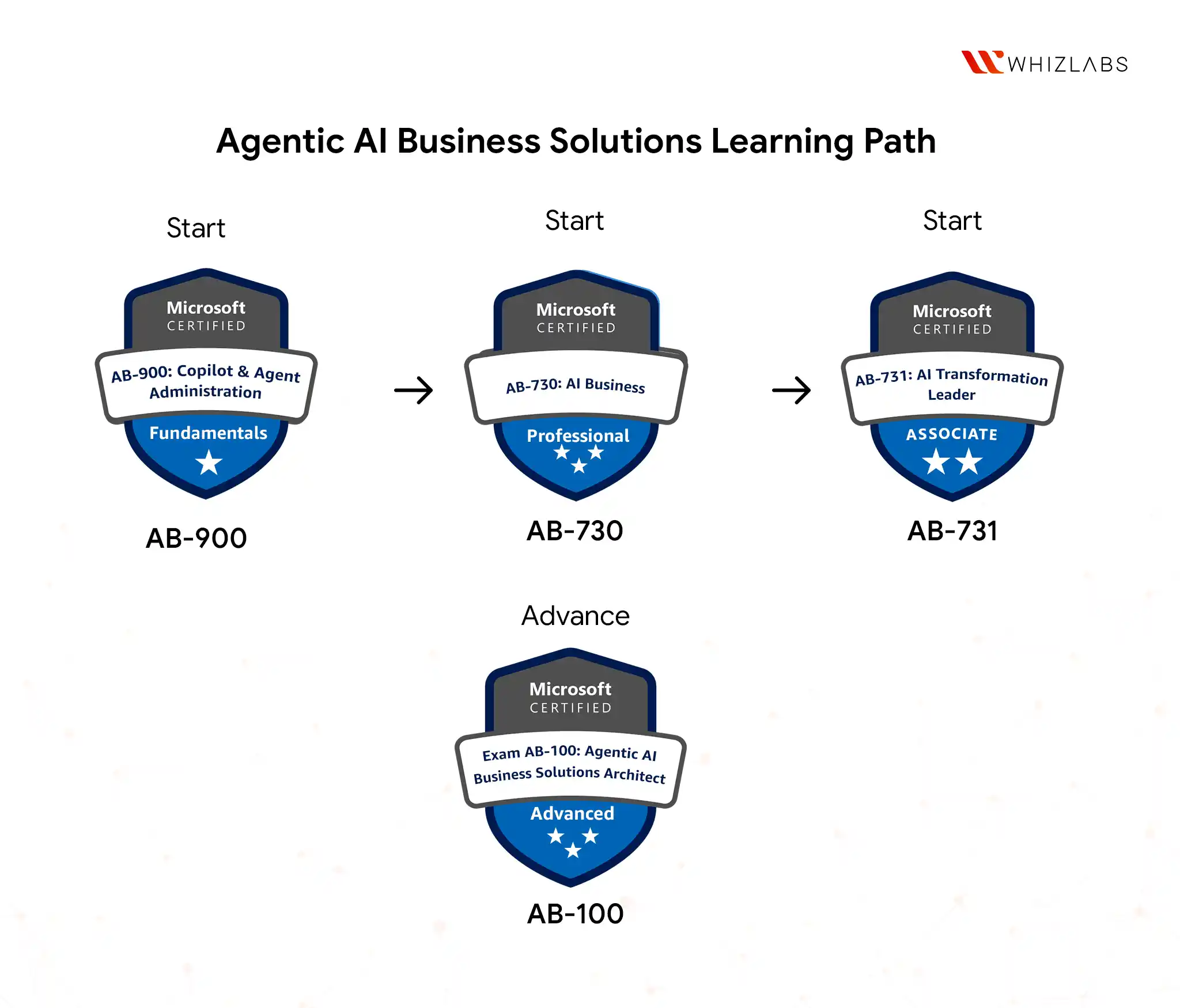
Agentic AI is completely redefining enterprise transformation in the forthcoming years. Organisations have levelled up and started deploying Copilot-enabled agents that observe, decide, act, and integrate across business systems.
This learning path prepares professionals to move from understanding AI-enabled workplaces to architecting end-to-end agentic AI business solutions at enterprise scale.
| 10. Agentic AI Business Solutions Learning Path | ||||
|
Stage |
Category | Exam Code | Certification |
Primary Learning Focus |
| Start | Fundamental | AB-900 | Microsoft 365 Copilot and Agent Administration Fundamentals | Understand Copilot, agents, permissions, data boundaries, security, and administrative foundations for agent-enabled workplaces |
| Build | Associate | AB-730 | AI Business Professional | Identify AI-driven business opportunities, map use cases, and understand Copilot and agent capabilities from a business value perspective |
| Build | Associate | AB-731 | AI Transformation Leader | Lead AI transformation initiatives, govern agent adoption, manage change, risk, ethics, and organisational impact |
| Advance | Expert | AB-100 | Agentic AI Business Solutions Architect | Design end-to-end agentic AI business solutions, including Copilot strategy, agent orchestration, governance, and enterprise integration |
Stage 1: AB-900 Microsoft 365 Copilot and Agent Administration Fundamentals
This certification builds a strong foundation on how Copilot and AI agents work within enterprise data environments. It focuses on governance-first deployment rather than technical coding.
Primary Domains in Copilot & Agent Administration Foundations (AB-900)
- Microsoft 365 Copilot architecture and ecosystem
- Agent permissions and identity boundaries
- Microsoft Graph, Dataverse, and connectors
- Data access governance and Zero Trust principles
- Responsible AI fundamentals and administrative controls
There is no mandatory prerequisite for AB 900 certification; it is ideal for IT administrators, business leaders, and digital transformation professionals beginning their AI adoption journey.
The market value is rising as organisations seek professionals who understand AI boundaries, compliance, and administrative risk controls.
Get to transition into roles like Microsoft 365 Administrator, AI Adoption Manager, Digital Workplace Lead and IT Governance Analyst. Whose salary varies between $85,000–$110,000 (depending on region and role).
Gain clarity on Copilot’s operational boundaries and enterprise governance model. This reduces AI implementation risks and enables secure AI workplace deployment.
Stage 2: AI Business Professional (AB-730)
This is the transitioning stage for professionals from understanding AI tools to strategically applying AI across operations, customer experience, and internal productivity systems. The certification focuses on:
- Identifying AI-driven business opportunities
- Mapping Copilot and agent use cases
- ROI modelling and automation impact analysis
- Workflow redesign with AI agents
- AI capability assessment across departments
You will need a basic understanding of business processes and digital transformation concepts. And with AB-730 certification, enter roles like AI Business Analyst, Automation Consultant, Business Transformation Specialist and Product Strategist. Salary ranging between $95,000–$125,000.
Professionals have moved from translating AI capabilities into measurable business value for AI-driven business transformation. Organisations today are actively looking out for professionals who can identify scalable AI use cases rather than just deploy tools.
Stage 3: AI Transformation Leader (AB-731)
The Ab 731 certification hastens leaders to manage the organisational shift that agentic AI introduces. It focuses on transformation, governance, and responsible AI adoption at scale.
Primary Domains include
- Leading enterprise AI adoption programs
- Agent governance frameworks
- Ethical AI and compliance oversight
- Risk management and change enablement
- Cross-functional AI integration strategies
Experience in project leadership or enterprise IT strategy with ABB 730 is beneficial.
Professionals gain credibility as AI transformation leaders capable of managing both technology and cultural change.
Roles like AI Program Manager, Head of Digital Transformation, Enterprise Innovation Lead, and AI Strategy Consultant become critical as AI moves into core operational systems. And their salaries potentially range between $120,000–$160,000+.
Stage 4: Agentic AI Business Solutions Architect (AB-100)
The AB 100 is an expert-level certification validating the ability to architect large-scale AI ecosystems that connect Copilot, enterprise data systems, automation tools, and governance layers. It covers domains such asEnd-to-end Magnetic AI architecture design
- Copilot orchestration across enterprise systems
- Multi-agent workflow design
- Enterprise integration patterns
- AI governance, compliance, and scalability frameworks
Require a strong experience and edge in Business architecture, enterprise systems integration, and AI adoption strategy, along with AB 731, is recommended.
This certification positions professionals at the forefront of enterprise AI architecture who design systems where agents coordinate workflows across different operations. Whose salaries go from $150,000 to this $200,000+, easily.
Wondering if you are eligible and ready for AB-100 right now? We have a full guide for that: Who Should Take the AB-100 Certification?
Why Is This Agentic AI Business Learning Path Important?
Enterprises have gone from Tool experimentation → Structured AI transformation → Agent orchestration at scale.
Organisations today ask,
- Can we govern Copilot securely
- Can agents operate across departments?
- Can AI automate multi-system workflows?
- Can we measure AI-driven business value?
This learning path directly addresses the needs of the enterprises.
AI-Aware Administrator → AI Business Strategist → AI Transformation Leader → Agentic AI Architect
Who Should Take the Microsoft AB-100 Certification Exam?
Not sure if AB-100 is the right move for you right now? Read this first: Who Should Take the AB-100 Certification?
Business Applications: Dynamics 365 (CRM / ERP) Career Path
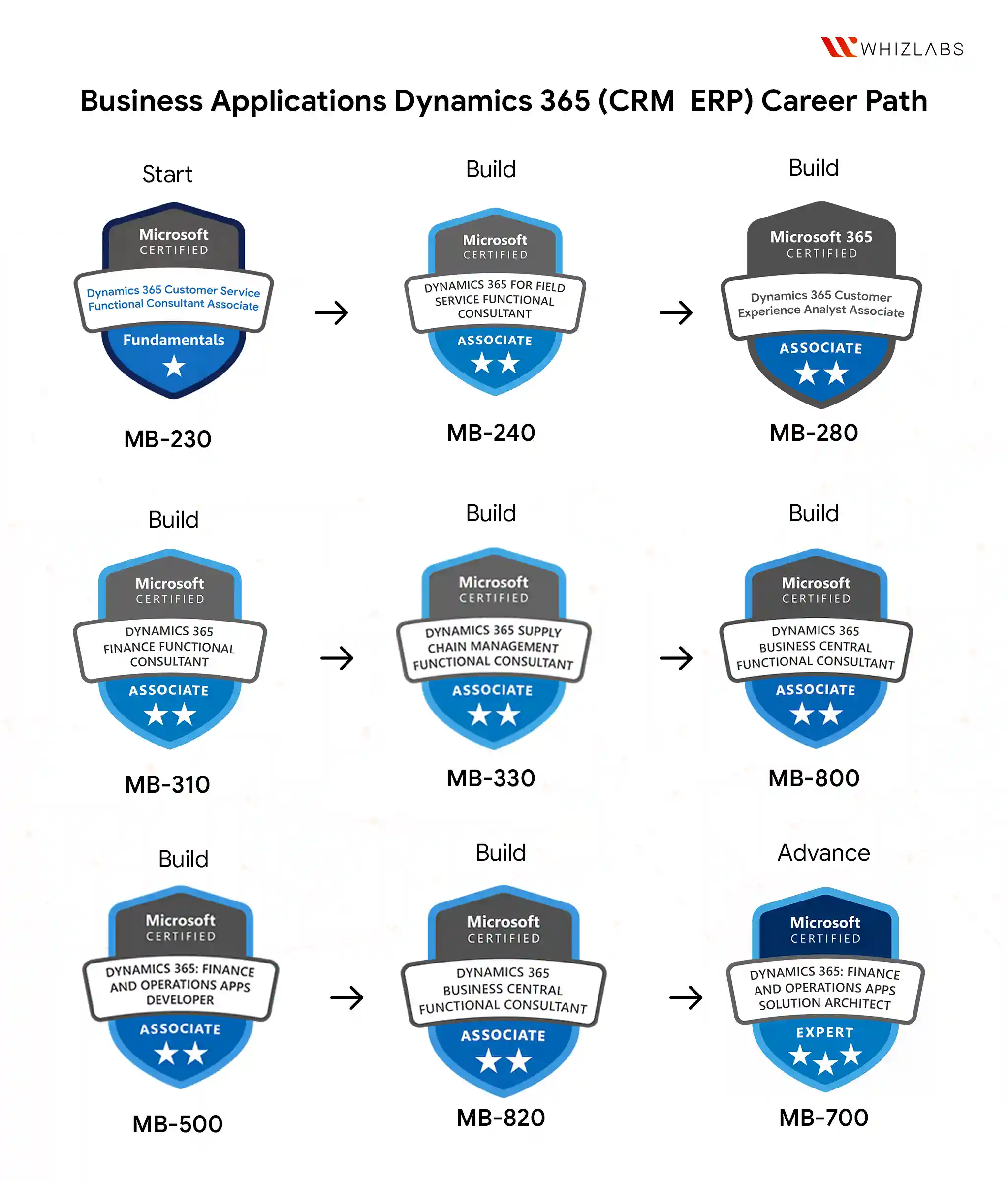
Microsoft Dynamics 365 is at the centre of digital transformation for customer engagement (CRM) and enterprise resource planning (ERP).
Today, companies go a step ahead; instead of just implementing CRM or ERP systems, they are integrating AI (Copilot), automation, analytics, and compliance into business workflows.
This learning path will help professionals move from functional consultant roles to enterprise-level solution architecture across:
- Customer Service
- Field Service
- Customer Experience
- Finance
- Supply Chain
- Business Central
- Development
- Enterprise Architecture
| 11. Business Applications: Dynamics 365 (CRM / ERP) Career Path | ||||
| Stage | Category | Exam Code | Certification | Primary Learning Focus |
| Start | Associate | MB-230 | Dynamics 365 Customer Service Functional Consultant Associate | Customer service workflows, case management |
| Build | Associate | MB-240 | Dynamics 365 Field Service Functional Consultant Associate | Field service operations, work orders, resource management |
| Build | Associate | MB-280 | Dynamics 365 Customer Experience Analyst Associate | Customer insights, journeys, analytics, and personalisation |
| Build | Associate | MB-310 | Dynamics 365 Finance Functional Consultant Associate | Financial processes, accounting, budgeting, and reporting |
| Build | Associate | MB-330 | Dynamics 365 Supply Chain Management Functional Consultant Associate | Inventory, procurement, manufacturing, logistics |
| Build | Associate | MB-800 | Dynamics 365 Business Central Functional Consultant Associate | SMB ERP configuration and business processes |
| Build | Associate | MB-500 | Dynamics 365 Finance & Operations Apps Developer Associate | Develop and extend Dynamics 365 F&O |
| Build | Associate | MB-820 | Dynamics 365 Business Central Developer Associate | Custom development and extensions for Business Central |
| Advance | Expert | MB-700 | Dynamics 365 Finance & Operations Apps Solution Architect Expert | End-to-end Dynamics 365 architecture and governance |
Stage 1: MB-230 Dynamics 365 Customer Service Functional Consultant Associate
This certification focuses on designing structured customer service experiences using Dynamics 365 Customer Service. Validates expertise in customer support system design. This certification is critical for service-driven enterprises adopting AI-powered service automation.
Stage 2: MB-240 Dynamics 365 Field Service Functional Consultant Associate
It focuses on managing field operations and optimising service dispatch and workforce productivity. Therefore has high relevance in manufacturing, utilities, telecom, and infrastructure industries.
Stage 3: MB-280 Dynamics 365 Customer Experience Analyst Associate
The major focus of this certification is on customer data platforms and analytics-driven engagement. It strongly aligns with AI-powered personalisation strategies and digital marketing ecosystems.
Stage 4: MB-310 Dynamics 365 Finance Functional Consultant Associate
ERP-based financial system configuration is its primary focus, which is critical for enterprises migrating legacy finance systems to cloud ERP.
Stage 5: MB-330 Dynamics 365 Supply Chain Management Functional Consultant Associate
With the rising demand for global supply chain digitisation and AI forecasting models, this certification is highly valuable.
Stage 6: MB-800 Dynamics 365 Business Central Functional Consultant Associate
This certification adds to your business process understanding. An ideal certification for professionals working with small-to-mid-sized enterprises.
Stage 7: MB-820 Business Central Developer
Developers in Dynamics 365 are critical for extending enterprise solutions. And this certification aids it.
Stage 8 – MB-700 Dynamics 365 Finance & Operations Apps Solution Architect Expert
This professional certification focuses on Enterprise solution design, Governance & compliance, Integration across CRM, ERP, Power Platform and others, which positions professionals as enterprise decision-makers overseeing multi-million-dollar implementations.
Why Dynamics 365 Certifications Matter in 2026?
Organizations prioritize AI-powered ERP systems, Copilot-enabled CRM automation, Real-time financial insights, Intelligent supply chain optimization and Enterprise governance & compliance. Dynamics 365 certifications validate expertise across these domains.
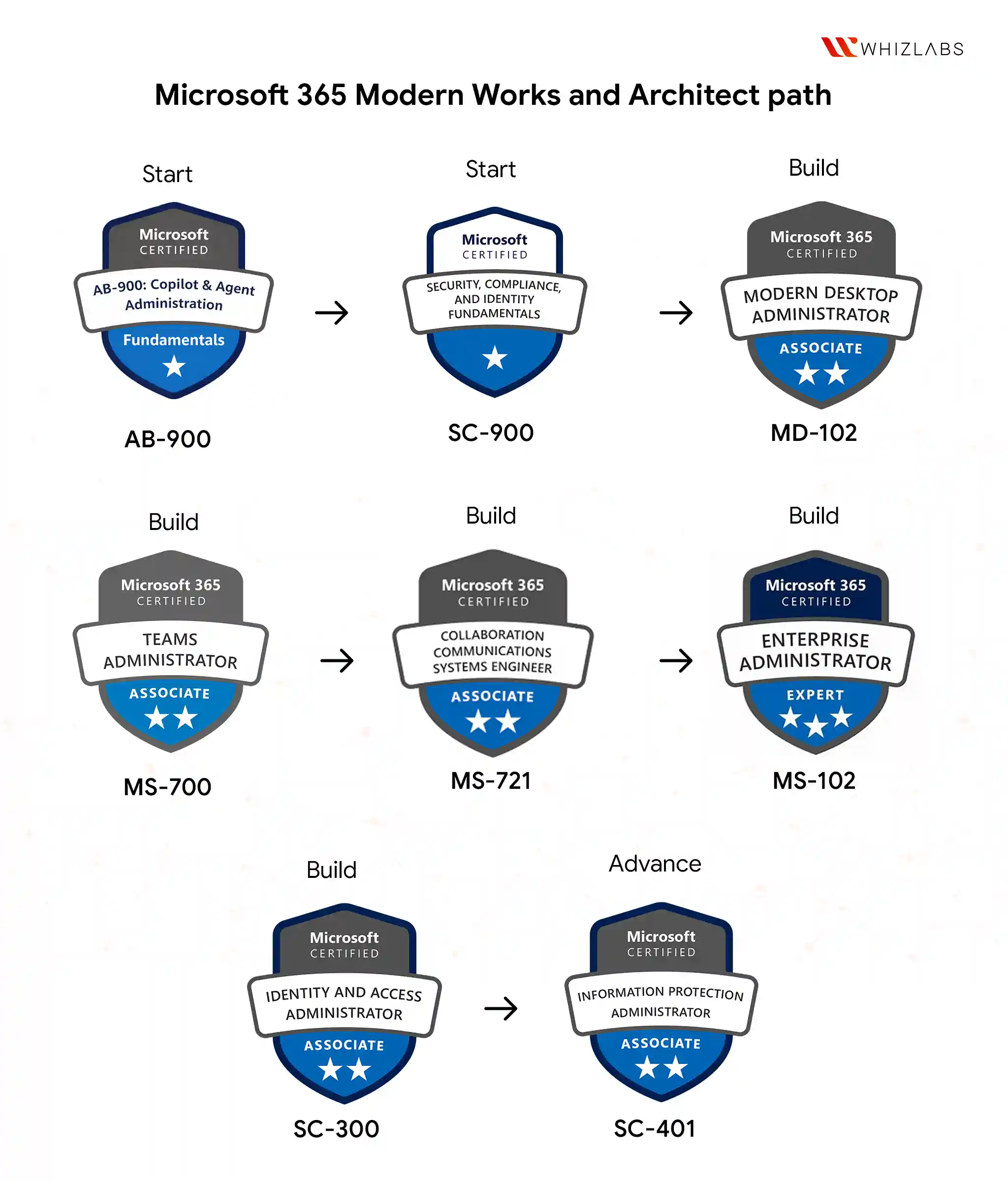
Modern Working is no longer just about email and collaboration.
It combines Microsoft 365 ecosystem management, such as Copilot integration, Endpoint security & device management, Identity-first architecture, Compliance and data governance and Enterprise voice and communications.
Productivity Administrator → Endpoint & Collaboration Engineer → Enterprise Architect → Security-Aware Modern Work Strategist
This roadmap prepares professionals to move from operational roles to Microsoft 365 Architect-level leadership.
| 12. Microsoft 365 Modern Works and Architect path | ||||
| Stage | Stage | Exam Code | Certification | Primary Learning Focus |
| Start | Fundamental | AB-900 | Microsoft 365 Copilot Fundamentals | Microsoft 365 ecosystem, Copilot concepts, productivity scenarios, and AI-assisted work |
| Start | Fundamental (Optional but made value) | SC-900 | Security, Compliance & Identity Fundamentals | Zero Trust, identity, compliance, and security fundamentals |
| Build | Associate | MD-102 | Endpoint Administrator Associate | Intune, Autopilot, device security, Windows & mobile management |
| Build | Associate | MS-700 | Teams Administrator Associate | Teams, meetings, voice, governance |
| Build | Associate | MS-721 | Collaboration Communications Systems Engineer | Teams Phone, PSTN, Direct Routing, Operator Connect, voice architecture |
| Advance | Expert | MS-102 | Microsoft 365 Administrator Expert | Tenant-wide administration, integration across M365 workloads |
| Advance | Associate (Optional) | SC-300 | Identity & Access Administrator Associate | Entra ID, Conditional Access, MFA, PIM |
| Advance | Associate (Optional) | SC-401 | Microsoft Information Protection & Compliance Administrator Associate | Microsoft Purview, DLP, sensitivity labels, insider risk |
GitHub Certifications Learning Path
GitHub functions as a DevOps engine, AI coding assistant hub, CI/CD platform, and secure SDLC backbone.
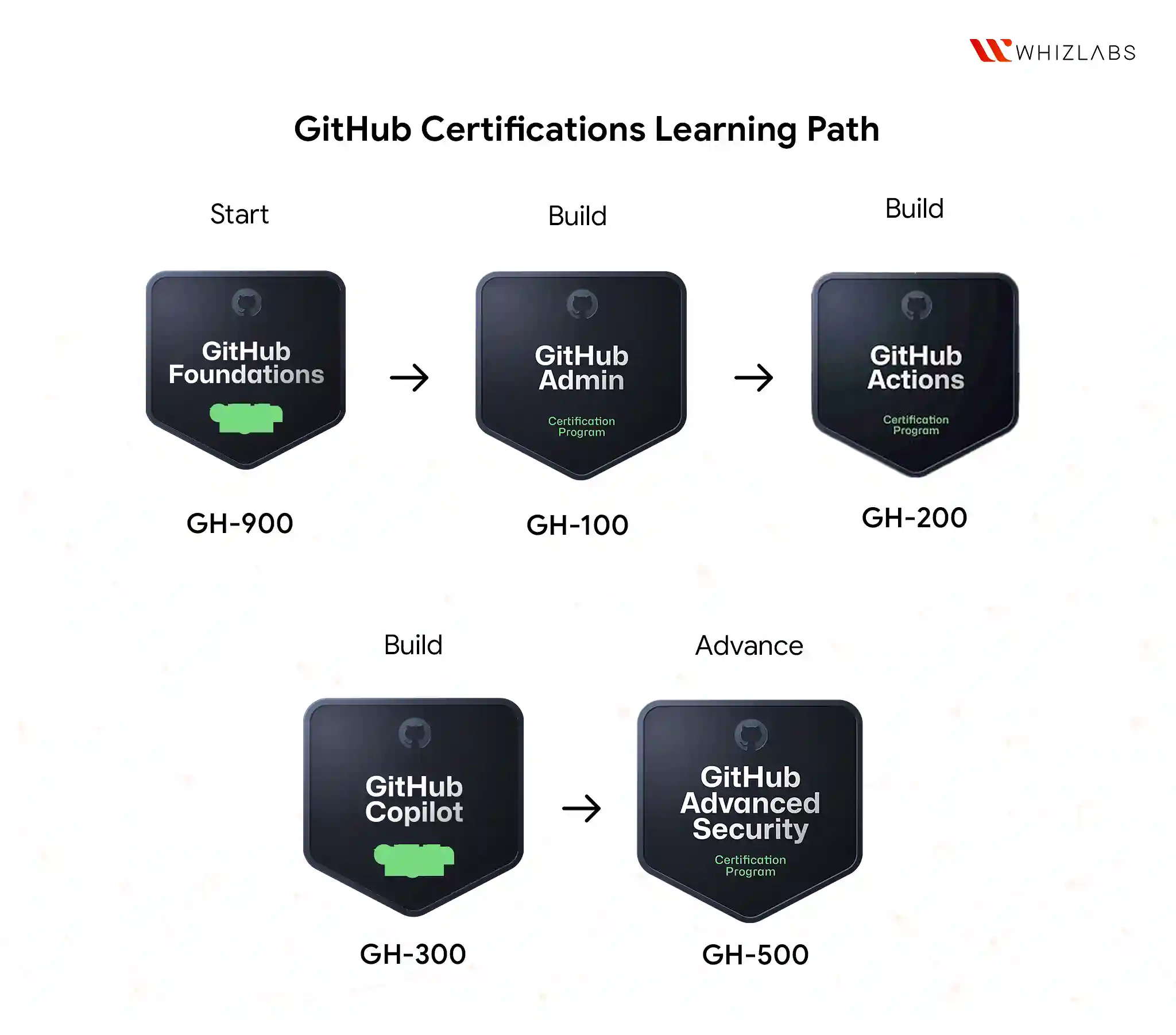 Git Collaborator → DevOps Engineer → AI-Augmented Developer → DevSecOps Architect
This certification path prepares professionals to move from Git collaboration fundamentals to enterprise-grade DevSecOps leadership.
| 13. GitHub Certifications Learning Path | ||||
| Stage | Category | Exam Code | Certification | Primary Learning Focus |
| Start | Fundamental | GH-900 | GitHub Foundations | GitHub basics: repositories, issues, pull requests, GitHub Flow, collaboration |
| Build | Associate | GH-100 | GitHub Administration | Organisation & repo management, access control, policies, governance |
| Build | Associate | GH-200 | GitHub Actions | CI/CD with GitHub Actions, workflows, runners, secrets, automation |
| Build | Associate | GH-300 | GitHub Copilot | AI-assisted coding, Copilot usage patterns, productivity, and responsible AI |
| Advance | Professional | GH-500 | GitHub Advanced Security | Code scanning, secret scanning, dependency review, secure SDLC |
These are the major classifications of Azure certification based on the career path. As a learner of Azure, you have to understand that beyond certification, you also require a vast hands-on experience and practice to succeed in your career.
How to Prepare for New Microsoft Azure Certifications?
To prepare for your Microsoft Azure certifications, Online video courses and classroom training are the best way to get prepared. After the concepts, you can also take practice tests, practice hands-on, guided labs and sandboxes for your certification.
Below are a few steps you can choose to prepare well for the new Microsoft Azure CertificationPath.
- Go through the exam details: You can get the information about the certifications from the official site, which is very important. This will be helpful for you to check the criteria.
- Check Course Content and Prerequisites: Azure certification courses encompass a variety of training programs designed to enhance skills and knowledge in Microsoft’s cloud platform.
Course content is the key aspect to prepare for any Azure certifications. Make sure you’ve gonee through all the prerequisites before opting for the new Microsoft Azure Certification Path.
- Check Exam Overview: Exam overview contains exam information, objectives, and domains. Before opting for Microsoft Azure certification training, check the exam overview.
- Take help of the Exam Guide: To know more deeply about the Microsoft Certification roadmap, also take help of the exam guide. It will help you to understand the various components of the Microsoft Azure Certification Path.
- Study Certifications Whitepapers: Whitepapers have the key points to prepare for the Microsoft Azure Certifications Path.
- Read recommendation books: It will be great to follow the instructions given in books to follow the Microsoft Azure Certifications Path.
- Take sample questions and practice tests: After preparing for the new Azure certifications path, you can also check sample questions and take practice tests.
How Whizlabs play a vital role in your Azure certification preparation?
Preparing for Azure certifications requires more than reading documentation. It demands exam alignment, real hands-on practice, and continuous feedback. Whizlabs supports this journey through a structured, exam-focused skill-building, learning ecosystem designed to help you move from concept clarity to certification confidence.
1. Practice Tests That Mirror the Real Azure Exam
Whizlabs practice tests are built on the official Microsoft exam blueprints and structured to simulate the real exam experience for candidates. Which would get them to lower their pressure and be confident, as they have prior experience practising with our Practice tests.
Two modes designed for mastery:
- Exam Mode – Full-length, timed simulations that replicate the actual Azure certification environment. This helps you improve time management, question interpretation, and exam stamina.
- Practice Mode – Detailed explanations, answer breakdowns, and topic-level analytics to identify weak areas.
These scenario-based questions strengthen decision-making skills across Azure services like Virtual Machines, Azure AD (Entra ID), Networking, Storage, Defender for Cloud, and more.
Are Whizlabs practice tests similar to the real Azure exam?
Yes. They are blueprint-aligned and designed to reflect real exam reasoning patterns.
Structured Video Courses for Concept Clarity
Azure exams test understanding, and that’s exactly what Whizlabs video courses focus on:
- Clear explanations of Azure architecture
- Service comparisons (e.g., App Service vs AKS vs VM)
- Real-world deployment scenarios
- Cost optimization and governance discussions
Instead of isolated service learning, the videos follow workflow-based teaching:
Deploy → Configure → Secure → Monitor → Optimize
These courses are well-structured to support both beginners and working professionals targeting Azure Administrator, Developer, Architect, or Security Engineer roles.
Guided Hands-On Labs for Real Azure Experience
Azure certifications require a heavy weight on practical thinking, for which Whizlabs Azure Guided labs help you build that muscle strong and efficient.
- Deploy and configure Azure resources.
- Implement RBAC and Conditional Access
- Create VNets, NSGs, and Load Balancers
- Configure Azure Monitor and Log Analytics
- Work with Azure Kubernetes Service (AKS)
Each guided lab walks you through real implementation steps, helping bridge the gap between theory and enterprise practice.
Azure Sandboxes for Safe Experimentation
One of the biggest challenges in Azure preparation is access to a live environment. Whizlabs sandboxes provide:
- Isolated Azure practice environments
- Pre-configured permissions
- Real-world simulation without production risk
You can test deployments, break configurations, troubleshoot errors, and learn safely, without impacting live workloads.
This builds operational confidence, which is critical for all Azure exams.
Capstone Projects for Real-World Application
Beyond labs, capstone projects help learners:
- Design complete Azure architectures
- Implement security controls
- Configure monitoring and cost management
- Build scalable and fault-tolerant environments
It’s especially valuable for architect-level certifications and career advancement roles, transforming learning from “exam preparation” to “career readiness.”
Updated Content Aligned with Azure Changes
Azure evolves rapidly, and at Whizlabs, we adhere toregulary updates:
- Practice questions aligned with new exam versions
- Azure service changes and feature updates
- Scenario-based question complexity
Customer Interaction & 24/7 Support
Certification journeys often require clarification. With continuous interaction, you can improve confidence and reduce preparation friction. That’s what Whizlabs offers:
- Subject Matter Expert support
- Clarifications on practice questions
- Learning guidance
- Responsive customer support
As Azure certifications validate skills in:
- Cloud infrastructure management
- Identity & access governance
- DevOps automation
- Security engineering
- Enterprise architecture design
Whizlabs creates an integrated learning path combining
Practice Tests + Video Courses + Guided Labs + Sandboxes + Capstone Projects + Continuous Support
This layered preparation model helps you understand Azure deeply, think like a cloud professional, perform under exam conditions and apply skills in real-world scenarios.
Ace your Azure Learning Journey with Whizlabs
The need for professional certifications for the Microsoft Azure platform is prominently evident due to the increasing demand for Azure services. The assortment of certification exams by Microsoft Azure provides considerable opportunities for aspiring IT professionals to establish their careers.
It’s important for the candidates to choose the right certification track according to their skills and career preferences. The key to success in the Microsoft Exams in the Azure certifications path is the right guidance, training, and support. Choose the right training course and ensure a bright career for yourself!
And here, Whizlabs plays a vital role in the Azure preparation journey by providing structured, hands-on, exam-aligned, and continuously updated learning resources that go beyond theory and prepare you for real Azure roles.
If your goal is not just to pass the Azure exam but to build long-term Azure expertise, a combination of practice, implementation, and guided learning makes the difference.
We will be happy to assist you in understanding the latest Azure certification path, along with the Azure career path. If you are preparing for these new role-based Azure certifications, Whizlabs Azure Certifications training courses will help you prepare and pass the new Azure certifications. Join us now to become a Microsoft Certified Azure professional.
Want to get started with Microsoft Azure Learning and a career-based certification path? You are in the right space, let’s get it started!

- How does FinOps Certified Practitioner Scale Financial & Tech Careers? - July 20, 2026
- What Is Generative AI for Azure Cloud Engineers? - July 13, 2026
- From Cloud Certification Ready To Building Real Capabilities - July 2, 2026
- How to Pass AWS SOA-C03 CloudOps Engineer Associate Exam? - June 12, 2026
- Claude Certified Architect – Foundations CCA-F Exam Guide - June 4, 2026
- DP-700 Master Content Guide Microsoft Fabric Explained for Data Engineers - May 28, 2026
- DP-700 Microsoft Fabric Data Engineer Career Roadmap - May 19, 2026
- AWS AI Practitioner vs Other AI Certs: Which to Choose in 2026 - May 6, 2026
Good One
Greetings
I have gone through this page and unfortunately i am confused i want to choose devops as my career path. Can you please guide me what certifications are associated with it. as my goal is to start with devops and reach to Devops solution architect.
I shall be waiting for your response in this regards.
Currently there is no such certification as DevOps Architect but you can definitely show skill as DevOps Engineer- Associate + Azure Architecture.
To achieve this you need to do below certification:
AZ-120
AZ-400
AZ-301
AZ-304
HI
I current have a Dual MCSE in Productivity and Cloud Infrastruture 2016. I want like to pursue an Azure Administrator and update my current MCSE. Is there a path to Microsoft Azure MCSE that utilizes some of my previous exams taken? I am current 2016 MCT.
Thank you
Hello Neeru,
I am glad someone has provided such a detailed information about the MS Azure path. Can you please provide an updated article since most of the exams have been expired?
I am having 10+ years of .net developer experience and wanted to start career with Azure. Now I don’t want to deal with programming, and wanted to work with non-programming field.
Which certification will you suggest me?
Ashish, it’s not good to leave your programming field. You can choose to be Azure developer if you want to extend your career with Azure. But if you really don’t want to continue with programming, you can choose to be Azure Admin or Azure Architect as programming knowledge will help you get ahead in these roles.
Neeru,
Thank you for a concise collation of information, well done and answered the questions I had.
However, I have a question please. I’m a delivery leader who needs to manage cloud developers and architects. I wanted to completely understand the 360 degrees of Azure so that I can effectively manage Azure projects/teams. I’m thinking of getting certified for AZ-300 and AZ-301. I have not done hands-on development or Infrastructure work for past 10 years, but I’m confident I can learn for these exams. What would your suggestion be ? Will it be difficult to pass 300 series without passing 100 and 200 series ?
New AZ-103 : Azure Administrator Associate Exam , what is the certification validity period ?
do we need to renew the certification once in 2 yrs ? pls confirm
How hard is it for a Linux person to learn Azure? Does one need to have knowledge on power shell and other windows concepts such as AD etc?
very nice content. I have written with few things different
hi, i want to pursue a career in Azure cloud. i have about 6yrs experience as IT/USER SUPPORT, SERVER/NETWORK ADMIN. without a degree in computer science what are my chances in the USA. my experience is in another country
thanks for giving information
Very detailed information. Thanks to Author.
This is such a great article. There are few more speciality certifications added recently. Could you please update them as well.
Very Brief Explanation, Usually I never comment on blogs but your article is so convincing that I never stop myself to say something about it. You have done a great job
Good one, thanks for sharing
Hey, thanks for a great post, it seems everyone these days is trying to make a little extra on the side but it is so hard to find really good blogs like yours.
Nice post. I learn something more challenging on different blogs everyday. It will always be stimulating to read content from other writers and practice a little something from their store. Thanks for sharing.
Hi, is the Administering Relational Databases on Microsoft Azure Exam (DP-300) exam still available?
I was completely lost trying to understand the different certifications from the official description. Thanks a ton for the infographic!
Good content and easy to decide the path… many thanks
Guess, DP 100, should link to AI 900, as per Microsoft article
A very useful article and source for learning such high-quality information! I appreciate you sharing this useful information.
https://proventuresindia.com/service/ms-power-bi/