

Why does the Microsoft Fabric Data Engineer DP-700 certification matter right now?
“LinkedIn job postings for Microsoft Fabric Data Engineer roles have more than doubled year-over-year, and fewer than 14,000 professionals globally hold the DP-700 certification.”
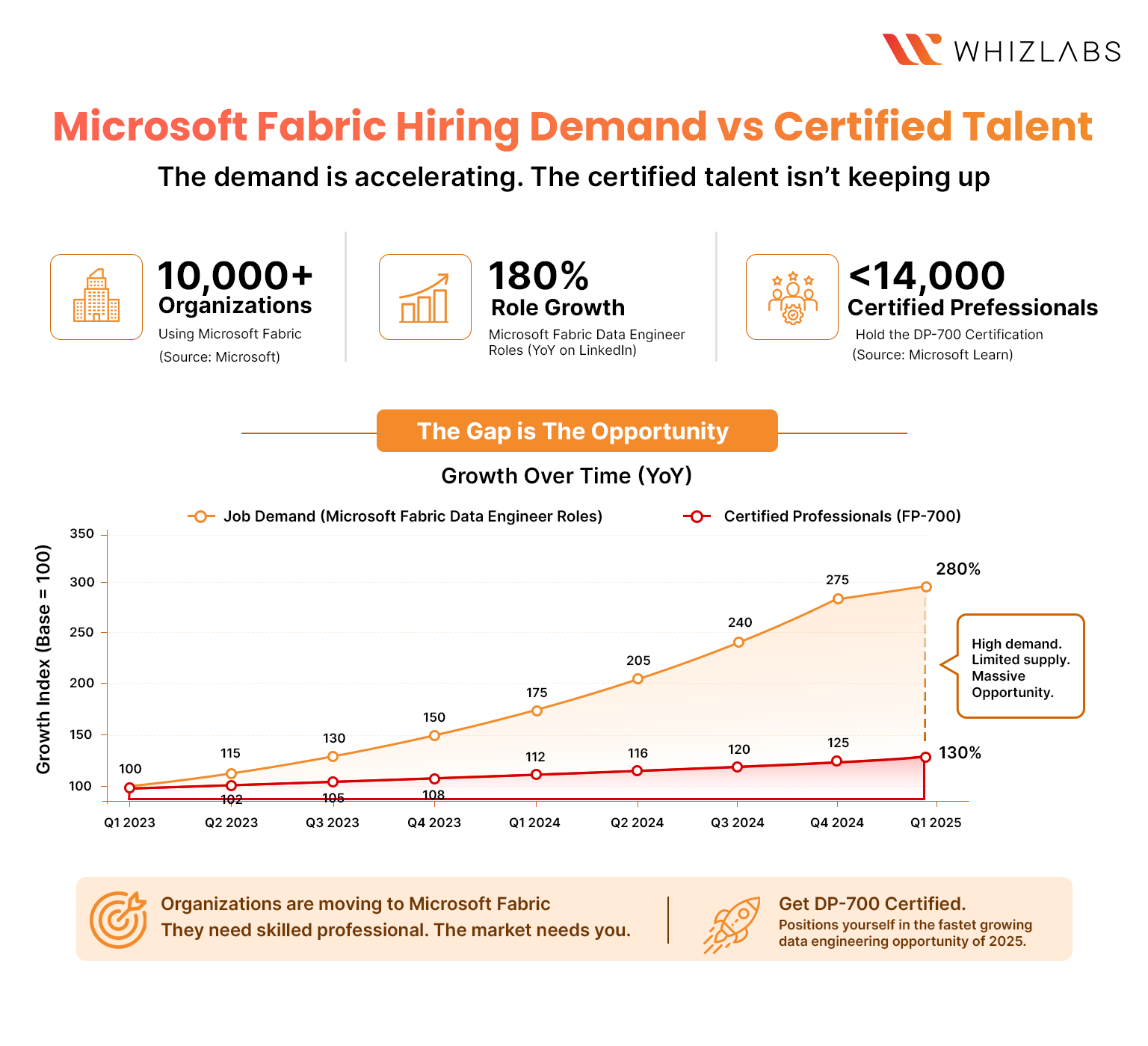
This gap is the exact opportunity.
The demand for data engineers hasn’t just increased, but it has shifted.
For years, being a data engineer meant knowing “how to stitch tools together: Azure Data Factory, Synapse, or Databricks, based on the depth and complexity of the operations. This made it useful for professionals to specialise in a few parts of the stack and still get through. Learning in fragments.
However, this model is fading.
Today, Microsoft Fabric is collapsing its stack into one single system: ingestion, transformation, real-time analytics, and governance. All in one place, which has shifted the expectation to a different angle. From moving data, you are now designing how systems behave end-to-end.
That’s exactly what the DP-700 certification is validating: your ability to think like a data engineer in a unified architecture. And that’s why this certification is showing up more often in job descriptions and hiring conversations. It perfectly aligns with how modern data systems are actually being built today.
If you’re evaluating whether DP-700 is worth your time, ask yourself this question: Are you learning tools, or are you learning how modern data systems actually work?
With that question in mind, let’s dig into the DP-700 Microsoft Fabric Data Engineer Roadmap.
What Is the DP-700 Exam – Microsoft Fabric Data Engineer Certification?
To answer your question: What is the DP-700 certification?
The DP-700 is Microsoft’s Associate-level certification for the Fabric Data Engineer role. It’s the credential that helps employers to validate your ability to design, build, and manage data engineering solutions on the Microsoft Fabric platform, not just talk about them.
DP-700 is built around how modern data systems actually work: unified, real-time, and production-ready. The exam focuses on your ability to handle the full lifecycle: ingestion, transformation, orchestration, monitoring, and optimisation. Everything inside Microsoft Fabric’s single ecosystem.
DP 700 Exam Format
| Format | Multiple-choice + case-based |
| Questions | 40–60 questions |
| Duration | 120 minutes |
| Cost | ~$165 USD (varies by region) |
| Passing Score | 700 / 1000 |
| Validity | 1 year (free renewal) |
Where does DP-700 fit in your Microsoft Certification Path?
DP-700 sits at the Associate level, specifically for Microsoft Fabric. If DP-900 (Fundamentals) is about understanding concepts, DP-700 is about building real systems.
It also quietly replaces what DP-203 used to represent. Instead of working across fragmented Azure services, DP-700 reflects the shift toward unified data platforms as one system, not five stitched together.
Who Should Actually Take the Microsoft Fabric Data Engineer Certification?
- Data engineers working with Azure, Synapse, or Databricks
- Azure/cloud engineers moving into data roles
- Power BI / BI developers stepping into engineering
- Career switchers with SQL, Python, or ETL basics
Who is DP-700 not for:
- Pure data scientists focused only on modelling
- Non-technical analysts looking for conceptual knowledge
This is an execution-level certification. It expects you to think in systems, not dashboards.
Now that we’re aligned on what the exam is, let’s break down what it actually tests, and why those skills map directly to where the job market is heading.
What Skills Does DP-700 Actually Validate?
The DP-700 wants you to prove you can make real decisions inside a Microsoft Fabric environment under pressure. Let’s break this down the way it actually shows up in work, not the typical exam PDFs.
Domain 1: Implement and Manage a Fabric Analytics Solution (30–35%)
Setting the foundation. You’re expected to understand how Fabric workspaces are structured, how Lakehouses and Warehouses are created, and how data is stored and governed. It also covers access control, security policies, and deployment pipelines. Defining who can access what, and how safely.
Basically, you’re designing the environment before any data even moves. This, in practice, looks like where you decide how the entire data platform is structured and whether it scales cleanly or becomes chaotic in 3 months.
Domain 2: Ingest and Transform Data (30–35%)
This is the core of the role, and the heaviest part of the exam. You get to work across pipelines, Dataflows Gen2, Spark notebooks, and SQL/KQL transformations. The exam expects you to understand and point out situations when to use each tool, how to design ingestion patterns (batch vs streaming), and how to structure data using approaches like the medallion architecture.
This clearly indicates that it’s not about writing syntax. It’s about choosing the right approach for the problem. So, in your day-to-day routine, you explore taking messy, raw data from multiple sources and turning it into something reliable, queryable, and production-ready.
Domain 3: Monitor, Optimise, and Troubleshoot (30–35%)
This is where most people underestimate the role. DP 700 certification pushes you to prove your ability to monitor pipelines, identify failures, tune performance, and manage cost. You need to understand how systems behave under the load and how to fix them when they don’t.
This is also where governance and reliability come into play. This is the difference between building pipelines and running systems that don’t break at scale.
How to Map DP 700 certification to Real Job Roles?
If you look at actual Microsoft Fabric Data Engineer job descriptions, you’ll see phrases like:
- Design and implement scalable data pipelines
- Build and manage Lakehouse architectures
- Optimise performance and ensure data reliability
- Implement data governance and access control frameworks
Each of these directly relates to the domains above. Therefore, claiming this certification isn’t abstract. It’s aligned to what companies are already hiring for, especially as unified platforms like Fabric become the default.
Skills validated. Now, the more important question: What does having them officially certified actually do to your career trajectory and earning potential?
The data here is more concrete than most people expect.
Career Impact: What Changes After DP-700
Certifications are only worth the career outcomes they produce. And when you look at the Microsoft Fabric ecosystem right now, the opportunity is less about the certification itself and more about where the market is heading.
Microsoft Fabric is no longer in an experimental phase. Within months of general availability, Microsoft confirmed that Fabric had crossed 10,000+ paying organisations, with enterprises like Marks & Spencer, Toyota, and Siemens already using it as part of their data modernisation strategy.
This matters because platform adoption always creates hiring demand. And that demand is already visible across LinkedIn, Indeed, and Glassdoor under roles like:
- Microsoft Fabric Data Engineer
- Azure Data Engineer (Fabric-focused)
- Analytics Engineer
- Data Platform Engineer
What the Salary Data Actually Shows?
| Region | Salary Range |
| USA | $115K – $148K |
| UK | £72K – £95K |
| Germany / Netherlands | €78K – €105K |
| India | ₹16 – ₹28 LPA |
| Australia | AUD $130K – $165K |
Sources: Glassdoor, LinkedIn Salary Insights, Levels. fyi
But the real story isn’t the numbers alone. It’s why companies are willing to pay them. Organisations are no longer hiring engineers who only understand isolated tools. The capabilities of the DP 700 certification play a major role here.
The DP 700 Exam ROI Is Surprisingly Practical
Let’s break it down simply:
- Exam cost: ~$165
- Prep timeline: ~6 weeks
- Estimated salary uplift: 15–25% for certified professionals
Industry reports from Pearson VUE and Global Knowledge consistently show certified Microsoft professionals earning more than non-certified peers in similar roles. That’s why the return here is less about passing an exam and more about repositioning yourself into a market that is still early in its growth cycle.=
If the numbers make sense and you’re ready to start building toward this, get started with Whizlabs’ DP-700 preparation. All aligned to the current exam version.
Try a free DP-700 practice test and see where you stand
Market Demand for DP 700 Certifications
Job demand for Microsoft Fabric skills isn’t a LinkedIn trend; it’s showing up in hiring budgets, platform adoption, and the job boards of some of the world’s largest enterprises. Here’s what the data actually shows.
1. Enterprise Adoption Is Already in Motion
Microsoft Fabric didn’t ease through the market; it scaled with skills requirements. Within six months of general availability, it crossed 10,000+ paying organisations. This completely demonstrated early standardisation. Enterprises such as Marks & Spencer, Toyota, and Siemens have already adopted Fabric as part of their data platform strategies. Gartner’s broader view was that data fabric architectures are becoming a default pattern for modern data ecosystems, not an edge case.
2. Job Demand Is Growing Structurally, Not Virally
Today, on LinkedIn or Indeed, it’s not “Fabric Data Engineer” as a standalone category. Instead, you’ll see a shift inside existing roles:
- Azure Data Engineer (Fabric-focused)
- Analytics Engineer (Fabric stack)
- Data Platform Engineer (Microsoft ecosystem)
LinkedIn and job trends show a clear acceleration in Fabric-related skill mentions, especially across BFSI (banking, fintech), Healthcare, Retail & e-commerce and Manufacturing. These industries already run large-scale data systems. Fabric is replacing complexity, not introducing it. That’s why hiring is steady, not noisy.
3. The supply gap is still early, and that’s the advantage
Here’s the part most people underestimate.
Fabric is new enough that the number of professionals with validated, end-to-end Fabric expertise (DP-700) is still limited. So the market dynamic right now looks like this:
- Growing enterprise adoption
- Increasing role requirements
- Limited certified talent pool
One of the most underrated advantages of emerging certifications is this: Early adopters often define what “experienced” looks like. Right now, companies are still building their internal Fabric capability. That means hiring managers are more open to:
- Certification-backed skills
- Transferable Azure experience
- Engineers willing to learn the ecosystem early
This window rarely stays open for long. Because once enterprise adoption matures, certifications like DP-700 stop being differentiators and become baseline expectations.
Why Does DP 700 Demand Have a 3-5 Year Runway?
DP 700 certification isn’t about new implementations. The real driver is migration. Enterprises already using: Azure Data Factory, Synapse Analytics and Power BI are actively consolidating into Fabric’s unified architecture. This shift creates a multi-year hiring cycle, not a short-term spike. Because every migration requires engineers who can:
- Understand legacy systems
- Redesign them in Fabric
- And keep them running in production
This makes a clear statement: adoption is real, demand is growing, and supply is still catching up. This phase is where entering early compounds faster than waiting for maturity.
The market demand is real. The salary upside is visible. And the supply gap still exists.
The real question now is:
How quickly can you position yourself before this becomes the standard expectation instead of the early advantage?
Let’s break this down.
Your Roadmap: From Zero to DP-700 Certified
Six weeks is a realistic timeline to go from foundational knowledge to exam-ready. If you follow a structured plan and prioritise hands-on practice over passive theory.
Step 1: Know Your Starting Point (Prerequisites)
You don’t need to be an expert, but you do need a base.
- Intermediate SQL (queries, joins, basic optimisation)
- Basic Python (reading and writing scripts, not advanced)
- Cloud fundamentals (any provider – AWS, Azure, GCP)
- Data concepts (ETL, data warehousing, pipelines)
You do not need DP-900 or any prior Azure certification. That’s a common assumption that holds people back unnecessarily.
Step 2: The 6-Week DP 700 Certification Study Plan
This is where most people either drift or make real progress.
Week 1 (8–10 hours): Fabric Foundations
- OneLake, workspaces, Lakehouse basics
- Understand how Fabric unifies services
Your goal here is to build a mental model of the platform
Week 2 (8–10 hours): Data Ingestion
- Pipelines, Dataflows Gen2
- Connecting and moving data
At this phase, you need to know how data enters the system
Week 3 (10–12 hours): Transformation Layer
- Spark notebooks, Delta Lake
- Medallion architecture (bronze → silver → gold)
Get to know how raw data becomes usable
Week 4 (8–10 hours): Governance + Monitoring
- Security, access control, workspace roles
- Monitoring pipelines and performance
This phase of your DP 700 exam preparation is understanding how systems are controlled and maintained.
Week 5 (6–8 hours): First Full Practice Cycle
- Take a full-length DP-700 practice test
- Identify weak domains (be honest here)
Make sure you diagnose your capability and not your score simply. Evaluate the process and plan your progression accordingly.
Week 6 (6–8 hours): Exam Simulation + Fix Gaps
- Revisit weak areas only
- Take 1–2 timed mocks
Be exam-ready, not overprepared, and the rest will obviously fall in place.
Step 3: Why Hands-On Practice Is Non-Negotiable
The DP-700 exam is not about memorising concepts, and we have been looking into it very commonly in this blog. The exam is all about scenario-based questions like:
- Which ingestion method fits this use case?
- How would you optimise this pipeline?
If you haven’t actually built these, you’ll guess. You need to run pipelines, use notebooks, and work inside Fabric.
This is exactly where most candidates fail, not because they didn’t study, but because they didn’t apply.
Step 4: Use Practice Tests Like a Strategy
Most people take tests at the end. But that’s not the right way. Instead
- Week 1: Take a baseline test → identify gaps
- Week 3–4: Domain-level tests → reinforce learning
- Week 5: Full mock → simulate real exam
- Week 6: Focus only on weak areas (<75%)
The goal isn’t to ask more questions. It’s to improve decision-making under pressure.
That’s the plan. Now the question is: Which resources actually support each phase of it? Because for a platform as new as Microsoft Fabric, the quality gap between providers is wider than it looks.
DP 700 Resource Comparison
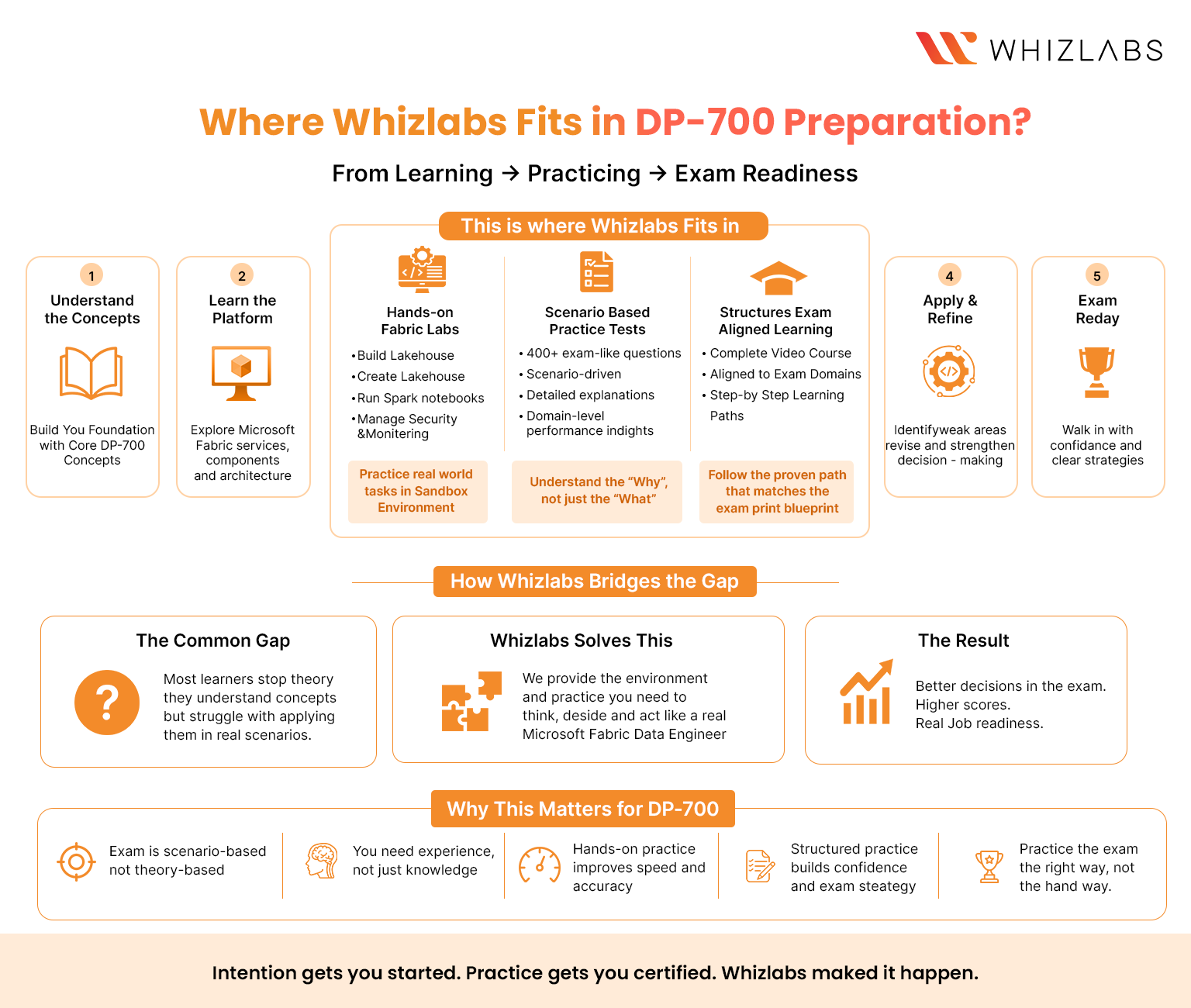
Whizlabs is the only platform in this comparison that covers all five criteria for Exam DP-700: Microsoft Fabric Data Engineer Associate, specifically. The course includes 102 video modules, 26 hands-on lab scenarios across the three exam domains, and 200 practice questions with domain-level performance tracking. That’s the gap between understanding the concepts and being ready to apply decisions under exam conditions.
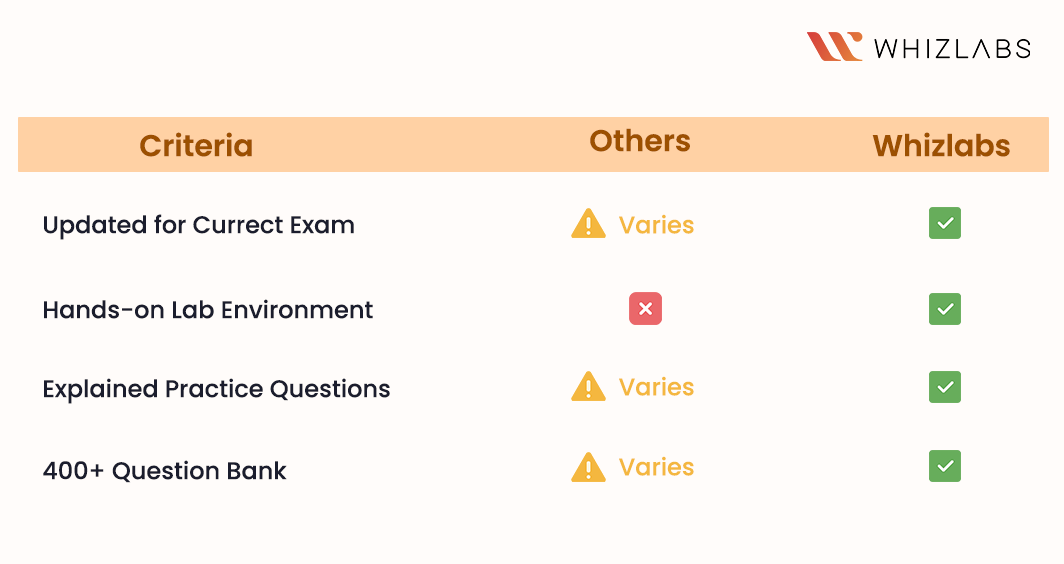
Why do you think Whizlabs resources fit in naturally in DP 700 Preparations?
At this point, execution matters more than intention. What actually helps:
- Hands-on Fabric labs – building Lakehouses, running pipelines, working with Spark
- Scenario-based practice tests – understanding why one decision works over another
- Structured learning paths – aligned to how the exam is actually designed
That’s where platforms like Whizlabs come in, not as “extra material,” but as the environment where you actually practice what the exam expects.
DP 700 Exam Microsoft Fabric Data Engineer certification resources in Whizlabs are not passive learning, but an execution layer of your preparation. Instead of just reading about:
- data ingestion → you build pipelines
- transformations → you run notebooks
- monitoring → you troubleshoot real scenarios
Practice tests go beyond right or wrong answers
- The explanation of why a choice is correct
- Where your reasoning breaks
- Which domains do you need to work on
That feedback loop is what improves performance. Because the DP-700 exam doesn’t reward recall, it evaluates how you approach decisions inside a real Fabric environment.
Bridging the gap between knowing concepts and applying them under pressure, Whizlabs provide a clear space to practice and gain practical readiness.
Best Resources to Prepare for DP-700 in 2026
Not all DP-700 prep resources are built the same, and for a platform as new as Microsoft Fabric, the quality gap between providers is wider than usual. Here’s how to evaluate what you’re looking at, and what the field currently looks like.=
At this point, your roadmap is clear. Now the risk is choosing the wrong tools and losing time.
What Actually Makes a DP-700 Resource Useful?
Before comparing platforms, set your filters:
- Updated for current exam version (Fabric evolves fast, outdated content is a real risk)
- Hands-on labs (not optional, this exam is scenario-based)
- Quality of practice questions (clear explanations > answer dumps)
- Question volume (400+ ensures coverage across domains)
- Sandbox access (so you’re not blocked by setup or cost)
If a resource misses even 2 of these, it will slow you down.
Free Resources Worth Using Alongside
Even with a structured platform, you should layer in:
- Microsoft Learn (DP-700 path) → Best for concept clarity
- Official skills outline (PDF) → Use as your checklist
- Microsoft Fabric community blogs → Real-world implementation insights
At this point, you have a clear roadmap, the right resources and a realistic timeline. So before wrapping up, let’s address the questions that usually come up before someone finally commits to DP-700.
FAQ
1. How long does it take to prepare for DP-700?
Most candidates with a data engineering background take 6–8 weeks, and 10–12 weeks if starting from scratch. Plan for 8–10 hours per week. Hands-on lab practice shortens this timeline significantly because the exam is scenario-based, and you’re tested on decisions, not theory.
2. Is DP-700 harder than DP-203?
It’s different, not necessarily harder. DP-203 covers a broader Azure stack, while DP-700 is narrower but deeper, focused entirely on Microsoft Fabric. It involves more scenario-based reasoning and less memorisation. If you’re already familiar with Fabric concepts, DP-700 tends to feel more practical.
3. Do I need Azure experience before taking DP-700?
No, it’s not required, but it helps. Microsoft Fabric runs on Azure infrastructure, so familiarity reduces the learning curve. That said, SQL, data pipelines, and basic Python matter more than prior Azure certifications like DP-900.
4. How long is the DP-700 certification valid?
The certification is valid for one year. You can renew it for free through a short online assessment on Microsoft Learn, available 6 months before expiry. This keeps your certification aligned with how quickly Fabric is evolving.
5. Is DP-700 replacing DP-203?
Not directly, but it reflects the shift. DP-203 focuses on the older Azure data stack (ADF + Synapse), while DP-700 is aligned with Microsoft Fabric, where current investment and hiring demand are moving. For new learners, DP-700 is the forward-looking choice.
To Conclude
The salary upside is already visible. The hiring demand is already building. And the number of professionals who can confidently work on Fabric is still limited. That combination doesn’t stay stable for long.
Right now, DP-700 acts as a differentiator, a clear signal that you understand how modern data systems are built and managed in a unified platform. But as adoption scales, that signal becomes a baseline expectation. In 12–18 months, this won’t stand out. It will be expected. That’s the window. This is not a random trend-based urgency, but an evolution happening based on technology cycles.
This guide points to the same conclusion: the Microsoft Fabric Data Engineer role is real, the demand is growing faster than the supply of certified talent, and the DP-700 is the most direct path to positioning yourself in that gap.
The roadmap is clear. The window is open. The only variable is when you start. With Whizlabs, ace your DP-700 preparation and step ahead in this data-driven era with your skills.
Still have questions? Drop us an email at [email protected]. We will sort it out.

- AWS Certified AI Business Strategist AIB-C01 Exam Overview - September 10, 2026
- How does FinOps Certified Practitioner Scale Financial & Tech Careers? - July 20, 2026
- What Is Generative AI for Azure Cloud Engineers? - July 13, 2026
- From Cloud Certification Ready To Building Real Capabilities - July 2, 2026
- How to Pass AWS SOA-C03 CloudOps Engineer Associate Exam? - June 12, 2026
- Claude Certified Architect – Foundations CCA-F Exam Guide - June 4, 2026
- DP-700 Master Content Guide Microsoft Fabric Explained for Data Engineers - May 28, 2026
- DP-700 Microsoft Fabric Data Engineer Career Roadmap - May 19, 2026