

Anthropic’s First Architecture Certification CCA – F: What’s it, What It Tests, Who Should Take, and How to Prepare.
AI adoption isn’t slowing down. But the gap between teams that deploy AI and teams that architect it responsibly is getting wider. The new Claude Certified Architect – Foundations exam bridges this exact gap. The certification is built to validate candidates’ system thinking, strategic AI adoption decisions, and build the kind of enterprise architecture that holds up in production.
This guide breaks down what the Claude Certified Architect – Foundations Exam tests, who it’s built for, skills, exam format, preparation strategy & career Value, where it fits in this rapidly evolving AI landscape, and whether it matters for your 2026 career roadmap.
Is the CCA-F Claude Certified Architect – Foundations Exam Worth It in 2026?
A year ago, being “good at AI” often meant knowing how to write better prompts. But today, that bar is much higher.
Organisations are no longer experimenting with AI in isolated use cases. They’re deploying AI systems that interact with internal tools, process sensitive data, support customers, assist developers, and operate inside production environments.
The challenge has shifted from generating responses to designing systems that are reliable, secure, scalable, and governable. That’s the reason for the AI certifications’ evolution.
-
Why are AI Certifications Evolving?
So far, AI certifications have focused on understanding models, services, or individual tools. But the market is now moving toward something different: system-level expertise.
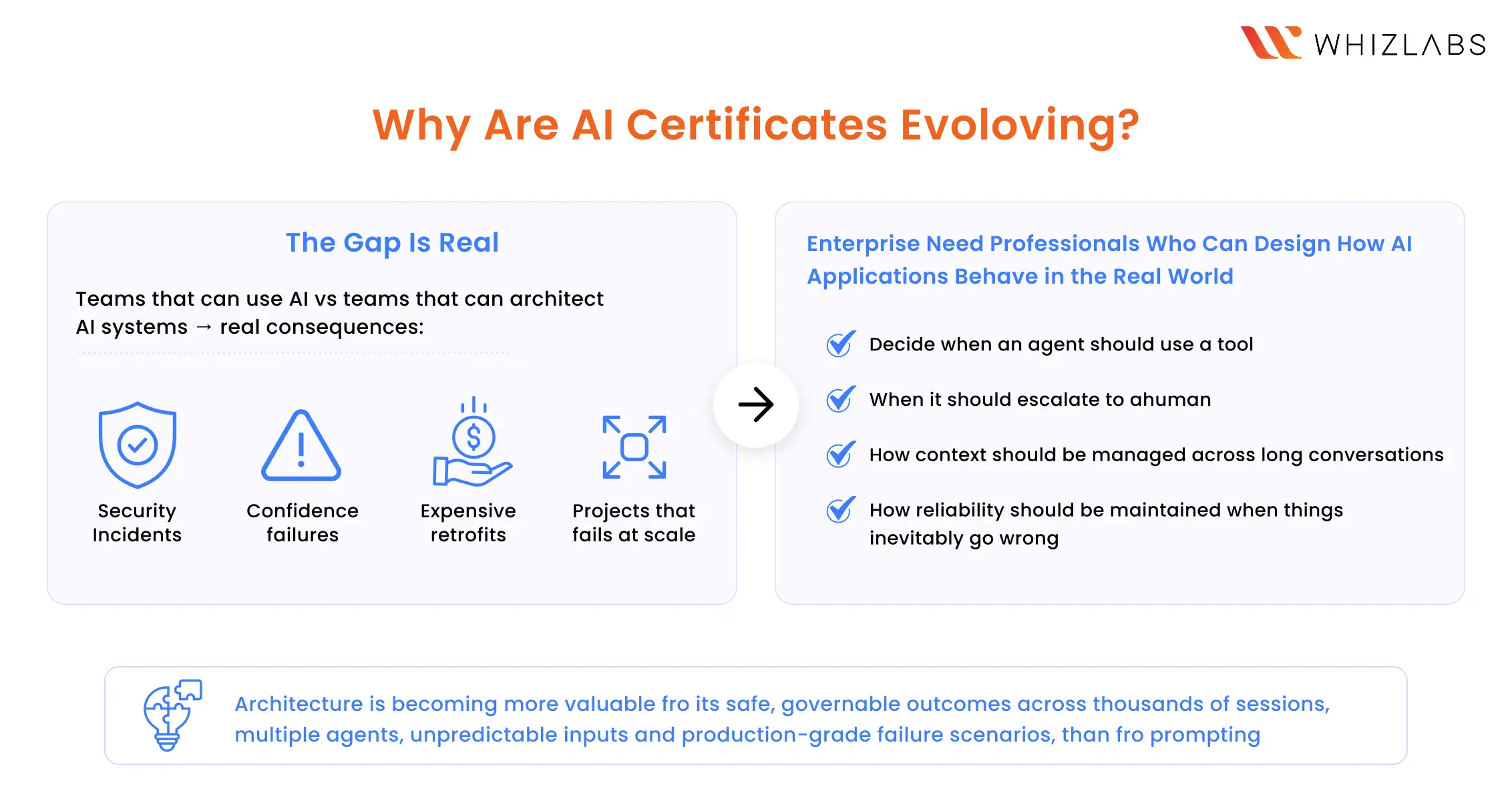
While the gap between teams that use AI and teams that architect AI systems is now generating real consequences: security incidents, compliance failures, expensive retrofits, and AI projects that looked good in demos and fell apart at scale.
This made Enterprise teams need professionals who can design how AI applications behave in the real world. This includes
- Deciding when an agent should use a tool
- When it should escalate to a human
- How context should be managed across long conversations, and
- How reliability should be maintained when things inevitably go wrong.
In other words, architecture is becoming more valuable for its safe, governable outcomes across thousands of sessions, multiple agents, unpredictable inputs, and production-grade failure scenarios, than for prompting.
-
What makes the CCA-F Exam Different from others?
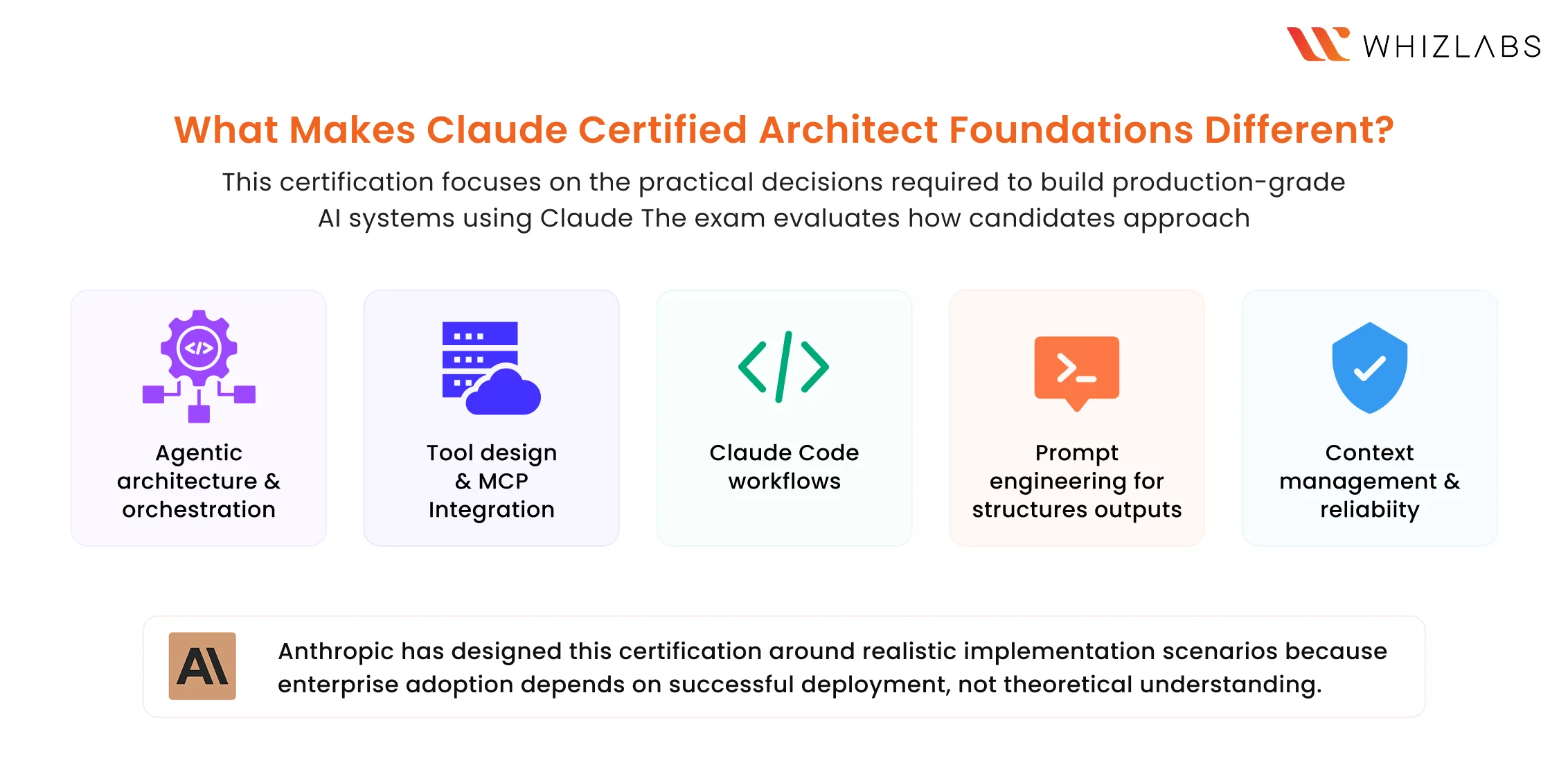
The Claude Certified Architect – Foundations certification focuses on the practical decisions required to build production-grade AI systems using Claude. The exam evaluates how candidates approach:
- Agentic architecture and orchestration
- Tool design and MCP integration
- Claude Code workflows
- Prompt engineering for structured outputs
- Context management and reliability
Anthropic has designed this certification around realistic implementation scenarios because enterprise adoption depends on successful deployment, not theoretical understanding.
Three things make this certification distinct in the enterprise AI market:
- Focus on decision-making. Every exam question is anchored in a scenario. You are always choosing a production context, not recalling a definition.
- Focus on enterprise implementation. The six scenarios that anchor the exam are drawn directly from real Anthropic customer deployments: customer support agents, multi-agent research systems, CI/CD integrations, and structured data extraction pipelines.
- Focus on responsible AI. Governance, safety, and reliability topics run through every domain. The ability to enforce business rules programmatically, design escalation logic that protects users, and build systems that fail safely rather than silently are the core competencies the exam measures.
Claude Certified Architect – Foundations Certification (CCA-F) – What is this about?
The launch of this Certification is Anthropic’s answer to a specific question: How do you verify that a practitioner can design, build, and operate production-grade AI systems using Claude responsibly and at scale?
The Claude Certified Architect – Foundations (CCA-F) exam was launched in March 2026 as part of Anthropic’s $100 million Claude Partner Network investment. It is the first and currently the only official technical certification from Anthropic. It is a proctored, scenario-based exam that tests architectural judgment. And it was built for practitioners who are already working with Claude in production environments, not for those just getting started.
Here, the framing matters the most: This is an architecture certification that distinguishes everything about what it tests, who it is for, and why it exists.
Anthropic’s First Architecture Certification Explained
Why did Anthropic create this certification?
Anthropic created it because enterprise AI adoption created a specific, verifiable problem that the market had no clean solution for.
The problem: as Claude deployments moved into production, the quality of the architectural decisions being made around these deployments started to matter enormously. Not just for performance but for safety, governance, reliability, and the kind of long-term maintainability that enterprise infrastructure requires. And there was no standard way to verify if a practitioner could make these decisions well.
Anthropic noticed that consulting firms, systems integrators, and enterprise engineering teams were building with Claude at scale. Some do it genuinely with architectural depth. While others do it with the level of familiarity that worked in demos, and created problems in production.
Both of these look identical on Resumes. Now the CCA-F exam distinguishes the two.
What is the main objective of the Claude Certified Architecture – Foundation Certification?
The certification objective is precise: validating the ability to design, implement, and optimise production-grade solutions using the Claude ecosystem. This includes the Claude Agent SDK, Claude Code, and the Model Context Protocol (MCP). The ability to make correct architectural decisions using them under conditions that production environments actually create.
What skills does the Claude Certified Architect- Foundations Exam validates?
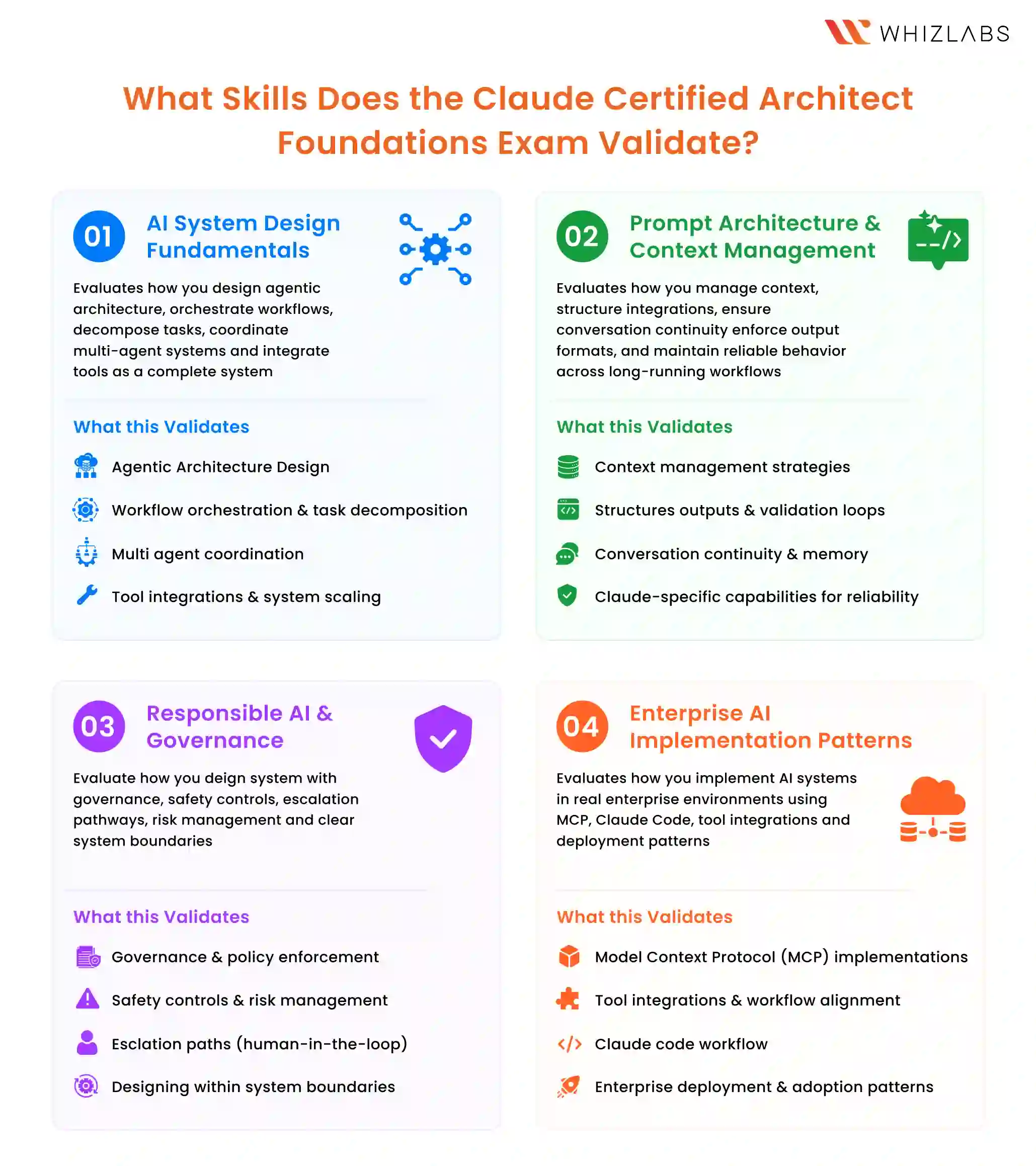
The exam reflects a broader shift happening across the industry. As organisations move from AI experimentation to AI implementation, technical knowledge alone is no longer enough. This is exactly what the certification is designed to measure. At the highest level, the Claude Certified Architecture – Foundation Certification validates four things:
- AI System Design Fundamentals
The exam evaluates how candidates think about agentic architectures, workflow orchestration, task decomposition, multi-agent coordination, and tool interactions. Rather than focusing on individual features, it focuses on how those features work together as a complete system.
This domain aligns closely with Anthropic’s focus on agentic architecture, orchestration patterns, session management, and workflow design. So basically the underlying question is: Can you design systems that scale beyond a demo environment?
- Prompt Architecture and Context Management
The certification evaluates how architects manage context, structure interactions, maintain conversation continuity, enforce output formats, and ensure reliable behaviour across long-running workflows.
In real-world systems, context becomes infrastructure. Architects must decide what information should persist, how memory should be managed, when retrieval should occur, and how structured outputs should be validated before downstream systems consume them.
This is where prompt engineering evolves into prompt architecture. The exam tests how candidates use structured outputs, validation loops, context management strategies, and Claude-specific capabilities to improve reliability rather than simply improve responses.
- Responsible AI and Governance
One of the clearest signals Anthropic sends through this certification is that responsible AI is not a compliance exercise; it’s an architectural responsibility. The exam evaluates how candidates think about governance, safety controls, escalation pathways, risk management, and system boundaries.
Enterprise AI systems often operate in environments involving customer data, business decisions, compliance requirements, and organisational policies. As a result, architects must understand not only what an AI system can do, but what it should do.
- Enterprise AI Implementation Patterns
The certification tests how candidates approach deployment patterns, tool integrations, Model Context Protocol (MCP) implementations, Claude Code workflows, and enterprise adoption scenarios.
These questions reflect the decisions architecture teams face every day:
- When should a tool be exposed to an AI system?
- How should AI interact with existing workflows?
- Where should governance controls be applied?
- How should errors propagate across interconnected systems?
- What is the safest and most reliable implementation approach?
These questions are similar to what the organisations must consider as AI becomes a permanent part of their technology stack.
That is ultimately what the Claude Certified Architect – Foundations certification validates: not familiarity with Claude, but the architectural thinking required to use it responsibly and effectively in the real world.
Why do Enterprise Teams need AI Architects, not just AI Users?
Enterprise AI has moved beyond experimentation. They look out for professionals to handle how AI systems should be governed, integrated, monitored, and scaled across real business environments.
It’s creating a new demand for a new type of practitioner: the AI Architect.
Unlike developers or prompt engineers focused on individual interactions, AI Architects design how AI systems operate across workflows, teams, data sources, and business processes. They make decisions about orchestration, reliability, tool access, governance, escalation paths, and operational risk.
This shift is already visible across enterprise deployments of Claude. Organisations are building customer support agents, internal knowledge assistants, research workflows, developer productivity tools, and AI-powered business applications. In each case, success depends less on the model itself and more on how the surrounding system is designed.
That’s also why architectural thinking is beginning to matter more than prompting alone.
As AI adoption matures, organisations increasingly need professionals who can think beyond model capabilities and design AI systems that operate safely and reliably in production. The Claude Certified Architect – Foundations certification reflects that shift by validating the architectural decision-making skills enterprise teams are actively trying to build.
Who benefits from this CCA-F Exam Certification?
- AI Engineers building applications with Claude
- Solution Architects designing AI-powered systems
- Technical Consultants advising enterprise AI adoption
- Platform and DevOps Engineers integrating AI into workflows
- Enterprise Innovation Teams are responsible for producing AI initiatives
The CCA-F exam is worth pursuing if you are building with Claude in production or preparing. It is worth waiting on if you are still in the early stages of working with the ecosystem and would need to build significantly more hands-on experience before the exam’s scenario-based questions would feel navigable.
Anthropic describes CCA-F certifications as a 301-level exam for practitioners with foundational knowledge ready to demonstrate deeper, applied expertise. The “Foundation” label reflects where it sits in the certification roadmap; more certifications are coming later in 2026, not the difficulty of what it tests.
What Domains are covered in the CCA-F Exam Certification?
| Domain | Weight | What It Tests |
| Agentic Architecture & Orchestration | 27% | Design of multi-agent systems, task decomposition, workflow orchestration, agent coordination, and maintaining reliable state across production AI workflows. |
| Claude Code Configuration & Workflows | 20% | Configuring Claude Code for team-scale development environments, including CLAUDE.md hierarchy, custom commands, development workflows, and CI/CD integration. |
| Prompt Engineering & Structured Output | 20% | Creating prompts that generate reliable, validated, and structured outputs for automated systems rather than one-off interactions. |
| Tool Design & MCP Integration | 18% | Designing tool interfaces that Claude can use effectively under ambiguity and integrating external systems through the Model Context Protocol (MCP). |
| Context Management & Reliability | 15% | Managing long-context AI systems, conversation continuity, escalation logic, error handling, reliability strategies, and production-grade AI operations. |
What to Expect in Claude Certified Architect – Foundations Exam?
By now, you would have gotten a picture of the certification and the trend movement. Let’s now get into your next question: what does the exam actually look like?
The Claude Certified Architect – Foundations (CCA-F) exam is designed as a scenario-based assessment that measures architectural decision-making rather than memorisation. Candidates are expected to evaluate realistic AI implementation challenges, identify the most effective solution, and apply sound architectural judgment across a variety of enterprise scenarios.
Claude Certified Architect – Foundations Exam Details
| Exam Component | Details |
| Certification | Claude Certified Architect – Foundations (CCA-F) |
| Issued By | Anthropic |
| Exam Format | Scenario-based Multiple Choice |
| Number of Questions | 60 Questions |
| Duration | 120 Minutes |
| Passing Score | 720 / 1000 |
| Exam Cost | $99 USD |
| Delivery Method | Online Proctored |
| Experience Level | Intermediate to Advanced |
| Recommended Audience | AI Engineers, Solution Architects, Technical Consultants |
| Certification Badge | Digital Badge upon Passing |
Difficulty Level of CCA-F Exam
Anthropic describes the certification as a practitioner-level exam designed for professionals who already possess foundational AI knowledge and some hands-on experience working with Claude-powered applications.
This is not a beginner certification.
Candidates are expected to understand AI workflows, prompt engineering fundamentals, tool integrations, architectural trade-offs, and enterprise deployment considerations before attempting the exam.
Where CCA-F Certification fits in the AI Certification Landscape?
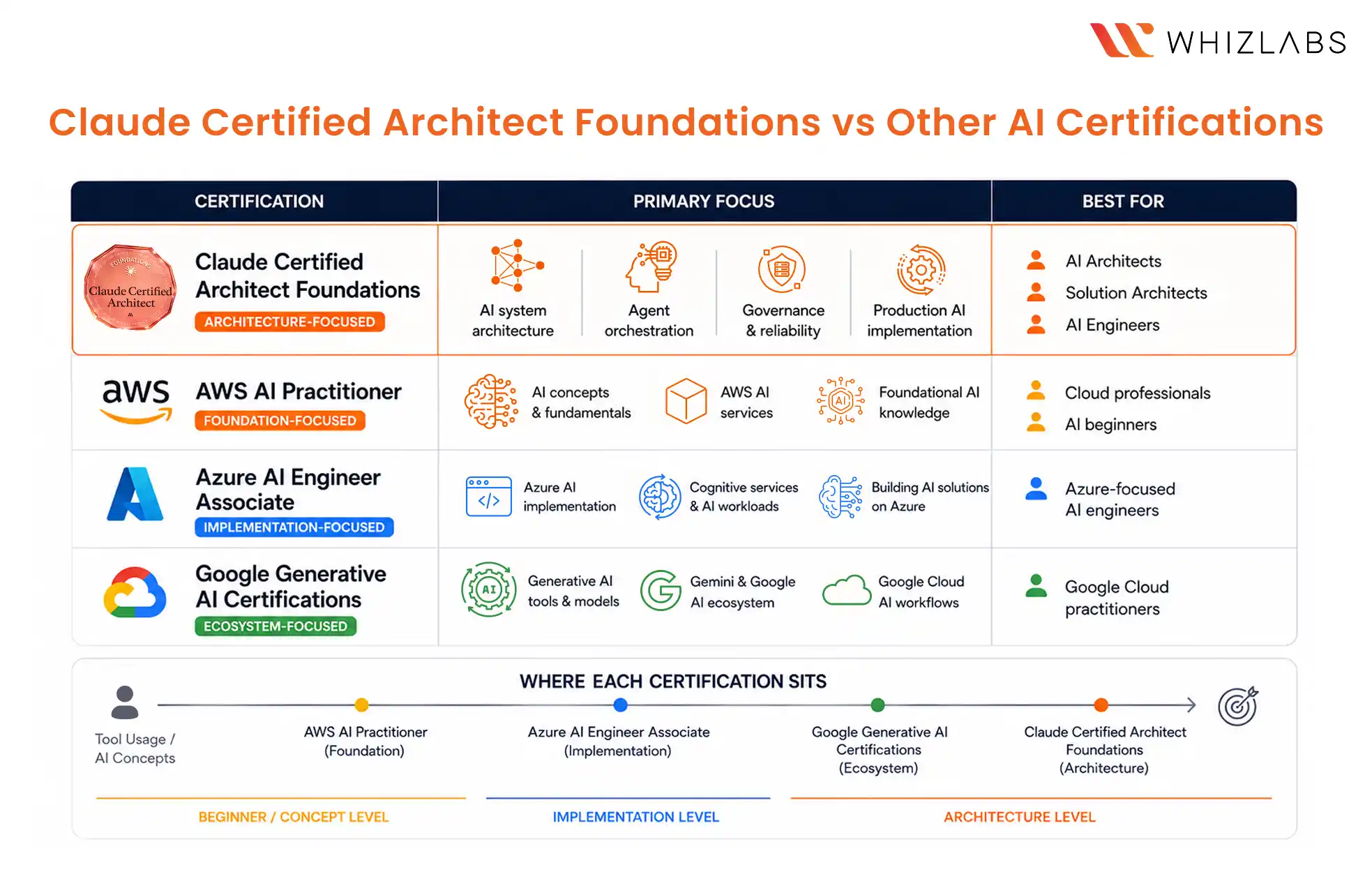
The certification trajectory that exists so far is based on platform breadth (AWS, Azure, GCP, etc) and concept-based. But the CCA-F occupies a different ground. It is catered specifically to the Claude ecosystem and the Claude-based development’s architectural patterns requirement. And every question here is anchored in a real scenario and tests decision-making.
The closest analogy is the AWS Solutions Architect certification, which validates architectural judgment in a specific ecosystem rather than general familiarity. The CCA-F does the same thing for the Claude ecosystem.
As the Claude Certified Architect – Foundations certification enters the market, it’s populated with AI and cloud credentials from AWS, Microsoft, and Google. However, it occupies a noticeably different position.
Claude Certified Architect – Foundations vs Other AI Certifications
What Career Paths align with CCA-F Certification?
As enterprise AI adoption continues to mature, several roles are emerging that align naturally with the skills validated by this certification:
- AI Architect – Designing enterprise-grade AI systems, workflows, and governance frameworks.
- AI Solutions Consultant – Advising organisations on AI implementation strategies and architectural best practices.
- AI Product Lead – Guiding AI-powered products from experimentation into scalable production systems.
- Enterprise AI Strategist – Defining how AI capabilities align with business goals, risk frameworks, and operational processes.
- AI Platform Lead – Building the internal platforms, tooling, and standards that enable responsible AI adoption across an organisation.
Who should take the Claude Certified Architect – Foundations Certification?
The Claude Certified Architect – Foundations CCA-F certification was designed for professionals who are already moving beyond AI experimentation and into AI implementation. It assumes you’re thinking about systems, workflows, governance, reliability, and architecture, not simply how to generate better outputs from a model.
That’s why the ideal candidate is often not the person writing the most prompts. It’s the person making decisions about how AI should work inside a business.
Strong Fit: Who are most likely to attempt the CCA-F Certification?
The CCA-F certification aligns particularly well with professionals who are responsible for designing, implementing, or governing AI-powered systems.
- AI Architects – If you’re defining how AI capabilities integrate into enterprise platforms, applications, workflows, and business processes, this certification directly maps to your day-to-day responsibilities.
- Solution Architects – Many solution architects are already being asked to incorporate AI capabilities into customer-facing and internal systems. The exam validates the architectural thinking required to make those decisions confidently.
- AI Engineers – AI engineers building production applications with Claude, agentic workflows, MCP integrations, or Claude Code will find strong alignment between the exam objectives and their practical work.
- Technical Leads and Engineering Managers – Leaders responsible for guiding AI initiatives often need a broader understanding of governance, orchestration, reliability, and implementation patterns beyond coding alone.
- Enterprise Innovation Teams – Organisations building AI Centres of Excellence (CoEs), internal AI platforms, or strategic AI programs can use the certification as a common benchmark for architecture-level capability.
Who should wait before taking the CCA-F Exam?
Just as important as knowing who should take the certification is knowing who may benefit from waiting.
- Complete Beginners to AI: If you’re still learning foundational concepts such as LLMs, prompting, retrieval, or AI application development, you’ve got some time.
- Non-Technical Users: Business users exploring AI productivity tools may find the certification unnecessarily technical for their current needs.
- Professionals Without Hands-On LLM Experience: Candidates who have never worked with AI systems, APIs, workflows, or agent-based applications may struggle to connect the scenarios to real-world experience.
Why Does “Foundations” Not Mean Beginner?
In many certification programs, foundation-level credentials are designed for newcomers. That’s not the case here. Anthropic positions the Claude Certified Architect – Foundations certification as an entry point into AI architecture, not an introduction to AI itself.
How to Prepare for the Claude Certified Architect – Foundations Exam?
The CCA-F candidates most likely to succeed are those who spend less time memorising features and more time understanding trade-offs, governance decisions, reliability patterns, and real-world implementation scenarios.
Knowledge Prerequisites: What you should know before you start
Before beginning exam preparation, you should be comfortable with a few foundational concepts:
- Basic understanding of Large Language Models (LLMs)
- Experience using Claude or similar AI systems
- Familiarity with prompt engineering concepts
- Understanding of APIs and system integrations
- Basic software architecture principles
- General awareness of governance, security, and operational risk
You don’t need to be a machine learning engineer. You do need enough experience to understand how AI systems behave once they’re deployed into real environments.
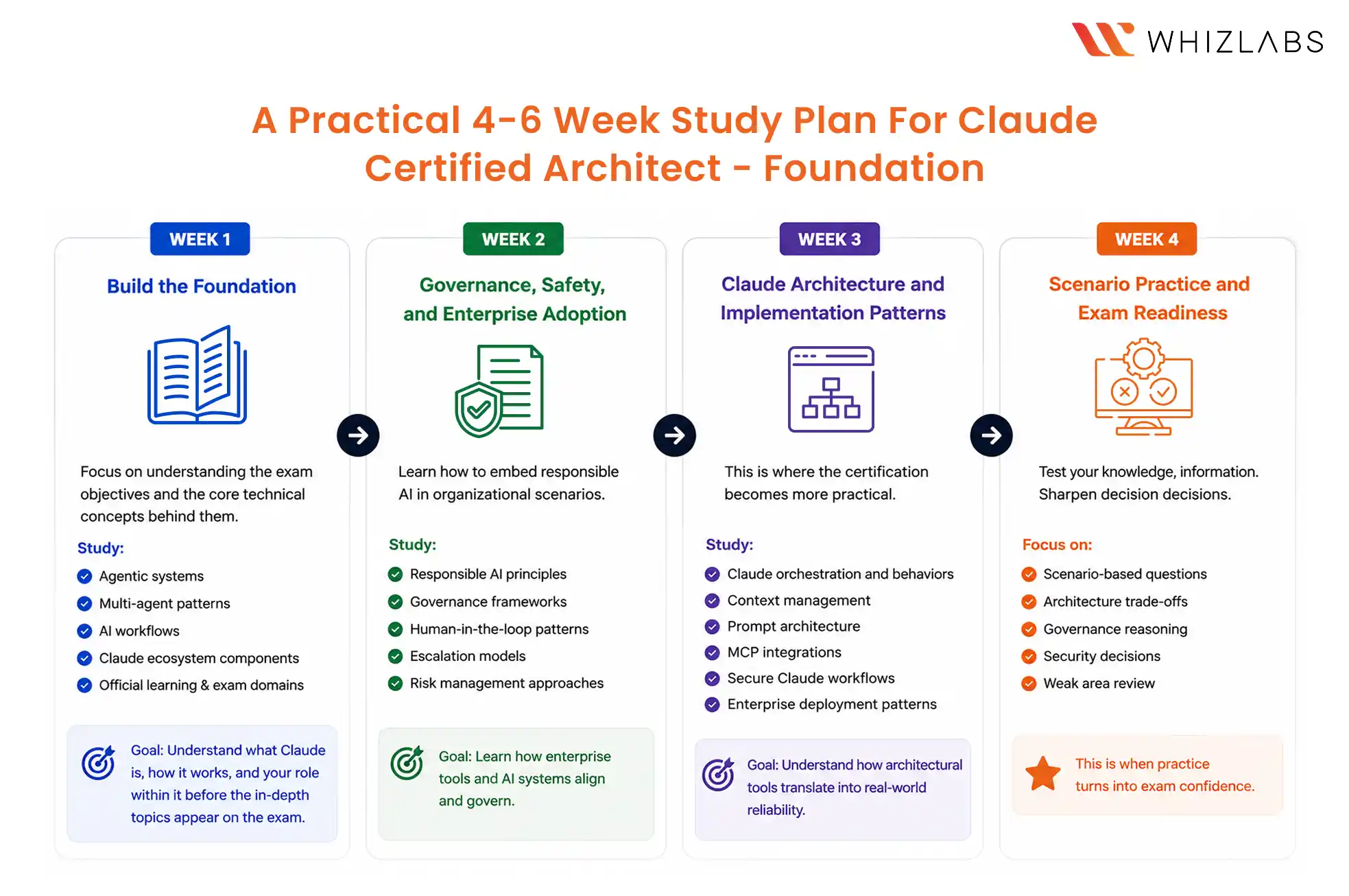
Practical 4–6 Week Study Plan for Claude Certified Architect – Foundations
Most candidates can realistically prepare in four to six weeks, depending on their existing experience with AI systems and architecture concepts for CCA-F exam.
Week 1: Build the Foundation
Focus on understanding the exam objectives and the architectural concepts behind them.
Study:
- Agentic systems
- Multi-agent patterns
- AI workflows
- Claude ecosystem components
- Official Anthropic exam domains
Goal: Understand what Anthropic is trying to validate, not just what topics appear on the blueprint.
Week 2: Governance, Safety, and Enterprise Adoption
Shift from technical capabilities to organisational concerns.
Study:
- Responsible AI principles
- Governance frameworks
- Human-in-the-loop patterns
- Escalation models
- Risk management approaches
Goal: Learn how enterprises think about AI systems after deployment.
Week 3: Claude Architecture and Implementation Patterns
This is where the certification becomes more practical.
Study:
- Claude’s capabilities and limitations
- Context management
- Prompt architecture
- MCP integrations
- Claude Code workflows
- Enterprise deployment patterns
Goal: Understand how architectural decisions influence reliability and scalability.
Week 4: Scenario Practice and Exam Readiness
Stop collecting information. Start making decisions.
Focus on:
- Scenario-based questions
- Architecture trade-offs
- Governance reasoning
- Reliability decisions
- Weak area review
This is where structured practice becomes most valuable.
Whizlabs Claude Certified Architect – Foundations Practice Tests are useful at this stage because they mirror the decision-heavy nature of the real exam.
Rather than simply testing recall, they expose you to realistic architectural scenarios involving agent orchestration, governance considerations, MCP integrations, context management, and production AI workflows.
If you need additional preparation time, use Weeks 5 and 6 exclusively for scenario practice and targeted revision.
Why Practice Tests matter more than reading documentation?
Candidates who only consume documentation often feel surprised by scenario-based certifications.
- You can understand what MCP is and still struggle with a question asking when it should be implemented.
- You can understand context management and still struggle to choose the best architecture for a long-running agent workflow.
- Practice questions force you to move from knowledge to decision-making. They expose gaps that reading rarely reveals.
The goal is to understand the reasoning behind architectural choices and develop confidence in evaluating competing solutions. This is also why high-quality practice tests matter. The closer your preparation resembles real implementation decisions, the more prepared you’ll be on exam day.
Common Mistakes candidates make during CCA-F preparation
- Treating It Like a Product Knowledge Test
The exam cares far more about how those features should be used within a larger system than theories.
- Ignoring Governance and Safety Topics
Governance can feel less exciting; unfortunately, it’s also one of the areas many candidates underestimate. Enterprise AI systems succeed or fail based on governance decisions as much as technical ones.
- Focusing Only on Models and Prompting
Prompt engineering matters, but it represents only one layer of the exam. Architecture, orchestration, reliability, context management, and implementation decisions carry equal weight.
- Skipping Scenario Practice
This exam rewards judgment. Judgment develops through practice, not passive reading. Candidates who never expose themselves to realistic architecture scenarios often struggle when multiple answers appear technically correct, and the exam asks for the best one.
- Underestimating the “Foundations” Label
This certification may be called Foundations, but it is foundational to the AI Architect role, not foundational to AI itself.
Best Resources for Claude Certified Architect – Foundations Exam preparation
The most effective preparation strategy for the Claude Certified Architect – Foundations Exam is combining official resources, real-world implementation knowledge, and scenario-based practice.
And the good news here is that Anthropic has already published a strong foundation of learning resources, and the certification itself is built around practical architectural thinking rather than obscure product trivia.
- Official Anthropic Resources
Anthropic Academy provides a growing collection of learning paths covering Claude fundamentals, Claude API development, Model Context Protocol (MCP), Claude Code workflows, and enterprise implementation concepts.
Candidates preparing for the exam should pay particular attention to:
- Claude 101
- Building with the Claude API
- Introduction to Model Context Protocol (MCP)
- Claude Code in Action
- Official Claude Certified Architect – Foundations study materials
These resources establish the conceptual foundation that the exam expects.
- Documentation and Learning Materials
Beyond formal training, Anthropic’s documentation remains one of the most valuable preparation resources available. Focus on understanding:
- Agentic architecture patterns
- MCP implementation principles
- Claude Code workflows
- Context management strategies
- Structured output techniques
- Governance and safety guidance
- Community Resources
Study guides, GitHub repositories, architecture discussions, implementation walkthroughs, and practitioner blogs can provide valuable perspectives on how teams are deploying Claude in production environments.
These resources often help bridge the gap between official documentation and real-world implementation.
Whizlabs Practice Tests for the CCA-F Exam
The more exposure you have to architecture trade-offs, governance decisions, orchestration patterns, and implementation scenarios, the more comfortable you’ll become evaluating the kinds of decisions the exam presents.
And this is not just possible with document and concept understanding. Therefore, bringing the need for a Pa practice test.
Whizlabs Claude Certified Architect – Foundations Practice Tests are designed specifically around the decision-making style of the real exam. The preparation package includes:
- 360+ practice questions
- Six full-length practice exams
- Scenario-based architectural challenges
- Governance and reliability-focused questions
- Agentic workflow and MCP scenarios
- Detailed explanations for every answer
Rather than focusing on memorisation, the practice tests help candidates develop the reasoning process required for architecture-level decisions. That makes them particularly valuable during the final stages of preparation when you’re moving from learning concepts to building exam readiness.
What to expect after you pass the Claude Certified Architect – Foundations Exams?
The Claude Certified Architect – Foundations certification is more valuable because it validates how you think. Passing the exam signals that you understand the architectural considerations involved in building AI systems that are reliable, scalable, governable, and ready for production environments.
For employers, consulting firms, and enterprise teams, that’s becoming an increasingly important distinction.
- It’s a Stronger Signal Than Technical Familiarity: As AI adoption matures, organisations are looking beyond prompt engineering skills and tool familiarity. The certification provides a structured way to demonstrate that capability.
- The Beginning of a Larger Certification Journey: The Foundations credential is expected to become the first step in Anthropic’s broader certification ecosystem. For many candidates, passing Foundations will be the starting point rather than the destination.
- Growing Relevance in Enterprise AI Conversations: Organisations are increasingly formalising AI adoption through governance programs, AI Centres of Excellence (CoEs), architecture review boards, and enterprise AI initiatives. The value is being able to participate more confidently in conversations about AI implementation, governance, deployment strategy, and organisational adoption.
- The Long-Term Advantage of Being Early: The Claude Certified Architect Foundations certification sits at the intersection of AI systems design, governance, enterprise adoption, and architectural thinking. That’s what makes it strategically interesting and opens up new possibilities.
CCA-F Exam FAQ
1. What is the Claude Certified Architect – Foundations certification?
The Claude Certified Architect- Foundations (CCA-F) certification is Anthropic’s first professional certification for AI architects, engineers, and solution designers. It validates your ability to design, implement, govern, and optimise AI systems powered by Claude.
2. Is the Claude Certified Architect – Foundations exam hard?
Yes, the exam is challenging for candidates without hands-on experience building AI systems. Candidates with experience in AI workflows, system design, or enterprise technology projects typically find the exam more approachable.
3. Is the Claude Architect Certification worth it?
The certification is worth considering for professionals working with enterprise AI initiatives, AI architecture, solution design, or AI implementation consulting. Its value is strongest for professionals responsible for designing AI systems rather than simply using AI tools.
4. Do I need coding experience for Claude Certified Architect – Foundations?
Some technical experience is recommended. Familiarity with Claude APIs, prompt engineering, or AI application development will make CCA-F exam preparation significantly easier.
5. How long should I study for Claude Architect – Foundations?
Most candidates can prepare in four to six weeks with consistent study. Professionals already working with AI systems may need less time, while those new to AI architecture may require additional preparation.
6. How much does the Claude Certified Architect – Foundations exam cost?
The exam costs $99 USD per attempt. Anthropic initially offered free access for the first 5,000 employees of organisations participating in the Claude Partner Network.
7. What are the best Claude Architect practice tests?
The best practice tests mirror the exam’s scenario-based format and focus on architectural decision-making rather than memorisation. Whizlabs offers practice tests with questions covering agentic systems, MCP integration, governance, reliability, context management, and enterprise AI implementation.
The Real Opportunity isn’t the Certification
Every major technology shift creates a period in which demand outpaces expertise. Enterprise AI is beginning to create a similar momentum as Cloud Architecture did a decade ago, creating massive opportunities for professionals who quickly adopted the shift.
The conversation is no longer about whether organisations will adopt AI. That question has already been answered. The challenge now is figuring out how AI systems should be designed, governed, integrated, and scaled across real business environments.
That’s where architectural thinking becomes valuable.
The CCA-F exam, which validates your ability to think through the decisions that determine whether an AI system succeeds in production or fails after the pilot phase, is the start of this era.
The Claude Certified Architect – Foundations certification is one of the few new credentials in 2026 that may genuinely be worth being early to, for the capability it represents.
If you’re ready to approach the exam with structure and confidence, Whizlabs Claude Certified Architect – Foundations Practice Tests can help you prepare through realistic scenarios, architecture-focused questions, and exam-style decision-making practice designed around the way the certification is actually tested.
The opportunity isn’t the certification.
The opportunity is to understand where enterprise AI is heading next and to position yourself before the rest of the market catches up.
Are you ready? Step up smarter with Whizlabs Practice Tests for the Claude Certified Architect – Foundations exam. Transform architecture concepts into the decision-making confidence that’s required to design AI systems that work in the real world.

- AWS Certified AI Business Strategist AIB-C01 Exam Overview - September 10, 2026
- How does FinOps Certified Practitioner Scale Financial & Tech Careers? - July 20, 2026
- What Is Generative AI for Azure Cloud Engineers? - July 13, 2026
- From Cloud Certification Ready To Building Real Capabilities - July 2, 2026
- How to Pass AWS SOA-C03 CloudOps Engineer Associate Exam? - June 12, 2026
- Claude Certified Architect – Foundations CCA-F Exam Guide - June 4, 2026
- DP-700 Master Content Guide Microsoft Fabric Explained for Data Engineers - May 28, 2026
- DP-700 Microsoft Fabric Data Engineer Career Roadmap - May 19, 2026