If you work in cloud operations: managing infrastructure, keeping systems healthy, automating deployments, handling incidents, the AWS Certified CloudOps Engineer Associate (SOA-C03) is one of the most directly relevant certifications you can earn.
The exam doesn’t validate you for theories but analyses your AWS services knowledge and experience to test whether you can operate, monitor, automate, secure, troubleshoot, and recover in real-world conditions that cloud operations professionals deal with every day.
In this guide, let’s walk you through everything you need to know to prepare for and pass the AWS SOA-C03 exam – from what the exam covers, how the domains break down, what the best study strategy looks like, and where to focus your time for the highest return on exam day.
Let’s dig in.
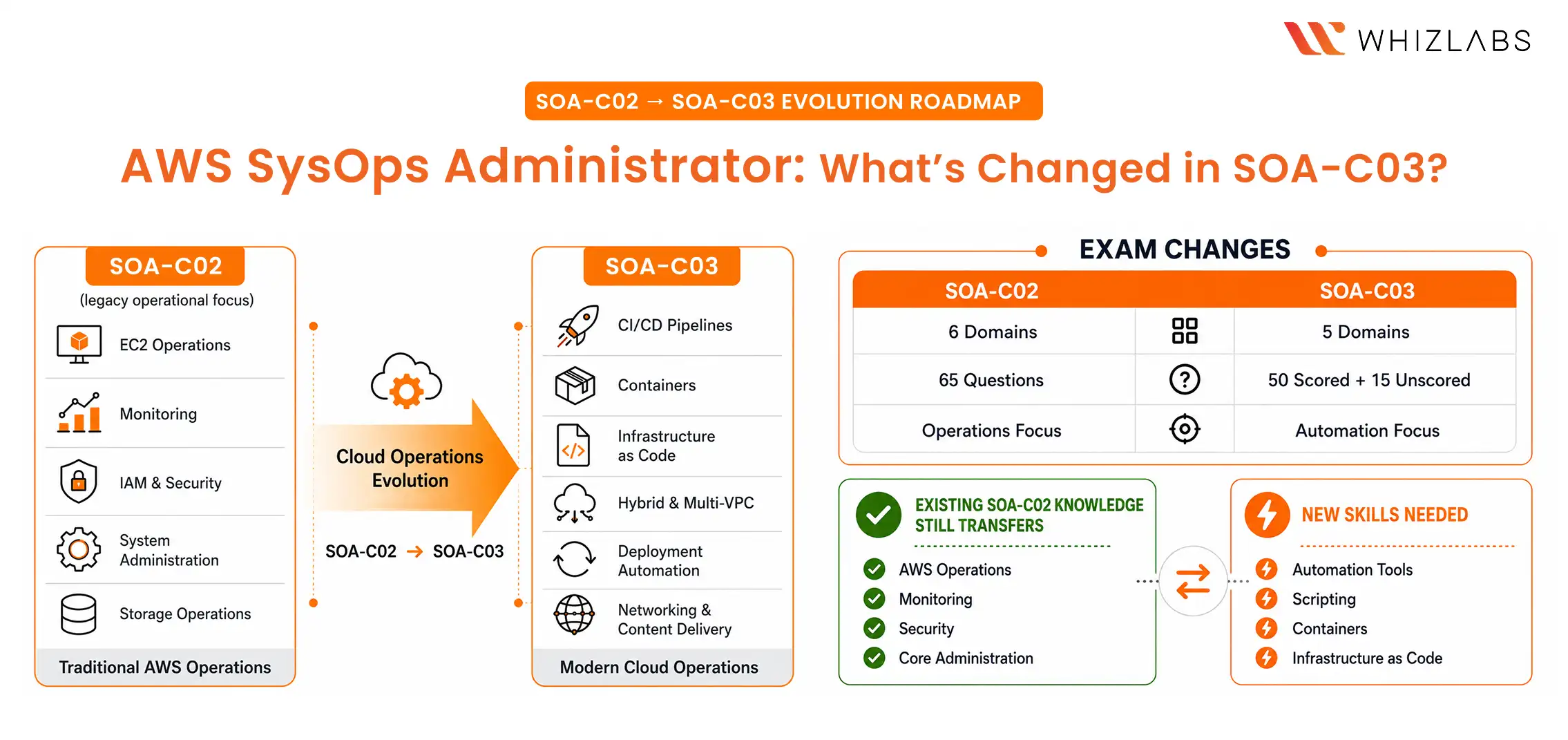
From SOA-C02 to SOA-C03: What has Changed?
If you have been searching for AWS SOA-C02 resources and landed here, the simplest answer would be: AWS SOA-C02 has been retired.
The current exam is the AWS Certified CloudOps Engineer Associate (SOA-C03), and the changes are worth understanding before you start studying.
The most visible change is the name itself. “SysOps Administrator” became “CloudOps Engineer.” This shift reflects a genuine broadening of scope.
| AWS SOA-C02 | AWS SOA-C03 |
| Focused on system administration and operational tasks on AWS. | Expands into modern cloud operations territory: CI/CD pipelines, containerised workloads, infrastructure as code, hybrid and multi-VPC environments, and automated deployment workflows. |
| Six Domains | Five Domains with increased emphasis on deployment and automation, and introduce networking and content delivery as a standalone domain. |
| Question Count: 65 | Question Count: 50 with 15 additional unscored questions. |
| If you were halfway through SOA-C02 prep, the core AWS operational knowledge transfers. | But the SOA-C03 expects you to be comfortable with automation tools, scripting, and containerization basics. |
What Is the AWS Certified CloudOps Engineer – Associate (SOA-C03)?
The AWS Certified CloudOps Engineer Associate (SOA-C03) is an AWS certification that validates your ability to deploy, manage, and operate workloads on AWS. It is designed for cloud operations engineers with at least one year of hands-on AWS experience in deployment, management, troubleshooting, networking, and security. A passing score of 720 out of 1000 is required.
Beyond the definition, here is what the exam is actually testing.
- Keep AWS workloads running in line with the AWS Well-Architected Framework
- Use the AWS Management Console and AWS CLI to perform real operations tasks
- Put security controls in place that meet compliance requirements
- Monitor, log, and troubleshoot systems when things go wrong
- Apply networking concepts — DNS, TCP/IP, firewalls — in practical scenarios
- Built for high availability, performance, and capacity
- Run disaster recovery and business continuity procedures
- Identify, classify, and fix incidents
The exam assumes you have practised doing them in a real AWS environment. You have to understand that reading about CloudWatch alarms is very different from having configured one, debugged one, and understood why it fired when it shouldn’t have.
SOA-C03 Exam Format at a Glance
| Detail | Information |
| Exam Code | SOA-C03 |
| Certification Name | AWS Certified CloudOps Engineer – Associate |
| Previous Exam | SOA-C02 (AWS Certified SysOps Administrator – Associate, retired) |
| Scored Questions | 50 |
| Unscored Questions | 15 (not identified during exam) |
| Total Questions | 65 |
| Question Formats | Multiple choice, multiple response |
| Passing Score | 720 out of 1000 |
| Exam Duration | 130 minutes |
| Exam Cost | USD 150 |
| Validity | 3 years |
| Delivery | Pearson VUE, online proctored or test centre |
| Official Exam Guide | SOA-C03 Exam Guide |
AWS SOA-C03 Exam Domains Explained
The SOA-C03 is organised across five domains. Knowing the weight of each domain is important because it tells you where to spend your preparation time.
| Domain | Title | Weight |
| Domain 1 | Monitoring, Logging, Analysis, Remediation, and Performance Optimisation | 22% |
| Domain 2 | Reliability and Business Continuity | 22% |
| Domain 3 | Deployment, Provisioning, and Automation | 22% |
| Domain 4 | Security and Compliance | 16% |
| Domain 5 | Networking and Content Delivery | 18% |
Three domains carry equal weight at 22% each: Monitoring, Reliability, and Deployment. Together they account for 66% of your exam score. If you are short on time, these three are where your preparation investment has the highest return.
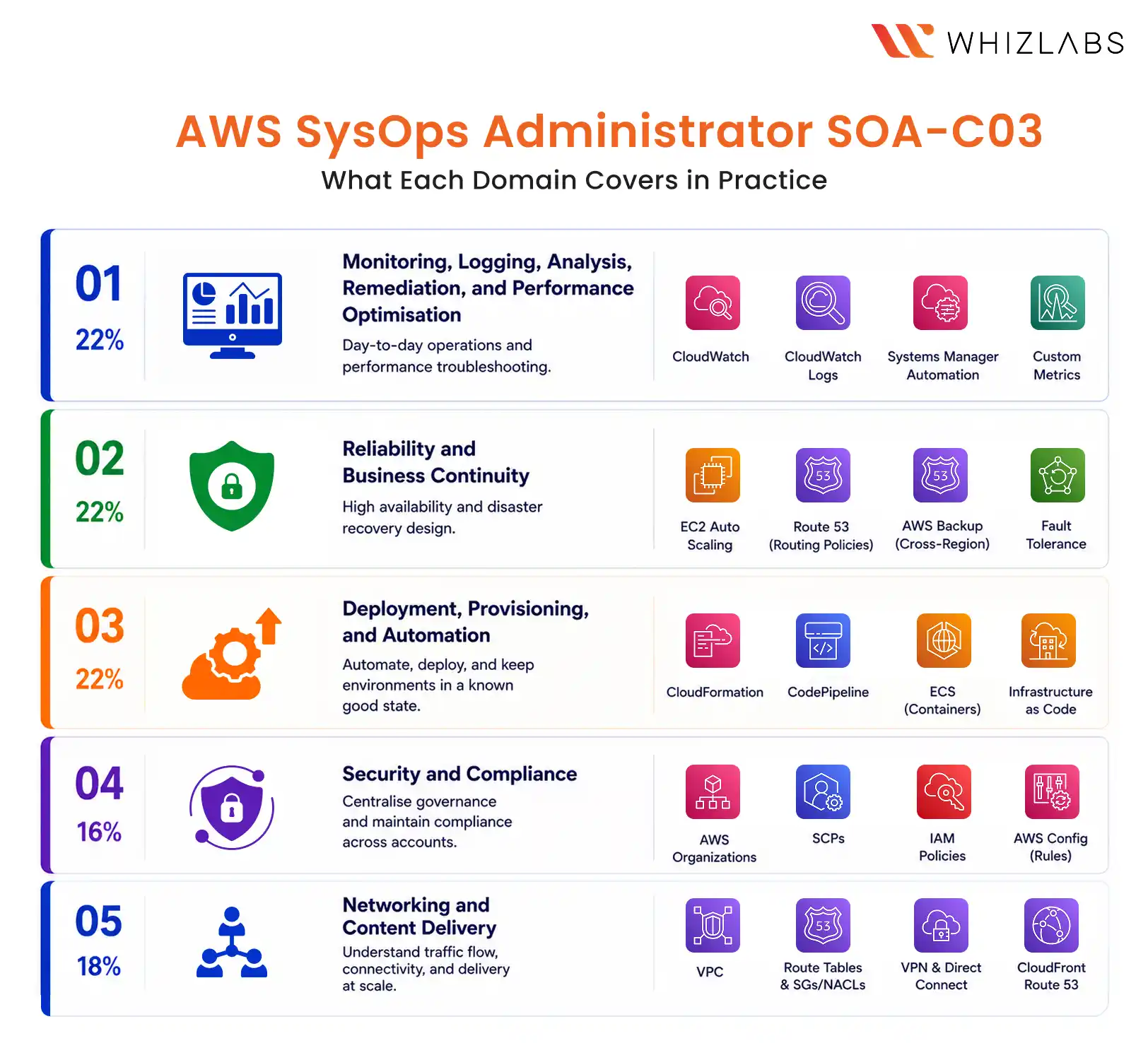
Here is what each domain actually covers in practice:
- Monitoring, Logging, Analysis, Remediation, and Performance Optimisation (22%)
This is the day-to-day operations domain. It covers configuring Amazon CloudWatch alarms, creating custom metrics, setting up log groups in CloudWatch Logs, using AWS Systems Manager Automation documents for self-healing instances, and analysing performance bottlenecks. Exam questions here tend to be scenario-based; something is wrong with a workload, and you need to identify the right combination of tools to diagnose and fix it.
- Reliability and Business Continuity (22%)
This domain includes Amazon EC2 Auto Scaling, Amazon Route 53 routing policies (failover, latency, weighted, geolocation), AWS Backup for cross-region disaster recovery, and how to design for fault tolerance when components fail. More on the lines of high availability and disaster recovery. Questions in this domain often give you an architecture and ask what happens under a specific failure condition and what you should change to prevent it.
- Deployment, Provisioning, and Automation (22%)
This is where SOA-C03 goes beyond what SOA-C02 covered. AWS CloudFormation, AWS CodePipeline, Amazon ECS for containerised workloads, and infrastructure as code practices. You are expected to understand how to deploy consistently, automate repetitive tasks, and keep environments in a known good state. Familiarity with at least one scripting language and Git basics is assumed.
- Security and Compliance (16%)
The main focus of this domain lays on AWS Organisations, Service Control Policies (SCPs), IAM policies, AWS Config rules, and how to centralise compliance across multiple accounts. Questions focus on preventing unauthorized actions and maintaining audit trails. Know the difference between what SCPs can and cannot do relative to IAM policies; this distinction shows up repeatedly in exam scenarios.
- Networking and Content Delivery (18%)
Here the focal point narrows to VPC architecture, route tables, security groups, NACLs, VPN connections, AWS Direct Connect, Amazon CloudFront, and Route 53. This domain tests your practical understanding of how traffic flows through AWS environments, and how to troubleshoot it when it doesn’t flow the way it should.
Why should you take the AWS Certified CloudOps Engineer Associate Certification?
The honest answer is that cloud operations is one of the most consistently in-demand skill sets in AWS-heavy organisations. It is also one of the most under-certified areas. Most cloud professionals chase developer or architect certifications. The CloudOps Engineer certification is a meaningful differentiator precisely because fewer people hold it.
Here is why it is worth your time:
- It validates the skills you actually use. Unlike certifications that test broad theoretical knowledge, the SOA-C03 is built around real operational tasks, monitoring, automating, troubleshooting, and recovering. If you work in cloud ops, this exam tests your actual job.
- The salary ceiling is real. AWS-certified CloudOps and SysOps professionals command salaries ranging from approximately USD 95,000 to USD 127,000 annually, depending on experience and region (according to industry salary data). Certification consistently appears as a differentiating factor in both hiring decisions and compensation reviews.
- It opens doors to specialist roles. The SOA-C03 is a natural stepping stone toward the AWS Certified DevOps Engineer Professional certification, one of the most advanced and well-compensated credentials in the AWS ecosystem. It also complements the AWS Certified Solutions Architect Associate path if you are building a broader AWS certification portfolio.
- The scope is modern. Because AWS SOA-C03 now covers CI/CD, containers, and automation tooling, it reflects how cloud operations actually work today, and not how they worked five years ago. Earning it signals that your skills are current, not legacy.
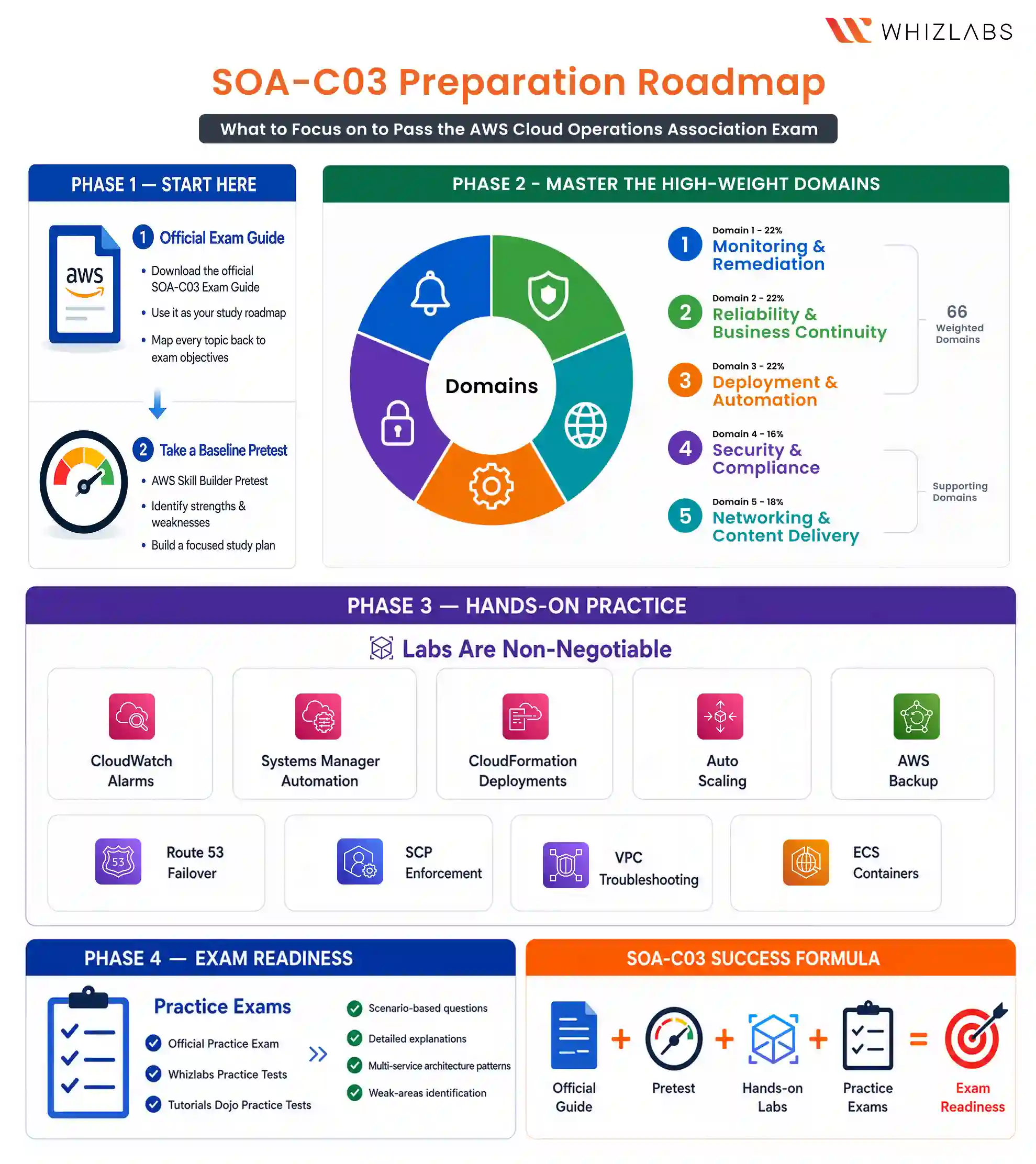
SOA-C03 Preparation Guide: How and What to Focus While Preparing for AWS Cloud Operations Associate Exams?
Here is the preparation strategy we recommend at Whizlabs. built around how the SOA-C03 actually tests you, not just what it covers.
I. Start With the Official SOA-C03 Exam Guide
Before anything else, download and read the official SOA-C03 exam guide from AWS.
This document tells you exactly what AWS expects you to know. It lists every domain, every task, and every AWS service in scope. Use it as your study roadmap from day one. Everything you study should trace back to something in this guide. If it doesn’t, deprioritise it.
II. Get a Baseline Early, Take a Pretest
One of the most common preparation mistakes is starting blind, no plan, no stratergy for weeks before ever testing what you actually know. We recommend taking the AWS Official Pretest for SOA-C03 on AWS Skill Builder early in your preparation, ideally in week one or two. It is not a full exam, but it gives you a baseline: which domains you are already comfortable with, and where your knowledge has gaps.
This changes how you allocate your study time. Without a baseline, most people start with what they already know because it feels productive. A pretest makes the gaps visible so you can actually close them.
III. Go Deep on the Five Domains; Especially These Three
All five domains matter. But Monitoring, Reliability, and Deployment together account for 66% of your exam score. Here is what to go deep on in each:
- Monitoring and Remediation
Get hands-on with Amazon CloudWatch. Not just what it does, but how to configure it. Custom metrics, composite alarms, CloudWatch Logs Insights queries, metric math. Then learn how AWS Systems Manager Automation documents work, specifically how to use them to trigger automated remediation when a CloudWatch alarm fires. This combination (CloudWatch detects → Systems Manager fixes) is one of the most tested patterns in Domain 1.
- Reliability and Business Continuity
Know how to route 53 policies cold to havae clarity around Failover, latency-based, weighted, geolocation, multivalue, understand when each is the right choice and what happens under different failure conditions. Know how EC2 Auto Scaling integrates with load balancers. Know how AWS Backup works for cross-region and cross-account recovery scenarios. Questions in this domain regularly give you an architecture and ask what the failure mode is, and what change prevents it.
- Deployment, Provisioning, and Automation
This is where the SOA-C03 is meaningfully harder than SOA-C02. You need working knowledge of AWS CloudFormation: stacks, change sets, drift detection, and rollback behaviour. You need to understand how AWS CodePipeline orchestrates a CI/CD workflow. You need to know how to run containerised workloads on Amazon ECS and how to manage them operationally. If you have not worked with these tools before, hands-on lab time here is not optional; it is the difference between understanding and guessing.
- Security and Compliance
Focus on AWS Organisations and Service Control Policies. Know what SCPs can enforce (which actions are allowed or denied across accounts) and what they cannot do (they cannot grant permissions, only restrict them). Know how AWS Config rules work for continuous compliance monitoring. Know how to use AWS CloudTrail for audit and investigation scenarios.
- Networking and Content Delivery
VPC troubleshooting questions are common here. Know your route table logic, your security group vs. NACL behaviour differences, and how to diagnose connectivity issues between VPCs and on-premises environments. Know when to use CloudFront vs. a load balancer vs. Route 53 for different traffic management scenarios.
IV. Make Hands-On Practice Non-Negotiable
The SOA-C03 is an operations exam. You cannot read your way to passing it. Every concept you study should be reinforced with time in a real AWS environment, configuring, testing, and understanding what happens when things do not behave as expected.
Labs that are directly relevant to the SOA-C03 include:
- Configuring CloudWatch alarms and custom metrics
- Setting up AWS Systems Manager Automation for self-healing EC2 instances
- Building CloudFormation templates and managing stack updates and rollbacks
- Configuring EC2 Auto Scaling with Application Load Balancers
- Setting up AWS Backup for cross-region recovery
- Creating and testing Route 53 failover routing policies
- Implementing SCP restrictions across AWS Organisations accounts
- Troubleshooting VPC connectivity route tables, NACLs, and security groups
- Deploying containerised workloads on Amazon ECS
- Using AWS Config rules for continuous compliance monitoring
AWS Sandboxes give you isolated, real AWS environments to experiment freely. No production risk. Full AWS access. If a concept is not clicking from documentation alone, twenty minutes in a sandbox environment will usually close the gap faster than another hour of reading.
V. Use Practice Exams the Right Way
Practice exams are where preparation converts into exam readiness, but only if you use them actively, not passively.
Take the AWS Official Practice Exam for SOA-C03 to experience the exact time constraints and question style of the real exam. It is the closest proxy available for actual exam-day conditions.
For detailed explanations of scenario-based questions, particularly the tricky multi-service ones that Domain 1 and Domain 3 are full of, we recommend going through our Whizlabs AWS SOA-C03 practice exams. Every question includes an explanation of why the correct answer is right and why each wrong option is wrong. That distinction is not just what is correct, but why the wrong answers are wrong; it is what builds the pattern recognition the exam rewards.
For every wrong answer, note three things: what you chose, why you chose it, and what the correct reasoning is. Most candidates find their mistakes clustered around two or three consistent gaps. Finding those patterns early is far more valuable than retaking the same test repeatedly.
A score of 750 or above on full-length practice exams is a reliable readiness signal for the real SOA-C03.
What Skills Will You Build From the SOA-C03?
Passing the SOA-C03 means you have demonstrated the following capabilities:
- Operational Monitoring and Incident Response
Setting up and managing CloudWatch across complex environments. Building automated remediation workflows using Systems Manager. Detecting performance issues before they become outages.
- Reliability Engineering:
Designing and validating high-availability architectures. Configuring Auto Scaling and load balancing for resilient applications. Implementing cross-region backup and disaster recovery procedures that actually work when needed.
- Infrastructure Automation:
Building and maintaining CloudFormation templates. Setting up CI/CD pipelines with CodePipeline. Running containerised workloads with ECS. Writing and running scripts to automate repetitive operational tasks.
- Security and Multi-Account Governance:
Implementing SCPs across AWS Organisations. Maintaining continuous compliance with Config rules. Using CloudTrail for investigation and audit. Managing identity and access at scale across multiple accounts.
- Network Operations:
Diagnosing and resolving VPC connectivity issues. Managing DNS routing with Route 53 under complex traffic conditions. Configuring and troubleshooting CloudFront distributions.
FAQ: AWS Certified CloudOps Engineer – Associate (SOA-C03)
What is the AWS Certified CloudOps Engineer – Associate (SOA-C03)?
The AWS Certified CloudOps Engineer – Associate (SOA-C03) is an associate-level AWS certification that validates your ability to deploy, manage, and operate workloads on AWS. It replaced the AWS Certified SysOps Administrator – Associate (SOA-C02) and covers a broader scope, including CI/CD, containerization, and infrastructure automation.
What is the difference between SOA-C02 and SOA-C03?
| AWS SOA Co2 – AWS Certified SysOps Administrator Associate | AWS SOA C03 – AWS Certified CloudOps Engineer Associate |
| 6 domains | 5 domains |
| If you were partway through SOA-C02 prep, the core AWS operational knowledge transfers. | But the SOA-C03 expects you to be comfortable with automation tools, scripting, and containerization basics. |
What is the passing score for the SOA-C03?
A score of 720 or above out of 1000 is required to pass the SOA-C03.
How many questions are in the SOA-C03 exam?
The SOA-C03 has 65 total questions: 50 scored and 15 unscored. The unscored questions are not identified during the exam and are used by AWS to evaluate new questions for future exam versions.
What are the five domains of the SOA-C03 exam?
AWS The SOA-C03 covers five domains: Monitoring, Logging, Analysis, Remediation, and Performance Optimisation (22%); Reliability and Business Continuity (22%); Deployment, Provisioning, and Automation (22%); Security and Compliance (16%); and Networking and Content Delivery (18%).
How long does it take to prepare for the SOA-C03?
Candidates with at least one year of AWS operations experience typically need 6–8 weeks of structured study at 10–15 hours per week.
Is the SOA-C03 harder than the SAA-C03?
They test different things, so direct comparison is difficult. The SAA-C03 focuses on architectural design decisions. The SOA-C03 focuses on operational execution, deploying, managing, monitoring, and recovering workloads. Candidates who have worked in cloud operations roles typically find the SOA-C03 more intuitive than those coming from an architecture or development background.
What prerequisites are recommended for the SOA-C03?
There are no formal prerequisites, anyone can register, but the exam assumes practical experience that is very difficult to substitute with study alone. AWS recommends at least one year of hands-on experience in deployment, management, troubleshooting, networking, and security on AWS, plus at least one year of experience in a related operations role such as system administrator or cloud operations engineer. Familiarity with CI/CD concepts, Git, containerization basics, and at least one major operating system is also recommended.
Is the SOA-C03 worth it in 2026?
Yes, particularly if you work in or are moving toward cloud operations roles. The SOA-C03 validates operational skills that are consistently in demand across AWS-heavy organisations, and the CloudOps Engineer framing reflects how modern cloud operations teams actually work.
Prepare for SOA-C03 With Whizlabs
We built our SOA-C03 preparation resources around one principle: the exam tests operational judgment, not service definitions. That means your preparation needs to go beyond reading. It needs to put you inside real AWS environments, working through the same kinds of scenarios the exam will put in front of you.
Here is what we offer for your SOA-C03 journey:
- SOA-C03 Practice Exams: Our SOA-C03 practice tests are built to match the exam’s scenario-based format across all five domains. Every question includes a detailed explanation, not just the correct answer, but why each wrong option is wrong. That distinction is what builds the pattern recognition that the SOA-C03 rewards. We consistently update our question bank to reflect the current SOA-C03 exam scope, including the expanded automation and containerization domains.
- Expert-Led Video Courses: Structured, domain-by-domain video learning is mapped directly to the five SOA-C03 exam domains. We cover CloudWatch configuration, Systems Manager automation, CloudFormation, CI/CD workflows, security and compliance governance, and VPC troubleshooting — in the sequence that builds operational understanding, not just service familiarity.
- Hands-On Guided Labs: Our SOA-C03 labs put you inside real AWS environments, working through the exact task types the exam covers: configuring CloudWatch alarms, building CloudFormation stacks, setting up Auto Scaling, implementing Route 53 failover policies, and more. Every lab is mapped to a specific SOA-C03 domain and task statement, so you know exactly which exam area your practice is building.
- AWS Cloud Sandboxes: Isolated, real AWS environments where you can experiment freely. Test a CloudFormation template. Build a Systems Manager Automation document. Set up an ECS task definition. Break things, fix them, and understand why, without any risk to production systems. Sandbox time is one of the highest-ROI preparations you can do for an operational exam like the SOA-C03.
- End-to-End SOA-C03 Certification Path: Practice tests, video courses, guided labs, and sandboxes work together as a single structured preparation system. We track your progress across domains so you always know where your readiness is strong and where it needs work.
To Conclude
The SOA-C03 is a hands-on exam for hands-on professionals. The best way to prepare for it is to actually do the work, and we have built everything you need to do exactly that. Start Your SOA-C03 Prep With Whizlabs. Access SOA-C03 practice exams, hands-on labs, expert video courses, and AWS cloud sandboxes, everything you need to pass the AWS Certified CloudOps Engineer – Associate exam.
What more? Let’s get you certified.

- AWS Certified AI Business Strategist AIB-C01 Exam Overview - September 10, 2026
- How does FinOps Certified Practitioner Scale Financial & Tech Careers? - July 20, 2026
- What Is Generative AI for Azure Cloud Engineers? - July 13, 2026
- From Cloud Certification Ready To Building Real Capabilities - July 2, 2026
- How to Pass AWS SOA-C03 CloudOps Engineer Associate Exam? - June 12, 2026
- Claude Certified Architect – Foundations CCA-F Exam Guide - June 4, 2026
- DP-700 Master Content Guide Microsoft Fabric Explained for Data Engineers - May 28, 2026
- DP-700 Microsoft Fabric Data Engineer Career Roadmap - May 19, 2026