
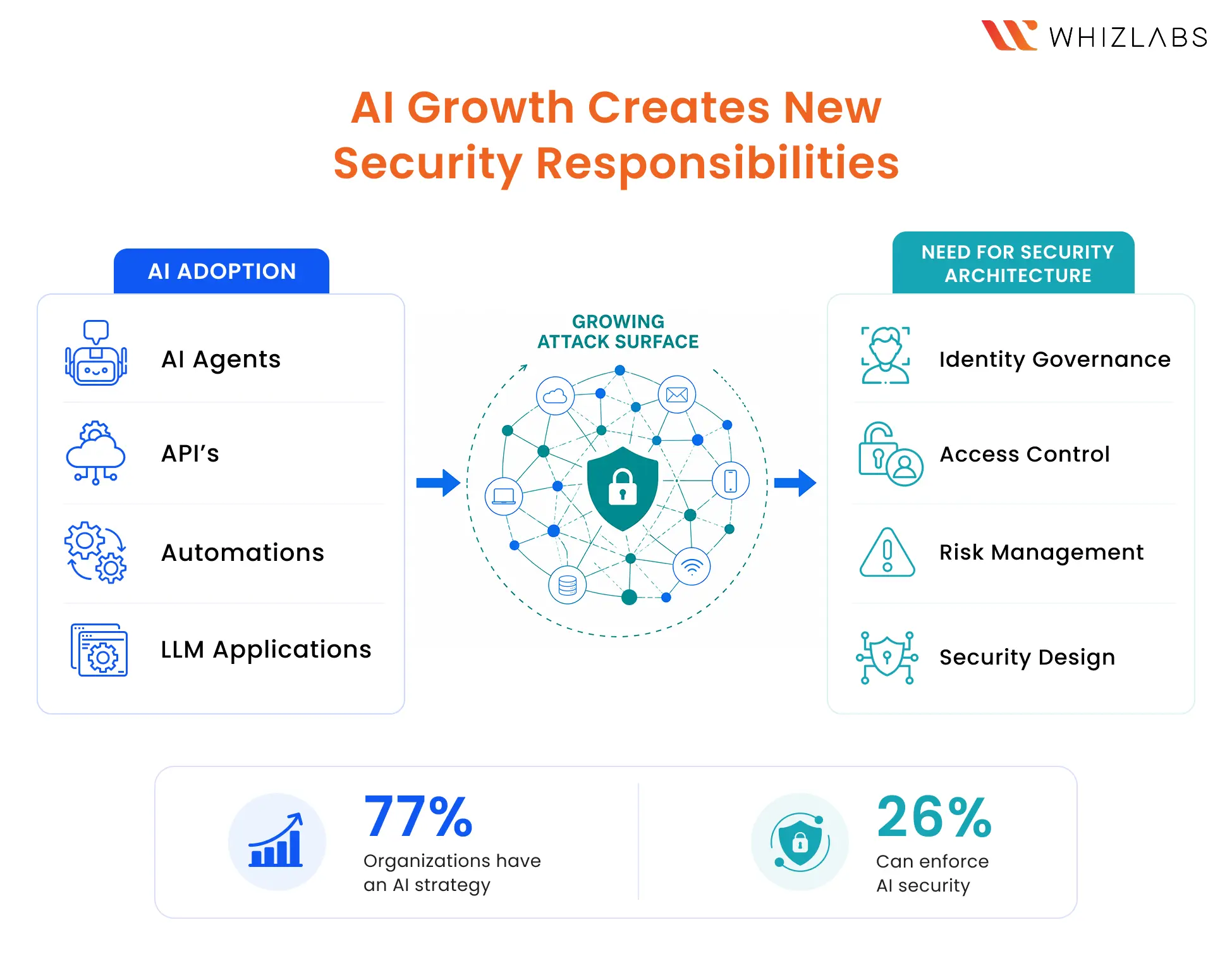
Check Point’s 2026 Cloud Security Report found that 77% of organisations have an AI strategy, but only 26% can actually enforce it. AI is reaching production faster than security teams can build controls around it.
The window to respond is shrinking at the same time. Zerodayclock.com tracks the gap between a software flaw going public and a working attack existing for it. In 2018 that gap was 771 days. Today it’s under four hours.
Attackers don’t have a change management process or an approval chain to work through. They grab a tool the second it works. A security team can’t move like that, every change goes through review first. So AI keeps shipping faster, attacks keep landing faster, and most companies are working with the same headcount they had before any of this started. Every new AI agent or automation pipeline is one more way in. The surface keeps growing while the teams stay the same size.
To get ahead of this issue, organisations need Cybersecurity architects. Right now, there are not enough of them. The cybersecurity architect career path has more momentum today than it has had at any point before.
*Source links: https://engage.checkpoint.com/2026-cloud-security-report-securing-the-ai-transformation
Why AI Is Creating More Security Roles
A lot of people assume AI will mean smaller security teams. It’s working out the other way. It is creating an entirely new domain, “securing AI systems” that simply did not exist five years ago.
Three things are driving this.
Non-human identities are the new frontier
AI agents make decisions while they run. They call tools, pull from data sources, hit APIs. The access systems most companies have were built for humans logging in, so they don’t really know what to do with an agent that acts on its own. Someone has to decide what each agent is allowed to touch, and right now, in most places, nobody owns that. Doing it takes a person who understands how AI systems are put together and how access control works, which is two skill sets that don’t usually live in the same head.
Compliance is catching up fast
The EU AI Act, evolving data protection regulations, and sector-specific requirements are adding a new layer of security obligation. Most security people don’t understand AI architecture, and most AI people don’t understand access control. The ones who understand both can mostly name their price.
Build fast, secure later until something breaks
Companies push new tech to production before anyone’s thought hard about security. Always have, honestly. AI just makes the build cycle faster, so the incident cycle is faster too. Then something breaks, and they bring in an architect to figure out what failed and rebuild it properly.
The Palo Alto Networks* AI research team put it clearly: as AI systems proliferate, the need for human oversight, strategic judgment, and governance will persist and intensify.
Cybersecurity jobs are not shrinking because of AI. In 2026, AI is the reason they are growing.
*Source Link: https://www.paloaltonetworks.com/perspectives/how-ai-will-forge-the-next-generation-of-cybersecurity-talent/
What a Cybersecurity Architect Does
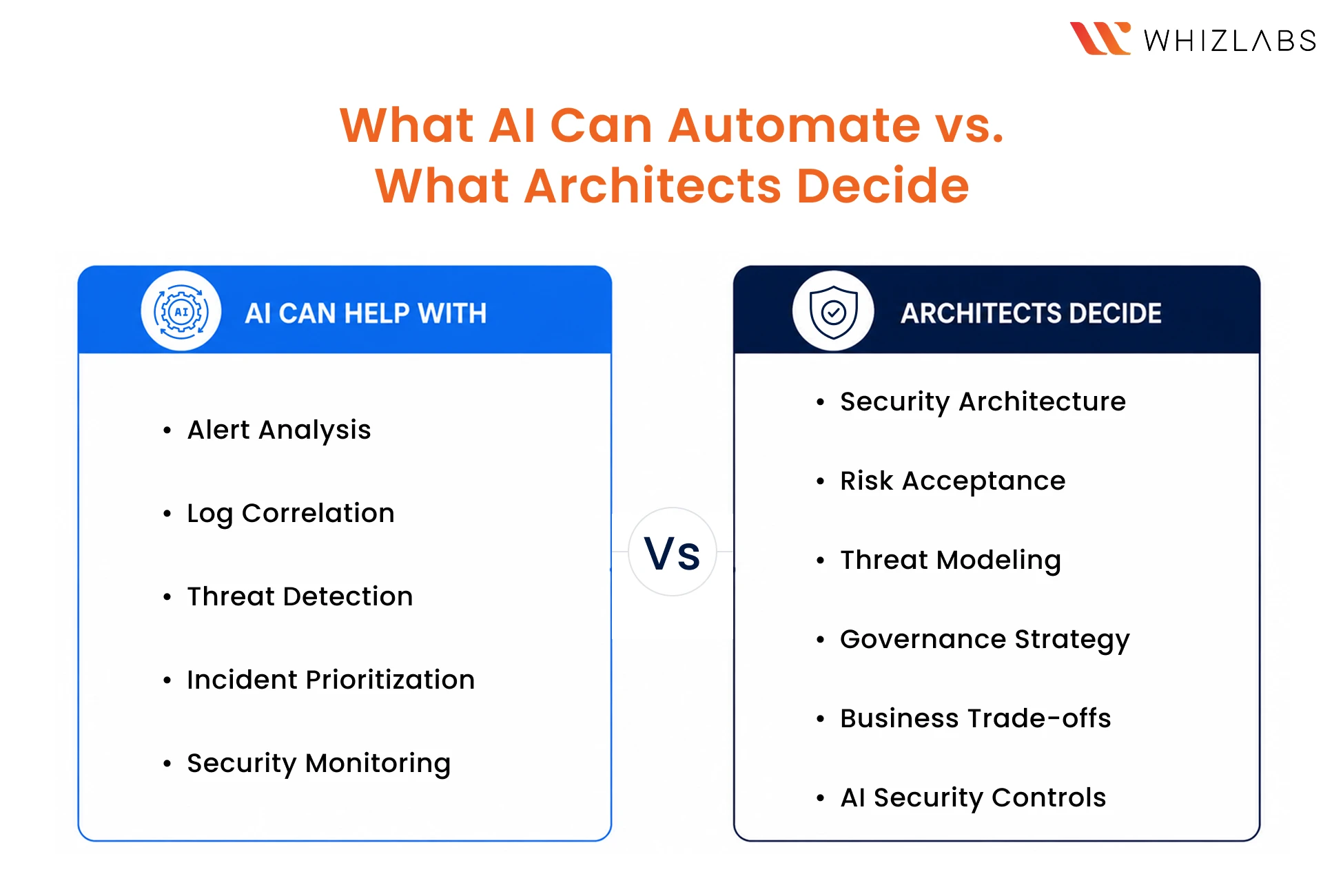
A cybersecurity architect works at the design stage, before anything actually gets built or deployed. The point is to make sure that whatever does get built is hard to break.
In practice, that looks like:
- Working with engineering and DevOps teams before anything ships
- Setting security requirements for new infrastructure
- Bringing the risk conversation to leadership in terms the business can act on
When an AI system flags an alert incorrectly, or an automated response triggers an outage, accountability sits with a person. The architect is often that person.
This is also why the role is resilient to automation. Execution is automatable. Design is harder. Knowing how a system should be built, what level of risk is acceptable, and how a security decision interacts with a business goal requires context that AI tools do not carry. Someone has to provide it.
That someone is a cybersecurity architect.
Cybersecurity Architect Skills
Cybersecurity architect skills span technical depth, business judgment, and organisational influence.
Network and infrastructure design. It’s not enough to understand how networks work. You’re deciding how they get segmented, where zero-trust fits, what good cloud security posture looks like, all from the ground up. The question you’re answering stops being “how do I secure this?” and becomes “how should this be built so it’s secure to start with?”
Threat modelling. You have to think like an attacker well enough to guess what they’ll go after. That’s different from reacting after something has happened. You’re looking at a design and asking which paths an attacker would take, then taking those paths off the board, instead of waiting to catch the exploit after it runs.
Risk as a business conversation. Every security decision costs something somewhere, so it’s always a trade-off. The business only acts on risk it understands and cares about like revenue, operations, regulation or reputation. If you can’t translate a security trade-off into those terms, the decision stalls. This is the one most engineers don’t see coming when they move toward architecture.
Communication across the org. A single architecture decision can land on engineering, DevOps, legal, product, and leadership all at once. So you end up needing to be credible with a CISO and a developer in the same conversation.
AI literacy. How attackers are using AI, whether a given AI security product actually does what it claims, how to keep your own AI systems governed. Three years ago you almost never saw this in a job description. Now it shows up at the senior level all the time, which tells you where the role is heading.
Cybersecurity Certifications to Pursue
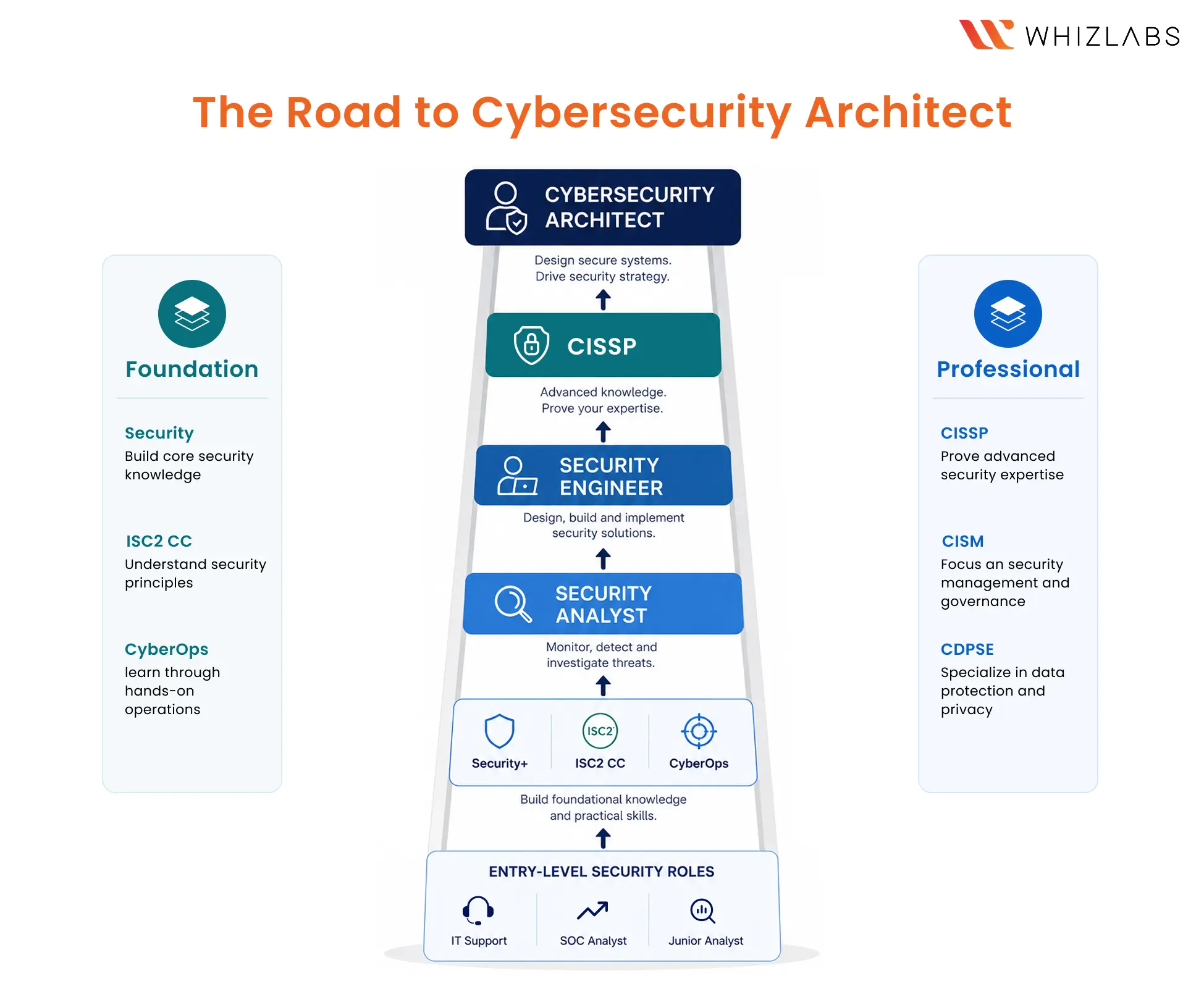
Cybersecurity architect certifications do two things. They validate your skills to employers and give you a structured path to follow. These are the top cybersecurity certifications that are active and carry weight in 2026.
Foundation Level
| Certification | What It Covers | Best For |
| CompTIA Security+ | Core security concepts across networks, threats, cryptography, and identity management | Anyone entering cybersecurity. Most entry-level roles expect it |
| Certified in Cybersecurity (CC) — ISC2 | Foundational cybersecurity concepts, accessible without prior experience | People transitioning into the field who need a structured starting point |
| Cisco Certified CyberOps Associate | Detection, analysis, and incident response | People entering through the security operations side |
Professional Level
| Certification | What It Covers | Best For |
| CISSP | Security architecture, engineering, governance, risk management across eight domains. Requires five years of experience | Security architects, security leads, senior practitioners |
| CISM | Governance, risk management, and security programme leadership | Security managers, CISO-track professionals |
| CEH | Penetration testing and offensive security techniques | Red team, vulnerability assessment, offensive security roles |
| CompTIA PenTest+ | Hands-on penetration testing and vulnerability assessment | Offensive security careers stepping beyond Security+ |
| CDPSE | Data privacy from an engineering and architecture perspective | Security architects working on compliance-heavy programmes |
| ISO/IEC 27001 Lead Auditor | Information security management system auditing | Consulting, enterprise security programmes, governance roles |
If you’re working toward an architect role, start with Security+, then aim for CISSP, since that’s the one most architect job postings ask for by name. Go for CISM or CDPSE depending on whether your role leans toward management or privacy engineering.
Whizlabs covers certifications across this path. Explore the cybersecurity course library here.
Salary and Market Outlook in 2026
Cybersecurity architect is a senior role, and compensation reflects that.
| Career Stage | Typical Role | Salary Range (USD) |
| Early career | SOC Analyst, Security Specialist | $70,000 — $95,000 |
| Mid-level | Security Engineer, Security Analyst | $100,000 — $140,000 |
| Senior | Cybersecurity Architect | $150,000 — $200,000+ |
The market is not cooling. The Check Point report found that 54% of organisations have already had an AI-related security incident. So AI threats have already happened to half of them, and now they’re looking for someone who can make sure it doesn’t happen anymore.
Across every stage, certified people tend to earn more than those who aren’t. The cybersecurity architect career path has one of the strongest salary trajectories in tech right now.
Is This the Right Career for You?
It depends on how you like to work. Here’s a quick gut-check on whether Cybersecurity architecture fits you:
- Go for it if you like getting to the root of things. If you’d rather understand why a system broke than just patch it, this is your kind of work. The job is about half technical and half talking to the business, so you have to be okay with both.
- Pick a different path if you want to stay hands-on. If you’d rather be close to building than in designing, architecture might not be your path, and there’s nothing wrong with that. You can pursue security engineering, penetration testing, and cloud security which focus more on building than designing.
- Give it a try if you like designing things. If working out how to build something secure from the start is the part that interests you, go for it. There’s real demand, the senior roles pay well, and it’s not work that’s going to dry up.
Further Reading
If this got you thinking about the next step, these blogs go deeper on specific areas:
- Microsoft Cybersecurity Reference Architectures
- Why Microsoft Entra Matters for Cybersecurity
- AWS Security Specialists and Cybersecurity
FAQs
How to become a cybersecurity architect?
Usually seven to ten years. The path typically runs through entry-level security or IT roles, then mid-level specialisation as a security engineer or analyst, then senior roles where design ownership begins. A cert like CISSP speeds up the credential side, but it won’t replace the judgment you get from working through real incidents.
What degree do I need?
A computer science or information security degree helps early on. By the time you’re going for architect roles, most hiring managers care more about your experience and certs than your degree. Some companies still want a bachelor’s as a baseline. A master’s degree in cybersecurity is common among people in CISO-track roles.
Is coding knowledge required?
For most architect roles, no. Understanding code at a conceptual level, knowing how applications are built and where vulnerabilities typically live is useful. Writing production code is not usually part of the job. Penetration testing and red team paths require more technical depth, including scripting ability.
What is the difference between a cybersecurity architect and a CISO?
A cybersecurity architect focuses on the design and integrity of security systems. A CISO is responsible for the organisation’s entire security programme: strategy, team, budget, compliance, and board-level communication. Many CISOs have architect backgrounds. The architect role is more technical and design-focused; the CISO role is more executive and programme-level.
Which certification should I start with in 2026?
Security+. It’s widely recognised, covers the basics everything else builds on, and most entry-level employers expect it. After a few years, aim for CISSP if you’re heading toward architecture or a senior role.

- GCP Agentic Architect Exam Guide: Format, Domains, and Beta vs GA (2026) - September 30, 2026
- AIP-C01 Sample Questions and Answers: Scenario-Based Practice - September 16, 2026
- Databricks Certified Generative AI Engineer Associate Exam Guide (2026) - August 4, 2026
- 10 AWS Security Projects SCS-C03 Candidates Should Build - July 10, 2026
- Microsoft’s Latest AI Launches: Are We In the Agent Era? - June 26, 2026
- What Career Does MLA-C01 Lead To? Read This Before You Start - June 18, 2026
- What Is Agentic AI? And Why NCP-AAI Is the Cert for It - June 4, 2026
- Who Should Take AB-100 Certification? Beginner or Professional? - May 14, 2026