What is Machine Learning?
Before you commit weeks to MLA-C01, it helps to know what the certification actually leads to. To get there, we need to start by understanding what machine learning is.
Normally, when we want a computer to do something, we write out the exact rules. If this, then that. Machine learning flips that. Instead of giving the computer the rules, you give it a lot of examples and let it work out the pattern on its own.
Say you run a food delivery app and you want to suggest to people the food they are likely to order next. The old way would be writing rules by hand: if someone orders pizza, suggest garlic bread. But tastes vary widely from person to person, and no one could write enough rules to cover everyone. With machine learning, you instead show the computer thousands of order combinations, and it figures out on its own what people usually like to eat together. That learned pattern is called a model.
So a model is just the thing that learned the pattern. It predicts what a customer might want next based on their order.
The model is built, but right now it’s just sitting on someone’s laptop, not helping anyone order dinner yet. Someone has to plug it into the actual app. They have to make it fast enough to respond while thousands of people are ordering at once. They have to watch whether the suggestions still make sense a few months later as tastes shift. And they have to fix it when they don’t. That work, getting a model into the real-world use case/scenario and keeping it working, is machine learning engineering.
So an ML Engineer sits between three worlds: software engineering, data, and machine learning. They borrow from all three, which is part of why the role can feel hard to pin down.
And that’s exactly where the confusion starts.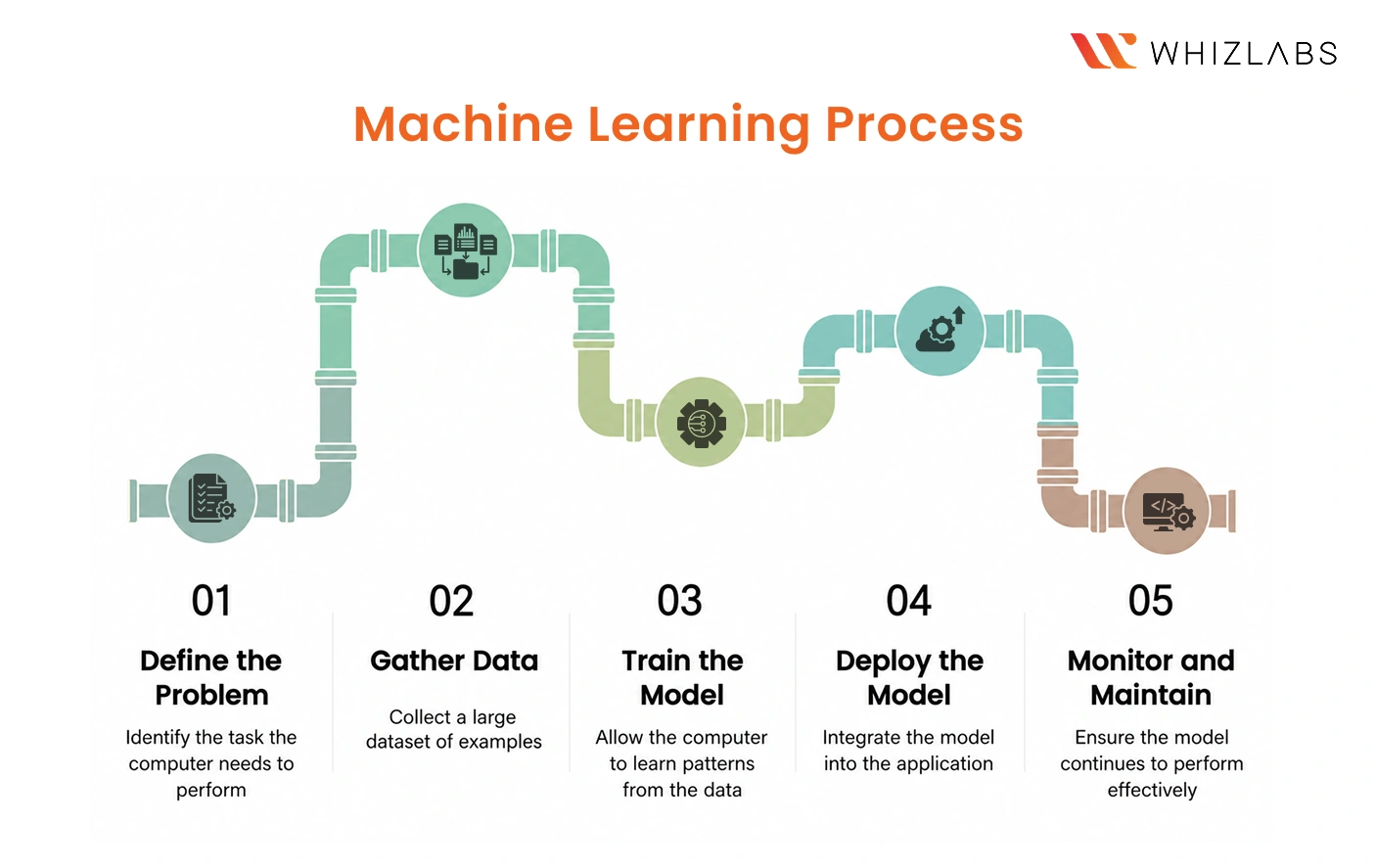
Does MLA-C01 Directly Lead You to Become an ML Engineer?
So now you know what an ML Engineer does. The natural next thought is, great, is there a way to prove I can do this? That’s where MLA-C01 comes in.
MLA-C01 is AWS’s machine learning certification for exactly this kind of work. The full name is the AWS Certified Machine Learning Engineer – Associate, and it’s the main AWS machine learning certification at the associate level.
So on paper, the answer is yes. MLA-C01 points you toward becoming an ML Engineer.
But here’s the catch, in most companies, “ML Engineer” is not really one job.
Think about everything that has to happen for that food app suggestion to work.
- The model has to be trained and kept accurate.
- It has to be connected to the live app and kept running smoothly.
- And the data feeding has to be clean and arriving on time.
That’s a lot of different work.
At a large organisation, three different people might handle those three parts. At a smaller one, a single ML Engineer might do all of it.
So the same title can mean very different jobs. It depends on where you work and which part of that chain you handle. Sometimes the role might even blur into data science, where you build and train the model yourself.
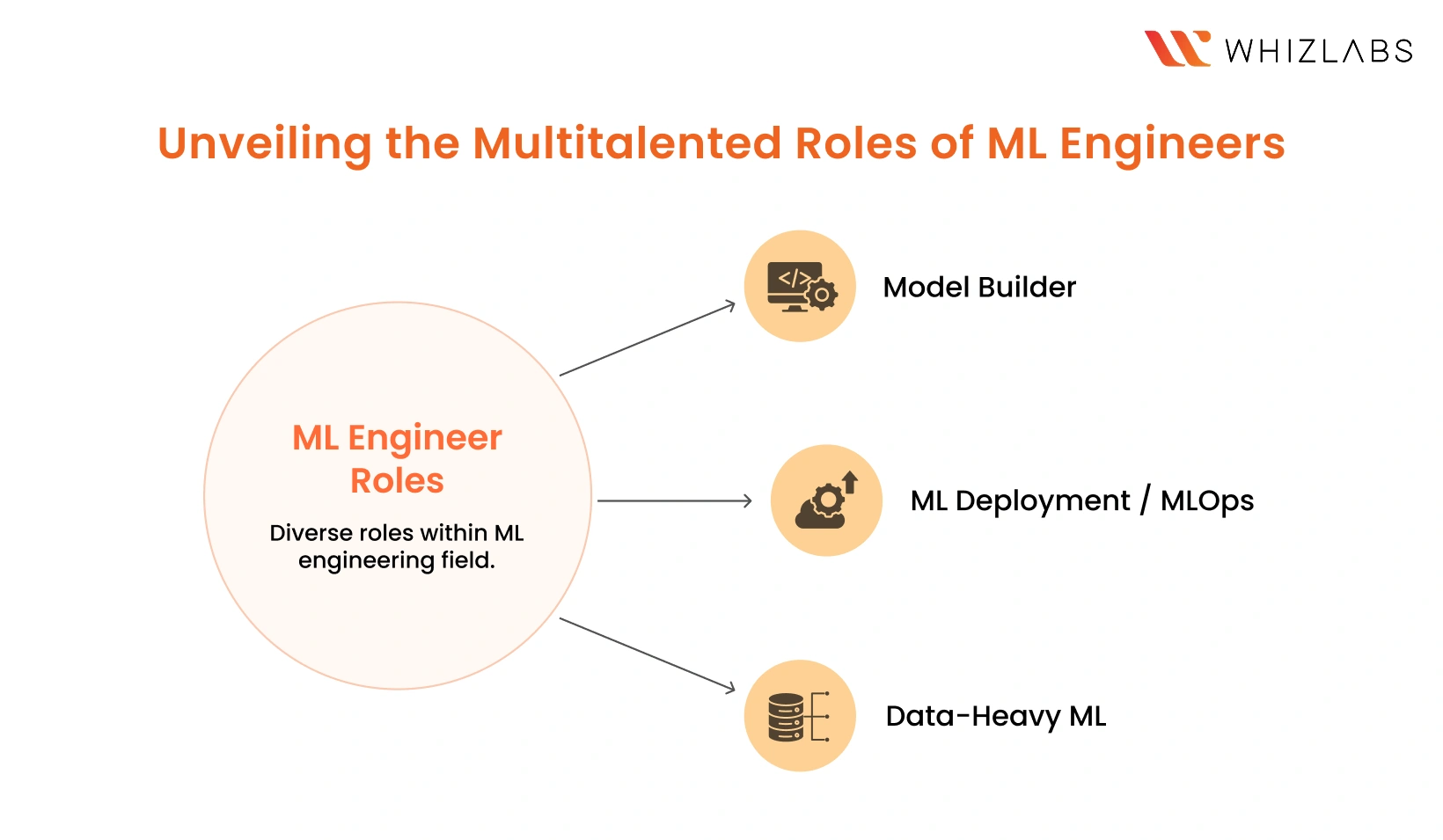
That’s why, when a company says it’s hiring an ML Engineer, you have to look closely at what they actually mean. It usually falls into one of three roles:
- Model builder (closer to data science) – In this role, a person has to train the models, write algorithms, do feature engineering and attain accuracy. There would be a lot of experimentation. And this job role is heavy on statistics and Python. There is only a thin line between this role and a “Data Scientist,” and sometimes even that blurs.
- ML deployment / MLOps (closer to DevOps) – In this job role, you will not be building the models. You will take a finished model and get it into production. And you will be responsible to monitor it, handle it when the model breaks, automate retraining, and manage cost. This role is leaning heavy on pipelines, infrastructure and automation.
- Data-heavy ML (closer to data engineering) – In this role, you mostly build the data side that feeds the models. You set up the pipelines and feature stores and make sure clean data reaches the right place. You will touch ML, but you will not really be building or deploying the models yourself.

So Which Role Does MLA-C01 Actually Train You For?
MLA-C01 doesn’t push you into just one of those three. It covers a piece of all of them.
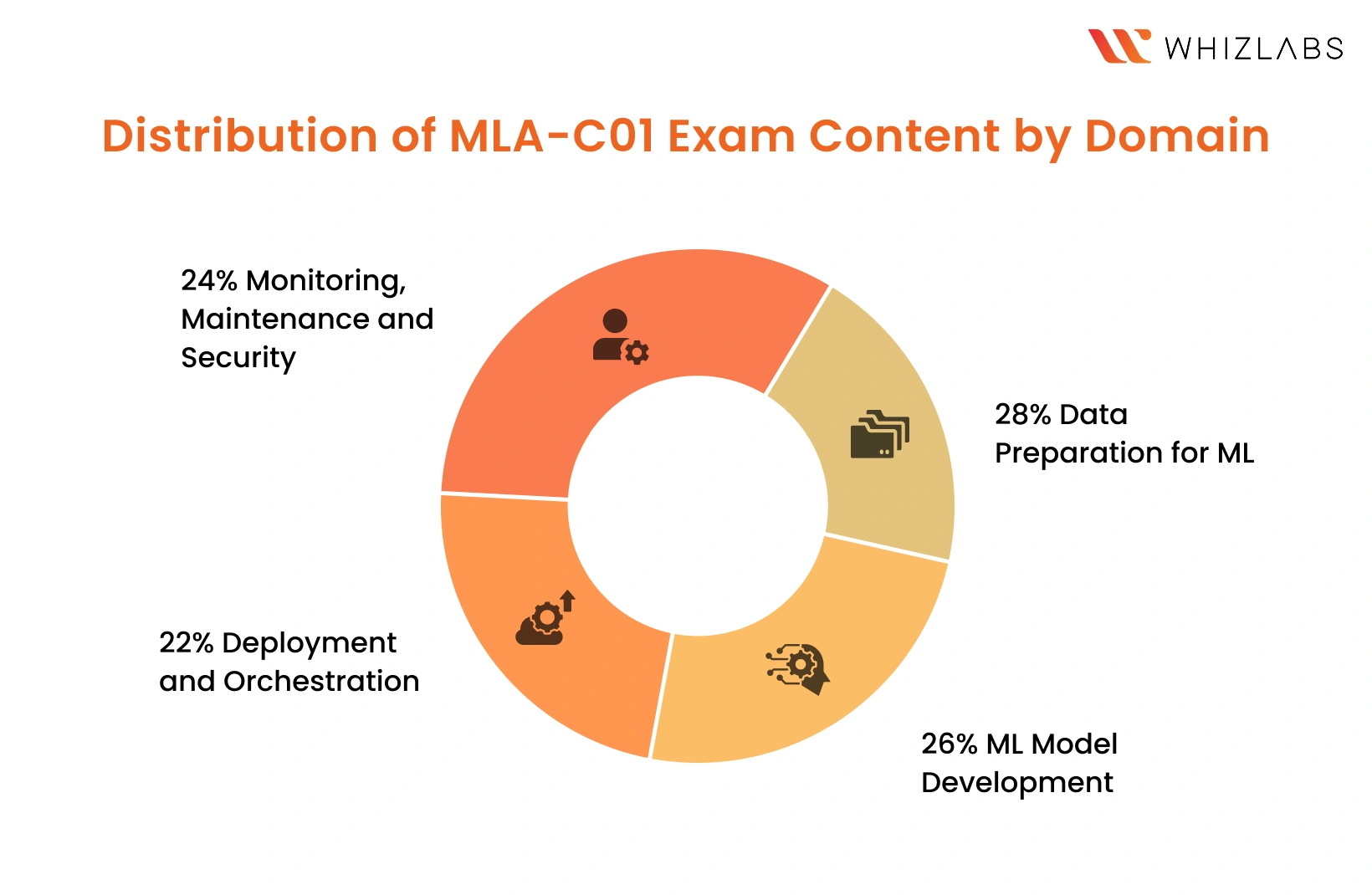
The exam is built around four areas:
- Domain 1: Data Preparation for Machine Learning (ML) (28% of scored content)
- Domain 2: ML Model Development (26% of scored content)
- Domain 3: Deployment and Orchestration of ML Workflows (22% of scored content)
- Domain 4: ML Solution Monitoring, Maintenance, and Security (24% of scored content)
The weight is spread fairly evenly. So it’s not a “you only handle one corner” cert.
MLA-C01 trains you to be the all-rounder. Not the deepest expert at any one stage, but the person who can take a model from raw data all the way to running smoothly in production.
Remember the ML Engineer role where we mentioned a single person does all three parts? This cert can get you closer to that.
That’s the career MLA-C01 points to: the all-rounder who can own a model end-to-end.
What MLA-C01 Doesn’t Cover (And Where to Learn It)
Short answer, no, and it isn’t trying to.
MLA-C01 does cover a complete machine learning pipeline. But it stays at a working level, not an expert one. A couple of things make that clear:
- AWS says it isn’t meant for designing full ML systems from scratch, or going deep into specialized fields like language or image models.
- But it expects around a year of hands-on AWS and SageMaker experience. So not for experts but also not for total beginners.
So think of it as broad, not deep. You come out able to handle the whole pipeline competently, not as a specialist in any single part.
And if you want that deeper expertise later, there isn’t a neat next cert that hands it to you. AWS used to offer MLS-C01, the Machine Learning Specialty, which leaned into the modeling side, but it’s been retired.
So the depth comes from doing.
- Build models yourself
- Deploy them, then watch them break and work out why
- Practice in a real AWS environment
What Does an ML Engineer Do Day to Day?
Across a normal stretch of work, you’ll move through all four parts of the job: getting the data ready, training and tuning the model, deploying it, then monitoring and maintaining it once it’s live. Some days lean more on one than another.
But once a model is actually out there, this last part, the MLOps side of keeping it running and reliable, is what tends to fill most days. A model doesn’t stay good on its own, and the world it’s predicting keeps changing.
Here’s what that looks like.
Watching for drift
Every model is trained on data from a certain moment. Over time, real-world data starts to look different from the training data. A fraud model trained last year doesn’t know this year’s fraud patterns. This is called drift, and catching it early is a big part of the job. You set up monitoring that flags when the incoming data, or the model’s accuracy, starts sliding.
Deciding what to do when it slips
Noticing is only half of it. Then you decide: retrain the model on fresh data, roll back to an older version that worked, or hold off because the dip is just noise. That’s a judgment call, and it’s the part that separates someone who understands the system from someone who just follows steps.
Keeping it running under load
A model serving predictions to thousands of users at once has to stay fast and not fall over. So you deal with things like auto-scaling, adding compute when traffic spikes, picking the right kind of endpoint, and keeping latency low.
Automating the boring parts
You don’t want to manually redeploy every time something changes. So you build pipelines that retrain, test, and redeploy a model with as little hand-holding as possible. Set it up well once, let it run.
Watching the cost
ML compute is expensive. A model running on oversized infrastructure quietly burns money. Part of the job is keeping it efficient, right-sizing what it runs on, and shutting down what isn’t needed.
Keeping it secure
The model touches real data, sometimes sensitively. So access control, encryption, and compliance aren’t side tasks. They’re part of shipping it properly.
The thread tying all of this together is judgment. The hard part of the MLA-C01 certification isn’t memorizing AWS service names. It’s knowing, in a given situation, whether the model is good enough, whether it needs attention, and what the right fix is. That’s what the work actually is once the model is live.
Who Should Take MLA-C01?
So is MLA-C01 worth it for you? Here’s a simple way to check.
It’s probably a good fit if:
- You already know AWS basics and want to move toward ML work
- You like building and running systems, not just studying algorithms
- You want to understand what happens to a model after it’s trained
- You care about the practical side: deployment, monitoring, cost, reliability
- You’re not trying to become a research scientist
You might want more foundation first if:
- You’re completely new to AWS
- You’ve never worked with data pipelines
- You only want to learn prompt engineering
- You’re expecting the cert alone to make you an ML Engineer
And one honest note. If you had read the model-builder role earlier and felt a pull toward that side, the experiments, the algorithms, the deeper math, that’s worth paying attention to. It might mean a more data-science-leaning path suits you better than this one. Better to notice that now than three weeks into the wrong material.
So, Where Do You Start?
If you’ve decided this is your path, the honest next step is the one this whole post keeps coming back to: learn it by doing, not by reading.
That’s why Whizlabs fits here. The hands-on labs and practice tests put you in a real AWS environment doing the actual work the exam is built around, so by exam day, a lot of it feels like something you’ve already done, not memorized.
Read more on how our practice tests help: How MLA-C01 Practice Tests Help You Master AWS SageMaker & MLOps
You’ve done the harder part already, understanding what this path actually is. The studying gets easier from here.
Good luck. You’ve got this.
If you have more questions, drop us an email at [email protected]

- GCP Agentic Architect Exam Guide: Format, Domains, and Beta vs GA (2026) - September 30, 2026
- AIP-C01 Sample Questions and Answers: Scenario-Based Practice - September 16, 2026
- Databricks Certified Generative AI Engineer Associate Exam Guide (2026) - August 4, 2026
- 10 AWS Security Projects SCS-C03 Candidates Should Build - July 10, 2026
- Microsoft’s Latest AI Launches: Are We In the Agent Era? - June 26, 2026
- What Career Does MLA-C01 Lead To? Read This Before You Start - June 18, 2026
- What Is Agentic AI? And Why NCP-AAI Is the Cert for It - June 4, 2026
- Who Should Take AB-100 Certification? Beginner or Professional? - May 14, 2026