


Are you in your AWS DevOps Engineer Professional Certification Preparation? We’ve got you covered with the AWS DevOps Engineer Professional Certification Preparation guide. In this article, you will also get a brief on AWS DevOps certification cost, AWS DevOps certification training, and AWS Certified DevOps Engineer Professional salary.
AWS DOP-C02 is a high-in-demand DevOps certification. Before moving to the AWS DevOps Engineer Professional Certification Preparation guide, let’s start with an introduction to the AWS Certified DevOps Engineer Professional certification exam. This exam validates the knowledge of an individual in
- Managing and implementing applications on the AWS platform
- Operating distributed application systems on AWS
- Designing and deploying logging systems on AWS
- Designing and maintaining automated operational processes
- Implementing compliance validation and security controls
- Deploying monitoring and metrics systems on AWS
- Troubleshooting availability and scalability across AWS system
AWS Certified DevOps Engineer Professional Exam – DOP-C02
An AWS DevOps professional engineer who has expertise in Amazon Web Services and has passed the AWS Cloud Practitioner or any of the Associate-level certification exams can start preparing for the AWS DOP-C02 Certification Exam. It is mandatory to cover all eight of the above-mentioned objectives for the exam, including associate-level development concepts during AWS DevOps certification preparation.
Candidate’s Overview: If you are interested in the AWS Certified DevOps Engineer Professional exam, then you must check the eligibility for this exam.
- No Prerequisites
- Two or more years’ experience provisioning, operating, and managing AWS environments
- You must know at least one high-level programming language.
- Experience in automation and testing via scripting or programming
- Agile Knowledge along with its processes & methodologies.
Try Now: AWS DevOps Engineer Professional Certification Free Test
DOP-C02 Exam Syllabus and Domain Weightage
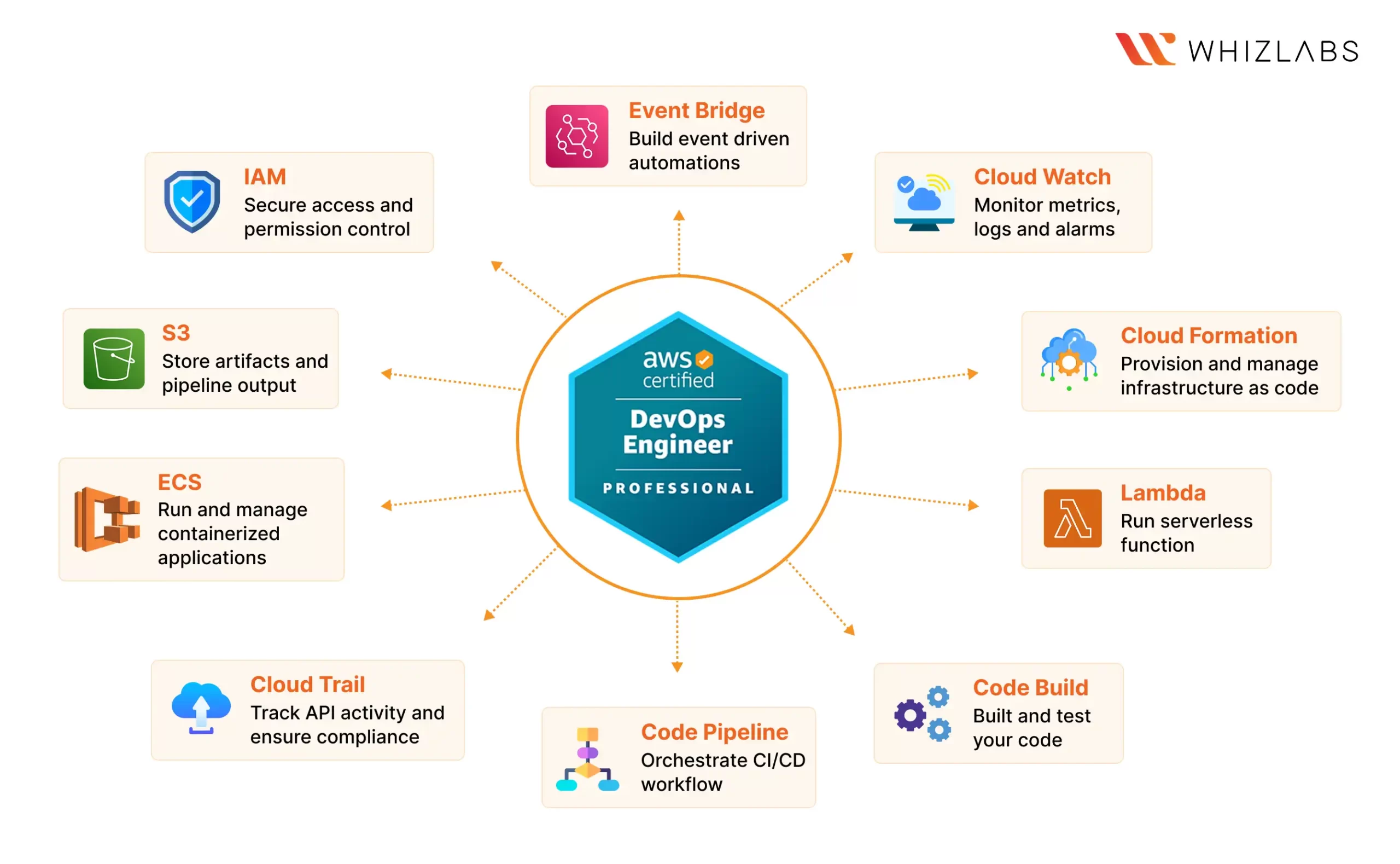
Domain 1: SDLC Automation (22%)
The new domain holds the maximum weightage and focuses on:
- Concepts and models of the software development lifecycle.
- Integration of automated CI/CD pipeline testing.
- Configuring tools like CodeBuild and Lambda to generate artefacts
- Configuring deployment agents and troubleshooting issues.
Domain 2: Configuration Management and IaC (17%)
The domain focuses on configuration management and Infrastructure as Cloud and covers the following:
- Configure and deploy IaC components like AWS CloudFormation and Cloud Deployment Kit.
- Implement governance and security protocols using AWS Control Tower, Security Hub, GuardDuty, and Service Catalogue.
- Standardise and automate account configuration.
- Develop and automate Lambda functions for complex situations.
Domain 3: Resilient Cloud Solutions (15%)
The domain assesses your skills in implementing cloud solutions to meet varying business needs, covering the following:
- Enabling cross-regional solutions like Amazon DynamoDB, RDS, Route 53, S3, and CloudFront.
- Understanding and implementing automated scaling, load balancing, and caching solutions.
- Implementing disaster recovery concepts to meet RTO and RPO requirements.
- Arrange a load balancer to recover from the backend failure.
Domain 4: Monitoring and Logging (15%)
This domain focuses on your ability to configure, monitor, and audit logs and metrics, covering the following skills:
- Create CloudWatch metric streams like Amazon S3 and Kinesis Data Firehose options.
- Process log data through CloudWatch subscriptions.
- Build CloudWatch dashboards and Amazon QuickSight visualisations.
- Analyse logs through AWS services like Athena.
- Configure automated scaling solutions using DynamoDB, EC2, and ECS.
- Follow routine health checkups.
Domain 5: Incident and Event Response (14%)
The domain assesses how you respond to particular events to keep the AWS cloud space working smoothly:
- Integrating AWS services like CloudTrail, EventBridge, and AWS Health.
- Modifying the existing infrastructure to respond to the events.
- Analyse failed deployments like CodePipeline, CodeDeploy, CodeBuild, and CloudFormation.
Domain 6: Security and Compliance (17%)
The domain focuses on your ability to manage AWS applications without compromising on security, covering the following key areas:
- Enforce policies that restrict unauthorised access.
- Manage permissions via multi-factor authentication, Security Token Service, and IAM profiles.
- Automate security protocols for multi-account and multi-regional environments.
- Adopt a robust security audit.
AWS DevOps Engineer Professional Exam Pattern, Cost, and Passing Score
Before starting your preparation, it is important to understand the DOP-C02 exam format, scoring pattern, and domain weightage so you can build an effective study plan.
Before beginning with the preparation stage, it is important to know the details about the exam. Below are the points to keep in mind:
| Format | 75 questions, either multiple choice or multiple response |
| Cost | USD 300 |
| Duration | 180 minutes |
| Passing Score | 750 |
| Testing Options | Pearson VUE testing center or online proctored exam |
| Languages Available | English, Japanese, Korean, and Simplified Chinese |
| Exam Prerequisites | Experience as a DevOps engineer and at least two years of working experience in AWS cloud environment. |
Learn more about the exam details here.
Preparing to become an AWS Certified Solutions Architect Professional? Get started with Whizlabs
What Skills Are Tested in the DOP-C02 Exam?
This DOP-C02 study guide covers all six major domains, along with the exact skills and AWS services you should focus on for the exam.
The latest AWS DevOps engineering certification focuses on various tools and services required to work with the AWS environment.
- Implementing and managing AWS continuous delivery systems & methodologies.
- Implementing and automation of security controls, compliance validation, and governance processes.
- Implementation of systems on the AWS platform with high availability, self-healing, and scalable attributes.
- Definition and deployment of AWS systems for monitoring, logging, and metrics.
- Design, management, and maintenance of tools for automation of operational processes.
- Automating software development processes and models.
- Set up build processes like AWS CodeBuild.
- Implementing CI/CD pipelines for single and multi-account environments.
Salary for AWS Certified DevOps Engineer
According to Talent.com, the average salary for AWS Certified DevOps Engineer in the USA is $135,000 per year or $64.90 per hour. Entry level positions get salary up to $119,709 per year while most experienced individuals can get up to $165,538 per year.
Who Should Take the AWS DevOps Engineer Professional Exam?
I would recommend that you take the AWS DevOps Engineer Professional exam if you meet the following requirements.
- Understanding of software development lifecycle concepts, models, and phases.
- Experience in the development of code in at least one high-level programming language.
- Significant experience in creating highly automated infrastructures.
- Understanding of operating system administration.
- Knowledge regarding modern development and operations processes & methodologies.
- Learning how to use different types of tests at various CI/CD pipeline stages.
- Building and managing artefact repositories, like AWS CodeArtifact, Amazon S3, and Amazon Elastic Container Registry.
- Implementing deployment strategies for serverless environments.
Step-by-Step Guide for AWS DevOps Engineer Professional Certification Preparation
“Success is the result of preparation, perfection, and hard work.” Thus, it is necessary to prepare well for the exam, and so there is a need for good AWS DevOps Engineer Professional Certification Preparation. Now, we will cover a step-by-step preparation guide on how to crack the AWS Certified DevOps Engineer Professional Certification Exam.
By reading this article, you will get a good knowledge about where to start and prepare to pass the AWS DevOps Engineer Professional exam. In case of any queries, you can also share your comments below; we’ll get back to you.
So, let’s begin the AWS DevOps Engineer Professional Certification preparation steps –
- Get Familiar with the exam blueprint
- Obtain an AWS Training course
- Study AWS Whitepapers
- Check Documentation and read the recommended books
- Check Sample Questions and Take Practice Exams, as well as Watch Online Videos
- Exam Registration to get the certification
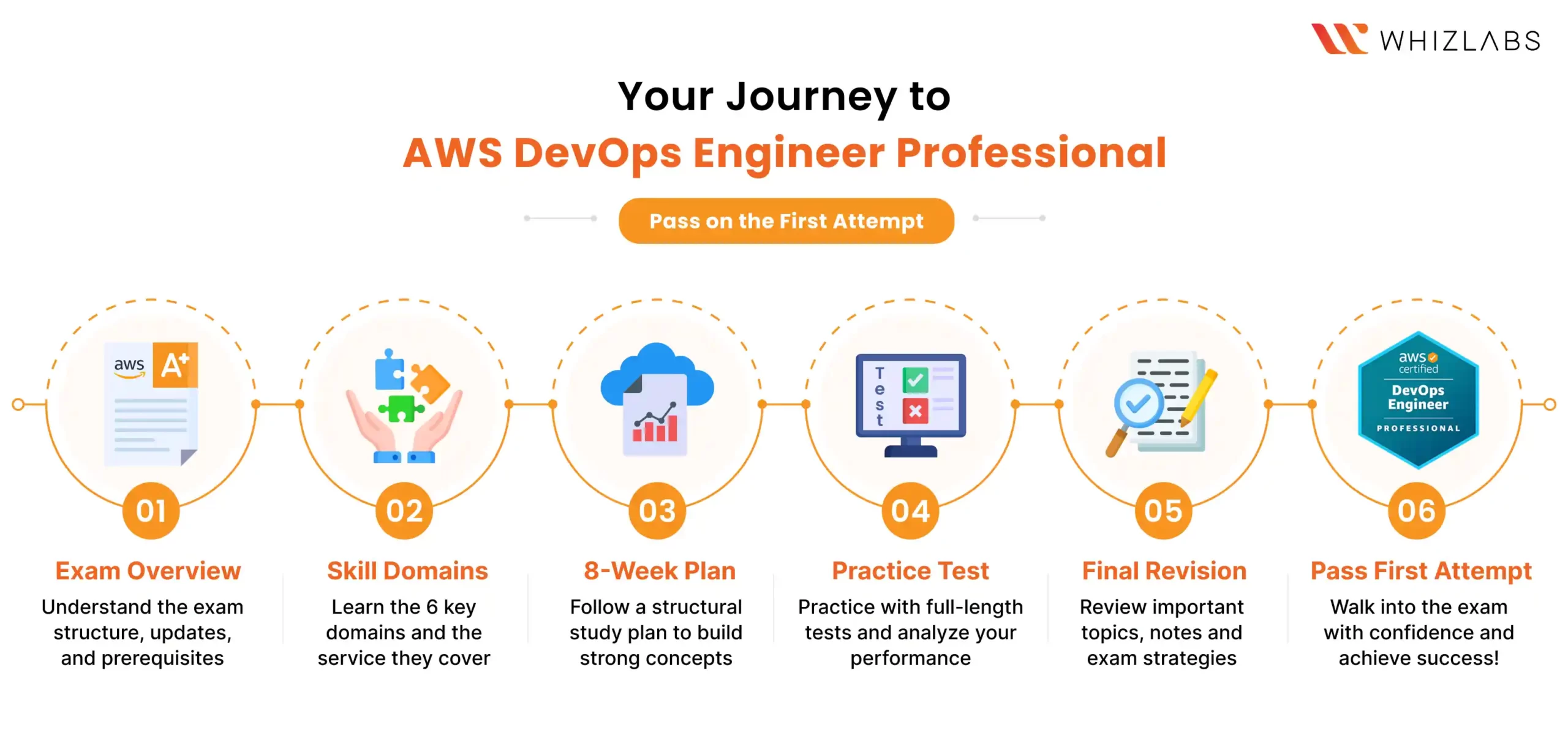
1. Get Familiar with Exam Blueprint
Getting familiar with the Exam Blueprint is the key start to achieving success in any IT certification. It is suggested to refer to the official exam guide. You can find the Blueprint for the AWS DOP-C02 Certification Exam on the official website of AWS. The table below lists the domains measured by this examination and the extent to which they are represented:
Establish an understanding of application lifecycle management
- Continuous Delivery and Process Automation
– Application deployment management policies such as rolling deployments and A/B.
– Version control, testing, build tools and bootstrapping.
- Validate an understanding of structure formation and automation.
- Implement and achieve continuous delivery processes using Amazon Web Services.
- Develop and accomplish scripts and tools to program operational tasks using the Amazon Web Services SDKs, CLI, and APIs.
So many AWS certifications- confused while choosing the AWS certification? Read our previous blog on Which AWS Certification Should I Choose?
Monitoring, Metrics, and Logging
- Monitor accessibility and performance.
- Monitor and manage billing and budget optimisation procedures.
- Aggregate and examine infrastructure, Operating System and application log files.
- Use metrics to drive the scalability and health of infrastructure and applications.
- Analyse data composed from monitoring systems to distinguish application patterns.
- Manage the lifecycle of application and infrastructure logs.
- Control the AWS SDKs, CLIs, and APIs for metrics and logging.
Security, Governance, and Validation
- Implement and manage Identity and Access Management and security controls.
- Implement and manage security for data in-flight and at rest.
- Implement, program and authenticate cost controls for AWS resources.
- Implement and achieve automated linkage security and checking.
- Apply the suitable Amazon Web Services account and billing set-up choices based on business requests.
- Implement and manage Amazon Web Services resource auditing and validation.
- Use Amazon Web Services to implement IT governance policies.
High Accessibility and Resistance
- Control suitable use of multi-AZ versus multi-region designs.
- Implement self-healing application designs.
- Implement the aptest front-end scaling architecture.
- Implement the most suitable middle-tier mounting architecture.
- Implement the aptest data storage mounting architecture.
- Validate an understanding of when to properly relate vertical and horizontal scaling options.
2. Obtain AWS Training Course
The next step in the AWS DOP-C02 certification preparation is to obtain an AWS training course that will help you understand the designs on the AWS platform, especially to develop and sustain applications. The course will brief you on the principles along with the concept of the DevOps methodology, and you will observe use cases connected to enterprise companies.
Course Objectives:
- Design and implement infrastructure to learn the concepts of AWS along with DevOps methodology.
- Use of AWS CloudFormation & AWS OpsWorks.
- Design & implement AWS CodePipeline.
- Use cases in AWS technologies.
- Differentiation between the technologies available on AWS.
- Patch management use in AWS.
- Use of AWS tools and technologies
Prerequisites:
- Operations and Development on the AWS Platform
- Understanding and work experience in one or more programming languages such as Python or Ruby on Rails.
- Knowledge of Operating systems such as Windows or Linux
- Good understanding and work experience of AWS Command Line Interface (AWS CLI) and AWS Management Console.
Have you made up your mind to build a career in AWS? Let’s start with a quick introduction to Amazon Web Services!
3. Study AWS Whitepapers
The AWS Whitepapers section ensures a number of technical Amazon Web Services whitepapers for integration, delivery, and management. Some of the white papers that are recommended for professionals during the AWS Certified DevOps Engineer Professional Certification preparation are –
- Organising Containerised Microservices on AWS
- Microservices on Amazon Web Services
- Infrastructure as Code (IaaS)
- Constant Integration Involvement
- Continuous Delivery on AWS
- Jenkins on Amazon Web Services
- Using PowerShell, Importing Windows Server to Amazon EC2
- Green/Blue Provisioning on AWS
- Intro to DevOps on AWS
- Testing and Development on AWS
4. Check Documentation and Read the Recommended Books
The AWS documentation gives you complete information about the services. You will get enough information about the services here, from the basic introduction to the high-level and advanced features. There are different categories of services, so choose the required one to get the details.
So, when you have gone through all the official study resources, it is the right time to read some good AWS books. For AWS DevOps Engineer Professional Certification Preparation, there are several books that cover the various objectives of the AWS Certified DevOps Engineer Professional Certification Exam. You can read one or more books that cover all the exam topics. A few recommended books are –
- Implementing DevOps on AWS by Veselin Kantsev
- Practical DevOps by Joakim Verona
- Effective DevOps with AWS by Nathaniel Felson
5. Check Sample Questions and Take Practice Exams
When you are done with your preparation, it’s time to check your preparation level with AWS Certified DevOps Engineer – Professional Certification Exam Free Sample Questions. These free questions will help you get an idea of the exam pattern of the actual exam.
Practice is the key point for perfection. When you are done with all the preparation, just focus on practice. Check online practice papers for the AWS Certified DevOps Engineer – Professional Certification Exam.
In case, if you are a self-learner, For AWS DevOps Engineer Professional Certification Preparation Online Training videos are good for preparing for the exam.
Preparing for the AWS Certified DevOps Engineer Professional exam? Check your current level of preparation with AWS Certified DevOps Engineer Professional practice tests.
6. Exam Registration to Get the Certification
So, all set? If you are prepared enough then why to delay? Get ready to register for the exam and create an AWS Certification account on the official website of Amazon Web Services. And you don’t need to worry about what benefits this certification can bring you. After taking this certification, you can also avail several benefits of DevOps domain. In short, this will help you to access, view and manage your certification.
Passing the exam confidently comes with, taking multiple AWS DevOps practice test sessions before the actual exam day.
Why Practice Tests Were the Key to Passing DOP-C02?
I also used AWS DevOps Engineer Professional practice tests to judge my preparation level. The practice tests helped me become familiar with the exam format.
In addition, I was also able to understand the nuances of time management through the practice tests that helped me considerably in the actual exam. Not only was I able to test my knowledge and skills with the practice tests, but I also used them to boost my confidence.
Trust me; the results of the practice tests always motivated me to invest additional effort in my preparations.
Whizlabs offers the following practice papers as a part of preparation, making sure you can confidently attempt the exam:
- Sample Test: You can attempt a full-length test before enrolling in the course to verify your preparedness.
- Practice mode: Unlike a full-length paper, a practice test does not test you under timed pressure. You can attempt to answer the questions and get explanations for each of them. It helps identify the gaps so you can work on your weak areas before attempting the actual exam.
- Exam Test: These are full-length tests with a timed frame so you can figure out how much time to dedicate to each domain. It also helps improve your time management skills so you don’t leave any questions unanswered.
- Cheatsheet: A quick recap sheet for the exams as a last-minute prep
Important Topics You Should Prepare for the Exam
I would like to present an outline of the specific topics that helped me qualify for the AWS DevOps Engineer Professional exam. Although the AWS DevOps Engineer Professional exam’s study guide provides a detailed impression of the important topics to cover for the exam, I have compiled the following topics that accounted for a major share of questions.
- You have to master skills and knowledge related to the creation of IAM policies with Lambda.
- I also found many questions on the migration of on-premises systems to AWS in the exam.
- Another important topic for the AWS DevOps Engineer Professional exam refers to the use of RDS with other AWS services.
- I also encountered questions on SNS in combination with other AWS services and the auto-scaling functionalities with SNS.
- I would recommend that you gain hands-on experience in the use of the Application Load Balancer alongside Elastic Beanstalk for the exam.
- You should also emphasize on the migration of repository by leveraging Git repository and Code Commit.
- I also faced questions in the AWS DevOps Engineer Professional exam dealing with the use of Amazon ECR and AWS CodePipeline for triggering deployment.
- I would strictly recommend all candidates to obtain an in-depth practical understanding of using Amazon ECS with Docker containers. In addition, you must develop promising skills in implementing version control efficiently for the certification exam. I would also like to draw your attention to the need for focusing on capturing logs through expertise in using a combination of CloudWatch and S3.
Try Now: AWS Certified DevOps Engineer Professional sample Test
Discussion Forums and Study Groups
While doing your certification preparation, it is always recommended to join good discussion forums, communities, and study groups. It’s actually the media that allows you to connect with other candidates who are preparing for the exam and those who have already passed the exam. You can put your query in the discussion forum and get it resolved by the industry experts and peer professionals.
It will also help you learn from the knowledge and experience of other certified professionals. So, join some good discussion forums and study groups now. You can also submit your query in the Whizlabs forum and get it resolved by the industry experts.
8-Week Study Plan for the AWS Certified DevOps Engineer Exam
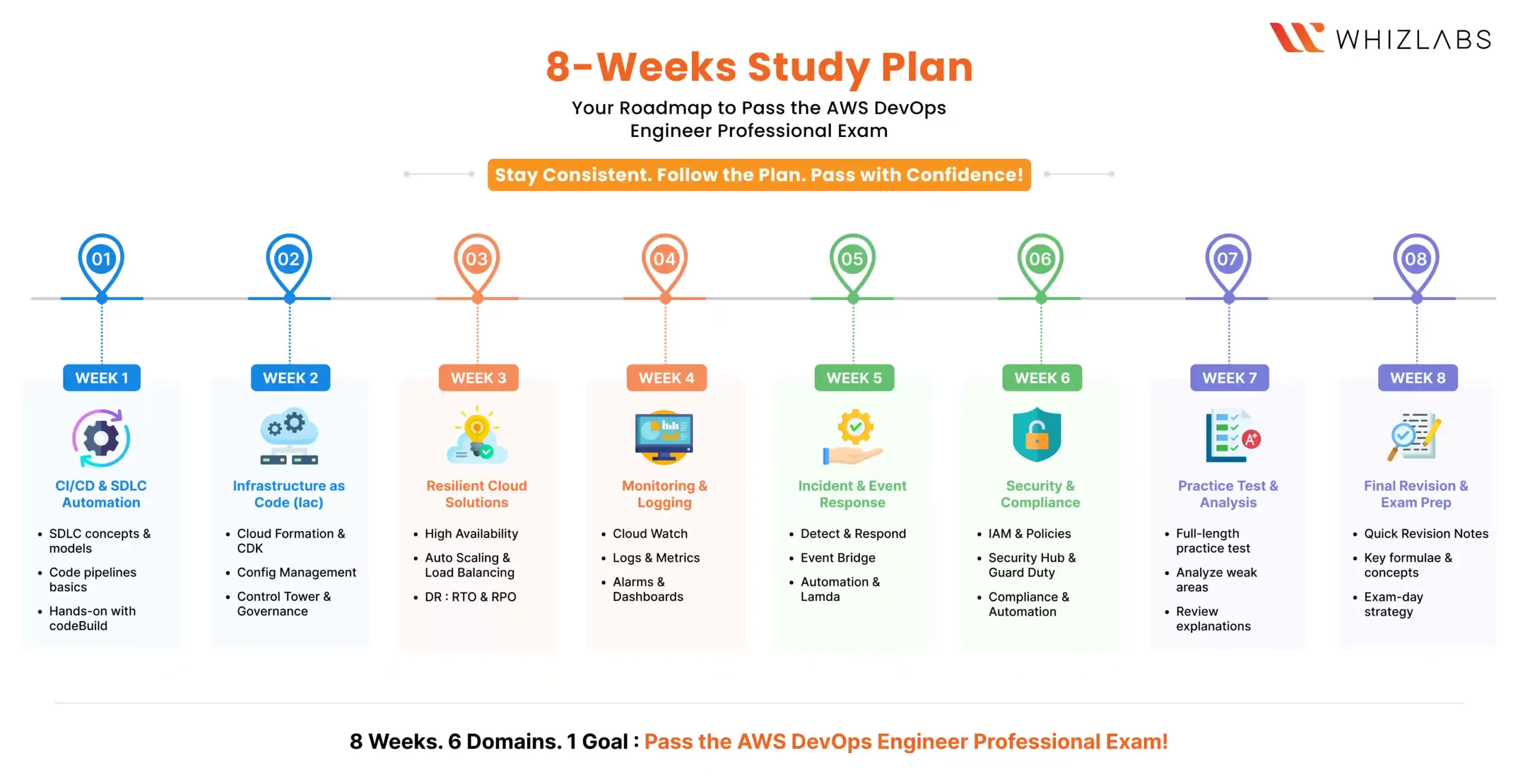
Preparing for the DOP-C02 exam takes around 8 weeks, allowing you to cover the entire syllabus and attempt full-length practice tests. Below is a detailed study outline for you to follow:
Week 1: Domain 1
- Use AWS CodePipeline to implement CI/CD pipelines.
- Work with Lambda and EC2 using AWS deployment services.
- Build and manage artefacts.
Week 2: Domain 2
- Manage AWS infrastructure using CloudFormation.
- Gain a basic understanding of the Cloud Development Kit and Serverless Application Model.
- Manage Systems Manager (SSM) documents and run commands on them.
Week 3: Domain 3
- Learn how to use Amazon API Gateway and Lambda effectively.
- Deploy container-based applications.
- Formulate backup and storage strategies.
Week 4: Domain 4
- Audit activities on the AWS cloud platform using CloudTrail.
- Set up alerts and metrics using CloudWatch.
- Analyse CloudWatch Logs Insights and Amazon Athena.
Week 5: Domain 5
- Understand how AWS Health, EventBridge, and CloudTrail operate.
- Use AWS services like Kinesis, SQS, and SNS.
- Monitor incidents using CloudWatch and X-ray.
Week 6: Domain 6
- Implement role-based access control.
- Automate the discovery of sensitive data.
- Implement a robust security audit.
Week 7: Practice Tests
Once your domains are covered, you can move on to attempting full-length practice tests. They help evaluate your stand. The exam mode is like a typical mirroring of the exam with time boxes. The result can be validated at the end so you know where you are lacking.
I personally felt that attempting domain-wise practice tests and DOP-C02hands-on labs helped me prepare for the exam better.
Week 8: Complete Revision
Revise all six domains for the last time and leverage Whizlabs’ cheatsheet for last-minute prep.
Now you are ready to attempt the actual exam confidently and pass it on the first go.
Best Tips to Pass the AWS DevOps Engineer Professional Exam
When following your study plan, strategic tips can accelerate your learning and boost your confidence:
- Do a quick AWS DevOps Professional review of previous exams to understand the approach.
- Take short intervals during study to relax and feel refreshed before taking up the next chapter.
- Pick high-weightage topics first to score higher.
- Follow a consistent sleep schedule to avoid burnout.
- Explain the concept to yourself or someone out loud as a memory exercise.
DOP-C02 Difficulty: What to Expect
DOP-C02 sits at the professional level, AWS’s highest certification tier, and the difficulty reflects that. Unlike foundational or associate exams, DOP-C02 leans heavily on multi-step, scenario-based questions that expect you to weigh trade-offs between several plausible-sounding answers, not just recognise a correct definition. The 750 passing score (versus 700 on most associate exams) is itself a signal of how much more demanding this exam is.
The breadth is also real: six domains spanning CI/CD, infrastructure as code, resilience, monitoring, incident response, and security mean shallow knowledge in any one area shows up quickly. Candidates who’ve genuinely worked hands-on with AWS DevOps tooling for 2+ years tend to find it demanding but fair. Candidates attempting it without that practical background typically find the gap between reading about a service and having configured it under real conditions is where they lose the most points.
Is DOP-C02 Worth It?
For working DevOps engineers, cloud automation specialists, or site reliability engineers already operating AWS environments day to day, yes, DOP-C02 is one of the more career-relevant professional certifications AWS offers. It’s consistently ranked among the highest-paying AWS credentials, and it validates exactly the skill set employers are hiring for in automation-heavy cloud roles.
It’s less clearly worth it if you’re newer to AWS or haven’t yet built the 2+ years of hands-on experience AWS recommends. In that case, an associate-level certification first, then DOP-C02 once you have real operational experience to draw on, is the more realistic path. DOP-C02 rewards practitioners who’ve already done the work, not a shortcut into the field.
Average AWS Certified DevOps Engineer Professional Salary
A certified AWS DevOps Engineer earns more than a non-certified AWS DevOps Engineer. As per the Global Knowledge platform, the average salary of a candidate with AWS DOP-C02 certification is 125,743 USD per Annum.
DOP-C02 Interview Questions
Passing the exam is one milestone; being able to speak to it in an interview is another. Expect questions like:
- “Walk me through how you’d design a blue/green deployment strategy for a containerised application on AWS.”
- “How would you automate incident response when a CloudWatch alarm triggers on a production service?”
- “What’s your approach to managing infrastructure as code across a multi-account AWS Organisation?”
- “How do you decide between a canary deployment and a rolling deployment for a given workload?”
Strong answers connect back to real, specific AWS services and your own hands-on experience configuring them, not just naming the concepts.
Summing Up
“There is no competition for real-world involvement in the Amazon Web Services domain”. If you are the self-learner kind of person and want to cover theory and practice both, all you need to do is focus on your training, focus more on weak areas, and gain considerable experience in the Amazon Web Console.
Hope after reading this article, you will learn more about the AWS DevOps Engineer Professional Certification Exam, AWS DevOps Engineer Professional Certification Preparation, AWS DevOps Certification Training, and the average AWS Certified DevOps Engineer – Professional salary.
Whizlabs, pioneering the online certification training industry, helps professionals to pass the exam and get the certification. To fulfil this aim, we have brought this AWS DevOps Engineer Professional certification preparation guide for you.
Besides that, our AWS DevOps Engineer Professional practice tests and AWS DevOps Engineer Professional Online Course help you prepare and pass the certification exam. These tests make you confident enough to pass the exam in the first attempt.
Wish you luck with your exam!
If you are serious about clearing the AWS DevOps certification, following a structured DOP-C02 study guide with hands-on labs and an AWS DevOps practice test strategy can significantly improve your chances of passing on the first attempt.
If you have any queries or concerns regarding AWS DevOps Engineer Professional Certification Preparation?
Reach out to [email protected] for personalised assistance.

- Why Cloud Architects Need Multi-Cloud Certs in 2026 - May 25, 2026
- How AI and Automation Help AWS SAP-C02 Architects in 2026? - January 2, 2026
- How to Prepare for the VMware VCP‑DCV Certification in 2025? - August 12, 2025
- What are the Key Model Deployment Strategies for AIF-C01? - February 26, 2025
- How I Passed AWS SAA-C03 Exam: My Study Plan and Mistakes - September 9, 2024
- What Are The Best Careers With AWS Cloud Practitioner Certification? - January 23, 2024
- Terraform with AWS and Azure: Integration Guide & Comparison - April 17, 2021
- AWS DOP-C02 Exam Guide: How to Prepare for AWS Certified DevOps Engineer Professional Exam - September 17, 2018
Here I am sharing my personal experience with passing Microsoft 70-486 Exam in my very first try. I tell you how can you prepare and pass this exam easily.As I tell you i pass this exam recently. One of the major reason of my success in 70-486 exam is I test my skills before taking the real exams. And I also suggest you to try valid 70-486 exams practice material in a way that you can evaluate your skills before taking the real 70–486 exam.