I’d been working in tech for a couple of years and had recently moved into a cloud role. When I looked up where to start upskilling, SAA-C03 came up everywhere – in job descriptions, cloud engineer roadmaps, LinkedIn profiles of people doing the kind of work I wanted to do.
Now, even in 2026, four years after its release, SAA-C03 is still the certification the cloud industry recognises and asks for. That convinced me to sign up for the exam. I went through many sources, researched online, and put together a preparation plan that would work for me.
This is what that process actually looked like, and everything I wish I’d known about how to pass AWS SAA-C03 before I started.
Why I Chose SAA-C03
There are more cloud certifications available now than ever. AWS alone has over a dozen. So why this one?I’d been working in tech for a couple of years and had recently moved into a cloud role. When I looked up where to start upskilling, SAA-C03 came up everywhere – in job descriptions, cloud engineer roadmaps, LinkedIn profiles of people doing the kind of work I wanted to do.
Now, even in 2026, four years after its release, SAA-C03 is still the certification the cloud industry recognises and asks for. That convinced me to sign up for the exam. The AWS Certified Solutions Architect – Associate is still the most recognised foundational cloud certification globally.
Employers know what it means. And in 2026, with most AI systems running on cloud infrastructure underneath, understanding how to architect scalable, secure AWS environments is more relevant than it’s ever been. The AWS SAA-C03 covers networking, compute, storage, security, cost optimisation, and resilience—the foundations that everything else sits on top of.
It’s not the easiest AWS exam. But it’s probably the most useful one to have early in a cloud career.
My SAA-C03 Study Plan
Most prep guides suggest four to eight weeks for someone with a tech background. I gave myself six weeks. It just felt realistic alongside work, and short enough that I couldn’t keep pushing it off.
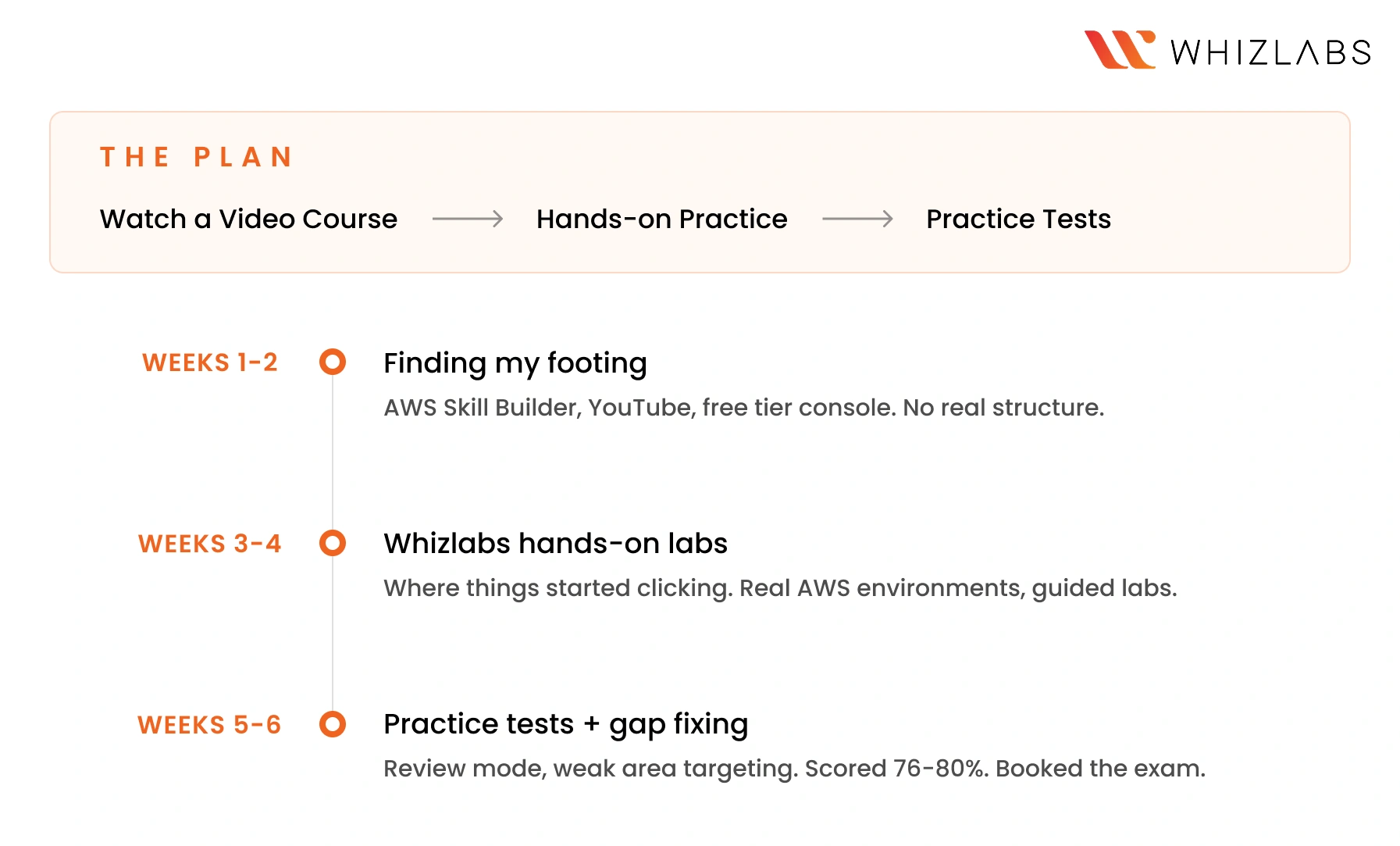
My SAA-C03 study plan was simple. Watch a structured video course, get some hands-on practice, take practice tests toward the end.
That lasted about a week.
Weeks 1–2: Finding my footing
The first two weeks were loose. I started with AWS Skill Builder — free, decent orientation. Watched some YouTube videos, read a few prep blogs, poked around the AWS console on a free tier account. I had a study schedule in Notion that I stopped updating by day four.
I also planned to finish a full video course in those two weeks. Started one, got through maybe 40% of it, then fell into a Reddit thread about which services to prioritise. Actually, that was not a waste of time. It gave me a lot of new perspectives. I picked up a lot of context from how other people approached the exam.
Week 3–4: Whizlabs hands-on labs
Around week three, I started the Whizlabs hands-on labs. That’s where things shifted. Networking in particular – VPCs, subnets, route tables, NAT gateways, security groups – made very little sense from reading alone. The labs walked me through building these configurations step by step in real AWS environments. Working through it hands-on is what made the logic click.
For reference: This guide by Whizlabs suggests some top SAA-C03 hands-on labs https://www.whizlabs.com/blog/hands-on-labs-saa-c03/
Somewhere in week four, I booked the exam. Having a fixed date was the only thing that made the final stretch feel real.
Weeks 5–6: Practice tests and gap fixing
I approached Whizlabs practice tests as a learning tool. I answered questions, went through every explanation, right or wrong. I figured out the patterns where I made mistakes. Kept mixing up SNS, SQS, and EventBridge. Aurora versus RDS wasn’t clear. S3 encryption had gaps. So I went back to those specific areas instead of restarting everything.
By the end, I was consistently scoring 76–80%. Not perfect. But I have heard that Whizlabs practice tests are harder than actual exams. So I was confident that I could do it.
What Actually Helped
Practice tests in review mode were the single biggest contributor. The Whizlabs practice tests were just like an actual exam with long scenarios, multiple plausible answers, architecture trade-offs, and subtle wording differences. I went through each question’s explanation, understood every single option and built a pattern recognition. A lot of SAA-C03 preparation is learning how AWS frames problems, not just learning the services themselves.
Hands-on labs were the second most valuable thing. Anything networking-related only made sense after I actually built it.
What Didn’t Help
Reading AWS documentation cold. The docs are detailed and accurate but they’re not written for exam preparation. They don’t tell you which trade-offs matter or how AWS expects you to reason through a scenario. I wasted a few days on this early on. The course gave me the context I needed to make the docs useful later.
Also, I tried to cover everything equally. The SAA-C03 is weighted. Resilient architectures and high-performing architectures make up more than half the exam. I should have spent more time there from the start.
Key AWS SAA-C03 Exam Topics: What Came Up in the Exam
These are the areas that appeared repeatedly. Worth spending real time on each.
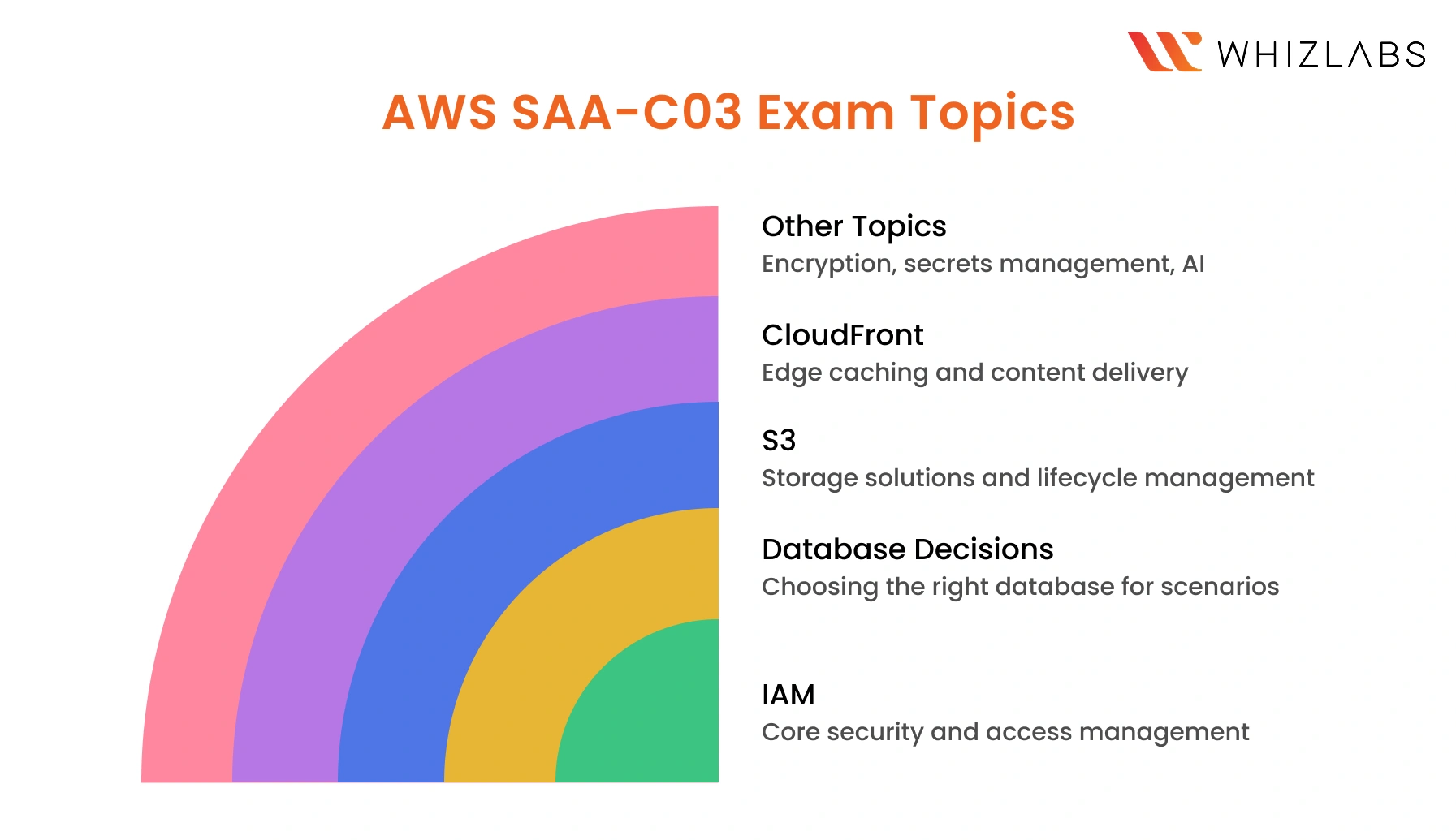
CloudFront and edge architecture
Questions weren’t basic definitions. They were scenarios about latency problems, path-based routing, and Lambda@Edge integration. Know why you’d use CloudFront, not just what it does.
For example: a company wants to reduce latency for users across multiple continents while keeping origin infrastructure in one region. Which CloudFront configuration would you recommend?
Database decisions: Aurora, DynamoDB, RDS
A significant portion of the exam is choosing the right database for the scenario. Aurora versus RDS, Multi-AZ versus read replicas, DynamoDB use cases, and failover behaviour. Multiple answers usually look correct. The difference is always in one specific requirement.
For example: an application needs a relational database with automatic failover and a recovery time under 30 seconds. Which option and configuration would you choose?
S3: storage tiers, lifecycle policies, Athena
S3 appeared more than I expected. Lifecycle transitions, Intelligent-Tiering, querying data with Athena, encryption options. SSE-S3 versus SSE-KMS versus SSE-C came up in context of compliance requirements.
For example: a company stores log files that are frequently accessed for the first 30 days and rarely after. What lifecycle policy would be most cost-effective?
Data migration scenarios
Moving data from on-premises to AWS with specific constraints. Limited bandwidth, large volumes, tight timelines, systems that can’t go offline. Know when to use DataSync, Storage Gateway, Snowball, and Snowmobile.
For example: a company needs to migrate 2 petabytes of data within two weeks with a limited internet connection and cannot take systems offline. What would you recommend?
IAM: policies, permissions, federation
IAM is woven into the entire exam. Policy JSON, identity-based versus resource-based policies, roles versus users, Service Control Policies in AWS Organizations. These require reasoning through access logic, not memorisation.
For example: a developer needs read access to one specific S3 bucket but must be denied access to all others. How would you write that policy?
KMS encryption
KMS questions were mostly about compliance and control. You need to know when to encrypt data at rest versus in transit. You also need to know the difference between customer-managed keys and AWS-managed keys: when to use each and what the cost and audit implications are.
For example: a financial services company needs full control over key rotation and audit logs for encrypted data in RDS. Which KMS configuration would you recommend?
Secrets Manager and Parameter Store
These two get tested together precisely because they overlap. Know what sets them apart, what each is built for, and when the cost difference justifies one over the other. Automatic credential rotation appeared as a direct scenario.
For example: an application needs to automatically rotate its RDS database password every 30 days without manual intervention. Which service handles this natively?
AI service integration
In 2026, this is showing up more. Not deep AI architecture, just enough to know what Rekognition, Comprehend, Transcribe, and Lex do and how they connect with Lambda or API Gateway.
For example: a company wants to extract sentiment from customer support calls and store results in DynamoDB. Which services would you combine to build this pipeline?
My SAA-C03 Exam Experience
I took the exam online through Pearson OnVUE. A few things worth knowing before you sit down.
The check-in process starts 30 minutes before your scheduled time. You upload ID photos, scan your room, show your desk, and then wait for a proctor to connect. I was waiting for some time, sitting there with nothing open, no phone, just a screen. Once the exam starts, the client takes up your full screen. The layout is wide and not particularly comfortable to read. The questions and answers stretched across the entire display. You adjust, but don’t expect a smooth experience.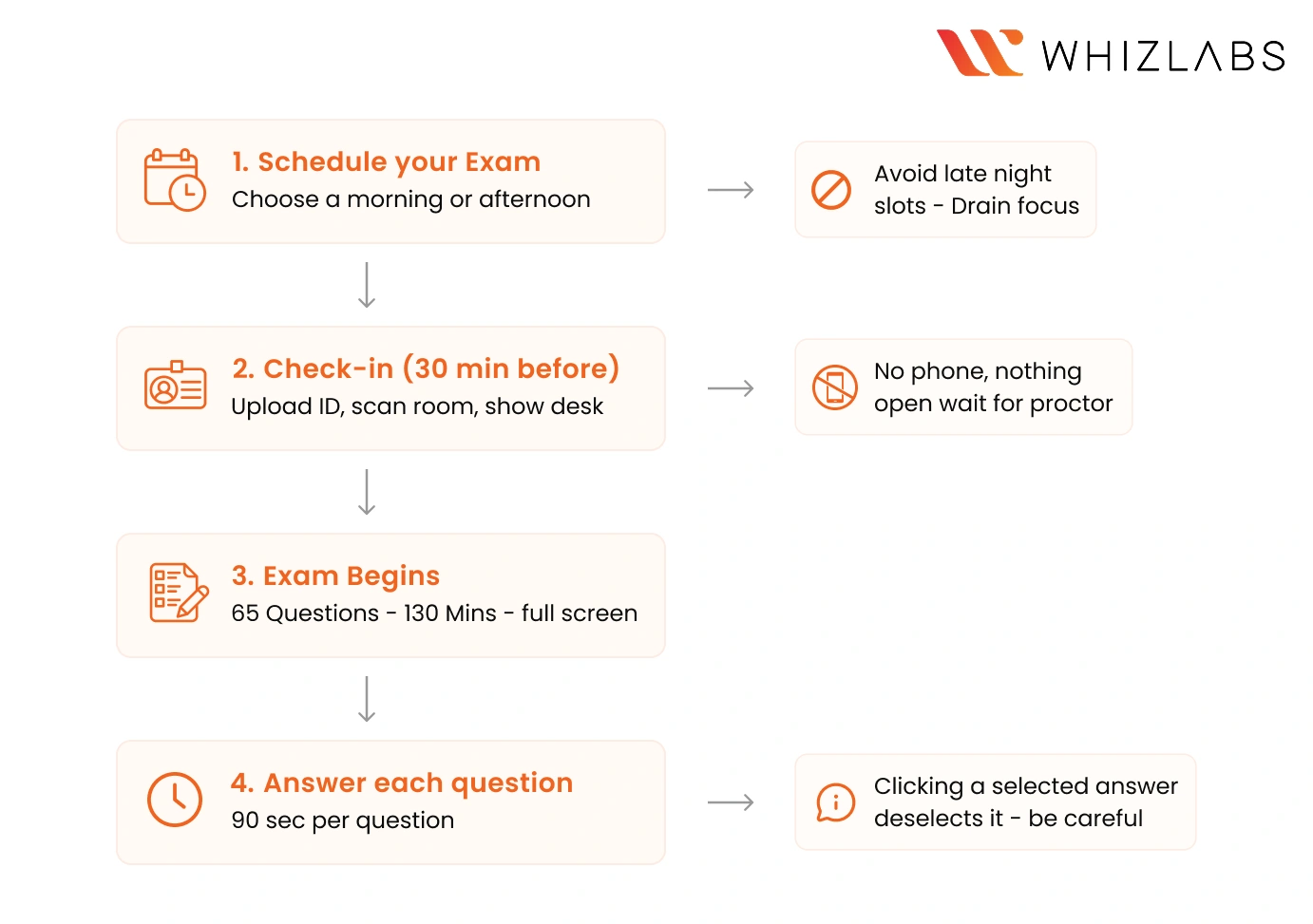
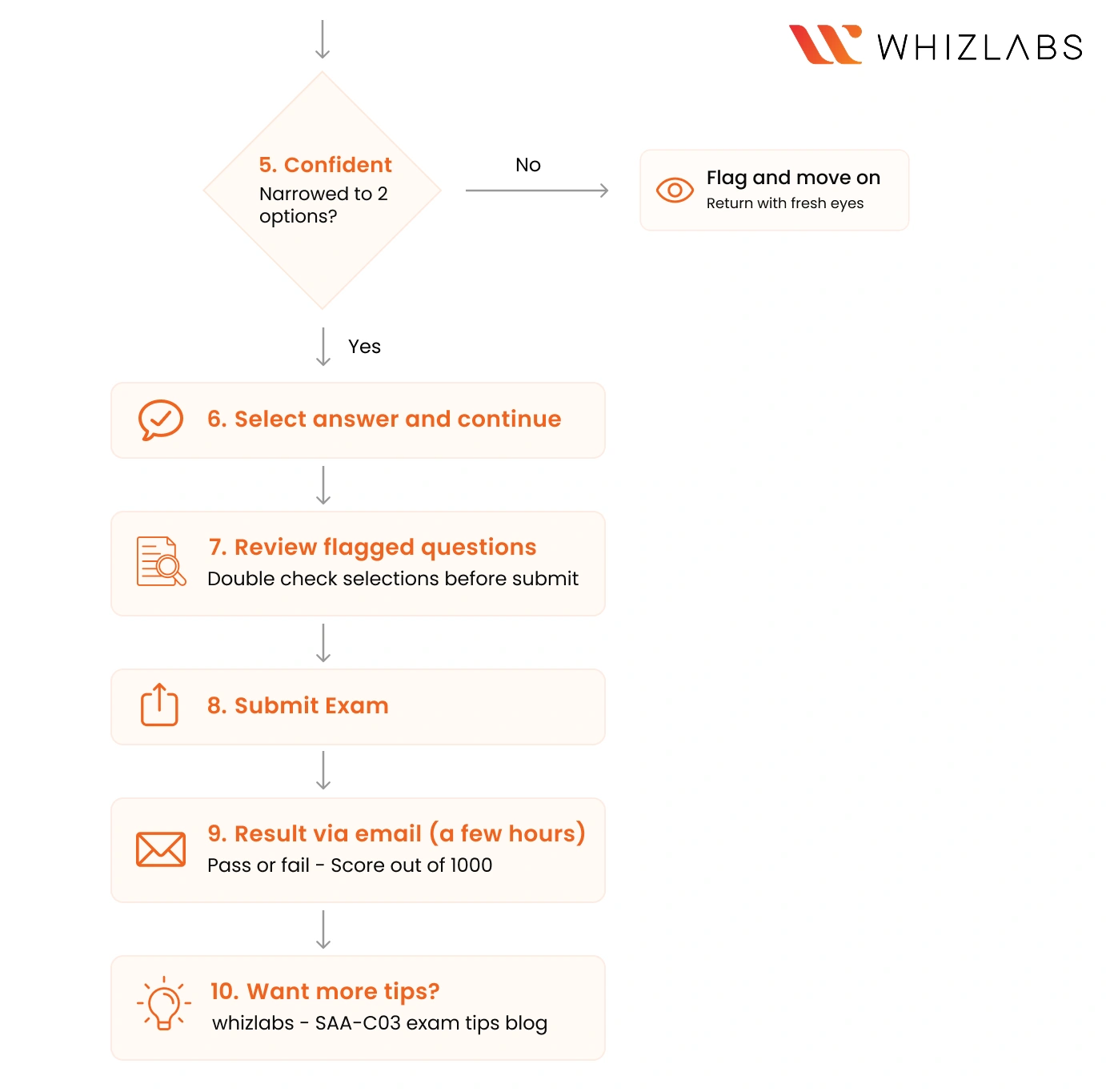
The exam has 65 questions, lasts 130 minutes. I used almost all of it. My approach: if I couldn’t narrow a question down to two options within about 90 seconds, I flagged it and moved on.Coming back with a fresh read helped more often than I expected.
A few hours later, the result came through email. I passed with a score of 812. Six weeks of learning and balancing work had paid off and honestly, it was a big relief. Now I could move my focus to something else: my head had been in SAA-C03 for long enough.
One small but important detail: clicking an already-selected answer deselects it. If you have a habit of clicking your answer more than once to confirm it, be careful. I caught this early and went back to double-check flagged questions before submitting.
A morning or afternoon slot works best. A late-night slot might seem convenient but sitting a 130-minute exam after a full day is not a good idea. If you have no choice, at least don’t schedule the exam right after a busy work day. Give yourself some breathing room beforehand.
For more exam AWS Solutions Architect Associate tips, refer to this blog – https://www.whizlabs.com/blog/aws-solutions-architect-associate-exam-tips/
After I Passed: How SAA-C03 Helped on the Job
The certification didn’t change everything overnight. But it changed how I understood cloud conversations almost immediately.
Before SAA-C03, architecture discussions were familiar but slightly abstract. I knew what services were being mentioned but not always why a specific decision had been made. After passing, I understood the reasoning. That was the biggest practical shift. Not the badge. The ability to reason through decisions.
I added the badge to my profile and let my team know about it. I had stronger opinions and I got pulled into architecture discussions earlier. The certification title opened doors because the knowledge behind it meant I was actually useful in those conversations. There’s a difference between sitting in a meeting, following along and being able to contribute something specific.
I’m already looking at the next one, the Professional level: SAP-C02.
Final Thoughts
That’s my SAA-C03 success story. If I were starting today, the first thing I’d do is take a practice test before touching any study material, to see where I actually stand. Most people skip this and spend weeks studying things they already know while the real gaps stay hidden. A practice test surfaces those gaps in about two hours.
Everything else follows from that. A structured course to build the foundation, hands-on labs to make it stick, and practice tests in review mode throughout. That combination worked for me. It’s not a complicated plan. The hard part is staying consistent long enough for it to come together.
Six weeks later, I had the cert, a better grasp of cloud architecture than I expected, and a clearer idea of where I want to go next. That is how I passed SAA-C03, and looking back, it was well worth it.
If you’re starting your SAA-C03 prep, the Whizlabs SAA-C03 course is worth checking out. It covers everything you need for the preparation in one place.
FAQs: How to Pass AWS SAA-C03
How long does it take to pass SAA-C03? I passed with a six-week study plan while working full time. With a tech background, four to eight weeks is realistic; complete beginners may want a little longer.
What score do you need to pass SAA-C03? The exam is scored from 100 to 1000, and you need 720 to pass. I scored 812.
What is the SAA-C03 exam experience like? It’s 65 scenario questions in 130 minutes through Pearson OnVUE, with a full-screen client and a 30-minute check-in. Give yourself breathing room and a morning or afternoon slot.
What is the best way to prepare, based on your experience? For me, the winning combination was a structured course, hands-on labs, and practice tests in review mode. Reading the docs cold was the least useful thing I tried.
Is SAA-C03 worth it? Yes. The knowledge behind the badge is what made the difference for me at work, more than the badge itself.
Keep Reading
If you are just starting out, get the lay of the land with the full SAA-C03 syllabus and an honest look at how difficult the SAA-C03 exam is. When you are ready to build a plan, follow this SAA-C03 study guide, and sharpen the practical side with hands-on labs for SAA-C03.

- Why Cloud Architects Need Multi-Cloud Certs in 2026 - May 25, 2026
- How AI and Automation Help AWS SAP-C02 Architects in 2026? - January 2, 2026
- How to Prepare for the VMware VCP‑DCV Certification in 2025? - August 12, 2025
- What are the Key Model Deployment Strategies for AIF-C01? - February 26, 2025
- How I Passed AWS SAA-C03 Exam: My Study Plan and Mistakes - September 9, 2024
- What Are The Best Careers With AWS Cloud Practitioner Certification? - January 23, 2024
- Terraform with AWS and Azure: Integration Guide & Comparison - April 17, 2021
- AWS DOP-C02 Exam Guide: How to Prepare for AWS Certified DevOps Engineer Professional Exam - September 17, 2018