We all have used AI and we all think we know AI at this point. It summarises emails, answers questions, creates documents and more. It has become part of how a lot of us work and honestly, some of us have started seeing it like a coworker and would love to CC it on our emails.
Most of us have a working understanding of AI. That understanding is accurate. But it is incomplete.
The AI that is being built and deployed inside enterprises right now works differently from the AI most of us interact with daily. It does not just respond. It acts. It takes a goal, works through it independently, and completes tasks that used to require multiple people and multiple tools.
That version is called agentic AI. And if your understanding of AI stops at chatbots and copilots, this is the part worth catching up on.
What Is Agentic AI?
The AI most of us use today waits to be asked. You give it an input, it gives you an output. Every step needs you in the middle of it.
Agentic AI works differently. You give it a goal and it figures out how to get there. It plans the steps, picks the tools, makes decisions along the way, handles what goes wrong, and keeps going until the job is done.

Agentic AI refers to AI systems that can act autonomously toward a goal rather than simply respond to an input.
You open your calendar in the morning and notice two meetings overlapping. Normally you:
- reschedule one meeting
- check availability
- update the invite
- message the other person
- update your own task list
An agentic AI system can handle that entire workflow on its own. And it handles all of that the moment the conflict appears. It does not wait for you to find the problem and ask for help.
It checks the calendar, finds a slot that works for everyone, reschedules, sends the update and logs the change.
So what is agentic AI exactly? It is an AI system that can act autonomously toward a goal rather than simply respond to an input.
What enterprise would not want such a smart and efficient system in their business? So it is coming into every sector.
Which Industries Use Agentic AI Right Now?
If you think agentic AI is still emerging, you could not be more wrong. Enterprises are running thousands of agentic systems in production. Thousands. In production.
Gartner predicts that by 2028*, 33 percent of enterprise software will include agentic AI. In 2024 that number was less than one percent. If your company has not started a conversation about this yet, it probably will soon.
*Source link: https://www.gartner.com/en/webinar/784381
| Sector | What Agentic AI Is Doing | Real Impact |
| Legal | Reading and reviewing contracts end to end | JPMorgan cut 360,000 hours of lawyer work annually |
| Customer Operations | Handling customer queries, complaints and resolutions without human involvement | Klarna serves 2M+ customers a month with no human agent |
| Manufacturing | Spotting equipment issues before a breakdown happens | Siemens stopped losing money to unplanned downtime |
| Healthcare | Managing patient schedules, records and flagging abnormal test results | Doctors spend less time on admin and more time on patients |
| Logistics | Watching supply chains live and fixing problems in real time | DHL reroutes shipments and adjusts inventory without waiting on a human decision |
Agentic AI vs Regular AI: What Is the Difference?
Regular AI responds to you. You ask, it answers. The intelligence is only in response and the agency is entirely yours.
Agentic AI acts toward a goal. It reasons through what needs to happen, uses tools to make it happen, checks whether it worked, and adjusts if it did not. The intelligence is now in the entire process of getting from goal to outcome. The agency belongs to the system.
The difference between agentic AI and regular AI is in architecture, ownership of decisions, and what breaks when something goes wrong.
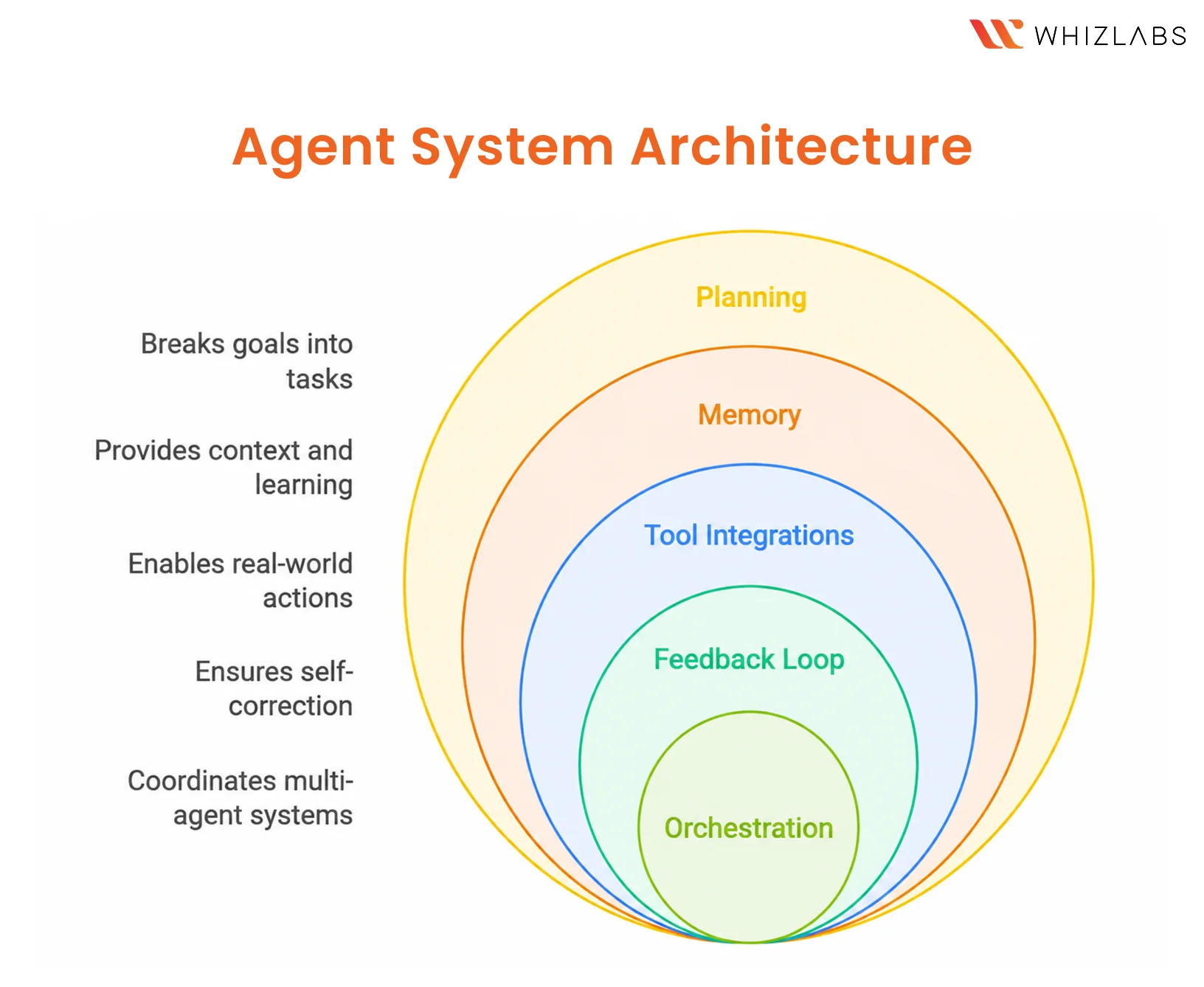
Underneath sits a completely different architecture. A regular AI system is essentially a model and a prompt. An agentic system is made of several components working together:
The planning layer breaks a goal into a sequence of tasks and decides what order to execute them in. This is what allows an agent to handle multi-step work without someone mapping out each step manually.
Memory gives the agent context. Short-term memory tracks what has happened within a single task. Long-term memory lets the agent carry information across sessions and improve over time based on past outcomes.
Tool integrations are what allow agents to actually do things in the real world. An agent without tools can only think. With tools it can search the web, query a database, send an email, trigger an API, write and run code, and interact with external systems.
The feedback loop is how the agent knows whether an action worked. After each step it checks the result, decides whether to continue, retry, or take a different path entirely. This is what makes agentic systems self-correcting rather than just self-running.
Orchestration is the layer that coordinates all of this. In multi-agent systems, where several agents are working in parallel on different parts of a problem, orchestration decides which agent handles which task, how they hand off to each other, and what happens when one of them fails.
| Regular AI | Agentic AI | |
| How it works | Responds to prompts | Acts toward goals |
| Who manages each step | You | The system |
| Architecture | Model and prompt | Model, memory, tools, planning layer, feedback loop, orchestration |
| What breaks it | Bad prompts | Poor system design, tool failures, unhandled edge cases |
| Skills needed to build it | Prompt engineering, model knowledge | Orchestration, tool integration, failure handling, system design |
Building regular AI and building agentic AI are not the same job. One is working with a tool. The other is designing a system that works on its own. The engineers who understand the difference, and can actually build for it, are the ones companies are struggling to find right now.
What Does Agentic AI Mean for AI Careers in 2026?
Companies want different kinds of AI engineers now.
A few years ago, AI hiring was heavily focused on models, training, and machine learning. Today, companies are increasingly investing in systems that can orchestrate tools, retrieve information, make decisions, and operate across workflows. As a result, skills like agent orchestration, autonomous system design, and end-to-end AI workflow development are becoming more valuable.
McKinsey* found that companies deploying agentic AI reported 40 percent faster process completion on average. Deloitte’s* research shows organisations using AI agents cutting operational costs by up to 30 percent in the functions where agents are deployed.
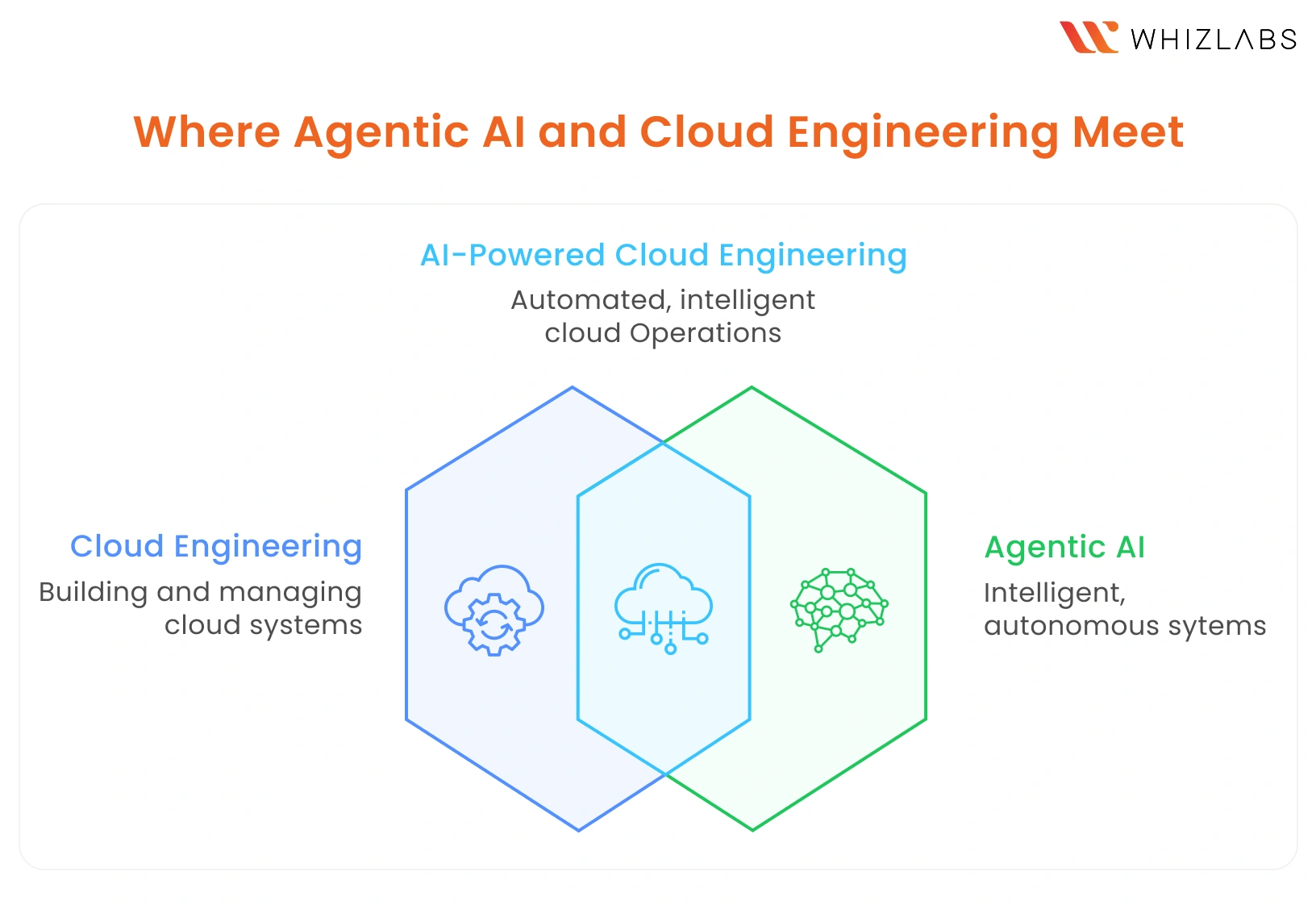
Agentic AI for engineers, specifically for cloud and backend engineers, this shift matters more because agentic AI systems behave much more like real software systems than simple chatbots.
These systems rely heavily on workflows, APIs, orchestration, monitoring, and handling failures properly. A lot of that already overlaps with the kind of work engineers do today. So actually the agentic AI is pulling traditional engineering skills back into AI.
For anyone building toward an AI career, agentic AI is where the demand is concentrated in 2026. Starting here is starting in the right place.
*Source links: https://www.mckinsey.com/capabilities/quantumblack/our-insights/the-state-of-ai
https://www.deloitte.com/global/en/issues/generative-ai/ai-use-cases.html
What Is the NCP-AAI Certification and What Does It Cover?
As companies move toward agentic AI systems, certifications are starting to move in that direction too.
The NVIDIA Certified Professional – Agentic AI (NCP-AAI) certification focuses on the skills needed to design and work with autonomous AI systems.
The emphasis is not just on prompts or model concepts. It is much more focused on how agentic systems actually operate in production.
What does NCP-AAI exam tests:
- Agent-based architecture and system design
- Multi-agent coordination and task handoffs
- AI deployment pipelines for autonomous systems
- Real-time decision-making and tool integration
- Monitoring and optimising agents in production
Every one of those topics maps directly to what enterprises are building right now and struggling to staff.
The NVIDIA Certified Professional Agentic AI credential carries weight precisely because NVIDIA is not just teaching agentic AI. They are running the AI ecosystem.
A large percentage of modern AI systems today run on NVIDIA hardware in some form. Whether it is ChatGPT, Gemini, enterprise copilots, or large-scale AI infrastructure inside enterprises, NVIDIA sits underneath much of the compute powering those systems.
That is part of why certifications from NVIDIA are getting attention in the AI space right now.
The company is closely tied not just to AI models, but to how AI systems are actually deployed and operated at scale.
More importantly, the certification aligns well with where AI systems are heading.
Who Should Get the NCP-AAI Certification?
Is NCP-AAI worth it in 2026? For most engineers in or entering the AI space, yes. Definitely yes.
This certification is still relatively new and the number of people holding it is small. But we are sure that situation does not last long in a field moving this fast.
Cloud and DevOps Engineers
If your work is starting to overlap with AI workflows, NCP-AAI can help you move into agentic AI in a structured way.
A lot of the skills already overlap more than people expect:
- workflows
- APIs
- orchestration
- integrations
- monitoring
- reliability engineering
Agentic AI systems behave much more like real software systems than simple chatbots, which makes the transition more natural for infrastructure and platform-focused engineers.
AI and ML Engineers
If you are already working with models, prompts, or AI applications, NCP-AAI helps expand your focus into system-level AI design.
The industry is gradually moving beyond standalone models and toward autonomous AI systems that can interact with tools, coordinate tasks, and operate across workflows.
That shift requires a broader understanding of how these systems are designed, deployed, monitored, and maintained in production.
Software and Backend Engineers
Backend and software engineers already work heavily with APIs, workflows, integrations, and distributed systems.
Those same concepts are becoming increasingly important in agentic AI systems.
NCP-AAI can act as a bridge into AI system design without requiring a traditional machine learning background first.
Architects and Platform Engineers
For architects and platform engineers, the certification is useful because it focuses on how autonomous AI systems operate at scale.
That includes:
- orchestration patterns
- multi-agent coordination
- deployment pipelines
- monitoring
- production reliability
These are becoming important considerations as enterprises move AI systems into real operational environments.
Professionals Moving Into AI Careers
For professionals trying to enter the AI space, agentic AI is one of the more practical areas to focus on right now.
The demand is increasingly shifting toward engineers who can build systems around AI models, not just work with the models themselves.
How to Prepare for the NCP-AAI Exam
How to prepare for NCP-AAI comes down to one principle. Build more than you read.
Start with the concepts
NVIDIA’s official learning path for NCP-AAI is the right first stop. It maps directly to what the exam tests and gives you structured coverage of agent architecture, multi-agent systems, and deployment pipelines. For a detailed breakdown of the exam structure and what each domain covers, the NVIDIA Agentic AI Certification NCP-AAI Guide 2026 on Whizlabs is worth reading before you start.
Use practice tests as a diagnostic
A lot of people treat practice tests like score checks. They are more useful as diagnostic tools.
Take a practice test before you feel fully prepared. Whizlabs practice tests are scenario-based and built around the kind of system-level reasoning the exam actually requires.
Build something before exam day
Even a small project helps, like a single-agent workflow.
A workflow that you design, run, troubleshoot, and improve yourself will teach more than passive study alone.
Most of the learning happens the first time something fails unexpectedly and you have to figure out why.
That is also very close to how real-world agentic systems behave in production.
Final Thoughts
Agentic AI is not where the industry is going. It is where it already is. The engineers who get here early will be the ones defining what comes next.
If you have read this far, you already know more about agentic AI than most people in your field. The next move is doing something with that.
Start with the concepts. Get your hands on the systems. Take a few NCP-AAI Practice Tests to create your study plan.

- GCP Agentic Architect Exam Guide: Format, Domains, and Beta vs GA (2026) - September 30, 2026
- AIP-C01 Sample Questions and Answers: Scenario-Based Practice - September 16, 2026
- Databricks Certified Generative AI Engineer Associate Exam Guide (2026) - August 4, 2026
- 10 AWS Security Projects SCS-C03 Candidates Should Build - July 10, 2026
- Microsoft’s Latest AI Launches: Are We In the Agent Era? - June 26, 2026
- What Career Does MLA-C01 Lead To? Read This Before You Start - June 18, 2026
- What Is Agentic AI? And Why NCP-AAI Is the Cert for It - June 4, 2026
- Who Should Take AB-100 Certification? Beginner or Professional? - May 14, 2026