

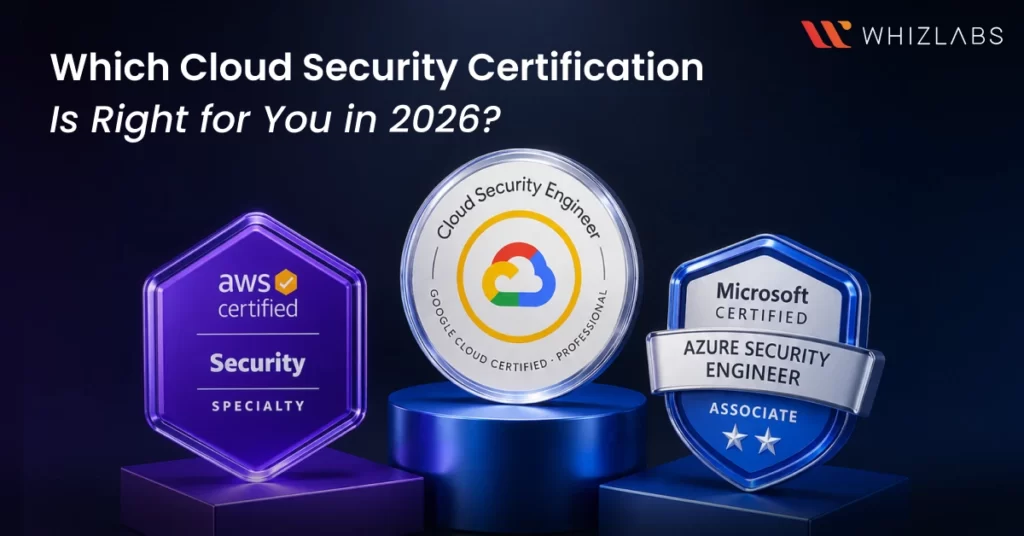
You’ve been working in the cloud for a couple of years. You understand how infrastructure fits together: compute, networking, IAM basics, maybe some scripting. Now you’re ready to move into security, and you’re looking at three certifications sitting in front of you: AWS Security Specialty, Azure AZ-500, and Google Professional Cloud Security Engineer.
Here’s the honest truth: all three are solid. All three will move your career forward. But they don’t move it in the same direction and that difference matters a lot more than most people realise when they’re first making this call.
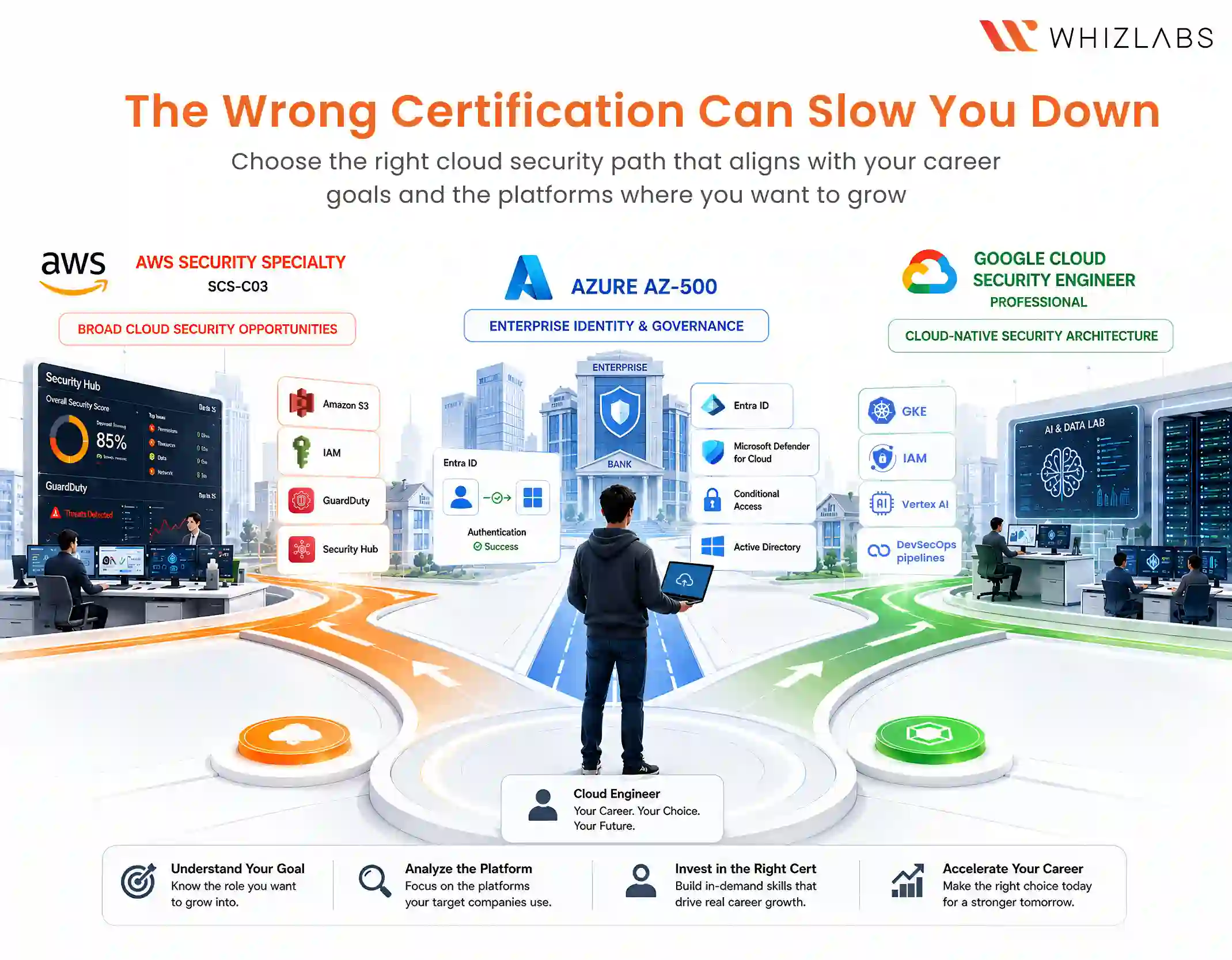
Picking by popularity is the most common mistake here. AWS shows up on most job listings, so it feels like the obvious answer. But if your company runs on Azure, or your target employers live in the GCP world, a popular cert that points the wrong way can quietly slow you down instead of accelerating you.
So before you open a study guide, spend five minutes getting clear on which direction you’re actually heading.
Best Cloud Security Certification in 2026: Quick Answer
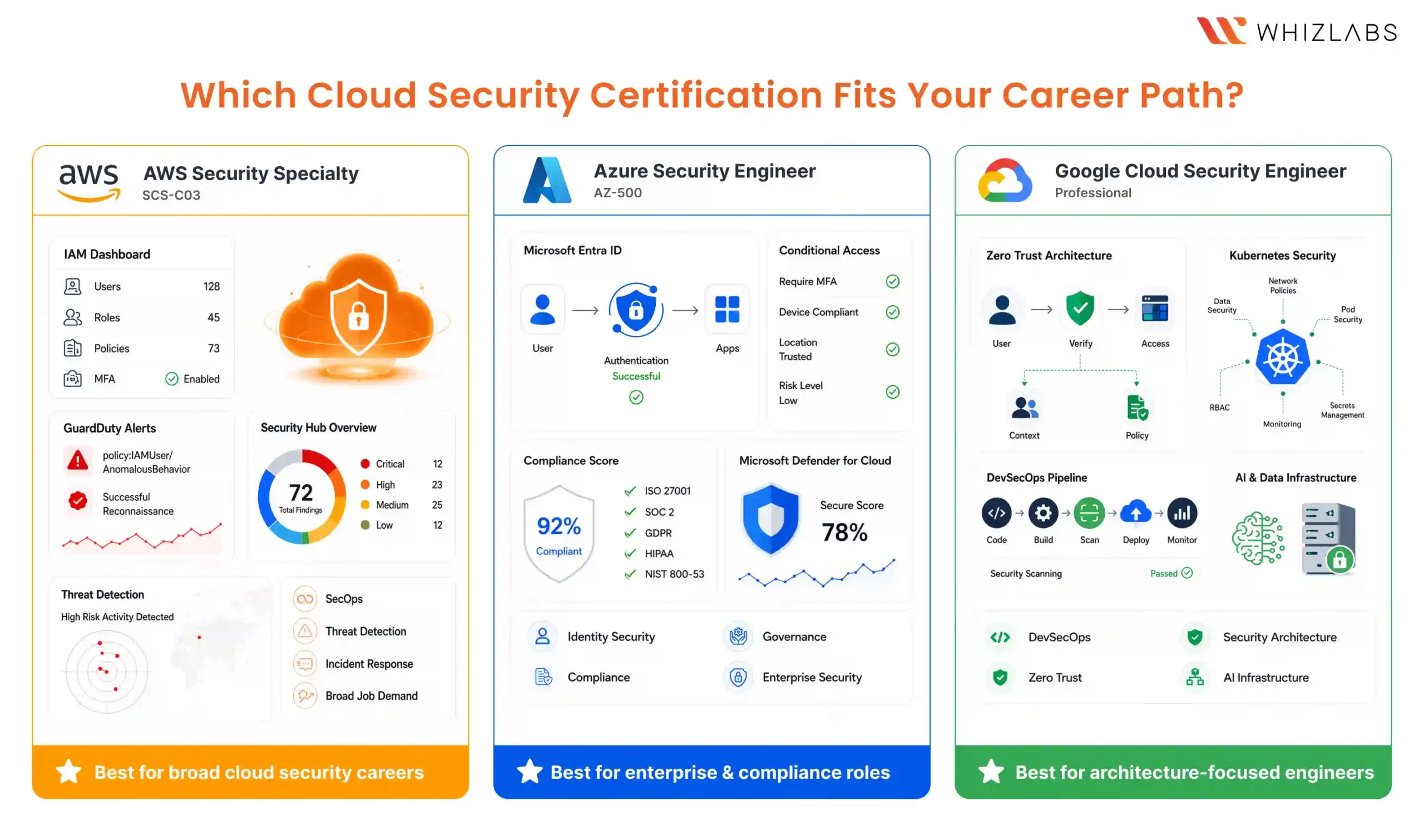
- Choose AWS Security Specialty for the broadest cloud security job opportunities.
- Choose AZ-500 for Microsoft enterprise security environments.
- Choose Google Cloud Security Engineer for cloud-native security and DevSecOps-focused careers.
Cloud Security Certifications at a Glance
| Certification | Best For | Cloud | Main Focus | Difficulty |
| AWS SCS-C03 | Broad job demand | AWS | Security operations | Medium |
| AZ-500 | Enterprise security | Azure | Identity & compliance | Medium |
| GCP Security Engineer | Cloud-native architecture | GCP | IAM & DevSecOps | Medium-High |
How to Choose the Right Cloud Security Certification in 2026
Think about where you spend most of your working hours right now.
Are you writing Terraform for AWS infrastructure? Debugging IAM policies in the console? Responding to GuardDuty alerts? That’s your signal that your existing platform knowledge is a head start you shouldn’t throw away unless you have a clear reason to.
Now think about where you want to be in two years. Not in a vague “I want to grow” sense specifically.
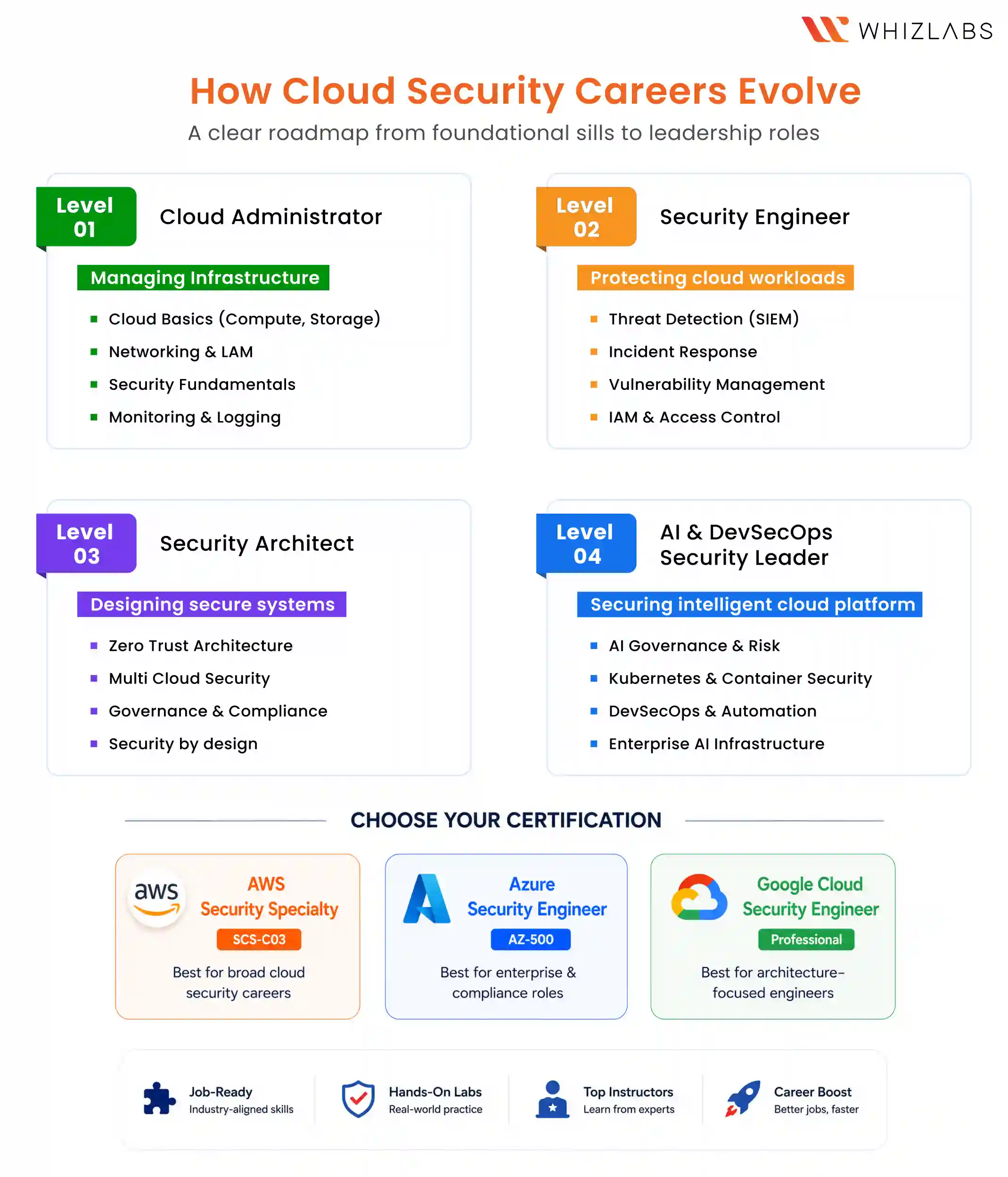 Do you want to be a cloud security engineer embedded in a product team?
A security architect advising on enterprise compliance?
A specialist in DevSecOps pipelines?
Each of those paths pulls toward a different certification.
“The fastest path to certification value is building on what you already know, not starting over on a new platform while simultaneously learning security concepts.”
Here are the four things that actually determine which cert is right for your situation:
Your current platform experience: The fastest path to certification value is building on what you already know. If you’ve spent the last two years in AWS, SCS-C03 will feel like a natural deepening of your existing knowledge. You’re learning the security layer on top of an ecosystem you already understand. Starting from scratch on a new platform while simultaneously learning security concepts doubles your workload for no clear gain, unless your career direction demands it.
Where your employer or target employers operate: This is the one most people skip, and it’s the one that bites hardest. AWS holds the broadest hiring market overall, but that’s not the whole picture. Azure dominates in financial services, government, healthcare, and large enterprises. GCP has a strong foothold in data, AI, and engineering-driven companies. Before you commit months of study, look at ten or fifteen job descriptions for the roles you actually want. Which platform keeps showing up?
The type of security work you want to own: SCS-C03 is built around security operations, threat detection, data protection, and incident response inside AWS. AZ-500 is heavily weighted toward identity, governance, and compliance across a Microsoft environment. GCP Security Engineer leans into architecture how you design security into a system from the ground up. These aren’t just exam differences. They reflect genuinely different day-to-day work. Pick the one that matches what you actually want to be doing.
The return you need from the investment: Certification costs time and money. The right question isn’t just “will this get me hired?” it’s “will this get me into the specific roles I want, at the level I’m targeting?” A cert that opens five deeply relevant opportunities in your target market is worth more than one that appears on hundreds of listings you’d never apply to anyway.
Salary & Job Market Insights by Certification (2025–2026)
| AWS Security Specialty (SCS-C03) | Azure Security Engineer (AZ-500) | Google Cloud Security Engineer | |
| US Avg. Salary | $145,000 – $175,000/yr | $130,000 – $160,000/yr | $140,000 – $170,000/yr |
| India Avg. Salary | ₹18,00,000 – ₹28,00,000/yr | ₹15,00,000 – ₹24,00,000/yr | ₹16,00,000 – ₹26,00,000/yr |
| UK Avg. Salary | £70,000 – £110,000/yr | £60,000 – £95,000/yr | £65,000 – £100,000/yr |
| US Job Openings | 12,000 – 15,000+ | 8,000 – 11,000+ | 3,000 – 5,000+ |
| India Job Openings | 4,500 – 6,500+ | 3,500 – 5,000+ | 1,200 – 2,500+ |
| UK Job Openings | 1,800 – 2,800+ | 1,400 – 2,200+ | 500 – 900+ |
| Top Hiring Sectors (US) | Tech, Fintech, Defense | Banking, Healthcare, Govt | AI/ML, Data, SaaS |
| Top Hiring Sectors (India) | IT Services, Startups | BFSI, MNCs, Consulting | Product companies, GCCs |
| Top Hiring Sectors (UK) | Fintech, Cyber, Defence | Banking, NHS, Govt, Consulting | DeepTech, AI labs, SaaS |
Resource Link: Cloud Security Engineer salaries
When Should You Choose AWS Security Specialty (SCS-C03)?
If you’ve been living inside AWS for the past year or two, this one is probably already calling your name and for good reason.
SCS-C03 is built for engineers who already understand how AWS works and want to go deeper into the security layer sitting on top of it. You’re not learning a new cloud from scratch. You’re learning how to lock down the one you already know how to protect data in S3, how to design least-privilege IAM policies that actually hold up, and how to configure GuardDuty and Security Hub to catch the threats that matter.
That existing familiarity is a genuine advantage. Concepts click faster when you’ve already wrestled with the underlying services. You spend more time learning security thinking and less time figuring out what a VPC is.
Beyond the exam itself, AWS still commands the largest slice of the cloud infrastructure market, around 28% according to Synergy Research Group, which means the hiring pool for AWS-certified security professionals is the widest of the three. If you’re job hunting or planning to be soon, that breadth gives you options.
This cert makes the most sense if:
- You’re already working day-to-day in AWS and want to formalise your security expertise
- You’re targeting roles at companies where AWS is the primary or only cloud
- You want the widest possible range of job opportunities as you make the move into security
One thing most people don’t expect going in: SCS-C03 is not a theory exam. A lot of candidates assume it’s about understanding security concepts at a conceptual level, encryption standards, compliance frameworks, that kind of thing. It’s not. The exam puts you in scenarios and asks how you’d actually solve the problem inside AWS. Which service do you use? How do you configure it? What breaks if you do it wrong? If you haven’t spent real time in the console, that gap will show up quickly.
Why Choose Microsoft Azure Security Engineer Associate (AZ-500)?
Here’s something worth knowing about AZ-500 before you decide: it’s less about “Azure security” and more about “enterprise security that happens to run on Azure.”
That distinction matters. If you’re imagining an exam that drills you on Azure firewall configurations and network security groups, you’re only looking at part of it. The heavier emphasis is on identity managing access at scale, enforcing conditional access policies, and governing who can do what across a complex Microsoft environment that often spans cloud and on-premise together.
“AZ-500 is less about Azure security and more about enterprise security that happens to run on Azure and that distinction changes everything about how you should prepare.”
That makes AZ-500 a strong fit if you’re moving toward security roles in larger organisations. Banks, hospitals, government agencies, and multinationals, these environments don’t run on the cloud alone. They run on Microsoft 365, Entra ID, Active Directory, Defender, and Azure all talking to each other. Security in those environments means managing identity and compliance across all of it, not just protecting cloud resources in isolation.
If that’s the world you’re heading into, AZ-500 teaches you exactly how security works in that context, not as an abstract skill, but as a practical toolkit for the problems those organisations actually face.
This cert makes the most sense if:
- Your company is already deep in the Microsoft ecosystem: 365, Entra ID, Defender, Windows Server
- You’re targeting roles in enterprise environments where security means more than cloud-native protection
- You want to work in compliance-heavy industries where identity governance and access control are central to the job
One thing most people don’t expect going in: Most candidates walk in expecting a cloud security exam and walk out surprised by how much of it was about identity and compliance. If you study purely from an “Azure services” angle and skip the identity management depth, you’ll feel underprepared on exam day. Go in knowing that Entra ID, conditional access, and Privileged Identity Management are not supporting topics; they’re the core of what this certification is actually testing.
When Should You Choose Google Professional Cloud Security Engineer?
GCP Security Engineer is the most architecture-focused of the three and that’s exactly what makes it different.
Where SCS-C03 tests how well you operate security inside AWS, and AZ-500 tests how well you manage identity and compliance across Microsoft, the GCP exam asks a different kind of question: how do you design a system that’s secure from the start? That shift in framing from operating security to architecting it is what draws a specific type of engineer to this certification.
If you find yourself more interested in the “why” behind security decisions than the “how to configure this service” mechanics, GCP’s approach will resonate. The exam goes deep on IAM architecture, zero trust models, DevSecOps integration, and the shared responsibility model not as checkbox topics, but as design principles that shape how you’d build a secure system end to end.
The market reality is different here too. GCP holds around 14% of the cloud infrastructure market according to Flexera’s State of the Cloud report, smaller than AWS or Azure. But the companies running on GCP tend to be data-heavy, engineering-driven, and often doing genuinely interesting work in AI, ML, and analytics. If that’s the environment you want to work in, the smaller market is actually an advantage less competition, higher specialisation value, and a clear signal to employers about the kind of engineer you are.
This cert makes the most sense if:
- Your current or target employer runs primarily on GCP
- You’re drawn to security architecture and want to think at the system design level, not just the operations level
- You want to build a career in data-forward, AI-driven, or engineering-led organisations where GCP is the platform of choice
One thing most people don’t expect going in: The GCP Security Engineer exam is more conceptual than either of the other two, but not in a light way. It expects you to reason through architectural decisions, understand trade-offs, and apply security thinking across the full stack. Engineers who prepare by memorising service configurations often struggle. The ones who do well are the ones who understand why the architecture decisions matter, not just what the correct answer looks like on paper.
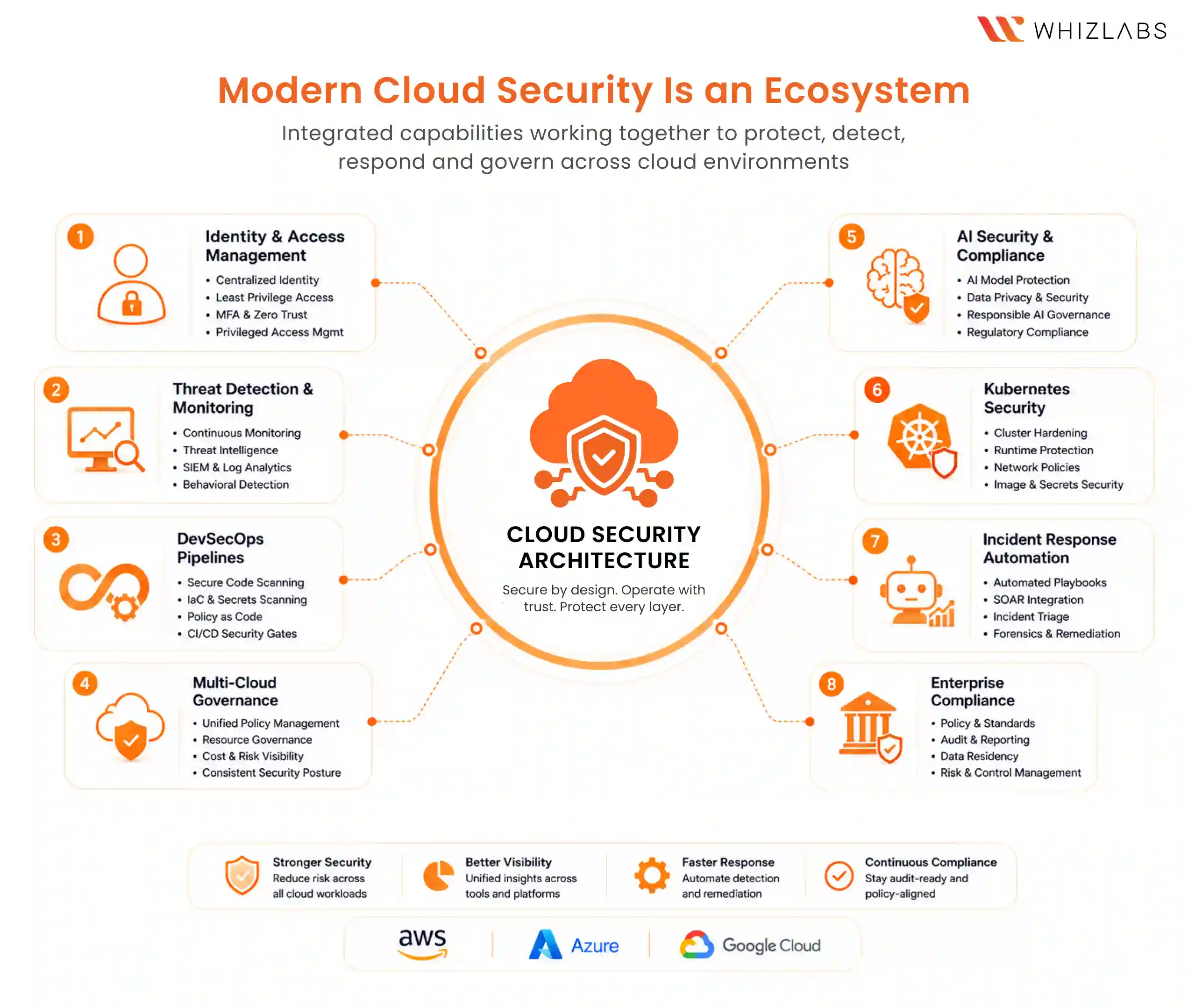
AWS vs Azure vs Google Cloud Security Certifications: Which One Fits Your Career Goals?
The security operations (SecOps) in AWS/Azure/GCP do not differ significantly, as the core idea is similar. Across all platforms, the operations include threat detection, security monitoring, incident response, compliance, and more.
At this point, the decision usually isn’t between AWS, Azure, and Google. It’s between staying where you are and moving toward where your industry is heading.
Choose AWS Security Specialty If:
Job visibility is one of the most common reasons why you may want to choose AWS. It appears on most job descriptions, making one question if another certification can limit their career growth. Here is when the AWS Security Specialty certification works the best:
- Your current organisation depends extensively on AWS services.
- You want to work as a multi-cloud security engineer.
- You already have hands-on experience working on the AWS ecosystem.
Choose Azure Security Engineer Associate If:
Azure works best when you work in an organisation with cloud security as a part of a bigger enterprise strategy. Here is when the Microsoft Azure Security Engineer Associate certification (AZ-500) fits with your career goals:
- You want to build a career in enterprise security.
- You want to gain expertise in security that focuses beyond the Microsoft cloud ecosystem.
- You want to work as a security specialist in environments that combine cloud and on-premise resources.
Choose Google Cloud Security Engineer If:
Google Cloud Platform is a suitable option for those who want to understand how modern security systems work. Here is when you should earn this credential:
- Your organisation (or prospective organisation) primarily uses Google Cloud services.
- You want to specialise in Google’s engineering approach instead of native cloud security.
- You want to develop expertise in a growing and innovative cloud ecosystem.
FAQs
Q1: Which certification has the strongest job demand? When we talk about the market position, AWS holds the largest share and offers a commonly demanded certification by recruiters. Still, the best choice depends on the companies and roles you are targeting.
Q2: Which certification is best for beginners? The certifications are not intended for beginners. Rather, they are for professionals who already have experience in cloud and security. If you are a beginner, you can start by earning a foundation certificate before pursuing security certifications.
Q3: Which cloud security certification is hardest? No cloud security certification is harder than the others. Each of them tests your practical concepts within the respective ecosystem. The difficulty level increases if you are new to a particular cloud platform and are yet to understand the basic concepts.
Q4: Can I switch platforms later? Even if you currently work within the AWS, Azure, or Google cloud platform, and want to switch, the transition is easy. That’s because the general security concepts majorly revolve around the shared responsibility model, cloud compliance and governance, cloud threat detection and monitoring, and incident response in cloud environments.
Q5: What matters when choosing between Azure, AWS, and Google Cloud security certifications? Some of the crucial deciding factors when choosing between AWS, Azure, and Google are industry demand, salary potential, exam difficulty level, and certification value in the future.
Q6: How can you choose from Google Cloud vs AWS vs Azure security certifications? Begin your decision-making process by targeting the job requirements, not the certification itself. AWS is the best fit if you are exploring a wide range of job opportunities. Azure is better when targeting enterprise environments. But Google is ideal when you want to work with data-heavy companies.
Q7: Is the AWS Security Specialty certification worth it? Yes, the AWS Security Specialty is a beneficial credential if you are already working on the AWS ecosystem. It holds value because it depicts how security actually works inside the cloud platform.
Q8: Why do most people pick the wrong cloud security certification? People end up picking the wrong certification because they focus on popularity instead of understanding their career direction. The mistakes are almost similar in all cases, i.e., the certification is decided before figuring out where they actually want to work.
Which Cloud Security Certification Is Best in 2026?
There’s no single right answer here and that’s actually good news.
It means the best certification isn’t the most popular one or the one your colleague picked. It’s the one that fits where you are right now and where you are heading next.
If your day-to-day runs on AWS, go deeper on AWS. If your company lives inside Microsoft tools, AZ-500 will pay off faster than anything else. If you’re drawn to data, AI, or engineering-led work, GCP is more valuable than its market share suggests.
“The only real mistake is picking a cert because it looks good on paper and spending months studying for a role you were never really chasing.”
You already know your platform. You already know the kind of work you want to do. Let that guide the decision, not the job board numbers.
Once you’ve made the call, the next step is finding a learning platform that actually explains things clearly, not one that just dumps documentation at you.
Start your journey with Whizlabs

- AZ-305 Worth It in 2026? Salary, ROI & Career Benefits - September 30, 2026
- AWS Cloud Certification Trends: MLOps & GenAI in 2026 - September 30, 2026
- Cisco AITECH (810-110) Study Guide & Exam Prep 2026 - September 24, 2026
- NVIDIA NCP-AIN Exam Prep & Practice Tests | Whizlabs - September 18, 2026
- SC-500 Exam Prep 2026: Study Guide & 5-Week Plan - September 7, 2026
- AI-200 Study Guide: 6-Week Exam Prep Plan - September 4, 2026
- AB-731 Exam Preparation: Domains & Study Guide - August 31, 2026
- How to Build AI Agents on Azure: AI-103 Guide - August 21, 2026