

Microsoft’s latest AI launches arrived fast. In a matter of weeks in 2026, it shipped five:
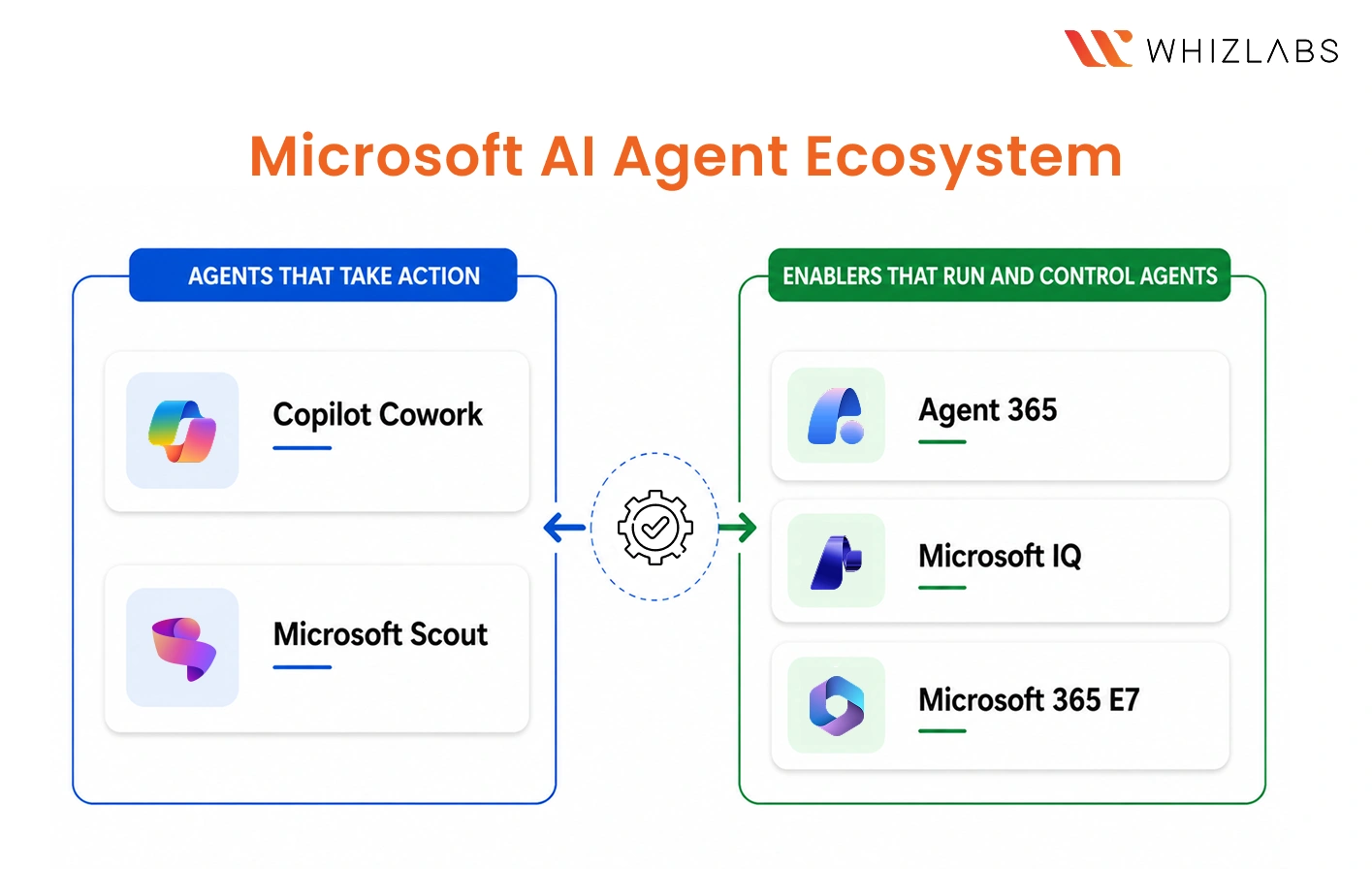
- Copilot Cowork
- Microsoft Scout
- Agent 365
- Microsoft IQ
- New Microsoft 365 E7
AI announcements have become a daily occurrence, so one new tool from Microsoft would be easy to shrug off as background noise. But Microsoft did not ship one. It shipped five in about a month, and all five are about the same thing: AI agents and the systems to run them.
When a company moves this fast, all in one direction, it is not random. Rather than looking at these launches in isolation, it’s worth asking why Microsoft is pushing so aggressively into AI agents, and what that signals about the future demand for cloud, AI, data, automation, and security skills.
Spend a few minutes on what these five actually do. Seeing them together is the fastest way to understand where work is heading for anyone in cloud, AI, or security. Then we’ll get to the questions you’re actually worried about.
A Closer Look at Microsoft’s Latest AI Launches
Copilot Cowork: Microsoft’s Agent That Completes Whole Tasks
You already know what regular Copilot does. It sits inside your apps and helps as you go, you ask it something and it gives you a draft, but you are still the one doing the work. Cowork goes a step past that. Instead of helping you with a task, you hand the whole thing over and let it get on with it. It works out the steps itself and comes back when it is finished, with a result rather than a draft you still have to shape.
Purpose: to move Copilot from helping you do the work to actually doing it for you.
Released: June 16 (generally available)
Microsoft Scout: The Always-On ‘Autopilot’ Agent
Where Copilot waits for you to ask, Scout runs on its own in the background. Microsoft calls it an “Autopilot,” which is its way of saying this is an agent with its own identity that quietly keeps an eye on your work across Teams, Outlook, and your calendar, and steps in to act without you prompting it.
Purpose: to take the constant coordination that eats up your day, like scheduling meetings and chasing stalled decisions, and handle it for you.
Released: June 2. Available in Frontier preview for Windows 11 or later and macOS 12 Monterey or later.
Agent 365: Microsoft’s Control Plane for AI Agents
Once a company has a handful of these agents running, it needs some way to keep track of them all. That is what Agent 365 is for. Think of it as the control room, a single place where a company can see every agent it has, secure them, and decide what each one is allowed to do.
Purpose: to keep autonomous agents accountable by plugging them into the identity, security, and data controls a company already uses.
Released: May 1 (generally available)
Microsoft IQ: The Four Engines That Give Agents Context
An agent is only as useful as what it knows about your business. Microsoft IQ is the shared memory that sits underneath the agents, feeding them real company context instead of leaving them to guess. It is actually a collection of four engines, each supplying a different kind of information:
- Work IQ reads your activity across Microsoft 365, your calendar, documents, and messages
- Fabric IQ connects to the company’s structured business data, like the real numbers in your analytics
- Foundry IQ pulls knowledge from internal documents and repositories
- Web IQ brings in live information from the open web
Purpose: to give every agent the same accurate picture of the business to work from, without building a custom data connection for each one.
Released: Released: June 2 (rolling out in stages)
Microsoft 365 E7: The New Enterprise Plan Built for Agents
E7 is Microsoft’s newest Microsoft 365 plan, sitting one tier above the E5 that many enterprises already run on. It brings the identity tools, Copilot, and Agent 365 together into a single subscription, so a company can turn on the full agent setup without assembling the pieces separately.
It is priced as a premium enterprise tier, and that pricing is part of the story. When Microsoft builds a whole plan around agents and puts it at the top of its lineup, it is signaling that this is where it expects enterprise customers to head next.
Purpose: to package Microsoft’s agent tools into a single enterprise subscription companies can simply switch on.
Released: May 1 (generally available; announced March)
| Offering | What it is | Status | For whom |
| Copilot Cowork | An agent that completes whole tasks on its own | GA, June 16 | Anyone with Microsoft 365 Copilot |
| Microsoft Scout | An always-on agent that works in the background | Frontier preview, June 2 | Limited preview orgs |
| Agent 365 | The control room for managing and securing agents | GA, May 1 | IT and security teams |
| Microsoft IQ | The context layer that feeds agents company knowledge | Rolling out, June 2 | Developers building agents |
| Microsoft 365 E7 | A new enterprise plan bundling the above | GA, May 1 | Enterprises buying the full setup |
Read them as a group and one direction is obvious. Every tool is either an agent that takes action, or the means to run and control those agents. That is also why it stirs up real questions. If this is where work is going, it is fair to ask what it means for your job, your skills, and whether any of it is worth chasing.
So let’s take the questions you have probably been sitting with, one at a time.
If AI Agents Can Do My Job, What’s Left for Me?
This is probably the first question people ask when they see Cowork and Scout.
The honest answer is that nobody knows exactly how these tools will reshape individual roles yet. What is clear is the direction. The repetitive parts of a job, like gathering information, coordinating, and running defined steps, are what these tools are built to take on. The parts that need judgment, deciding what matters, checking the output, and owning the decision, are not.
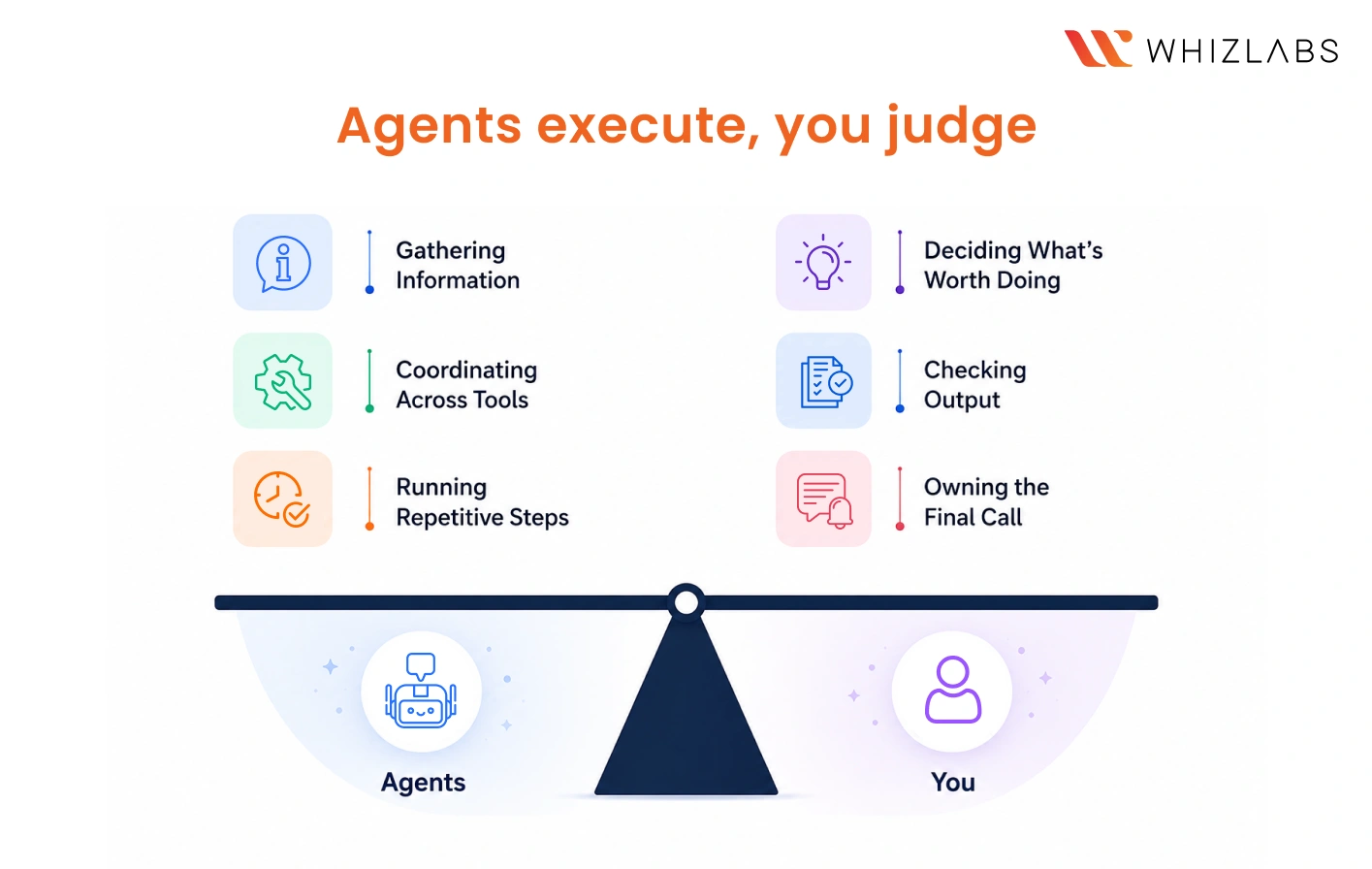
So instead of asking whether your role disappears, ask which half of it you spend most of your time in. If most of your day is spent on repetitive execution, it may be worth paying attention to how those activities are evolving. Many of the new AI tools being introduced are designed to assist with exactly those kinds of tasks. Understanding why your task matters and whether it is right is what carries you forward from here.
Worth exploring:
- AI fundamentals, to understand what these systems can and cannot do
- Agentic AI concepts, to understand how the agents actually work
If you would like to read in detail, here’s what agentic AI is and why it matters.
Do I Need to Learn All of These Tools to Keep Up?
Probably not.
Products, names, and interfaces change constantly. Azure AD became Entra ID. Azure AI Foundry became Microsoft Foundry. If you anchor your learning to a product name, you start over every time it changes.
Focus on the ideas underneath instead. The same themes run through all five launches: cloud, identity and access, data, security, and automation. Those stay relevant no matter what the products are called next year.
Worth exploring:
- A core cloud certification, matched to the cloud your employers actually use. Good starting points are AWS Solutions Architect Associate, Azure Administrator, or Google Associate Cloud Engineer.
Is the AI Agent Shift Worth Paying Attention to?
Yes, but not because of any single product.
Companies launch AI features constantly. Some become standards, others fade. What stands out here is not one tool; it is five announcements pointing the same way.
A useful habit is to watch where big companies invest consistently over time, rather than reacting to each launch on its own. By that measure, with a price, a ship date, and enterprise customers behind it, this is a real bet worth following.
Can Companies Trust AI Agents?
This is one of the biggest questions organizations are working through right now.
Agent 365 exists because Microsoft recognizes the risk. As agents gain access to data, systems, and workflows, companies need ways to manage permissions, monitor behavior, and keep them accountable.
For professionals, that is an opening. As adoption grows, companies will need people who understand how to run agents safely, and those skills are less crowded than the rush to build AI apps.
Worth exploring:
- Identity and access management
- AI security and governance
- A security certification like CompTIA Security+ or a cloud security specialty as grounding
What Skills Should I Learn for the AI Agent Era?
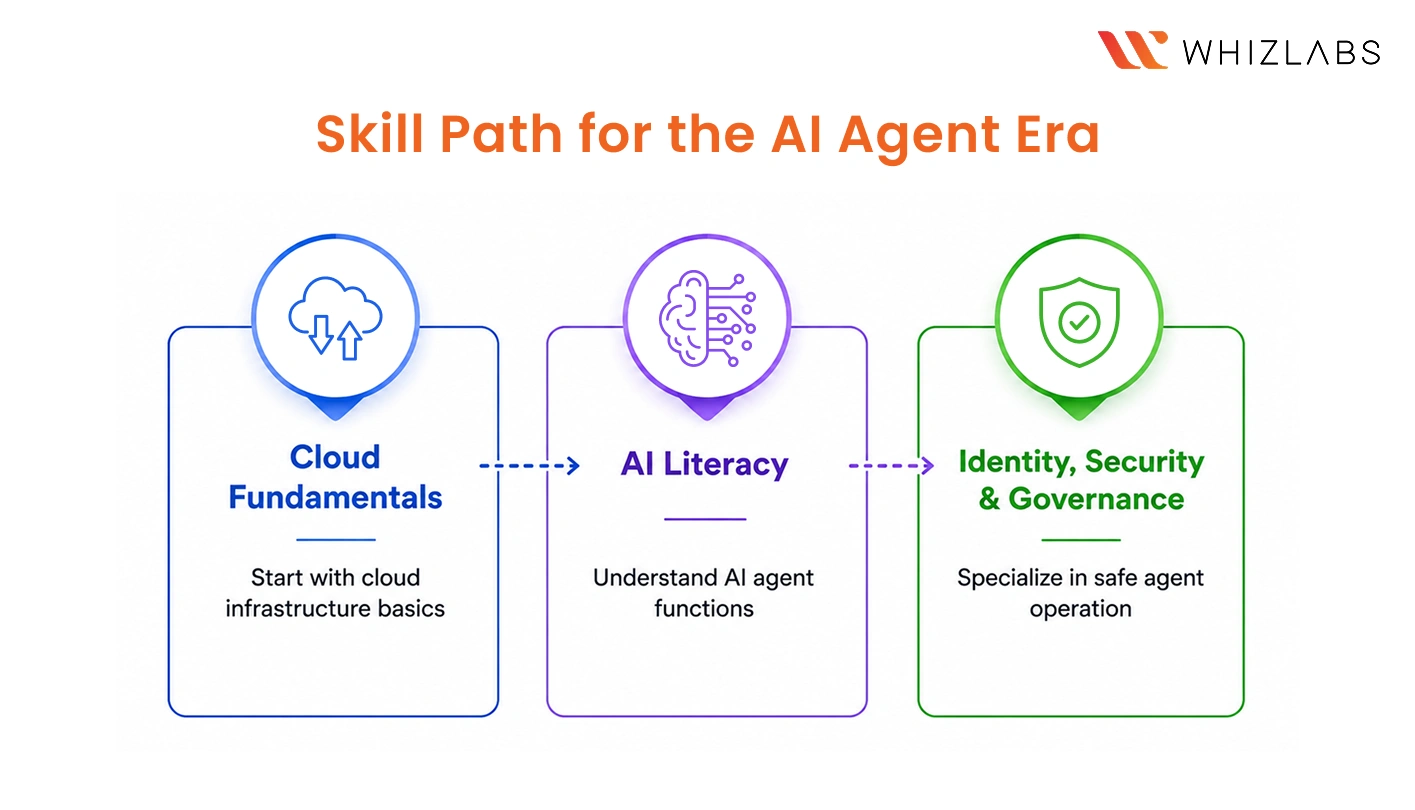
Focus on the skills that keep showing up across these launches, and build them in order. Start with cloud fundamentals, since everything runs on it ->Add AI literacy next, so you understand what agents do ->Then move toward identity, security, and governance, the skills companies need to operate agents at scale, not just build them.
A few areas worth paying attention to are:
- Cloud fundamentals
- Microsoft Entra and identity management
- Data platforms and analytics
- AI fundamentals
- AI governance and security
- Automation and workflow design
Product names will change and features will evolve. The underlying skills are far more likely to stay relevant.
What Microsoft’s Latest AI Launches Tells You
Microsoft appears to believe the next phase of AI is not just helping people create content faster. It is helping organizations coordinate, automate, and execute work through agents operating alongside people.
Whether that arrives in two years or ten is still open. But when one of the world’s largest technology companies reorganizes its products, pricing, identity, and governance around that idea, it is a signal worth taking seriously.
For professionals, the takeaway is simpler.
- Understand the theme behind these launches. Closely watch where major tech companies are investing to know where the future is moving.
- Pay attention to how your own role is changing and which tasks are becoming more automated.
- Build skills like cloud, data, identity, security, automation, and AI literacy as they appear repeatedly across every major technology strategy today.
That is a shift you can begin now, long before any of it reaches you.
If you have any questions regarding the Microsoft tools and AI agents, drop an email to us at [email protected]
Source links:
- https://www.microsoft.com/en-us/microsoft-365/blog/2026/06/16/copilot-cowork-is-now-generally-available/
- https://learn.microsoft.com/en-us/microsoft-scout/overview
- https://www.microsoft.com/en-us/security/blog/2026/05/01/microsoft-agent-365-now-generally-available-expands-capabilities-and-integrations/
- https://www.microsoft.com/en-in/ai/microsoft-iq
- https://techcommunity.microsoft.com/blog/microsoft_365blog/microsoft-365-e7-and-agent-365-are-now-generally-available/4516295

- Databricks Certified Generative AI Engineer Associate Exam Guide (2026) - August 4, 2026
- 10 AWS Security Projects SCS-C03 Candidates Should Build - July 10, 2026
- Microsoft’s Latest AI Launches: Are We In the Agent Era? - June 26, 2026
- What Career Does MLA-C01 Lead To? Read This Before You Start - June 18, 2026
- What Is Agentic AI? And Why NCP-AAI Is the Cert for It - June 4, 2026
- Who Should Take AB-100 Certification? Beginner or Professional? - May 14, 2026
- How to Pass Cloud Certifications While Working Full-Time - April 28, 2026
- Is Power BI Worth Learning in 2026? PL-300 Guide - April 21, 2026