

Let’s be honest when you first Google “Azure certifications for beginners,” you end up more confused than when you started.
Three exams. Similar names. Same beginner level. All from Microsoft. All under $200.
So what’s actually different between them, and more importantly, which one should you start with?
That’s exactly what this guide answers. No fluff, no jargon overload, just a clear breakdown of DP-900 vs AZ-900 vs AI-901 so you can make a confident decision and actually move forward.
Why These Three Certifications Confuse Everyone
Here’s the thing: AZ-900, DP-900, and AI-901 look almost identical on paper.
All three are foundation-level Microsoft Azure certifications designed for beginners with zero prior Azure experience, available for roughly $165 USD, vendor-recognized, and widely respected in tech hiring. No prerequisites. No experience required. Just study, sit the exam, pass.
So why do so many people get stuck choosing?
Because they cover completely different parts of Microsoft’s ecosystem and choosing the wrong one for your goals is a real waste of time and money.
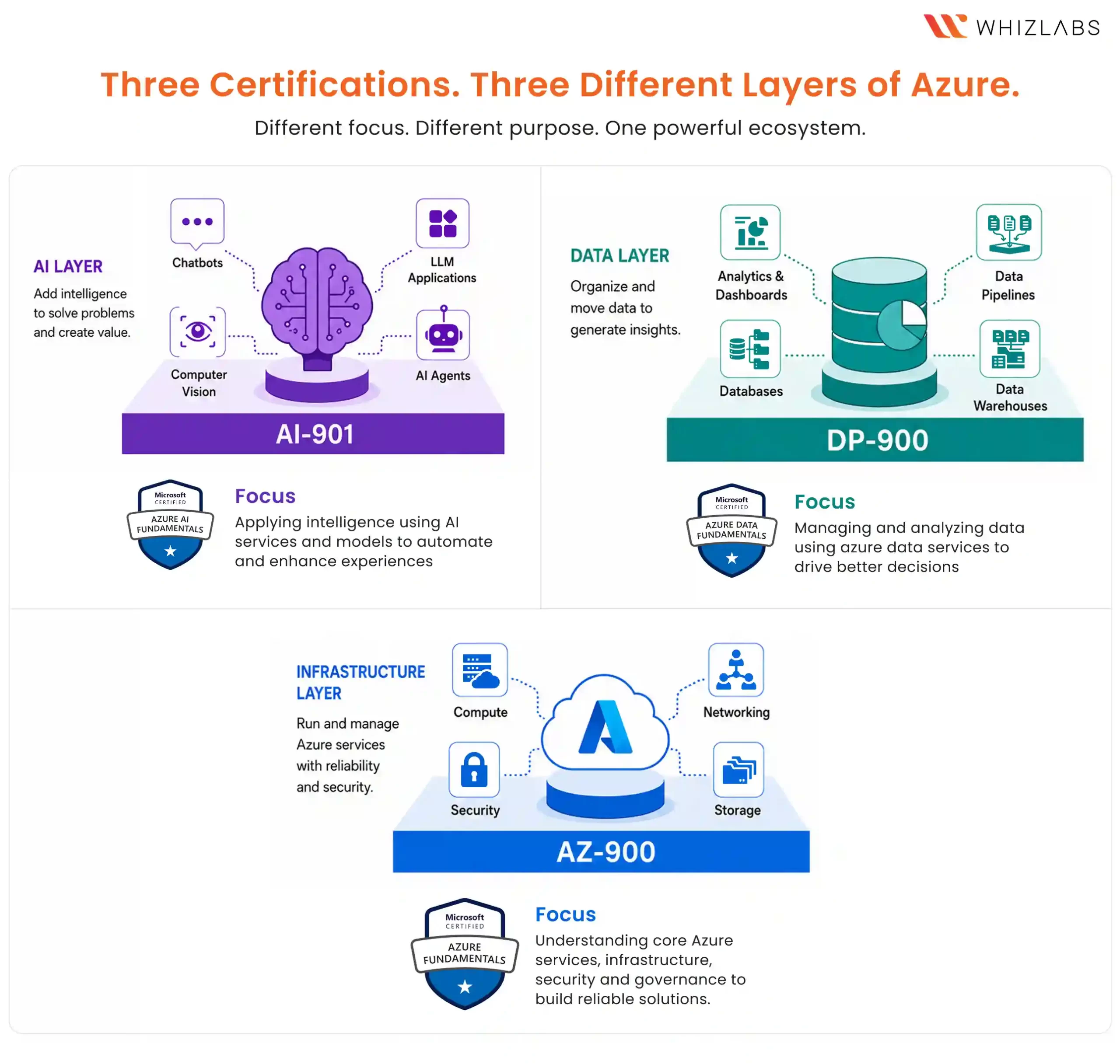
Think of Microsoft Azure like a massive smart city.
AZ-900 teaches you how the city works: the roads, the utilities, the infrastructure.
DP-900 shows you how information flows through that city, the pipes, the systems, the data networks.
AI-901 introduces the intelligent layer on top of the cameras, the sensors, the systems making the city “think.”
They’re connected, but each leads somewhere very different. Let’s break down each one properly.
Official Exam Details at a Glance
Before diving into the content differences, here are the official exam specifications for all three certifications:
| Exam | Questions | Duration | Passing Score |
| AZ-900 | 40–60 | 45 minutes | 700 / 1000 |
| DP-900 | 40–60 | 45 minutes | 700 / 1000 |
| AI-901 | 40–60 | 45 minutes | 700 / 1000 |
All three exams share the same format and passing threshold, which reinforces that Microsoft intentionally designed them at equal difficulty levels. The differentiator isn’t how hard they are, it’s what they cover and where they lead.
“ Important update: AI-900 officially retired on June 30, 2026. Microsoft has replaced it with AI-901: Microsoft Azure AI Fundamentals, a more current exam built around the generative AI landscape of today. If you were preparing for AI-900, your foundational study largely carries over, with added emphasis on generative AI and Azure OpenAI Service.”
AZ-900: Microsoft Azure Fundamentals The Foundation of Everything
Best for: Complete beginners to cloud computing who want to understand the big picture.
AZ-900 is the closest thing Microsoft has to a “cloud 101” course. It describes it as validating foundational knowledge of cloud services and how those services are provided with Microsoft Azure.
It doesn’t teach you how to build things in Azure. It doesn’t turn you into a cloud engineer overnight. What it does do is give you a solid mental model of how Azure operates as a platform and that matters more than most people realize.
What AZ-900 Covers
- Cloud concepts: IaaS, PaaS, SaaS, public/private/hybrid cloud
- Core Azure services: compute, networking, storage, databases
- Security and compliance fundamentals
- Identity management and Azure Active Directory basics
- Azure pricing, service level agreements (SLAs), and support options
- Governance, Azure Policy, and resource management
You won’t become a cloud administrator after passing AZ-900. But you’ll finally understand what your cloud team is actually talking about and that’s genuinely valuable.
Who Should Take AZ-900
Take AZ-900 if any of these sound like you:
- You’re completely new to cloud computing and want a structured starting point
- You’re moving into IT, cloud administration, or DevOps roles
- You work in sales, consulting, or project management and need to speak credibly about Azure
- You plan to pursue advanced Azure certifications like AZ-104 or AZ-305 and want to build the right foundation first
The honest truth: AZ-900 is the most “general purpose” of the three. If you genuinely have no idea where you want to go in tech yet, this is a safe and useful place to start.
DP-900: Microsoft Azure Data Fundamentals For the Data-Curious
Best for: Anyone interested in analytics, databases, business intelligence, or data engineering.
DP-900 doesn’t get as much attention as AZ-900, but for the right person, it’s actually the more valuable certification. It validates foundational knowledge of core data concepts and how they’re implemented using Azure data services.
Here’s why it matters: data skills are in enormous demand right now. Organizations are drowning in information and desperately need people who can help them make sense of it. DP-900 speaks directly to that need.
What DP-900 Covers
- Core data concepts: structured, semi-structured, and unstructured data
- Relational databases and SQL fundamentals
- Non-relational data stores: NoSQL, document, key-value, and graph databases
- Data analytics workloads: batch processing vs. real-time streaming
- Azure data services: Azure SQL, Cosmos DB, Azure Synapse Analytics, Azure Data Factory, Power BI
- Modern data warehousing concepts
- Event-driven architectures and real-time data processing
What makes DP-900 particularly valuable is that it teaches you the language of modern data teams. Even if you don’t become a data engineer, understanding how organizations collect, store, transform, and analyze information makes you significantly more effective in almost any technical or business-facing role.
Who Should Take DP-900
DP-900 is the right choice if:
- You’re drawn to analytics, reporting, or business intelligence work
- You’re interested in becoming a data analyst, data engineer, or analytics engineer
- You already work with spreadsheets, SQL, or BI tools and want to level up
- You want to understand how platforms like Azure Synapse, Databricks, or Power BI actually function under the hood
- You’re exploring cloud data architecture or database administration
One thing worth knowing: DP-900 tends to feel easier for people with database or analytics backgrounds but harder for those with zero exposure to data concepts. If data is genuinely your interest area, lean into it.
AI-901: Microsoft Azure AI Fundamentals For the AI-Curious
Best for: Anyone who wants to understand what AI actually does and how businesses use it.
A few years ago, an AI fundamentals certification felt like the optional add-on nice to have, but not essential.
In 2026, that’s completely changed.
AI is no longer a future technology. It’s showing up in hiring processes, customer service tools, product development, content creation, coding assistants, and strategic planning. Executives are talking about AI roadmaps. Teams are integrating AI into existing workflows. Non-technical professionals are expected to have at least a basic understanding of what these tools do and how they work.
Microsoft recognized this shift and evolved the certification to match it. With AI-900 retiring on June 30, 2026, AI-901: Microsoft Azure AI Fundamentals takes its place as a more current, more relevant exam built for the AI landscape of today.
What Changed from AI-900 to AI-901
AI-901 isn’t just a renamed exam. It reflects how dramatically the AI space has shifted:
- Significantly deeper coverage of generative AI and large language models (LLMs)
- Expanded Azure OpenAI Service content reflecting its growing enterprise adoption
- Updated responsible AI frameworks aligned with Microsoft’s current AI principles
- Stronger emphasis on prompt engineering and practical AI application patterns
- Refreshed Azure AI service references to match the current product landscape
If you were preparing for AI-900, your study time isn’t wasted as the foundational concepts carry over. The difference is AI-901 goes further where it matters most in 2026.
What AI-901 Covers
- Core machine learning concepts: supervised, unsupervised, and reinforcement learning
- Common AI workloads: classification, regression, clustering, and object detection
- Computer vision: image analysis, facial recognition, and optical character recognition (OCR)
- Natural language processing: sentiment analysis, entity extraction, and translation
- Conversational AI: bots, virtual agents, and dialog flows
- Generative AI: large language models, prompt engineering fundamentals, and responsible deployment
- Azure OpenAI Service: capabilities, use cases, and integration patterns
- Responsible AI principles: fairness, reliability, privacy, inclusiveness, transparency, and accountability
- Azure AI services: Azure AI Vision, Azure AI Language, Azure OpenAI Service, and Azure Bot Service
Here’s the key distinction between AI-901 and the other two certifications: it’s less about infrastructure and more about understanding capability. You’re not learning how to build an AI model from scratch. You’re learning what AI can and can’t do, how Azure’s AI services work, and how responsible organizations approach AI deployment with a lens that’s genuinely current.
Who Should Take AI-901
AI-901 is the strongest fit if:
- You’re fascinated by artificial intelligence and want a structured, up-to-date introduction
- You work in product management, innovation, or digital transformation and need real AI literacy
- You’re a developer curious about integrating AI particularly generative AI into applications
- You want to eventually pursue roles like Azure AI Engineer Associate
- You simply want to understand the technology reshaping every industry right now
Honest take: AI-901 is arguably the most accessible of the three for non-technical professionals. If your goal is genuine AI literacy not just buzzword familiarity this exam delivers that clearly, efficiently, and with credentials that reflect where the industry actually is.
Direct Comparison: DP-900 vs AZ-900 vs AI-901
| AZ-900 | DP-900 | AI-901 | |
| Focus | Cloud infrastructure | Data & analytics | AI & machine learning |
| Best for | Cloud beginners | Data-focused roles | AI-curious learners |
| Technical depth | Broad & conceptual | Moderate | Conceptual |
| Exam difficulty | Moderate | Moderate | Accessible |
| Career paths | Cloud admin, DevOps, SysAdmin | Data analyst, data engineer, BI | AI engineer, ML roles, product management |
| Next certifications | AZ-104, AZ-305, AZ-400 | PL-300, DP-300, DP-600 | AI-102, AI-103, AI-300 |
| Exam cost | ~$165 USD | ~$165 USD | ~$165 USD |
Which Exam Is Actually the Hardest?
This question comes up constantly, and the honest answer is: it depends entirely on your background.
AZ-900 covers the most ground. It introduces dozens of Azure services across compute, networking, storage, identity, and governance. If you’ve never worked in IT before, the sheer breadth of concepts can feel overwhelming at first not because individual topics are hard, but because there are so many of them.
DP-900 tends to feel comfortable for anyone who’s worked with databases, used Excel at an advanced level, or operated any BI tool. If data concepts are completely new to you, terminology around data warehousing, ETL pipelines, and non-relational stores can take time to click.
AI-901 is often considered the most accessible because it focuses on concepts more than technical implementation. You don’t need to know how to code. You don’t need to configure Azure services. You need to understand what AI workloads do, how generative AI works, and what responsible AI looks like in practice.
But here’s the more important insight: difficulty is largely irrelevant when you’re studying something that genuinely interests you. Motivated learners almost always find their chosen certification easier than expected because they’re actually engaged with the material.
The Mistake That Wastes People’s Time and Money
After helping thousands of learners prepare for Azure certifications, one pattern appears consistently: people succeed faster when they choose certifications aligned with their actual interests rather than market hype.
Here’s what that pattern looks like in practice.
Someone who genuinely wants to work with data spends three months studying AI-901 because AI is dominating headlines. They pass, feel proud for about a week, and then realize they still have no idea how to work with Azure data services. Back to square one.
Someone interested in cloud infrastructure picks DP-900 because they heard it was “easier” and ends up with skills that don’t connect to their actual goals. More wasted months.
The result is always the same: frustration, wasted money, and an extra three to six months getting back on track.
Certifications work when they’re part of a direction. Pick the one that aligns with where you actually want to go, not what’s trending on LinkedIn this month.
What Recruiters Actually Look For in 2026
Let’s address the elephant in the room: do these certifications actually impress hiring managers?
Yes but not in the way most candidates assume.
Recruiters don’t hire someone purely because they hold an AZ-900. What they notice is what the certification signals about your direction and seriousness.
An AZ-900 on a resume says: “This person is seriously exploring cloud infrastructure and Azure administration.”
A DP-900 says: “This person has foundational knowledge of data platforms and is moving toward analytics or data engineering.”
An AI-901 says: “This person is investing in current AI literacy and is building toward AI-adjacent roles or integrations.”
In 2026, with AI transforming virtually every industry, employers increasingly look for candidates who demonstrate direction and initiative, not just a long list of qualifications.
A foundation certification alongside a portfolio project, documented hands-on experience, or even a personal write-up of what you learned carries significantly more weight than a certification sitting alone on a CV.
The certification opens the door. Your applied skills close the deal.
Where These Certifications Lead Next
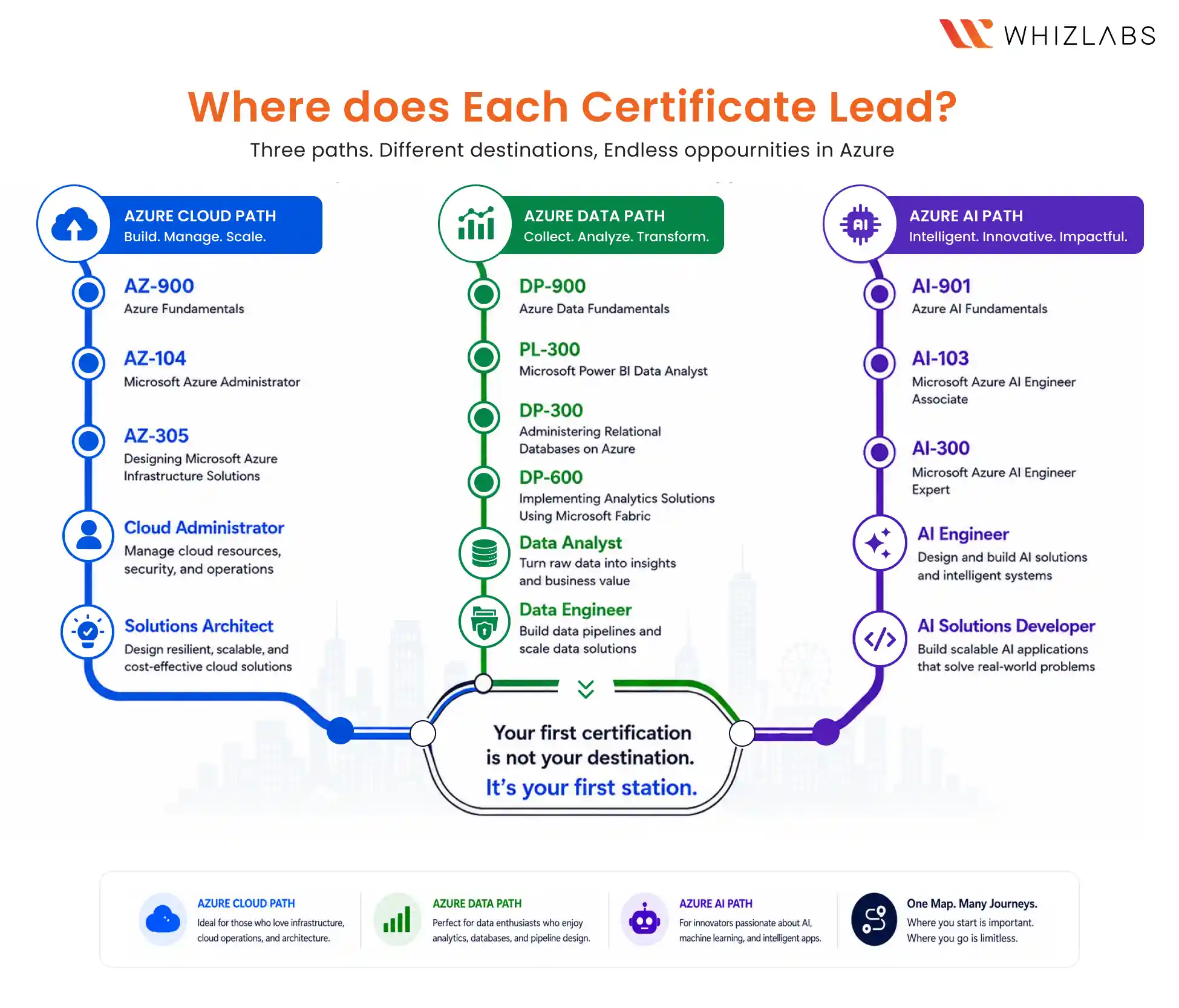
These are starting points, not destinations. Understanding what comes next helps you evaluate which foundation makes the most sense right now.
After AZ-900:
- AZ-104: Microsoft Azure Administrator (the most popular next step for cloud roles)
- AZ-305: Azure Solutions Architect Expert
- AZ-400: Azure DevOps Engineer Expert
- SC-900: Microsoft Security Fundamentals
After DP-900:
- PL-300: Microsoft Power BI Data Analyst
- DP-300: Azure Database Administrator Associate
- DP-600: Microsoft Fabric Analytics Engineer
After AI-901:
- AI-103: Microsoft Azure AI Apps and Agents Developer Associate
- AI-300: Microsoft Machine Learning Operations (MLOps) Engineer Associate
Each path leads to associate and expert-level certifications that carry strong market value in specialized roles. The foundation certification is step one. The direction you commit to from here shapes everything else.
How to Actually Prepare (What Works in 2026)
Reading documentation alone won’t cut it. Neither will passive video watching.
Here’s what actually works:
Understand concepts, don’t memorize them. These exams test conceptual understanding, not your ability to recall exact service names. When you understand why a service exists and what problem it solves, exam questions become significantly easier.
Use practice exams early, not just at the end. Taking practice tests at the beginning of your study period reveals gaps immediately. Most candidates wait until they feel “ready” before touching practice exams. That’s the wrong approach.
Focus on scenarios, not definitions. Exam questions frequently present a business scenario and ask which Azure service best fits the requirement. Practicing scenario-based thinking is far more valuable than memorizing service definitions.
Get hands-on from day one. Passive study creates passive knowledge. Whizlabs Hands-on Labs and Cloud Sandbox let you work directly inside real Azure environments without needing your own subscription; the combination of conceptual review and practical reinforcement consistently produces stronger results and better retention than memorization-based approaches alone.
So, Which One Should You Actually Take First?
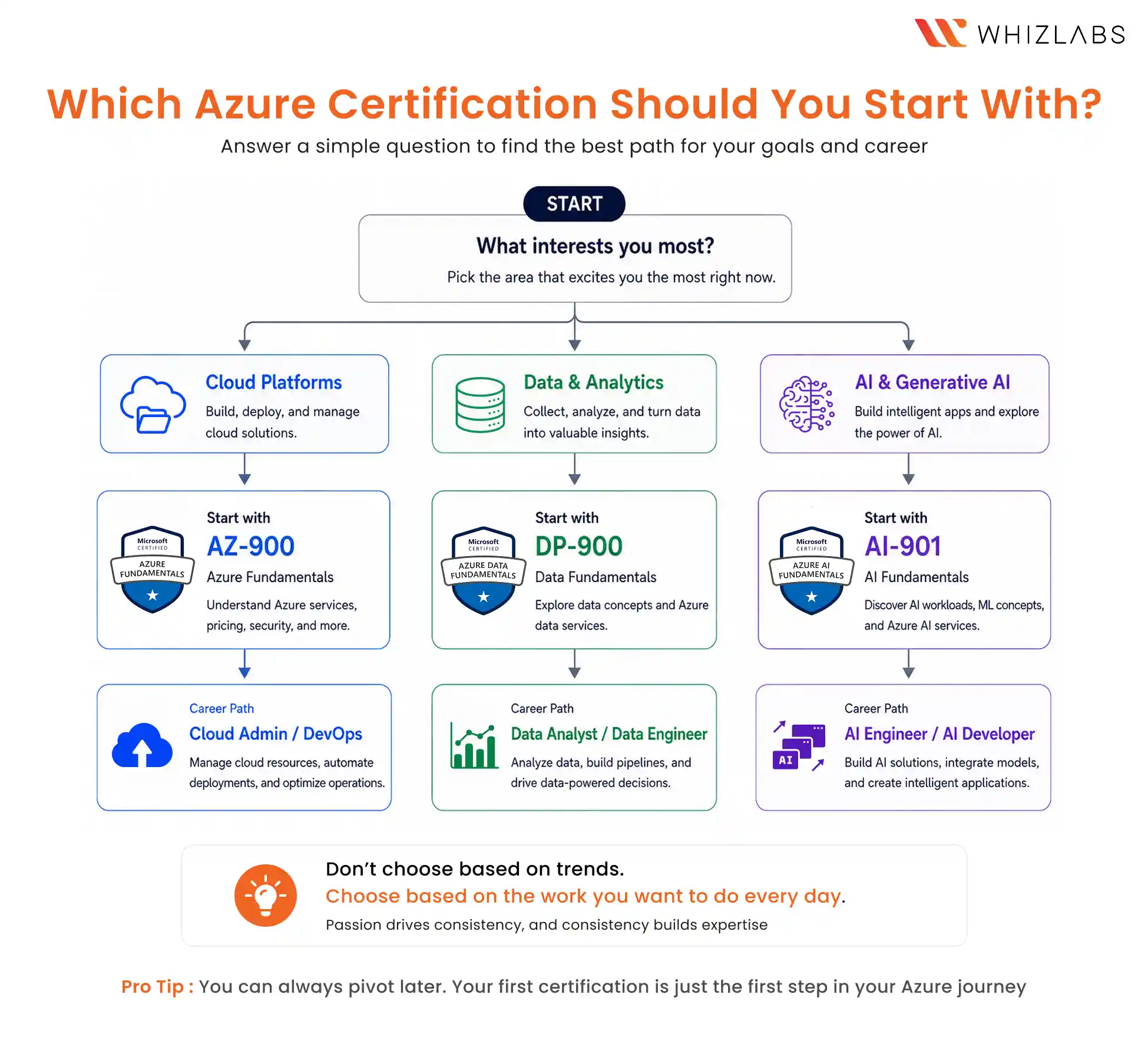
Here’s the decision framework, simplified.
Choose AZ-900 if you’re completely new to cloud and want to understand how Azure operates as a platform especially if cloud administration, DevOps, or solutions architecture is where you’re headed.
Choose DP-900 if data genuinely interests you. If you find yourself curious about databases, analytics, reporting, data pipelines, or business intelligence, DP-900 is your most direct path forward.
Choose AI-901 if you want to understand AI properly, not build models from scratch, but genuinely understand what these technologies do, how businesses use them, and where the opportunities and risks actually lie. With AI-900 retired, AI-901 is now the definitive starting point for anyone entering the AI space through Azure.
There is no universally “best” first certification. There’s only the best first certification for you based on your interests, your career direction, and where you realistically want to be in three years.
Microsoft designed all three to serve different people heading toward different goals. Respect that design. Pick the one that actually matches where you’re going.
Once you’re clear on your direction, the choice between DP-900 vs AZ-900 vs AI-901 stops feeling like a dilemma and starts feeling like an obvious next step.
Frequently Asked Questions
Q1: Can I take all three certifications?
Absolutely many professionals hold all three. However, starting with all three simultaneously is inefficient. Choose one, complete it, then evaluate whether additional foundation certifications add meaningful value before moving to associate-level exams.
Q2: Which certification is most in demand right now?
In 2026, AZ-900 holds the broadest market recognition because cloud infrastructure skills remain foundational across virtually every industry. However, DP-900 and AI-901 are gaining significant traction as organizations invest heavily in data platforms and AI capabilities.
Q3: Do these certifications expire?
No. AZ-900, DP-900, and AI-901 are all Microsoft fundamentals certifications, and fundamentals-level certifications do not expire and each is valid for the lifetime of the credential. (Role-based and specialty Azure certifications are different: those are valid for one year and renew for free through a Microsoft Learn assessment.)
Q4: Can I pass without prior IT experience?
Yes. All three exams are specifically designed for beginners without technical backgrounds. Many business analysts, project managers, consultants, and non-technical professionals successfully pass with two to four weeks of focused study.
Q5: Is self-study sufficient, or do I need a course?
Microsoft Learn provides free official learning paths for all three exams, and many candidates pass using these alone. Supplementing with Whizlabs practice exams and hands-on labs generally improves both scores and knowledge retention significantly.
Q6: Where can I schedule my exam?
All three exams can be scheduled through Microsoft’s official exam scheduling portal via Pearson VUE, either online proctored or at a local testing center.
Q7: What happened to AI-900?
AI-900 officially retired on June 30, 2026. Microsoft replaced it with AI-901: Microsoft Azure AI Fundamentals, which covers the same foundational AI concepts with expanded generative AI, Azure OpenAI Service, and updated responsible AI content. If you were preparing for AI-900, transition to AI-901 your preparation is still largely applicable.
Q8: What’s the difference between AZ-900, DP-900, and AI-901 in one sentence each?
AZ-900 teaches you how Azure works as a cloud platform. DP-900 teaches you how organizations store, process, and analyze data using Azure. AI-901 teaches you how artificial intelligence including modern generative AI works within Azure’s ecosystem and how to apply it responsibly.
Still have questions? Drop us an email at [email protected]. We will sort it out.

- AZ-305 Worth It in 2026? Salary, ROI & Career Benefits - September 30, 2026
- AWS Cloud Certification Trends: MLOps & GenAI in 2026 - September 30, 2026
- Cisco AITECH (810-110) Study Guide & Exam Prep 2026 - September 24, 2026
- NVIDIA NCP-AIN Exam Prep & Practice Tests | Whizlabs - September 18, 2026
- SC-500 Exam Prep 2026: Study Guide & 5-Week Plan - September 7, 2026
- AI-200 Study Guide: 6-Week Exam Prep Plan - September 4, 2026
- AB-731 Exam Preparation: Domains & Study Guide - August 31, 2026
- How to Build AI Agents on Azure: AI-103 Guide - August 21, 2026