

Let me ask you something straight.
If a recruiter called you today and asked “which data engineering platform are you strongest in?“ What would you say?
Most people pause at that question. Not because they don’t have experience. But because they’ve never actually stopped to think about which direction they want their career to go.
AWS? Azure? Databricks?
You’ve probably already searched this. Read the comparison posts. Watched the YouTube videos. And you’re still not sure which certification is actually worth your time in 2026.
Here’s the truth nobody tells you clearly: most people compare certifications the wrong way. They look at exam fees, question formats, and difficulty ratings.
That’s the wrong lens entirely.
The right question is: which certification moves your career forward in the direction YOU want to go?
That’s what this guide is actually about. Not exams. Careers.
Let’s figure it out together.
Which Data Engineer Certification Is Best in 2026?
If you want the short version before diving in, here it is.
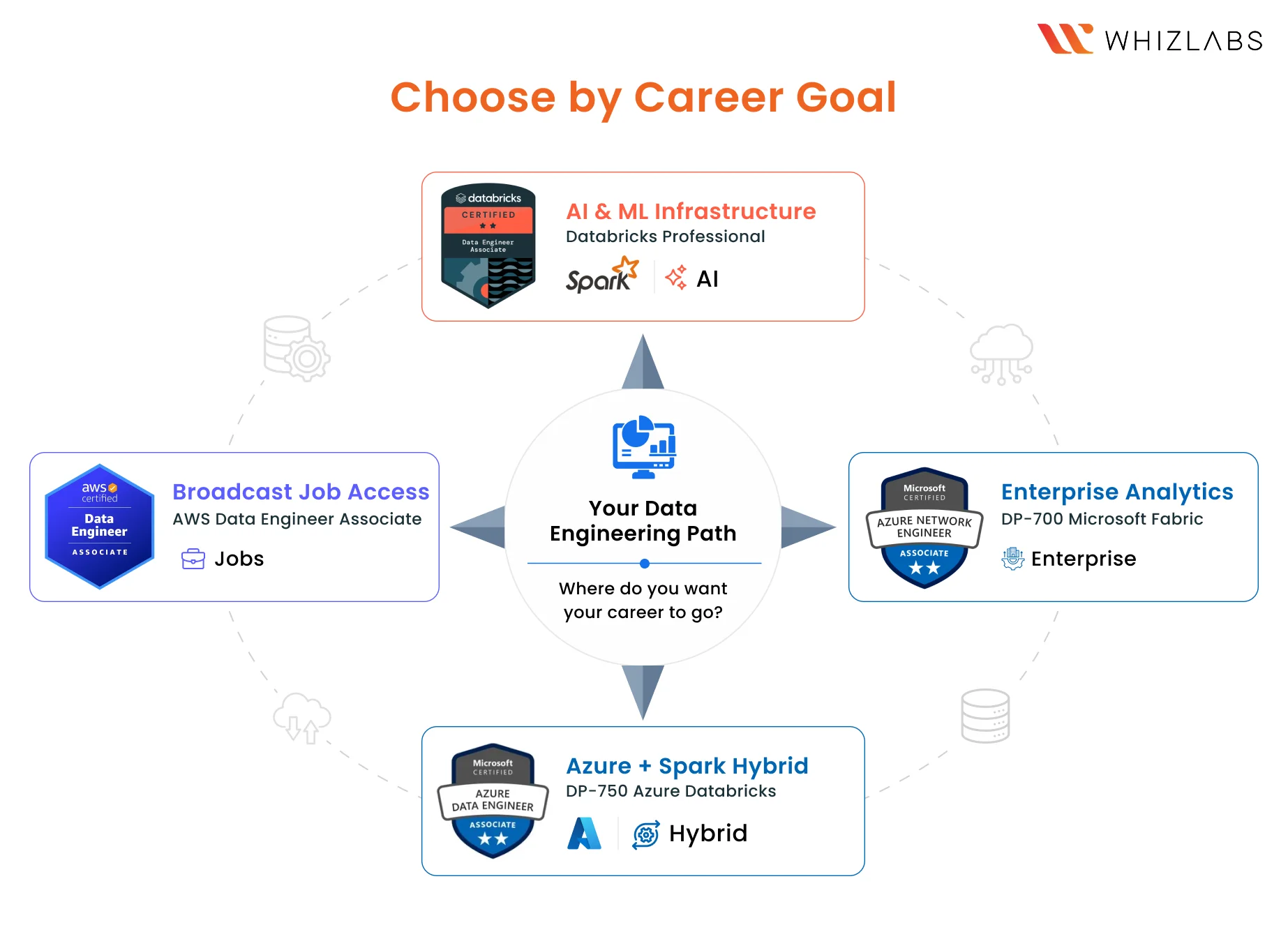
| Your Goal | Best Certification |
| AI & ML Infrastructure | Databricks Certified Data Engineer Professional |
| Broadest Job Opportunities | AWS Certified Data Engineer Associate |
| Enterprise Analytics | DP-700 Microsoft Fabric |
| Azure + Spark Hybrid Skills | DP-750 Azure Databricks |
| Highest Salary Potential | Databricks |
| Best Flexibility for Beginners | AWS |
Keep reading and I’ll explain exactly why with enough context that this decision actually makes sense for your specific situation.
Why the Certification You Choose in 2026 Actually Matters
Data engineering today looks nothing like it did five years ago.
Back then, the job was mostly about moving data from point A to point B, loading it into a warehouse, and keeping things from breaking. That was it.
Today, organisations are building AI-ready data platforms. They’re running real-time analytics pipelines. They’re adopting lakehouse architecture to unify data and machine learning workflows. They’re managing data across multiple clouds simultaneously. And they’re being pushed hard by generative AI to rethink how data is collected, stored, and made available at scale.
According to the USDSI, cloud and data engineering roles continue to rank among the highest-paying technical career paths globally and that demand keeps climbing.
The certification you choose influences which projects you get assigned to, which technologies you learn on the job, and which salary bands you can realistically target. It shapes your entire data engineer roadmap for the years ahead.
Every time I evaluate a certification, I ask four questions:
- Are companies actively hiring for this skill set right now?
- Is that demand growing or shrinking?
- Does this technology align with where the industry is heading?
- Will this certification actually accelerate my career in a meaningful way?
These four questions tell me far more than any difficulty rating or exam popularity poll.
Let’s go through each platform with exactly those questions in mind.
The Three Certification Tracks We’re Comparing
Before diving in, let me be clear about which exact certifications we’re talking about.
For AWS: AWS Certified Data Engineer – Associate
For Microsoft:
- DP-700: Microsoft Fabric Data Engineer Associate
- DP-750: Microsoft Azure Databricks Data Engineer Associate
For Databricks:
Notice something? Databricks actually spans both the native Databricks ecosystem and Microsoft Azure. That matters when you’re planning your data engineering career path and we’ll come back to it.
What Kind of Data Engineer Do You Want to Become?
Let’s make this practical.
Imagine you have six months to focus on learning. You can pursue one certification seriously. Which one do you choose?
The honest answer is: it depends on the type of work you actually want to do.
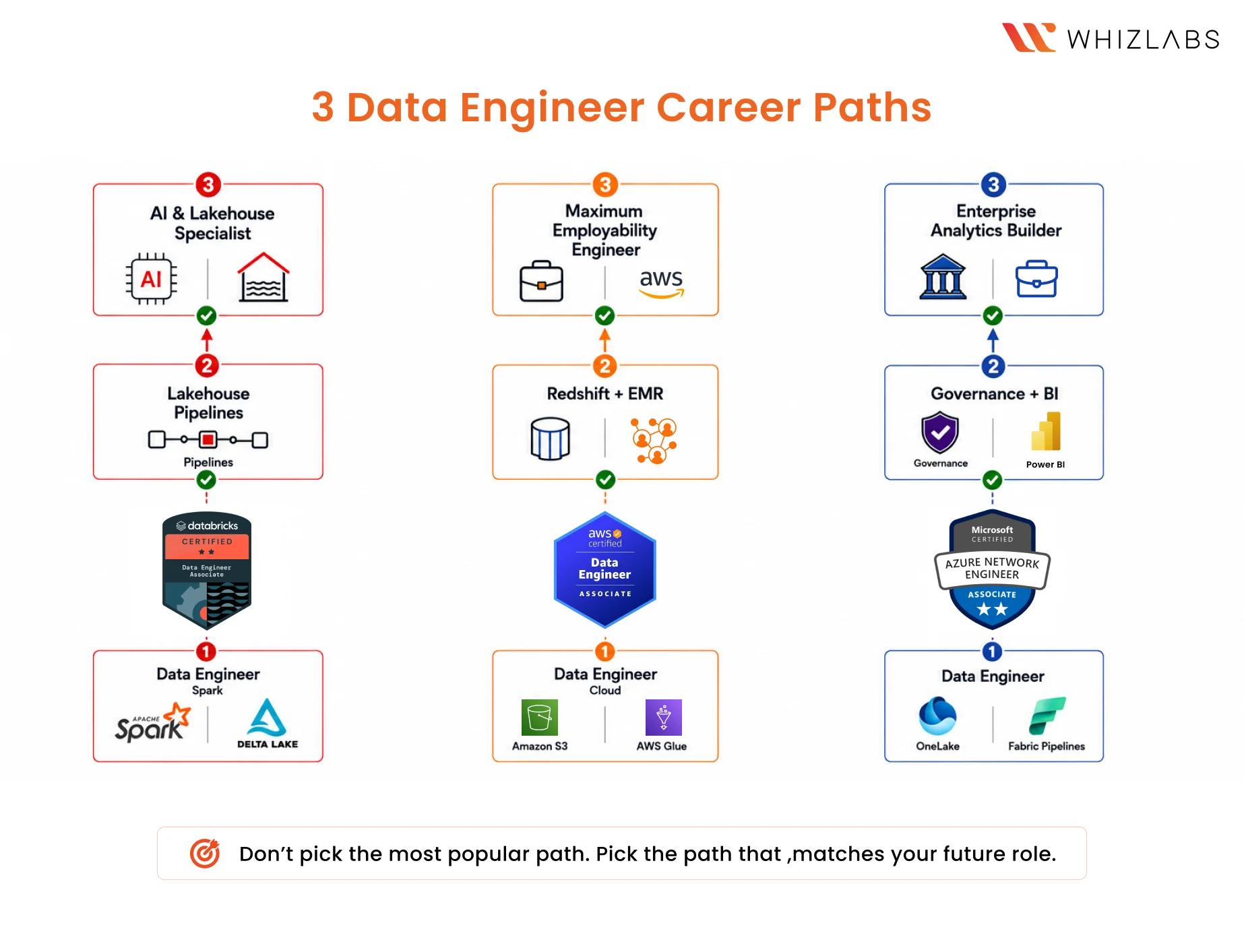
So let me walk you through three distinct career paths. See which one sounds most like you.
Career Path 1 – The AI and Lakehouse Specialist (Databricks)
If you get genuinely excited about large-scale analytics, machine learning pipelines, optimising Spark jobs, and building data foundations for AI systems pay close attention to this path.
Databricks has become one of the most talked-about platforms in the industry, and for good reason. The lakehouse architecture movement it helped pioneer has fundamentally changed how forward-thinking organisations manage data. Instead of running separate systems for analytics, engineering, and machine learning, companies increasingly want everything unified on a single platform.
That shift has driven demand for Databricks professionals through the roof.
The Databricks Certified Data Engineer Associate certification tests your ability to work with:
- Apache Spark for distributed data processing
- Delta Lake for reliable, scalable storage
- Data transformation and cleansing pipelines
- Streaming data workflows
- Lakehouse architecture design
- Performance optimisation for large-scale workloads
Once you’re comfortable at Associate level, the Databricks Certified Data Engineer Professional pushes deeper into advanced pipeline design, orchestration, performance tuning, and production-grade data engineering at real scale. This is the certification that signals genuine specialisation not just familiarity with tools.
Here’s why this path is particularly valuable right now: scarcity. Finding engineers with real Spark expertise is significantly harder than finding general cloud engineers. As AI and analytics workloads explode in size and complexity, organisations desperately need people who can build the scalable data infrastructure sitting underneath those AI systems.
The trade-off is real though. The learning curve is steeper. Spark and distributed computing aren’t concepts you master over a weekend. But the reward in role seniority, technical credibility, and salary often reflects that investment.
Best for: Engineers who want to specialise deeply in AI infrastructure, lakehouse architecture, and large-scale data processing.
Career Path 2 – The Maximum Employability Engineer (AWS)
Not everyone wants to specialise deeply right away. Some people want options. They want to apply for a wide range of roles across a wide range of industries.
If that sounds like you, AWS is still one of the hardest certifications to argue against.
Here’s the simple reality: AWS powers a massive share of enterprise cloud infrastructure worldwide. Financial services companies run on it. Healthcare organisations run on it. Retailers, manufacturers, tech startups, government agencies the list is enormous. That creates consistent, broad demand for engineers who understand how AWS data services actually work together.
The AWS Certified Data Engineer – Associate prepares you to work with:
- Data ingestion patterns and pipeline design
- AWS Glue for ETL and data cataloguing
- Amazon S3 for scalable storage
- Amazon Redshift for data warehousing
- Amazon EMR for big data processing
- Athena for serverless querying
- Lambda for event-driven automation
- Data security, monitoring, and governance
What makes this certification powerful isn’t mastery of any single service, it’s understanding how all these services connect to support end-to-end data engineering workloads at scale.
When you compare AWS Data Engineer Certification vs DP-700, volume is AWS’s clearest advantage. There are simply more AWS-based data engineering roles available at any given moment. If you’re early in your career or transitioning into data engineering from another technical background, that availability is a real safety net.
Multi-cloud data engineering is also becoming increasingly common, and AWS knowledge forms a strong baseline that translates well across environments.
Best for: Engineers who want maximum job market flexibility, broad industry access, and a solid cloud data engineering foundation.
Career Path 3 – The Enterprise Analytics Platform Builder (Microsoft Fabric)
A third path has emerged rapidly over the past two years, and it deserves serious attention.
Microsoft Fabric has become one of the most actively adopted enterprise analytics platforms on the market. Many large organisations already run deep Microsoft infrastructure Power BI for reporting, Azure for cloud services, Microsoft 365 for productivity. Microsoft Fabric layers a unified data engineering and analytics experience on top of that existing foundation.
The DP-700: Microsoft Fabric Data Engineer Associate is the primary credential for this ecosystem. It covers:
- OneLake architecture and the Fabric ecosystem
- Building and managing data engineering workloads
- Implementing Fabric pipelines for data movement
- Creating and managing lakehouses within Fabric
- Data transformation with notebooks and dataflows
- Governance, security, and monitoring
The DP-750: Microsoft Azure Databricks Data Engineer Associate deserves a mention here too because it bridges two worlds. If an organisation runs on Azure but wants the power of Databricks for large-scale engineering and Spark workloads, DP-750 is the credential that covers that intersection. It’s a smart option for engineers who want Azure context combined with Databricks capabilities.
One of Fabric’s biggest strengths is simplicity for the organisations adopting it. Companies are increasingly trying to reduce the number of disconnected tools their teams manage. A platform that brings engineering, analytics, and business intelligence together under one roof is extremely appealing to enterprise decision-makers.
For professionals already working inside Microsoft-heavy environments Azure, Power BI, or Microsoft 365 DP-700 represents a natural and high-value extension of skills you’ve likely already been building.
Best for: Engineers working in enterprise environments who want to build unified analytics platforms with strong governance and business intelligence integration.
DP-700 vs Databricks Data Engineer Associate: The Direct Comparison
This is the question I get asked most often.
“Should I do DP-700 or Databricks Data Engineer Associate?”
Let me give you a direct answer instead of a vague “it depends.”
Choose Databricks if: your work is primarily engineering-focused you care about Spark optimisation, distributed data processing, advanced pipeline architecture, and building infrastructure for AI and ML workloads. Databricks offers greater technical depth here, especially at the Professional level.
Choose DP-700 if: your work is primarily analytics platform-focused. You care about governance, integrated reporting, enterprise adoption, and building data environments that non-engineering stakeholders can actually use.
Think of it this way. Databricks tends to attract engineers who want to go deep into the technical engine room. Fabric tends to attract professionals who want to build platforms that serve broader business teams.
Neither is better. They solve different problems for different organisations.
The question isn’t which looks more impressive on a resume. The question is which matches the work you actually want to do.
Databricks vs Microsoft Fabric: Which Has More Momentum Right Now?
Both platforms are growing fast. But in different directions. Understanding why matters for making a smart long-term bet.
Databricks momentum is driven almost entirely by AI and analytics demand. As organisations pour investment into building AI-ready infrastructure, they need scalable, reliable data foundations. Databricks sits directly at the intersection of data engineering, analytics, and machine learning right in the path of that spending.
Microsoft Fabric momentum comes from a different source. Enterprise organisations want simplification. They have multiple disconnected tools, complex governance challenges, and pressure to modernise analytics without multiplying complexity. Fabric speaks directly to that problem. And because Microsoft already has deep relationships with enterprise IT buyers, Fabric adoption is accelerating faster than many predicted.
Here’s the most useful way to frame it:
- Databricks excels where advanced engineering and AI workloads are the priority
- Fabric excels where unified enterprise analytics and governance are the priority
Demand for both is rising. The better question is: which environment do you actually want to work in?
Is Spark Still Worth Learning in 2026?
Absolutely and here’s why that matters for your certification choice.
Apache Spark has remained the backbone of large-scale data processing for years, and it’s not going anywhere. If anything, it’s becoming more central as AI workloads require processing datasets that are orders of magnitude larger than traditional analytics.
Databricks is built on Spark. So is Amazon EMR. Azure HDInsight runs it too. Spark expertise gives you transferable skills that work across cloud environments which is increasingly valuable in a world where organisations run multi-cloud architectures.
If you’re serious about a high-ceiling data engineering career, learning Spark well is one of the highest-ROI investments you can make.
Can Beginners Start with Databricks Certifications?
Yes, but with some honest caveats.
The Databricks Certified Data Engineer Associate is approachable for someone with foundational Python and SQL skills. You don’t need years of Spark experience to pass it but you do need to genuinely understand how Delta Lake works, how Databricks notebooks and workflows operate, and the basics of lakehouse architecture.
Where beginners sometimes struggle is the distributed computing mindset. Thinking about data processing at scale is a shift from working with traditional databases or single-machine scripts.
If you’re newer to data engineering, AWS gives you more room to explore a wider range of foundational concepts first. Many engineers find it useful to start with AWS, build real project experience, and then move into Databricks once they have production context.
That said, if you’re already working with data regularly and you’re genuinely excited about AI infrastructure, there’s no reason you can’t start directly with Databricks Associate.
Data Engineering Salary Trends in 2026
Let’s talk numbers, because it matters.
Salary shouldn’t be the only factor in your decision, but it’s a real consideration. Based on current hiring trends and data from Glassdoor’s 2024 Data Engineer Salary Report, here’s what the market looks like right now.
Mid-level (3–5 years of experience):
- AWS Data Engineers: $120,000–$150,000
- Microsoft Fabric / Azure Data Engineers: $115,000–$145,000
- Databricks Data Engineers: $130,000–$165,000
Senior and architect level (5+ years):
- AWS Data Engineering Architects: $160,000–$200,000+
- Microsoft Fabric Solution Architects: $150,000–$190,000+
- Databricks Platform Specialists: $170,000–$220,000+
Databricks professionals tend to command premium salaries largely because of that scarcity factor we talked about earlier. Real Spark and distributed computing expertise is genuinely hard to find.
AWS engineers benefit from the volume of more roles available and creates competitive salaries even if the very top ceiling is slightly lower.
Microsoft Fabric professionals are seeing salaries rise quickly as enterprise adoption accelerates, especially in large organisations running digital transformation programmes.
But here’s what no salary table tells you: the highest-paid engineers aren’t just the ones who passed the most certifications. They’re the engineers who combine certification knowledge with architecture design experience, business problem-solving ability, and a track record of shipping real production systems.
Cloud data engineer jobs at the $170,000+ level almost always require a portfolio of real-world outcomes alongside the credentials.
Which Certification Has the Highest ROI?
This depends heavily on your starting point, but here’s an honest framework.
Highest immediate ROI for job placement: AWS. The sheer volume of available roles means faster time-to-hire. If you need a role quickly, AWS gives you the most options.
Highest long-term salary ceiling: Databricks Professional. Specialised Spark expertise combined with AI infrastructure experience puts you in a genuinely scarce talent category.
Highest ROI inside enterprise organisations: DP-700. If you’re already working in a Microsoft-heavy environment, you’re leveraging existing organisational context rather than learning from scratch.
Best ROI for bridging two ecosystems: DP-750. Azure context plus Databricks depth is a combination that real-world hybrid organisations actively need.
Can You Combine AWS + Databricks + Fabric Skills?
You can and a growing number of senior engineers do exactly this.
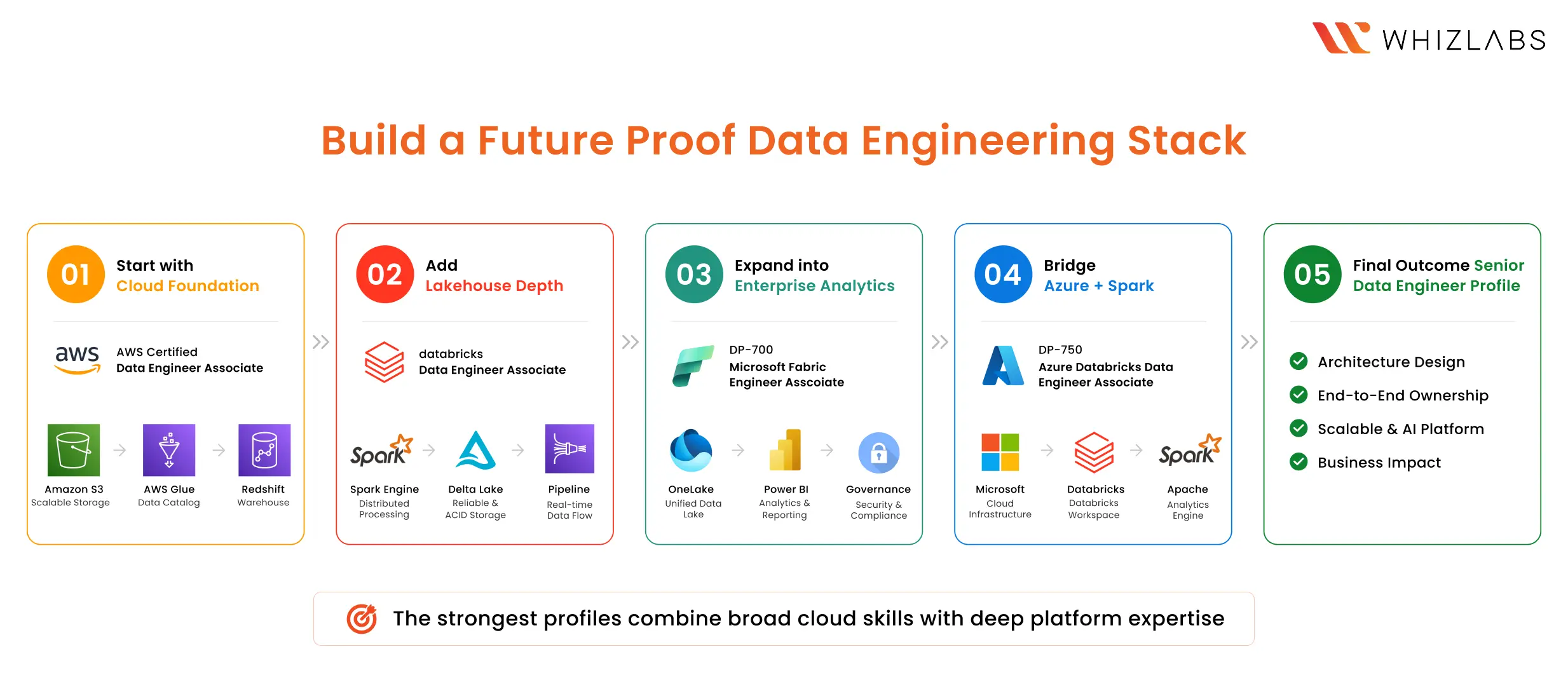
Here’s how it tends to work in practice. AWS gives you a broad, highly transferable foundation. Databricks adds deep specialisation in lakehouse architecture and AI infrastructure. Fabric knowledge makes you valuable inside enterprise Microsoft environments.
The most versatile data engineering profiles right now combine at least two of these: typically AWS plus Databricks, or Azure/Fabric plus Databricks.
Going all three at once is ambitious. But building sequentially starting with whichever path matches your current role, then expanding is a genuinely smart long-term strategy.
What Recruiters Actually Want in 2026
Let me be honest with you about something recruiters rarely say out loud.
Certifications are not the deciding factor in most hiring decisions.
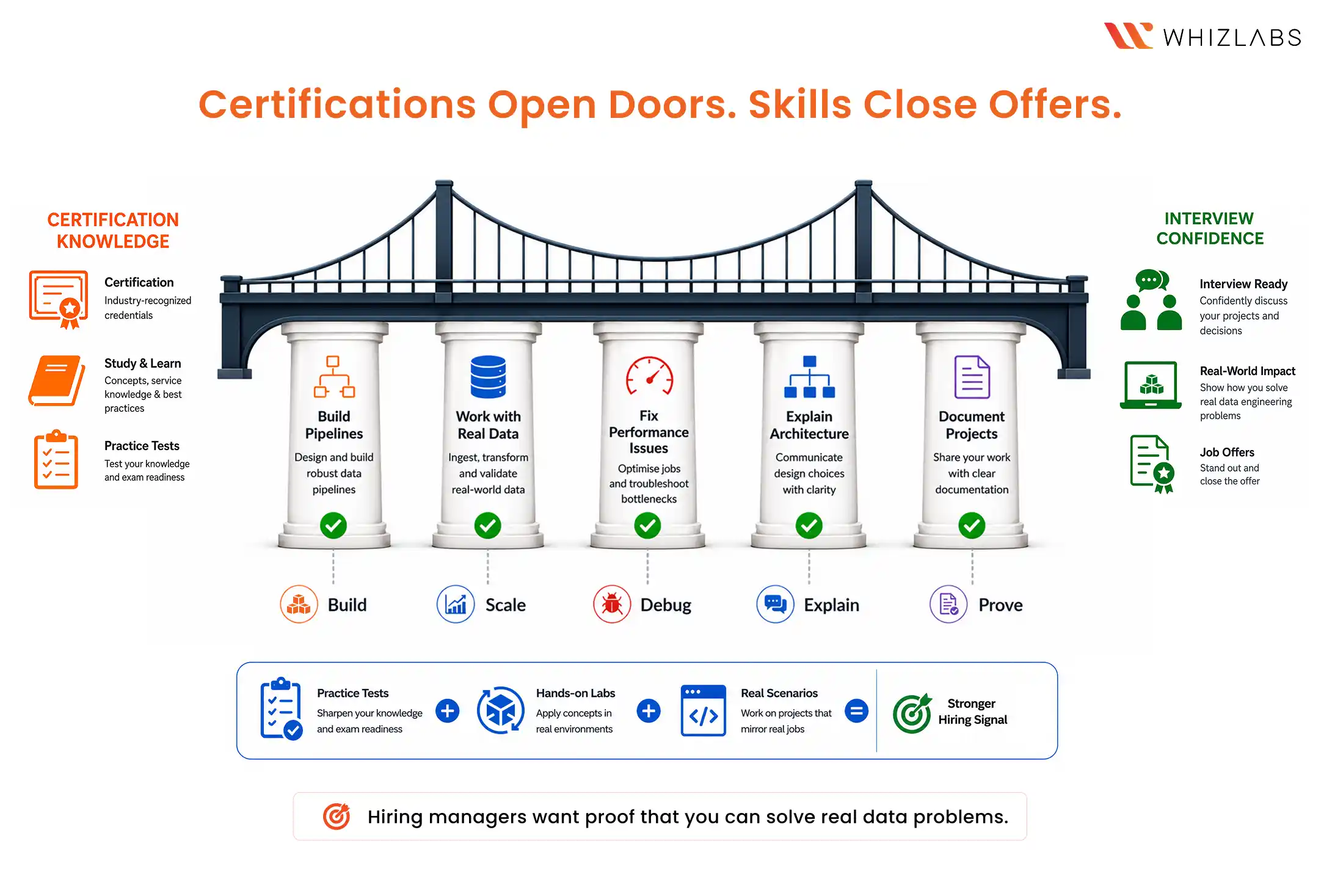
Hiring managers want to know whether you can actually solve their problems. Can you build a data pipeline that scales? Can you diagnose a performance bottleneck? Can you improve data quality in a messy production environment? Can you support an AI team building a feature store? Can you explain architecture decisions to a business stakeholder who doesn’t know what Spark is?
Those are the questions that separate candidates who get offers from candidates who don’t.
Certifications matter because they signal structured knowledge and commitment to learning. They help you get past initial screening. They give interviewers a starting point for technical questions. But they don’t replace hands-on experience.
This is why practical preparation, the kind that includes hands-on labs and real-world scenario practice matters so much more than just memorising exam questions. The goal is to be able to talk about what you’ve actually built, not just what you’ve studied.
If you’re preparing for any of these certifications in 2026, build alongside your studying. Create pipelines. Work through real datasets. Document what you built and why.
That’s what actually closes the gap between exam knowledge and production-level capability.
Frequently Asked Questions
Q1: Is Databricks better than AWS for data engineering?
Not universally it depends on what you want to build. Databricks is deeper for AI infrastructure and Spark-based workloads. AWS offers broader career flexibility and more available job openings. Both are strong certifications in 2026.
Q2: Is DP-700 worth it in 2026?
Yes, especially if you’re working in a Microsoft-heavy enterprise environment. Fabric adoption is accelerating rapidly and the demand for DP-700 certified engineers is rising with it.
Q3: Which data engineering certification pays the highest salary?
Databricks Certified Data Engineer Professional consistently sits at the top of salary ranges for data engineers, driven by the scarcity of qualified Spark and lakehouse specialists.
Q4: Is Microsoft Fabric replacing Azure Synapse?
Microsoft has been consolidating its analytics platform strategy around Fabric. While Azure Synapse still exists and supports existing workloads, Microsoft is clearly pushing Fabric as its unified analytics platform going forward. Learning Fabric is the forward-looking bet.
Q5: Which certification is best for AI data engineering roles?
Databricks Certified Data Engineer Professional. The combination of Spark expertise, lakehouse architecture, and Delta Lake knowledge directly maps to what AI infrastructure teams need.
Q6: Can beginners start with Databricks certifications?
Yes, at the Associate level with the right preparation. Start with solid Python and SQL fundamentals, understand Delta Lake basics, and get hands-on practice in a Databricks workspace before exam day.
Q7: Which certification has the most job openings?
AWS Certified Data Engineer – Associate. The sheer volume of AWS-powered enterprises creates the largest pool of actively hiring data engineering roles at any given time.
Q8:Is Spark still worth learning in 2026? Absolutely. Spark is the backbone of large-scale data processing across cloud platforms. Databricks is built on it. EMR runs it. It’s transferable, valuable, and not going anywhere especially as AI workloads demand larger-scale data processing.
So Which Data Engineer Certification Should You Choose?
Let me give you the clearest possible summary.
Choose Databricks Certified Data Engineer Associate or Professional if you want to specialise in Spark, lakehouse architecture, AI infrastructure, and large-scale data engineering. This path leads toward some of the most technically demanding and well-compensated roles in the field.
Choose AWS Certified Data Engineer – Associate if you want the broadest possible access to cloud data engineer jobs, maximum career flexibility, and a strong foundation across diverse industries and company sizes.
Choose DP-700 Microsoft Fabric Data Engineer Associate if you want to build enterprise analytics platforms within the Microsoft ecosystem, and you genuinely enjoy working on governance, integration, and unified data environments.
Choose DP-750 Microsoft Azure Databricks Data Engineer Associate if you’re working in Azure environments and want to combine Databricks capabilities with Microsoft cloud infrastructure, a practical bridge certification with strong real-world demand.
There is no universally “best data engineering certification in 2026.” There’s only the best certification for your specific goals, your current environment, and the kind of work you want to be doing three years from now.
Ready to Start?
Here are the direct paths to begin structured preparation:
- AWS Certified Data Engineer – Associate
- DP-700: Microsoft Fabric Data Engineer Associate
- DP-750: Microsoft Azure Databricks Data Engineer Associate
- Databricks Certified Data Engineer Associate
- Databricks Certified Data Engineer Professional
Each path comes with practice tests, hands-on labs, and real-world scenarios through Whizlabs, the kind of preparation that helps you show up to interviews ready to talk about what you’ve actually built, not just what you’ve studied.
Final Thought
Here’s something worth sitting with before you decide.
That recruiter question I mentioned at the start? It was never really about technology.
It was asking: do you know where you’re going?
Most people spend weeks comparing exam costs and pass rates. Very few actually stop and ask themselves one simple question:
What kind of data engineer do I want to be?
Answer that honestly and the certification choice becomes obvious.
You don’t need the most popular certification. You need the right one for the future you’re building.
So close the comparison tabs. Pick the path that excites you. Then go build something real with it.
That’s what actually gets you hired.
Still have questions? Drop us an email at [email protected]. We will sort it out.

- AZ-305 Worth It in 2026? Salary, ROI & Career Benefits - September 30, 2026
- AWS Cloud Certification Trends: MLOps & GenAI in 2026 - September 30, 2026
- Cisco AITECH (810-110) Study Guide & Exam Prep 2026 - September 24, 2026
- NVIDIA NCP-AIN Exam Prep & Practice Tests | Whizlabs - September 18, 2026
- SC-500 Exam Prep 2026: Study Guide & 5-Week Plan - September 7, 2026
- AI-200 Study Guide: 6-Week Exam Prep Plan - September 4, 2026
- AB-731 Exam Preparation: Domains & Study Guide - August 31, 2026
- How to Build AI Agents on Azure: AI-103 Guide - August 21, 2026