

With the rapid rise of multi-cloud architectures, AI-driven infrastructure, and Kubernetes adoption, organisations are no longer relying on a single cloud provider. Companies now expect cloud architects and engineers to understand how AWS, Google Cloud, Azure, and modern DevOps ecosystems work together in real-world environments.
This shift is redefining the landscape of cloud certification careers for 2026. Professionals who can validate their expertise across multiple cloud ecosystems are sold out faster in hiring pipelines, architecture roles, and enterprise infrastructure teams.
If you are looking to expand your expertise across multiple cloud platforms to stay competitive in 2026, multi-cloud learning and certification paths are becoming one of the smartest ways to future-proof your cloud career.
That is exactly why multi-cloud certifications are becoming the new baseline for modern cloud architects.
In this blog, we will explore why enterprises are rapidly adopting multi-cloud strategies, why single-platform expertise is no longer enough, the top certifications shaping cloud careers in 2026, the skills employers are actively hiring for, and how professionals can build a future-ready multi-cloud certification path with hands-on learning and practical experience.
The Shift From Single-Cloud to Multi-Cloud Environments
The rise of multi-cloud environments is not just a trend. It is a direct response to how businesses now operate. Organizations today prioritise:
- Vendor flexibility
- Global scalability
- Cost optimization
- Disaster recovery resilience
- Regulatory compliance
- AI and data specialisation
- Reduced dependency on a single provider
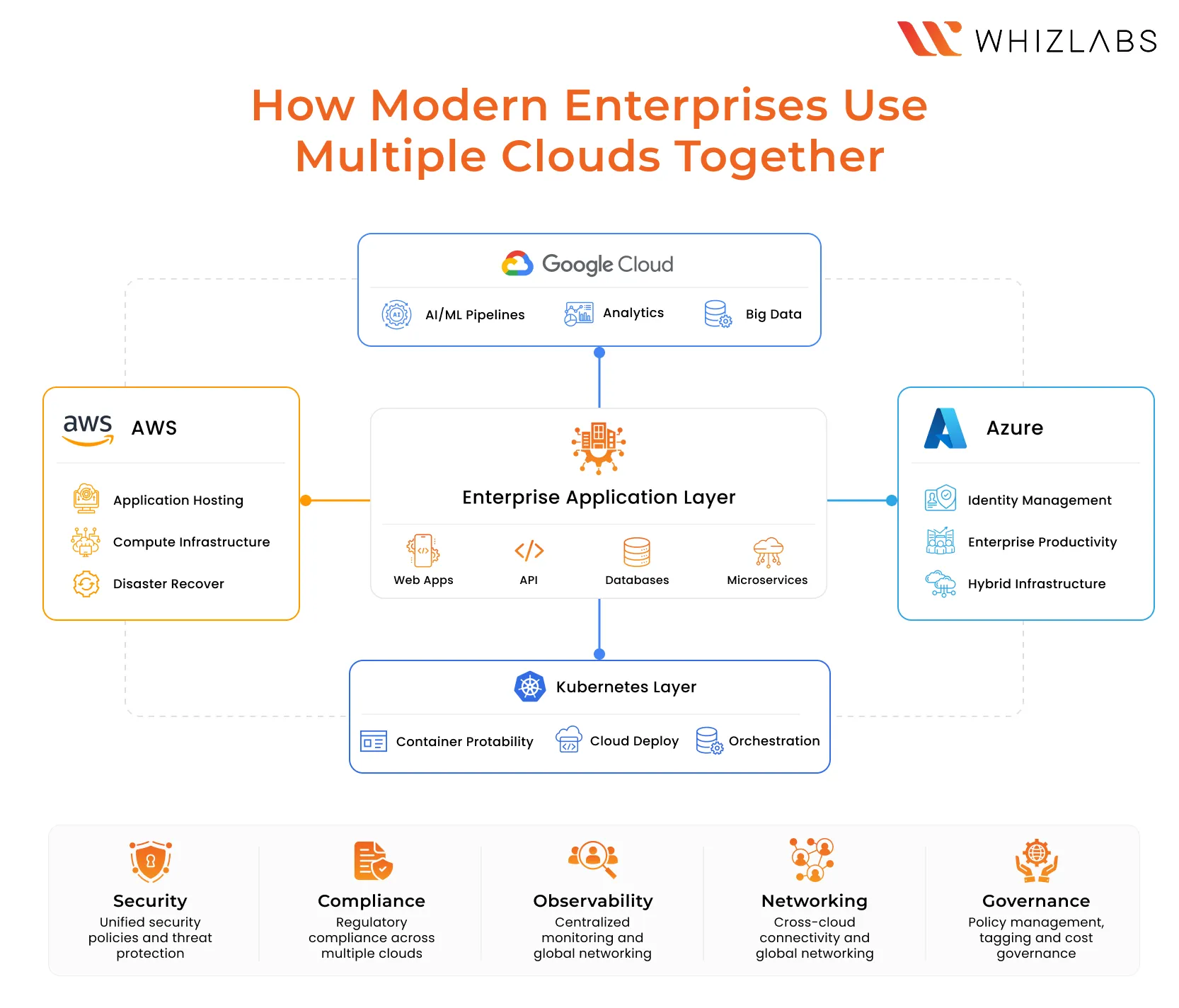
Different cloud providers excel in different areas. AWS continues to dominate in infrastructure maturity and service breadth. Google Cloud is heavily preferred for AI, analytics, and data engineering. Microsoft Azure remains deeply integrated within enterprise IT ecosystems.
As a result, companies are intentionally distributing workloads across platforms. For example:
- A company may use AWS for application hosting
- Google Cloud for machine learning pipelines
- Azure for identity management and enterprise productivity systems
This creates an entirely new challenge. Cloud architects must now understand how systems communicate across providers. They need expertise in cross-cloud networking, identity federation,multi-cloud security policies, distributed monitoring, hybrid infrastructure design, container portability, Kubernetes orchestration, infrastructure as Code across platforms and cost governance across multiple cloud vendors.
A cloud architect who only understands one ecosystem can become a bottleneck inside these environments. This is exactly why hiring priorities are changing in 2026.
Why Single-Platform Expertise Is No Longer Enough?
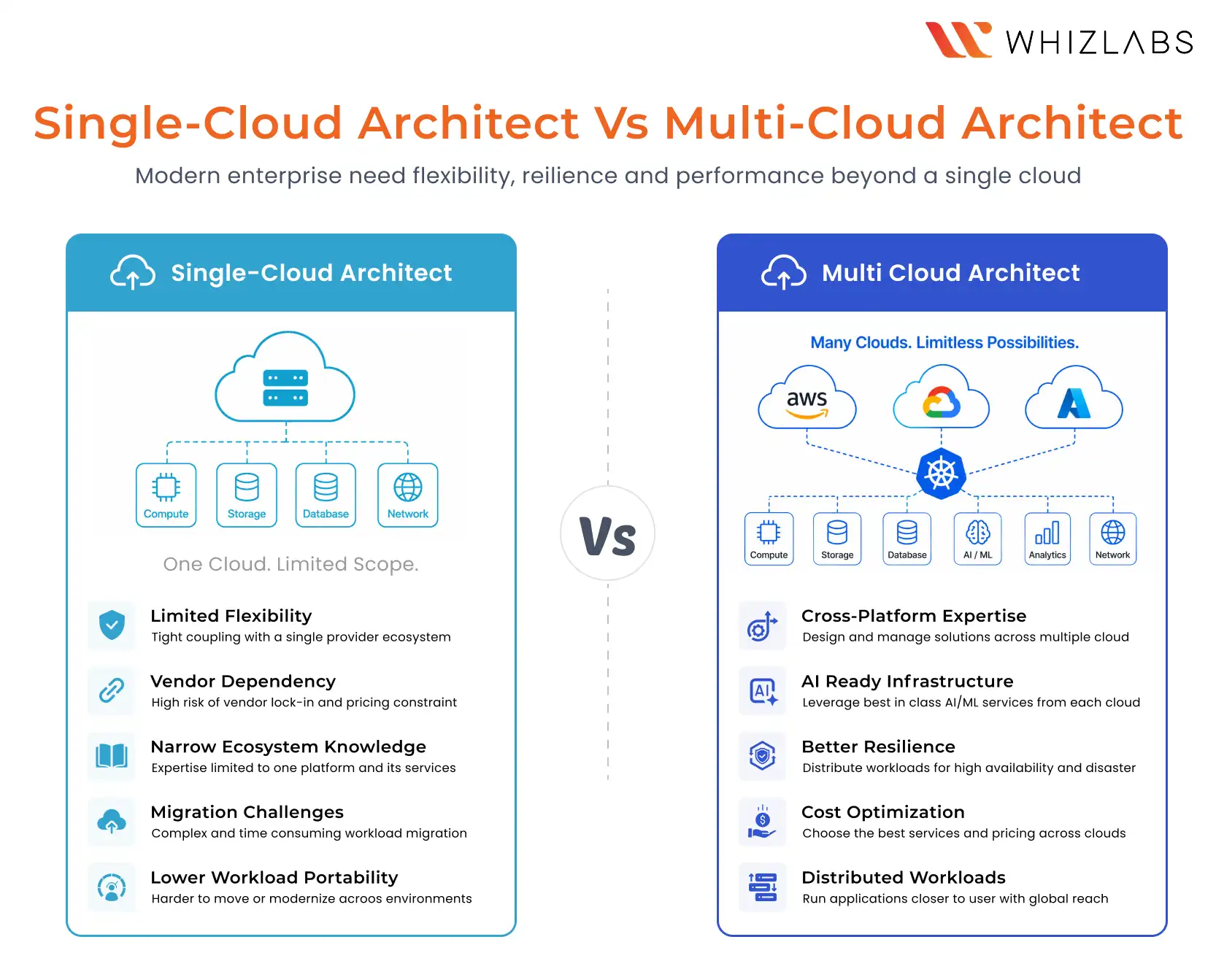
Single-cloud expertise still has value. Organisations still hire specialists. However, architecture roles increasingly require broader visibility.
Companies no longer want architects who only know how to deploy services within one vendor ecosystem. They want professionals who understand:
- Platform trade-offs
- Multi-cloud migration strategies
- Cross-cloud security models
- Data portability
- AI workload distribution
- Multi-region disaster recovery planning
- Compliance across environments
This becomes especially important for enterprises operating globally. For example, an architect may need to:
- Run compute-heavy workloads on AWS
- Use Google Cloud Vertex AI for machine learning
- Integrate Azure Active Directory for authentication
- Maintain centralised observability across all environments
This level of orchestration requires broader certification pathways. Employers increasingly view multi-cloud certifications as proof that an architect can adapt beyond a single vendor ecosystem. In the cloud certification career 2026 market, adaptability is becoming one of the most valuable skills.
The Rise of Vendor-Neutral Architecture Thinking
One of the biggest changes happening in cloud architecture is the movement toward vendor-neutral system design. Modern architecture decisions are now driven less by brand loyalty and more by workload optimisation.
Architects are expected to evaluate:
- Which platform offers the best performance for a workload
- Which cloud provides the best AI tooling
- Which environment offers stronger regional compliance support
- Which provider delivers better cost efficiency
- Which services integrate more effectively with existing infrastructure
This mindset changes how certifications are viewed. Earlier, certifications mainly validated platform-specific operational knowledge. Now, they are increasingly seen as evidence of architectural flexibility.
A multi-cloud certified architect demonstrates:
- Broader infrastructure awareness
- Stronger interoperability understanding
- Better migration planning capability
- Improved disaster recovery design thinking
- Wider security knowledge
- Greater adaptability to enterprise environments
This is why companies now prioritise candidates who understand multiple ecosystems instead of only mastering one.
How AI Is Accelerating Multi-Cloud Adoption?
Different cloud providers offer different strengths for AI workloads. Google Cloud is widely recognised/recognized for its Vertex AI and data analytics capabilities. AWS offers extensive infrastructure scalability and ML deployment tooling.
Azure remains heavily integrated into enterprise AI ecosystems. NVIDIA technologies are increasingly shaping accelerated AI infrastructure and autonomous AI workflows.
AI adoption is one of the biggest reasons multi-cloud architecture is expanding rapidly. Organisations are no longer deploying AI workloads in isolated environments.
AI systems depend on:
- Massive datasets
- Distributed storage systems
- Specialised GPU infrastructure
- Real-time inference environments
- Edge deployment strategies
- Data governance controls
- Cross-platform orchestration
As enterprises combine these capabilities, cloud architects must understand how AI systems move across cloud boundaries. This is creating a major shift in the cloud certification career landscape for 2026.
Architects are now expected to understand both traditional infrastructure design and AI infrastructure orchestration. This combination is becoming a highly valuable specialisation.
The Certifications Driving Multi-Cloud Careers in 2026
Multi-cloud careers are increasingly shaped by solution architect certifications across major cloud platforms. These certifications validate the ability to design scalable, secure, and cost-efficient architectures in diverse enterprise environments.
Some of the most valuable certifications for multi-cloud professionals include:
AWS Certified Solutions Architect – Professional
This certification remains one of the strongest credentials for infrastructure architecture.
It focuses heavily on:
- Scalable cloud design
- High availability systems
- Disaster recovery planning
- Networking architecture
- Security implementation
- Cost optimization
- Enterprise deployment strategies
AWS expertise remains foundational because many enterprises still operate significant workloads on AWS.
Google Cloud Professional Cloud Architect
This certification focuses on designing scalable and secure systems within Google Cloud environments.
It emphasizes:
- Cloud-native architecture
- Hybrid connectivity
- AI and analytics integration
- Infrastructure reliability
- Security governance
- Operational efficiency
Google Cloud certifications are becoming increasingly important because of growing enterprise investment in AI and data engineering.
Microsoft Certified: Azure Solutions Architect Expert
Azure remains deeply embedded within enterprise IT operations.
This certification validates expertise in:
- Hybrid cloud environments
- Enterprise networking
- Governance frameworks
- Identity management
- Security compliance
- Business continuity planning
Architects working in enterprise environments increasingly need Azure expertise because many organisations continue to depend heavily on Microsoft ecosystems.
Kubernetes and Container Certifications
Multi-cloud systems often depend on container portability.
This is why certifications such as:
have become increasingly valuable.
Containers allow workloads to move across providers more efficiently. Kubernetes skills are now considered critical for modern architecture roles.
The Skills Employers Actually Want in 2026
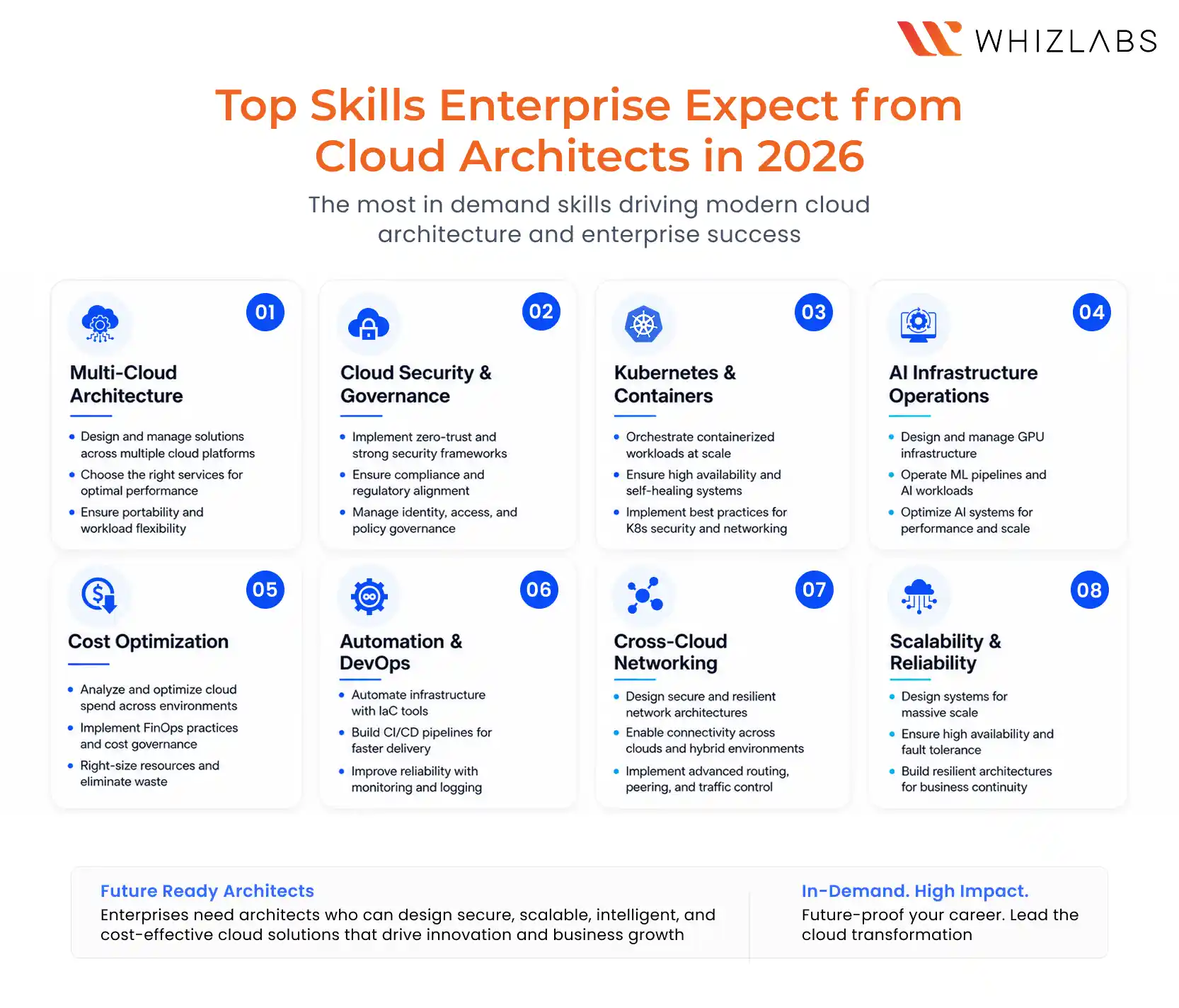
Modern cloud architecture roles are no longer focused purely on deployment knowledge.
Companies are hiring architects who can solve operational complexity.
The most valuable professionals now combine:
- Infrastructure expertise
- Security knowledge
- Automation capability
- AI infrastructure awareness
- Cross-platform integration skills
- Governance understanding
- Scalability planning
Hiring managers increasingly evaluate whether candidates can:
- Design resilient multi-cloud systems
- Reduce operational risk
- Optimize cloud spending
- Improve workload portability
- Build scalable AI-ready infrastructure
- Maintain compliance across regions
This is why certification strategy matters.
Employers are paying attention not just to how many certifications a candidate has, but also to how strategically those certifications connect.
For example:
- AWS + Kubernetes signals scalable infrastructure expertise
- Azure + security certifications signal enterprise governance capability
- Google Cloud + AI certifications signal data and ML specialisation
- Multi-cloud architecture certifications signal adaptability and broader systems thinking
The cloud certification career 2026 market rewards architects who can operate across ecosystems rather than staying locked into one platform.
Multi-Cloud Certification vs Multi-Cloud Experience
A common misconception in cloud careers is that certifications alone are enough to succeed.
In reality, modern cloud roles require both validated knowledge and hands-on execution.
Certifications and experience serve different purposes. The strongest multi-cloud professionals combine both.
What Certifications Prove?
Multi-cloud certifications help employers validate foundational capability across platforms.
They show that a professional:
- Understands cloud fundamentals
- Has validated technical knowledge
- Can adapt across platforms
- Can learn complex systems
This is why solution architect certifications remain highly valuable in multi-cloud career paths.
Certifications such as the AWS Certified Solutions Architect – Associate, Microsoft Certified: Azure Solutions Architect Expert, and Google Professional Cloud Architect help establish competency across major cloud providers.
What Experience Proves?
Real-world experience validates execution.
It demonstrates the ability to:
- Handle production workloads
- Solve operational challenges
- Optimize performance and security
- Work within business constraints
Experience shows how effectively architectural knowledge can be applied in practical environments.
Why Do Both Matter in Multi-Cloud Careers?
Multi-cloud environments require professionals to work across different platforms and architectures.
This makes the combination of certifications and experience especially important.
For example:
- An AWS engineer moving into Google Cloud
- An Azure administrator expanding into Kubernetes
- A DevOps engineer transitioning into cloud architecture
In these situations, certifications provide structured learning while experience builds operational confidence.
The most successful cloud architects in 2026 combine cross-platform certifications with practical implementation experience to design scalable and interoperable cloud environments.
Why Enterprises Prefer Multi-Cloud Ready Architects?
Organisations today are under constant pressure to improve resilience.
Vendor outages, regulatory changes, cybersecurity risks, and AI infrastructure demands are forcing companies to reduce dependency on single providers.
This is one reason multi-cloud architecture has become a strategic business decision.
Enterprises prefer architects who can:
- Avoid vendor lock-in
- Design portable systems
- Build resilient failover strategies
- Manage distributed infrastructure
- Integrate AI workloads effectively
- Improve operational flexibility
Architects who understand multiple platforms help businesses reduce long-term infrastructure risk.
This directly impacts hiring decisions.
The Future of Cloud Architecture Careers
Cloud architecture is evolving into a broader systems engineering role.
Future architects will manage:
- Distributed AI systems
- Edge and hybrid environments
- Cross-cloud security frameworks
- Intelligent automation pipelines
- Multi-region compliance architectures
Enterprise hiring is already shifting in this direction. Companies increasingly expect architects to understand cloud infrastructure, DevOps, security, AI operations, Kubernetes, data systems, and governance together.
At the same time, most organizations no longer operate on a single cloud platform. Modern enterprise environments combine AWS, Azure, Google Cloud, Kubernetes, SaaS platforms, and AI services within the same architecture.
As a result, architects are now expected to design systems that work seamlessly across multiple ecosystems. This is why multi-cloud certifications are becoming increasingly important. They validate cross-platform architectural knowledge and prepare professionals to build scalable, interoperable, and cloud-agnostic enterprise systems.
In the future of cloud architecture careers, multi-cloud expertise will increasingly become a foundational requirement rather than an optional specialization. So let us see how to build your cloud architecture career.
How to Build a Strong Multi-Cloud Certification Path?
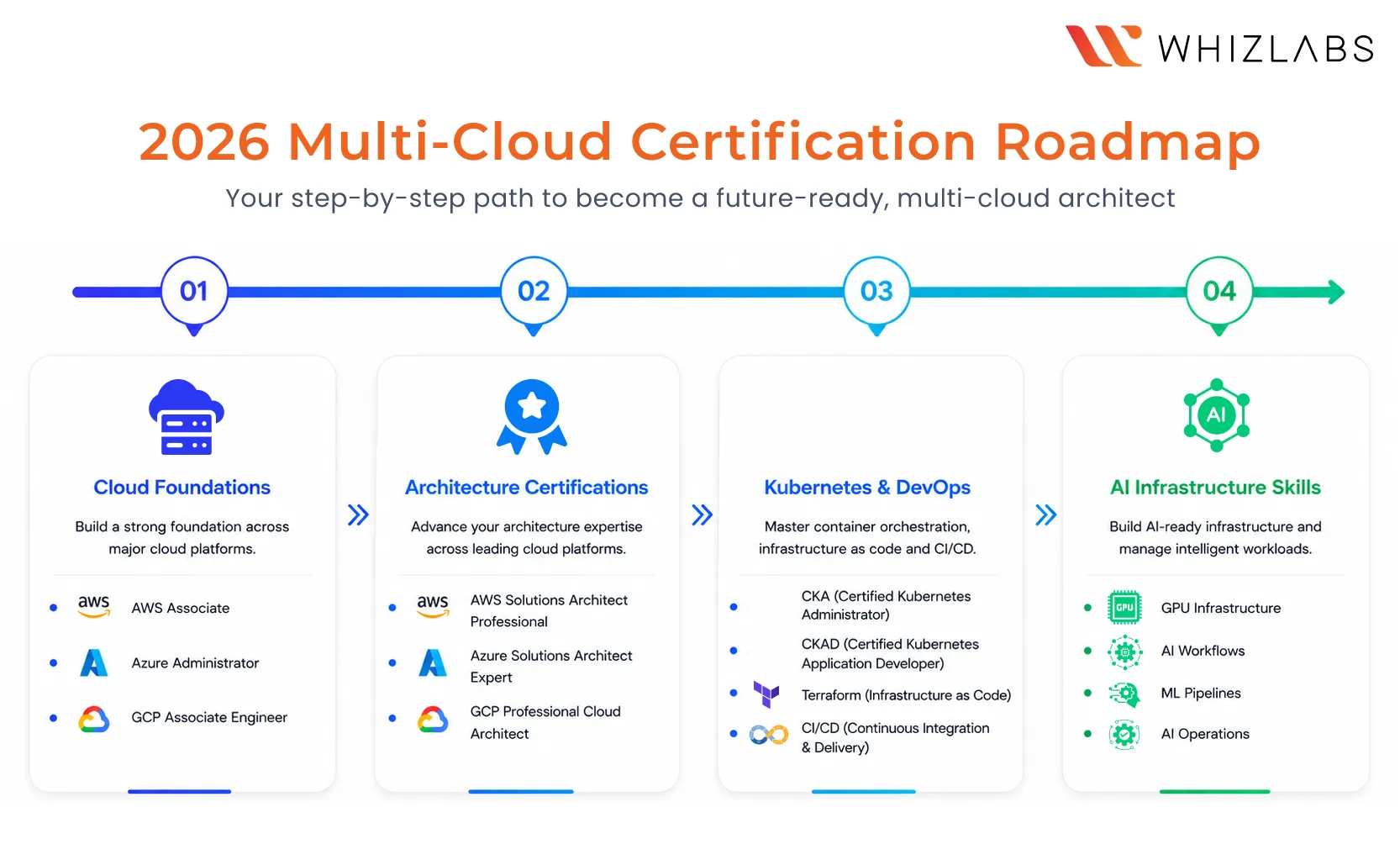
Professionals entering cloud architecture in 2026 should focus on building layered expertise.
A practical progression often looks like this:
Step 1: Master One Core Cloud Platform
Start with one ecosystem first.
Examples include:
- AWS Certified Solutions Architect – Associate
- Google Cloud Associate Cloud Engineer
- Microsoft Azure Administrator Associate
This builds foundational cloud knowledge.
Step 2: Expand Into Architecture-Level Certifications
Once foundational knowledge is established, move toward architecture certifications such as:
- AWS Certified Solutions Architect – Professional
- Google Cloud Professional Cloud Architect
- Microsoft Certified: Azure Solutions Architect Expert
These certifications focus more heavily on enterprise system design.
Step 3: Add Kubernetes and Automation Skills
Modern cloud systems depend heavily on automation and containerization.
Adding Kubernetes, Infrastructure as Code, and CI/CD expertise significantly improves architectural capability.
Step 4: Learn AI Infrastructure Concepts
AI is increasingly shaping cloud infrastructure decisions.
Architects should understand:
- GPU infrastructure
- AI deployment workflows
- ML pipelines
- AI observability
- Distributed inference systems
This will become increasingly important over the next few years.
Common Mistakes to Avoid While Preparing for Multi-Cloud Architecture Certifications
Preparing for multi-cloud architecture certifications requires more than studying exam objectives. Many professionals make mistakes that limit both certification success and long-term career growth.
Studying Only to Pass the Exam
Many professionals focus only on clearing certification exams instead of understanding real architecture concepts. This often creates gaps in practical decision-making and system design skills.
Hands-on labs and scenario-based learning can help bridge the gap between certification knowledge and real-world application.
Learning Multiple Clouds Too Quickly
Trying to learn AWS, Azure, and Google Cloud simultaneously can become overwhelming without first building strong expertise in one platform.
A structured learning path makes it easier to expand gradually into broader multi-cloud concepts.
Skipping Hands-On Practice
Cloud architecture requires practical deployment, troubleshooting, and infrastructure management experience, not just theoretical understanding.
Sandbox environments and guided cloud labs help professionals gain confidence with real-world workflows.
Memorizing Services Instead of Use Cases
Many learners memorize cloud services without understanding where and why they are used in enterprise environments. This limits architectural thinking.
Scenario-based learning helps connect cloud services with practical business and infrastructure requirements.
Ignoring Cross-Cloud Concepts
Multi-cloud architects must understand interoperability, networking, security, and integration across platforms.
Cross-platform training helps professionals develop a broader architectural perspective across AWS, Azure, and Google Cloud.
Neglecting DevOps and Kubernetes
Modern cloud architecture increasingly depends on automation, containers, CI/CD pipelines, and orchestration tools.
Exposure to DevOps and Kubernetes workflows is becoming essential for enterprise cloud roles.
Avoiding Real Troubleshooting Scenarios
Certification preparation often lacks operational problem-solving experience. However, enterprise architects are expected to handle performance, networking, and deployment issues in production environments.
Practical simulations and troubleshooting exercises help improve real-world readiness.
Overlooking Emerging Trends
AI infrastructure, hybrid cloud operations, and edge computing are becoming important parts of modern cloud architecture.
Keeping up with evolving cloud and AI technologies helps professionals stay aligned with future industry demands.
You can avoid these mistakes by using structured learning platforms.
Why Structured Learning Platforms Matter More in 2026?
The complexity of multi-cloud architecture means professionals can no longer rely only on documentation or fragmented tutorials.
Modern cloud environments require architects to understand how different platforms interact, how workloads behave in production, and how to troubleshoot issues across distributed systems.
Many professionals preparing for multi-cloud roles still lack practical exposure to:
- Cross-platform deployment workflows
- Real infrastructure troubleshooting
- Identity and networking integration across clouds
- Cost optimization and scalability decisions
- Interoperability challenges between AWS, Azure, and Google Cloud
Without hands-on experience, it becomes difficult to apply architectural knowledge confidently in enterprise-scale environments.
This is why structured learning ecosystems are becoming increasingly important in cloud certification preparation in 2026.
Cloud architects today need more than theoretical learning. They need Hands-on labs, Real exam simulations, Cross-platform learning paths, Practical sandbox environments, Scenario-based architecture training, and AI and cloud integration exposure.
Platforms like Whizlabs help professionals build practical multi-cloud expertise through guided hands-on learning experiences.
These platforms typically provide:
- Cloud labs and sandbox environments
- Certification-aligned practice tests
- Multi-cloud learning paths across AWS, Azure, and Google Cloud
- DevOps, Kubernetes, and AI-focused training
- Role-based learning for architects, administrators, and engineers
For professionals preparing for modern cloud architecture roles, practical exposure matters just as much as theoretical understanding.
Build a Future-Ready Multi-Cloud Career
Cloud architecture in 2026 is no longer limited to mastering a single platform. Modern enterprises now operate across AWS, Google Cloud, Azure, Kubernetes environments, and AI-driven infrastructure ecosystems simultaneously.
That shift has completely changed what companies expect from cloud professionals.
Today, cloud architects are expected to understand interoperability, automation, security, scalability, governance, and AI-ready infrastructure across multiple environments. Simply knowing one platform is no longer enough for long-term career growth.
This is exactly why multi-cloud certifications are becoming the new industry baseline. They validate your ability to design resilient systems, manage distributed workloads, and adapt to modern enterprise infrastructure requirements.
If you are preparing for a successful cloud certification career in 2026, focus on learning paths that combine certifications with hands-on practical exposure. With Whizlabs Practice Tests, video courses, Hands-on Labs, and Cloud Sandboxes, you can build real-world multi-cloud experience across AWS, Google Cloud, Azure, Kubernetes, DevOps, and AI-focused environments without feeling overwhelmed.
Now is the time to accelerate your career with certifications that truly reflect modern cloud architecture skills and enterprise-ready expertise.
Prepare smarter with Whizlabs and confidently move toward your next cloud career milestone!
Still have questions? Drop us an email at [email protected]. We will sort it out.

- Why Cloud Architects Need Multi-Cloud Certs in 2026 - May 25, 2026
- How AI and Automation Help AWS SAP-C02 Architects in 2026? - January 2, 2026
- How to Prepare for the VMware VCP‑DCV Certification in 2025? - August 12, 2025
- What are the Key Model Deployment Strategies for AIF-C01? - February 26, 2025
- How I Passed AWS SAA-C03 Exam: My Study Plan and Mistakes - September 9, 2024
- What Are The Best Careers With AWS Cloud Practitioner Certification? - January 23, 2024
- Terraform with AWS and Azure: Integration Guide & Comparison - April 17, 2021