After a long day at work, you are sitting in front of your laptop, trying to study but cannot. Most people assume it’s laziness or lack of motivation. It’s neither. It’s biology, and once you understand what’s actually happening, the whole approach to cloud certification while working full-time changes.
Why Studying After Work Feels Impossible
Your job and your studies draw energy from the same cognitive pool.
Your brain has a finite amount of focused energy each day, and your job spends most of it before you even get home. Every meeting, every decision, every context switch at work draws from the same pool you need for learning. A useful way to think about it: your capacity for focused thinking isn’t unlimited, and it doesn’t reset at 5pm. By the time most people sit down to study in the evening, that pool is running low; sometimes very low.
When working professionals struggle to focus on upskilling, the fix isn’t more discipline. It’s matching what you study to how much mental fuel you actually have left.
Three study modes, matched to energy level:
|
Energy level |
What to study |
When it happens |
| High | Active learning New concepts, hands-on labs, dense documentation |
Morning before work, After a light day |
| Medium | Consolidation Flashcards, reviewing notes, re-reading familiar material |
Lunch breaks, early evening after a normal day |
| Low | Passive review Cloud podcasts, summary videos, listening to whitepapers |
Commute, late evenings, high-stress weeks |
The insight here isn’t that low-energy sessions are useless. Nothing is wasted if you stop pretending every session needs to be a deep study block.
When is your best window?
For most working professionals, it’s one of these three:
- Before work: 30 to 45 minutes before your day starts is genuinely the best slot for active learning if you can protect it. Your cognitive budget is full and there are no interruptions yet.
- Lunch: good for timed practice questions. Set a 15-question test, do it without looking anything up, review the results. You’re consolidating, not learning from scratch.
- Commute: audio is underrated. AWS has whitepapers. All three major clouds have official podcasts. A 40-minute commute, used consistently, adds up to real hours over a month.
Which is your tough window?
Evenings.
This is the slot most study plans assume. But it’s usually a tough time to focus. So, use evenings for passive review only and on the nights you genuinely have no energy left, close the laptop without guilt. You’ll retain more from a 20-minute morning session than from two hours of exhausted re-reading.
Now that you know how your brain works under these conditions, the next question is whether the effort is worth it at all.
Why Cloud Certifications Actually Matter in 2026
For some people, that’s already settled: their employer told them to get certified, or they’ve watched colleagues get promoted after doing it. But if you’re still on the fence, the data makes a stronger case than most people realise.
The salary numbers are greater.
According to Global Knowledge’s IT Skills and Salary Report, AWS-certified professionals earn on average 25% more than their non-certified peers in equivalent roles. Azure and GCP certifications show similar patterns.
Hiring filters are blunter than you’d expect.

The honest version of what happens when a cloud engineer role gets posted: the ATS (applicant tracking system) filters for cert keywords before a human sees the résumé. A mid-size SaaS company posting for a cloud engineer role will often list “AWS SAA-C03 or equivalent required.” A candidate without the certification won’t proceed to the technical round. The cert is for clearing the filter so you get to the conversation with hirers where you can prove your expertise.
The internal role switch is easier.
Employees who certify tend to get pulled onto cloud migration projects, included in architecture conversations, and noticed by engineering leadership without asking for it. The cert signals that you took the initiative, so you are serious about the job.
How to Pick the Right Certification Without Overthinking
There is one rule that cuts through most of the noise: if your organisation or the one you are trying to switch to run primarily on a specific cloud, certify in that first.
The knowledge transfers directly to your day-to-day work, and you build credibility with the people already around you. The “which cloud is biggest” debate is largely irrelevant if you already know which cloud you’re going to work with.
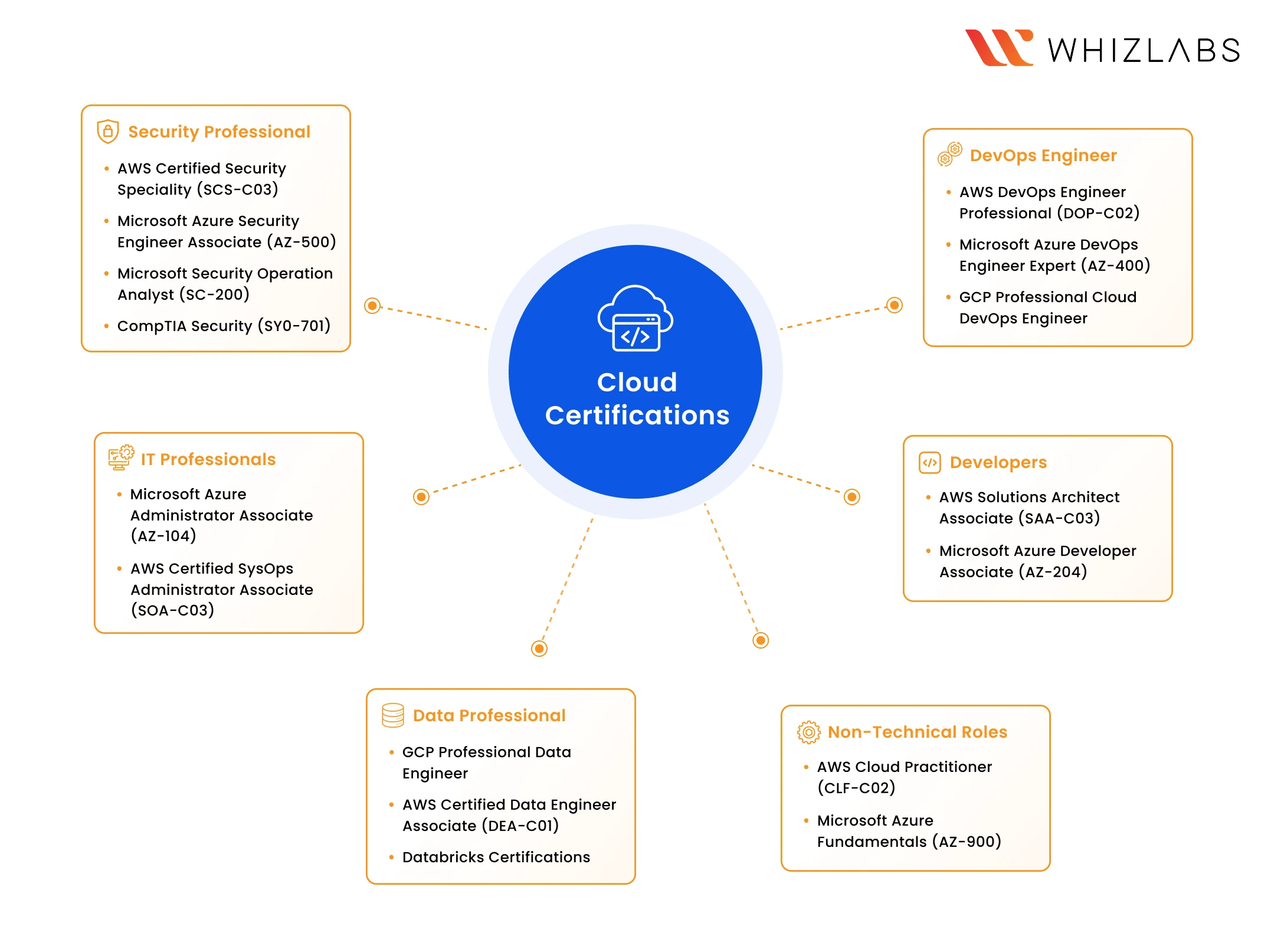
If you’re genuinely neutral with no employer preference or no existing exposure, here is a quick list of some of the best cloud certifications in 2026 by market demand: AWS SAA-C03, AZ-104 and GCP ACE consistently top employer requirements across industries. They are not the only good choice, but they are the least risky starting points for someone aiming for employment outcomes.
Time investment by certification level:
| Level | Examples | Study hours | Part-time timeline | Exam cost (approx.) |
| Foundational | AWS CCP, AZ-900, GCP Digital Leader | 40–60 hrs | 4–5 weeks | $100–$130 |
| Associate | AWS SAA-C03, AZ-104, GCP ACE | 80–120 hrs | 8–12 weeks | $150–$180 |
| Professional / Specialty | AWS DevOps Pro, AZ-400, GCP Pro Data Engineer | 150–250 hrs | 14–20 weeks | $200–$300 |
A note on skipping the foundational level: it’s tempting when you have a technical background to go straight for the Associate. Sometimes that’s the right call. But for working professionals with limited study time, the foundational cert is often worth 4–5 weeks of investment. It builds the mental model that makes Associate-level content faster and less effortful to absorb. Someone who tries to learn AWS SAA-C03 without that foundation will spend study hours building context that the foundational cert would have given them directly.
Which Certification Is Right for Your Role
“Which cert should I get” is almost never really about the cert. It’s about where you are, what you’re trying to get to, and how much time you realistically have. Here are the situations we see most often, and what makes sense for each
“I’m in IT, sysadmin, or helpdesk and my company is moving to cloud”
This is the most common scenario, and it has a clear answer. If your company runs on Microsoft infrastructure like Active Directory, Windows Server, Exchange or on-prem networking, Azure will feel the most familiar. The concepts map more directly onto what you already know. Microsoft Azure Administrator Associate (AZ-104) is the most manageable Azure certification for part-time study, and it’s also one of the most requested certs in enterprises.
If your company runs on AWS, AWS Certified SysOps Administrator Associate (SOA-C03) covers the operational side like monitoring, deployments, security and networking which aligns well with what a sysadmin does day to day.
“I’m a developer and I want cloud on my résumé”
AWS Solutions Architect Associate (SAA-C03) is the most valued AWS certification while working full-time, purely from a job market standpoint. It covers compute, networking, storage, databases, and architecture patterns which are the building blocks of cloud-native development. Developers tend to find the material more approachable than non-technical people do, because a lot of the underlying concepts (APIs, infrastructure, data flow) are already familiar.
If you’re already working with Azure, Microsoft Azure Developer Associate (AZ-204) is a more directly relevant option. It’s specifically aimed at developers building on Azure rather than infrastructure administrators managing it.
“I have no technical background. I’m in PM, business analysis, or a non-engineering role”
This audience is larger than most cloud certification content acknowledges, and the advice is usually wrong for them. Going straight for an Associate cert with no technical background is a painful experience.
Start foundational. AWS Cloud Practitioner (CLF-C02) and Microsoft Azure Fundamentals (AZ-900) are both genuinely passable in 4–5 weeks of part-time study, with no prior technical knowledge. The goal here is only cloud fluency. You want to be able to participate in vendor discussions, understand architecture diagrams, contribute to cloud budget conversations, and engage meaningfully with engineering teams. That’s valuable, and both foundational certs deliver it.
A project manager who passes AWS Cloud Practitioner and can talk credibly about cloud cost models and service tiers is a more attractive candidate for cloud program lead roles.
“I work with data as an analyst/data engineer/BI developer and cloud keeps coming up”
Cloud is now the default infrastructure for data work. If you’re building pipelines, running analytics, or working with warehouses, you almost certainly already interact with cloud services.
GCP Professional Data Engineer is the strongest choice in this space if you work with modern data stacks. BigQuery is genuinely dominant in enterprise data warehousing, and GCP’s data tooling (Pub/Sub, Dataflow, Looker) is more purpose-built than the equivalent on other platforms. The exam is harder than the Associate tier, so allow more time.
If your environment is AWS-first, AWS Certified Data Engineer Associate (DEA-C01) is the current option. It replaced the older Data Analytics Specialty and is more directly relevant to engineering work.
Databricks certifications (Certified Data Engineer Associate and Certified Data Engineer Professional) are increasingly requested alongside cloud certs for data roles. If you work with Spark or Delta Lake, they complement a cloud cert well and are platform-agnostic.
“I’m in DevOps or platform engineering and I need a cert that reflects what I do”
You would already have strong hands-on experience.
AWS DevOps Engineer Professional (DOP-C02) and Microsoft Azure DevOps Engineer Expert (AZ-400) are both strong choices. They cover CI/CD pipelines, infrastructure as code, container orchestration, monitoring and observability which are the actual content of the job. Neither is an easy exam. If you haven’t done the Associate level, do that first. Attempting a Professional-level cert without the Associate foundation is a common and expensive mistake.
GCP Professional Cloud DevOps Engineer is the equivalent in GCP, with a strong emphasis on SRE practices and reliability engineering.
“I’m in security and cloud security keeps coming up in my work”
Security is one of the fastest-growing areas in cloud, and if you’re already in a security role the cloud cert options are very strong.
AWS Certified Security Specialty (SCS-C03) is the most recognised cloud-specific security cert in the AWS ecosystem. Microsoft Azure Security Engineer Associate (AZ-500) and Microsoft Security Operations Analyst (SC-200) cover different aspects of Azure security: AZ-500 for infrastructure security configuration, SC-200 for threat detection and response.
If you want a platform-agnostic security credential that covers cloud alongside broader security concepts, CompTIA Security+ (SY0-701) remains widely recognised and is a common baseline requirement in many security job postings, particularly in the US.
Cloud Certification Study Plan While Working Full-Time
Here’s why pre-built study plans fail working professionals. They assume equal cognitive load every week. They don’t account for quarterly deadlines, unexpected on-call rotations, family, or the fact that some weeks you’re simply running on zero energy. The moment you fall behind a pre-built schedule, the whole thing starts to feel broken, and most people quietly stop right there.
So instead of a schedule, let us build a plan that can be restarted even when it breaks.
Step 1: Book the exam first, then work backwards
Set a date. Schedule the exam. Non-refundable commitment creates a healthy kind of pressure that open-ended “I’ll take it when I’m ready” intentions never produce.
From there, work backwards. Look at your chosen cert’s typical study hours (from the table above). Divide by your realistic weekly hours. Add a 20% buffer for the weeks when life happens. That number is your start date.
If SAA-C03 takes roughly 100 hours and you can genuinely do 7 hours per week, you need about 16 weeks with a buffer. Count back 16 weeks from your target exam date. That’s when you start. Simple.
Step 2: Colour your calendar at the week level, not the day level
Building a cloud certification schedule as an employee is different from building one as a student. Your week is never fully in your control, which is exactly why we plan at the week level and not the day level.
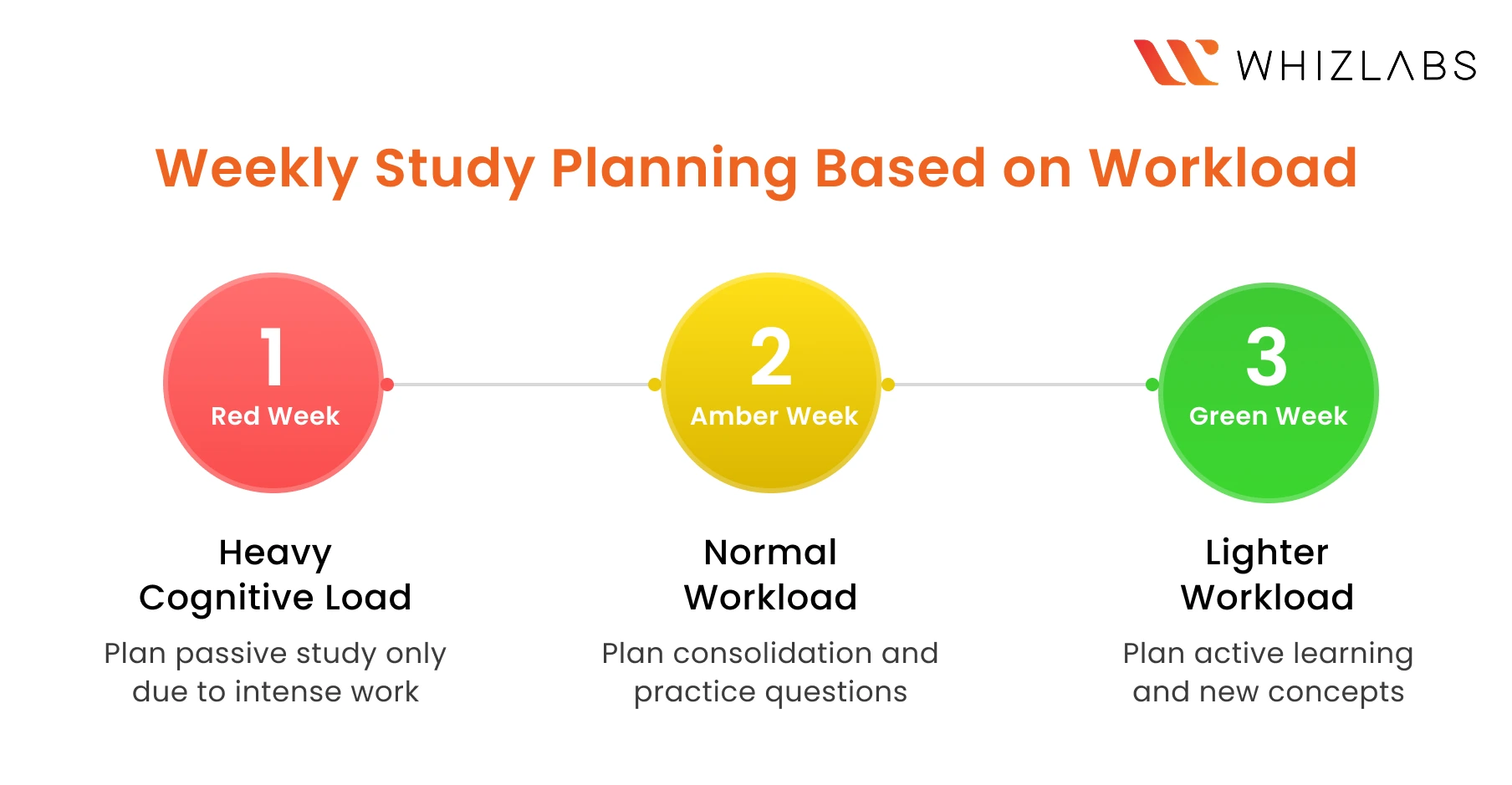
Mark weeks as one of three types:
- Red weeks: Heavy cognitive load at work
Product launches, performance reviews, travel, on-call rotation, major deadlines.
Plan passive study only. - Amber weeks: normal workload.
Plan consolidation – practice questions, flashcard review, re-reading notes. - Green weeks: lighter than usual.
Plan active learning – labs, new concepts, dense documentation.
Now your plan can survive. When a red week hits, you don’t feel like you’ve failed since you were already planning for it.
Step 3: Build your three-layer study stack
Every cert prep needs three components, not one:
- A video or reading course for conceptual understanding.
- Hands-on labs for muscle memory and real understanding.
- Practice exams for exam readiness and identifying weak areas.
Why hands-on labs matter more for professionals than for students. When an exam scenario asks “which configuration handles this VPC requirement,” someone who has actually built a VPC in a lab environment answers that question faster than someone who watched a video about it. They also accelerate transfer to your actual job in a way that video content alone doesn’t.
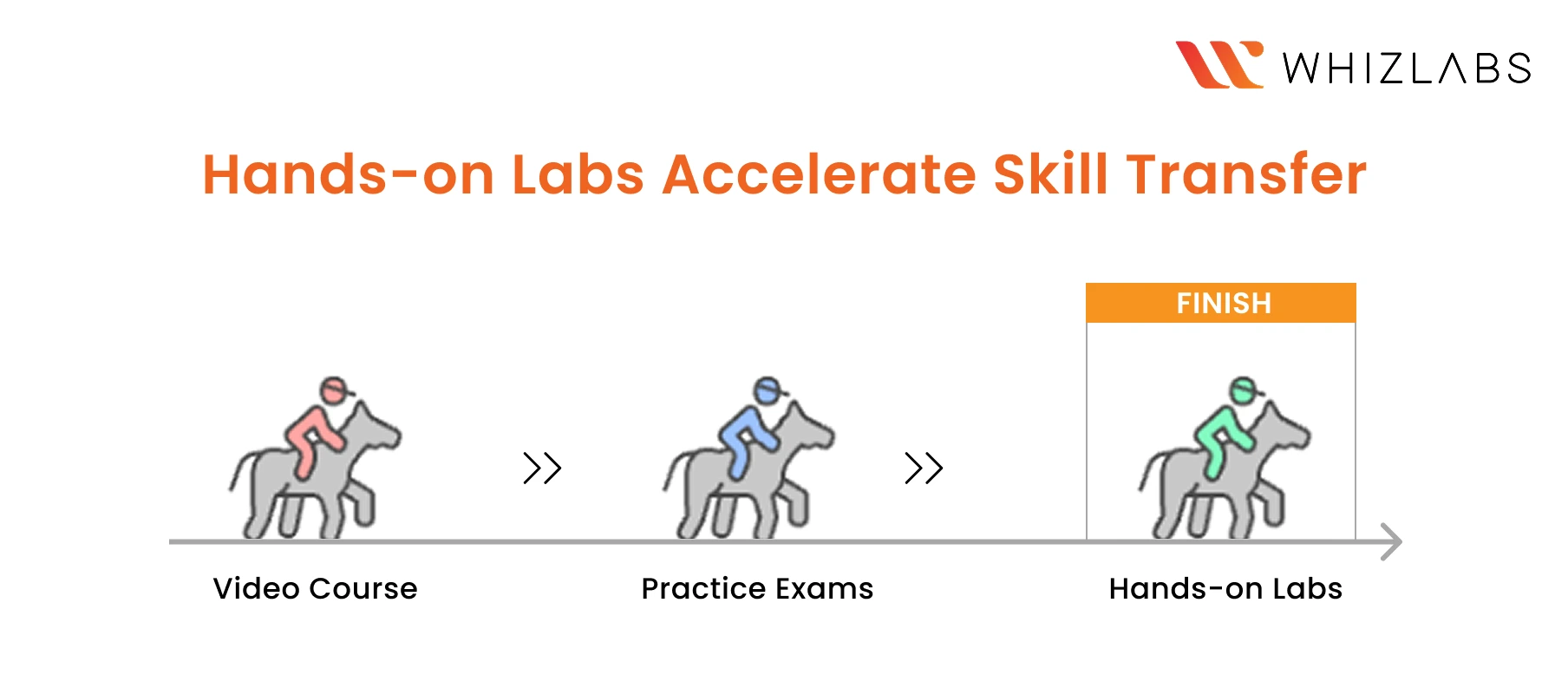
The sandbox problem. This is where most working professionals quietly abandon hands-on practice. Setting up a free-tier personal cloud account eats up your scarce time and it kills your momentum.
Invest in a platform that gives you pre-configured, time-boxed lab environments with a clear task to complete and no account management required. Whizlabs offers exactly this: guided hands-on labs for AWS, Azure, and GCP alongside practice tests and video courses in one place.
For a working professional who can’t afford to spend 45 minutes setting up a sandbox, purchasing a lab environment that is ready to go when you open the browser is a solid investment decision.\
Step 4: Build a catch-up week into every month
Every four weeks: review everything from the past month. Take a full-timed practice test under real conditions (no pausing, no looking things up). Note your weakest domains. Adjust your plan for the next month based on where your scores are weakest. Long-term retention happens in catch-up weeks, not in new-content sessions.
Step 5: Track scores, not hours
Hours studied is a comfort metric. It tells you how long you sat at a desk. Practice exam score tells you whether you are learning and retaining knowledge.
If your score isn’t moving after two weeks, change the mode. Specifically: if you’re consistently weak on a domain, go back to the lab environment and documentation for that domain. Re-watching a video lecture you’ve already seen rarely moves the needle. Getting your hands on the console usually does.
Cloud Certification  for Working Professionals
 for Working Professionals
Set up tomorrow’s session tonight
Before you go to bed, spend two minutes setting up tomorrow’s study session. Open tabs, queue practice exam, bookmark labs. You want to sit down and start studying straight away, not spend the first 15 minutes just getting ready.
Use transition time, not just free time.
Transition time is more valuable than you think. Your commute is good for podcasts and audio. Lunch works well for a quick set of practice questions. A focused 20 minutes at lunch will honestly do more for you than 45 distracted minutes after dinner, so stop saving it all for the evening.
Plan at the week level, not the day level.
Every Sunday, take 15 minutes to look at the week ahead. If it is a heavy week, plan for passive study only. If it is lighter, schedule a lab session or some reading. The mode changes depending on the week but the goal stays the same.
Use one platform, not five.
Most working professionals end up juggling a video course on one platform, practice tests on another and a sandbox account somewhere else. Every extra login is a small decision that quietly drains your momentum. Whizlabs keeps practice tests, hands-on labs and course content all in one place, which means one less thing to manage when you are already stretched thin.
Tell someone your exam date.
Put it in your email signature, mention it to your manager, or ask a colleague to check in with you on Fridays. It does not need to be a formal arrangement. It just needs to exist, because having someone else aware of your goal makes quitting feel like a bigger deal than it would otherwise.
Week four is the hard one, not week one.
The initial motivation has worn off, the exam still feels far away, and work has probably thrown something unexpected at you. Know this before you get there. When it happens, shrink the task rather than abandoning the goal. One practice question on a hard day still counts as a session.
If work takes over for two weeks, do not try to make up the time.
Instead just take one practice test, review what you got wrong and move forward from there. The material you covered is still in your head. It just needs a nudge to come back.
Conclusion: Start Small, Stay Consistent
- Don’t try to make extra hours, find the usable hours you already have.
- Match your study mode to your energy level.
- Build a plan that bends instead of a rigid schedule.
- Get hands-on with the material, so you can apply it in your job.
- And pick up the cert that makes sense for where you are and where you want to go.
You already have the hardest part figured out: you are doing this while holding down a job. That takes more discipline than any study schedule requires.
Schedule the exam. Start this Weekend.
Frequently Asked Questions
Is a cloud certification worth it in 2026? Yes. AWS-certified professionals earn an average of 26% more than non-certified peers according to Global Knowledge, with Azure and GCP showing similar figures. Beyond salary, certifications now function as ATS filters — many job postings list them as required, not preferred. For professionals already employed, the internal impact is often faster: access to cloud projects, better visibility with leadership, and stronger conversations at review time.
How many hours a week do I need to study for a cloud certification? 5 to 10 hours per week is realistic for most working professionals. At that pace, a foundational cert takes 4 to 5 weeks and an Associate-level cert takes 10 to 12 weeks. Pushing much beyond 10 hours on top of a full-time job tends to produce burnout rather than faster results.
Can I pass a cloud certification without hands-on experience? For foundational certs like AWS Cloud Practitioner and AZ-900, yes. For Associate level and above, hands-on practice makes a real difference. The exam scenarios assume you have console familiarity, and people who have worked through labs consistently perform better than those who studied only from videos and reading material.
What is the best cloud certification to start with in 2026? If your employer uses a specific cloud platform, start there. If you are choosing freely, AWS SAA-C03 has the widest job market recognition globally. AZ-104 is the stronger choice for enterprise and government roles. GCP ACE is worth considering if you work in data, ML or startups where GCP adoption is growing. If you have no prior cloud background, do the foundational cert on your chosen platform first before attempting the Associate level.

- Databricks Certified Generative AI Engineer Associate Exam Guide (2026) - August 4, 2026
- 10 AWS Security Projects SCS-C03 Candidates Should Build - July 10, 2026
- Microsoft’s Latest AI Launches: Are We In the Agent Era? - June 26, 2026
- What Career Does MLA-C01 Lead To? Read This Before You Start - June 18, 2026
- What Is Agentic AI? And Why NCP-AAI Is the Cert for It - June 4, 2026
- Who Should Take AB-100 Certification? Beginner or Professional? - May 14, 2026
- How to Pass Cloud Certifications While Working Full-Time - April 28, 2026
- Is Power BI Worth Learning in 2026? PL-300 Guide - April 21, 2026