


If you are preparing for the AIP-C01 exam, working through realistic AIP-C01 exam questions is the fastest way to find out where you actually stand. The AWS Certified Generative AI Developer – Professional exam is not a recall test. Its questions are scenario-based: each one hands you a real-world setup with specific constraints, then asks you to choose the design that satisfies all of them. Many are multiple-response, where you select two or three services and every choice has to be right.
Below are 8 practice questions across all five exam domains, each with the correct answer and a short explanation. These are practice questions built around the AIP-C01 exam blueprint, not actual exam content. Use them to spot your weak domains before syou book.
Let us get into 8 AIP-C01 exam sample questions and answers along with detailed explanations.
To access our full free test with 25 practice questions and answers, click here – AIP-C01 Free Test.
AIP-C01 Domains and Weightage
Before getting into the questions, let us quickly take a look at the domains and weightage of the AIP-C01 exam. The number of sample questions provided for each domain varies with its weightage in the exam.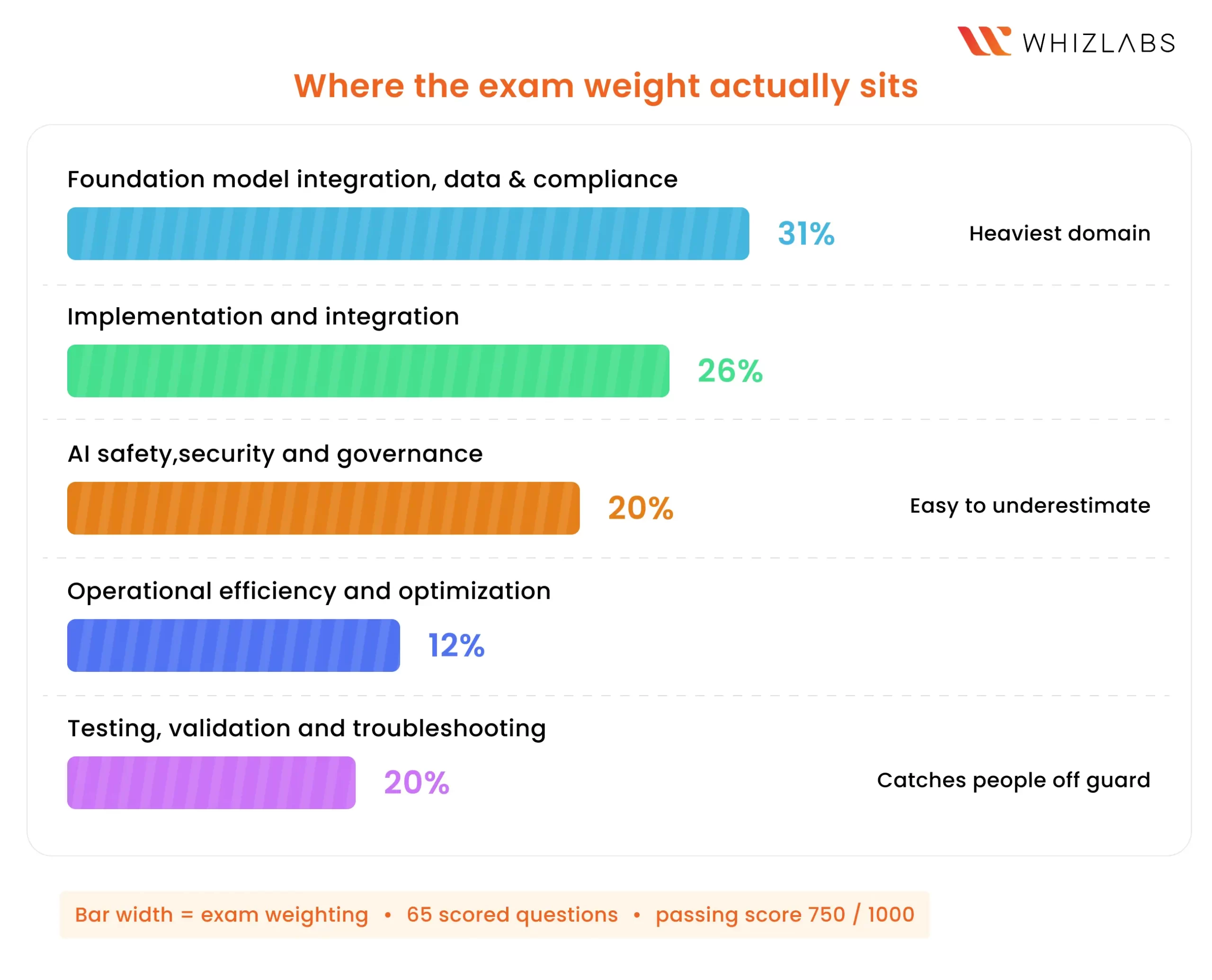
AIP-C01 Sample Questions
Domain 1: Foundation Model Integration, Data Management, and Compliance (31%)
Question 1
A global insurance company is planning to deploy a GenAI-powered claims processing assistant. The solution must:
- Process claims documents in 12 languages across Europe, Asia, and North America
- Maintain 99.9% availability with automatic failover during regional outages
- Allow the operations team to switch between foundation models (Claude, Titan, Llama) based on cost and performance without code deployments
- Comply with the AWS Well-Architected Framework for generative AI workloads
The CTO wants the solution validated before committing to full production deployment. Which combination of approaches should the solutions architect implement to meet ALL requirements?
- A. Use Amazon SageMaker to train custom models for each language, deploy endpoints in every region, hardcode model endpoints in the application, and create custom high-availability patterns
- B. Select the model with the best published benchmarks, deploy using Amazon EC2 with Application Load Balancer for high availability, and implement blue-green deployments for model switching
- C. Deploy directly to production using Amazon Bedrock with a single model in us-east-1, implement manual failover procedures documented in runbooks, and use AWS CloudFormation to change models when needed
- D. Develop a technical proof-of-concept using Amazon Bedrock to validate feasibility, implement Cross-Region Inference for automatic failover, use AWS Lambda with Amazon API Gateway and AWS AppConfig for dynamic model selection, and align the architecture with the AWS Well-Architected Generative AI Lens
Correct answer: D
A proof-of-concept validates feasibility before production, satisfying the CTO’s requirement. Amazon Bedrock provides multilingual foundation models that support all 12 languages without custom training. Cross-Region Inference gives automatic failover for 99.9% availability by routing requests to available regions with no manual intervention. Lambda, API Gateway, and AppConfig enable dynamic model selection without code deployments, since Lambda reads AppConfig at runtime to route to the right model.
Why the others fail: A hardcodes endpoints, which contradicts switching models without deployments. B validates nothing multilingual, and EC2 with ALB gives only within-region high availability. C runs in a single region, so it cannot meet 99.9% during a regional outage, and CloudFormation model changes are deployments.
References: Bedrock Cross-Region Inference, AppConfig feature flags, Well-Architected Generative AI Lens
Question 2
A retail company needs to implement a GenAI architecture that allows switching between foundation models (Anthropic Claude, Amazon Titan, Meta Llama) without application code changes. The operations team should be able to change models through configuration in response to new model releases with better performance, cost optimization requirements, and model-specific rate limiting during peak periods.
Which THREE AWS services should be combined to enable this dynamic model selection capability? (Select 3)
- A. AWS AppConfig
- B. Amazon SageMaker Pipelines
- C. Amazon API Gateway
- D. AWS CloudFormation
- E. AWS Lambda
- F. Amazon EventBridge
Correct answers: A, C, E
AppConfig provides runtime configuration management, letting the team store model selection parameters as feature flags and change them without code deployments. API Gateway provides stable endpoints that decouple client applications from model selection logic, and handles routing, authentication, and rate limiting. Lambda is the routing layer that reads configuration from AppConfig and invokes the appropriate Bedrock model, so the same code routes to Claude, Titan, or Llama without modification.
Why the others fail: B (SageMaker Pipelines) orchestrates ML workflows, not runtime request routing. D (CloudFormation) changes are deployments, violating the no-code-change requirement. F (EventBridge) routes events but cannot store model selection configuration.
References: AppConfig Lambda extensions, AppConfig feature flags, API Gateway request throttling
Domain 2: Implementation and Integration (26%)
Question 3
A media streaming company needs to deploy a content recommendation system with the following characteristics:
- Daily requests: 2 million during normal operations
- Peak traffic: 10x spike during new content releases (every Friday)
- Response time: sub-3 second latency requirement
- Cost optimization: minimize costs during low-traffic periods (late night)
The current architecture uses Amazon Bedrock on-demand pricing for all requests, resulting in unpredictable costs during traffic spikes. Which deployment strategy BEST addresses these requirements?
- A. Migrate entirely to Amazon SageMaker real-time endpoints with auto-scaling configured for peak capacity, using GPU instances for all inference
- B. Deploy the model on Amazon EC2 GPU instances with fixed capacity sized for peak traffic, running 24/7 to ensure availability
- C. Use AWS Lambda functions for on-demand invocation during variable traffic, combined with Amazon Bedrock Provisioned Throughput for the predictable baseline workload, implementing a hybrid approach that optimizes cost and performance
- D. Use Amazon Bedrock on-demand pricing exclusively but implement aggressive client-side caching to reduce API calls during peaks
Correct answer: C
A hybrid strategy addresses all four requirements. Provisioned Throughput gives guaranteed capacity and lower per-request cost for the predictable 2-million-request baseline at sub-3-second latency. For the 10x Friday spikes, Lambda invokes Bedrock on-demand for overflow, and since that burst is time-limited, on-demand rates are cheaper than provisioning 10x capacity permanently. During low-traffic periods, provisioned throughput handles everything with no extra on-demand cost.
Why the others fail: A adds SageMaker infrastructure complexity and GPU cost, and auto-scaling cold starts may violate the latency requirement. B pays for 10x capacity 24/7 at roughly 10% normal utilization, which is heavy waste. D uses client-side caching that cannot address spike costs, and personalized recommendations have low cache hit rates.
References: Bedrock Provisioned Throughput, Provisioned capacity monitoring, Bedrock quotas
Question 4
A wealth management firm is building an autonomous AI financial advisor that must meet the following requirements:
- Multi-agent coordination: specialist agents for tax planning, investment analysis, and estate planning must collaborate
- Tool integration: agents must access portfolio databases, market data APIs, and compliance checking systems
- Memory management: maintain context across multi-turn conversations spanning days or weeks
- Human oversight: critical recommendations (transactions > $100,000) require human approval before execution
The system should break down complex financial questions into sub-tasks, delegate to specialist agents, and synthesize comprehensive recommendations. Which combination of technologies should be used to implement this multi-agent system?
- A. Amazon Bedrock with a single large prompt containing all specialist instructions, Amazon S3 for storing conversation history, and email notifications for human approvals
- B. Amazon Lex for conversation management, AWS Lambda for each specialist function, Amazon DynamoDB for conversation storage, and Amazon SNS for human notifications
- C. Amazon SageMaker endpoints for each specialist model, Amazon API Gateway for routing, Amazon ElastiCache for session storage, and AWS Lambda for approval workflows
- D. Strands Agents and AWS Agent Squad for multi-agent orchestration, Model Context Protocol (MCP) for agent-tool interactions, DynamoDB for memory and state management, and AWS Step Functions to orchestrate human approval workflows
Correct answer: D
Strands Agents and AWS Agent Squad provide the multi-agent coordination framework: a supervisor agent decomposes complex questions, delegates to specialist agents (tax, investment, estate), and synthesizes outputs. MCP standardizes agent-tool interactions so agents can reach portfolio databases, market data APIs, and compliance systems through a consistent interface. DynamoDB provides persistent, low-latency state for memory across conversations spanning weeks. Step Functions orchestrates human approval with task tokens that pause execution until approval, plus timeout handling and audit trails.
Why the others fail: A cannot scale multi-agent coordination from a single prompt, and S3 plus email lacks workflow state. B (Lex) is for conversational interfaces, not autonomous orchestration, and SNS has no workflow state management. C uses SageMaker endpoints for model hosting (out of scope), and ElastiCache is ephemeral rather than persistent weeks-long memory.
References: Strands Agents SDK, Strands Agents deep dive, Bedrock agents and MCP, Step Functions callback tasks
Domain 3: AI Safety, Security, and Governance (20%)
Question 5
A company needs to protect personally identifiable information (PII) during GenAI interactions while maintaining model utility. Customer service conversations may contain names, addresses, social security numbers, and financial information.
Which THREE AWS services should be combined for comprehensive PII protection? (Select 3)
- A. Amazon Polly for converting sensitive text to speech
- B. Amazon Macie for discovering and protecting sensitive data in S3
- C. Amazon Rekognition for detecting faces in uploaded documents
- D. Amazon Comprehend for PII detection and entity recognition in text
- E. Amazon Translate for obfuscating PII through language translation
- F. Amazon Bedrock Guardrails for filtering PII from model inputs and outputs
Correct answers: B, D, F
Macie provides automated discovery and protection of sensitive data stored in S3, such as conversation logs and knowledge bases, using machine learning to identify PII at scale before it is used in GenAI workflows. Comprehend provides real-time PII detection and entity recognition, catching over 30 PII entity types before inputs reach the foundation model, which enables precise redaction or tokenization. Bedrock Guardrails provides native PII filtering within the model interaction pipeline, filtering from both inputs and outputs, which catches cases where the model might generate PII that should not be disclosed.
Why the others fail: A (Polly) is text-to-speech and would expose PII by reading it aloud. C (Rekognition) analyzes images and video, not conversational text. E (Translate) preserves PII meaning across languages, giving zero protection.
References: What is Macie, Comprehend PII detection, Bedrock Guardrails sensitive filters
Question 6
A children’s educational technology company is deploying a GenAI-powered tutoring assistant for students aged 8 to 14. Given the sensitive audience, the Chief Trust Officer has mandated comprehensive content safety controls:
- Inappropriate user inputs: block profanity, violence, and adult content before reaching the model
- Harmful model outputs: prevent generation of age-inappropriate content and dangerous activities
- Prompt manipulation: detect and block attempts to jailbreak or manipulate the tutor persona
- Hallucinated information: ensure educational content is factually grounded
The security team wants a defense-in-depth approach with multiple layers of protection. Which architecture provides comprehensive content safety for this use case?
- A. Deploy Amazon Bedrock with default settings and rely on the foundation model’s built-in safety training to handle all content filtering, adding a disclaimer that “AI may make mistakes”
- B. Implement client-side JavaScript filtering to block inappropriate words before submission, with Amazon Bedrock handling all server-side processing without additional safety controls
- C. Use Amazon Rekognition for content moderation of all text inputs, Amazon Bedrock for inference, and Amazon SNS to alert administrators when inappropriate content is detected
- D. Implement Amazon Comprehend for pre-processing input filters, Amazon Bedrock Guardrails for model-level content filtering on both inputs and outputs, AWS Lambda functions for post-processing validation, and Amazon API Gateway for API response filtering, creating multiple defensive layers
Correct answer: D
This is true defense-in-depth with independent layers. Comprehend pre-processes inputs, detecting toxicity and profanity before they reach the model, which handles inappropriate user inputs. Bedrock Guardrails filters both inputs and outputs using denied topics, content filters, and prompt-attack detection, covering harmful outputs and prompt manipulation. Lambda post-processing verifies factual claims against approved sources, addressing hallucinated information. API Gateway does final response filtering. Each layer backs up the others, which matters for a children’s application where safety failures have serious consequences.
Why the others fail: A relies only on built-in model safety, a single point of failure that jailbreaking can bypass, and a disclaimer is legal language, not technical protection. B uses client-side JavaScript that users can disable or bypass by calling APIs directly, so it counts as zero effective layers. C uses Rekognition, which analyzes images and video rather than text, and SNS alerts are reactive, notifying admins only after content may have reached a child.
References: Guardrails content filters, Guardrails denied topics, Comprehend toxicity detection, API Gateway request validation
Domain 4: Operational Efficiency and Optimization for GenAI Applications (12%)
Question 7
A company wants to implement intelligent caching to reduce GenAI costs and improve response times. Their application handles customer service queries with significant semantic overlap.
Which THREE caching strategies should be implemented for GenAI workloads? (Select 3)
- A. Cache all responses indefinitely to maximize cache hit rate regardless of data freshness
- B. Semantic caching that identifies queries with similar meaning and returns cached responses for near-duplicate questions
- C. Result fingerprinting that creates unique identifiers for responses based on content characteristics
- D. Disable caching entirely for GenAI workloads because model responses are non-deterministic
- E. Store foundation model weights in local memory to eliminate network latency for each inference request
- F. Prompt caching that reuses processed prompt prefixes across multiple requests with the same system context
Correct answers: B, C, F
Semantic caching uses embedding models to recognize queries with similar meaning and return cached responses for near-duplicates, which eliminates substantial FM invocations for customer service traffic with heavy overlap. Result fingerprinting creates unique identifiers for cached responses based on content, enabling deduplication and intelligent eviction. Prompt caching reuses processed prompt prefixes across requests that share the same system context, skipping redundant processing of large system prompts.
Why the others fail: A creates stale data problems as products, policies, and pricing change. D is wrong because non-determinism does not invalidate caching, and slight response variation is acceptable in customer service. E is not possible, since Bedrock is a managed service and customers cannot download or cache model weights.
References: Bedrock prompt caching, ElastiCache caching strategies, ElastiCache vectors
Domain 5: Testing, Validation, and Troubleshooting (11%)
Question 8
An e-commerce company is evaluating multiple foundation models for their product recommendation system. They need to select the best model based on:
- Response quality (40%): subjective assessment of recommendation relevance
- Cost efficiency (30%): token costs vary significantly between models
- Latency (20%): real-time recommendations require fast responses
- Consistency (10%): the same product query should yield similar recommendations
The team has limited resources and cannot conduct extensive human evaluations for all model candidates. Which evaluation approach provides a comprehensive model assessment within these constraints?
- A. Select the model with the best published benchmark scores from the model provider’s documentation without conducting internal testing
- B. Conduct exhaustive human evaluation of all models with 10,000 test cases each before making any selection decision
- C. Use Amazon Bedrock Model Evaluation with automatic evaluation using built-in metrics for initial screening, LLM-as-a-judge for quality assessment at scale, cost-performance ratio analysis comparing token costs against quality scores, and targeted human evaluation only for top candidate models
- D. Deploy all models to production simultaneously and use A/B testing with real customers to determine the winner
Correct answer: C
This approach addresses all four criteria within the resource constraints. Automatic evaluation with built-in metrics efficiently measures latency and consistency across every candidate. LLM-as-a-judge provides scalable quality assessment for the subjective 40% response-quality criterion without thousands of human evaluations. Cost-performance analysis directly addresses the 30% cost criterion. Targeted human evaluation only for top candidates ensures a high-confidence final choice while staying within limited resources.
Why the others fail: A accepts unverified benchmark claims for a business-critical system. B violates the limited-resources constraint with 10,000 human evaluations per model. D deploys untested models to real customers, when pre-production evaluation should narrow candidates first.
References: Automatic model evaluation, LLM-as-a-judge, Human evaluation, Model evaluation jobs
Ready for the full set?
These 8 questions are a AIP-C01 exam sample questions. Whizlabs free AIP-C01 practice test gives you 25 scenario-based questions with instant scoring and a report that shows exactly which domains to work on next. It is free, and it is the honest baseline worth taking before you build a study plan.
Our complete AIP-C01 course has 220 unique practice questions across 4 tests and 18 hands-on labs on Bedrock, RAG, and agents.
Read more on AIP-C01:
AWS Generative AI Developer Certification 2026 Guide
How to Pass AIP-C01: AWS GenAI Exam Experience (2026)
Frequently Asked Questions
Are these real AIP-C01 exam questions? No. These are AIP-C01 exam sample questions only for practice. These are written around the official AIP-C01 exam blueprint and its five domains. They mirror the exam’s scenario-based style and difficulty, but they are not actual exam content. Using real exam questions would violate AWS certification policy.
How many questions are on the AIP-C01 exam? The AIP-C01 exam has 75 questions. 65 are scored and 10 are unscored. You have 180 minutes, and you pass with a scaled score of 750 out of 1,000. Question types are multiple choice and multiple response.
Are AIP-C01 exam questions multiple choice? The AIP-C01 exam uses both multiple choice and multiple response questions. Multiple choice has one correct answer, while multiple response asks you to select two or more, with no partial credit. Most questions are scenario-based rather than definition-based.
What topics do AIP-C01 questions cover? AIP-C01 questions cover five domains: Foundation Model Integration, Data Management, and Compliance (31%), Implementation and Integration (26%), AI Safety, Security, and Governance (20%), Operational Efficiency and Optimization (12%), and Testing, Validation, and Troubleshooting (11%).
How should I practice for the AIP-C01 exam? Start with a practice test to get an honest baseline, then use the results to target your weak domains. Pair practice tests with hands-on labs, since the exam rewards real experience with Bedrock, RAG, and agents over memorization. Take the free AIP-C01 practice test to begin.

- GCP Agentic Architect Exam Guide: Format, Domains, and Beta vs GA (2026) - September 30, 2026
- AIP-C01 Sample Questions and Answers: Scenario-Based Practice - September 16, 2026
- Databricks Certified Generative AI Engineer Associate Exam Guide (2026) - August 4, 2026
- 10 AWS Security Projects SCS-C03 Candidates Should Build - July 10, 2026
- Microsoft’s Latest AI Launches: Are We In the Agent Era? - June 26, 2026
- What Career Does MLA-C01 Lead To? Read This Before You Start - June 18, 2026
- What Is Agentic AI? And Why NCP-AAI Is the Cert for It - June 4, 2026
- Who Should Take AB-100 Certification? Beginner or Professional? - May 14, 2026