ML Engineer vs AI Engineer on AWS: Certification, Skills & Salary Comparison
ML engineers and AI engineers are closely related. That’s why it is common for professionals to confuse the two. They are a part of the same digital world, but some important differences set them apart.
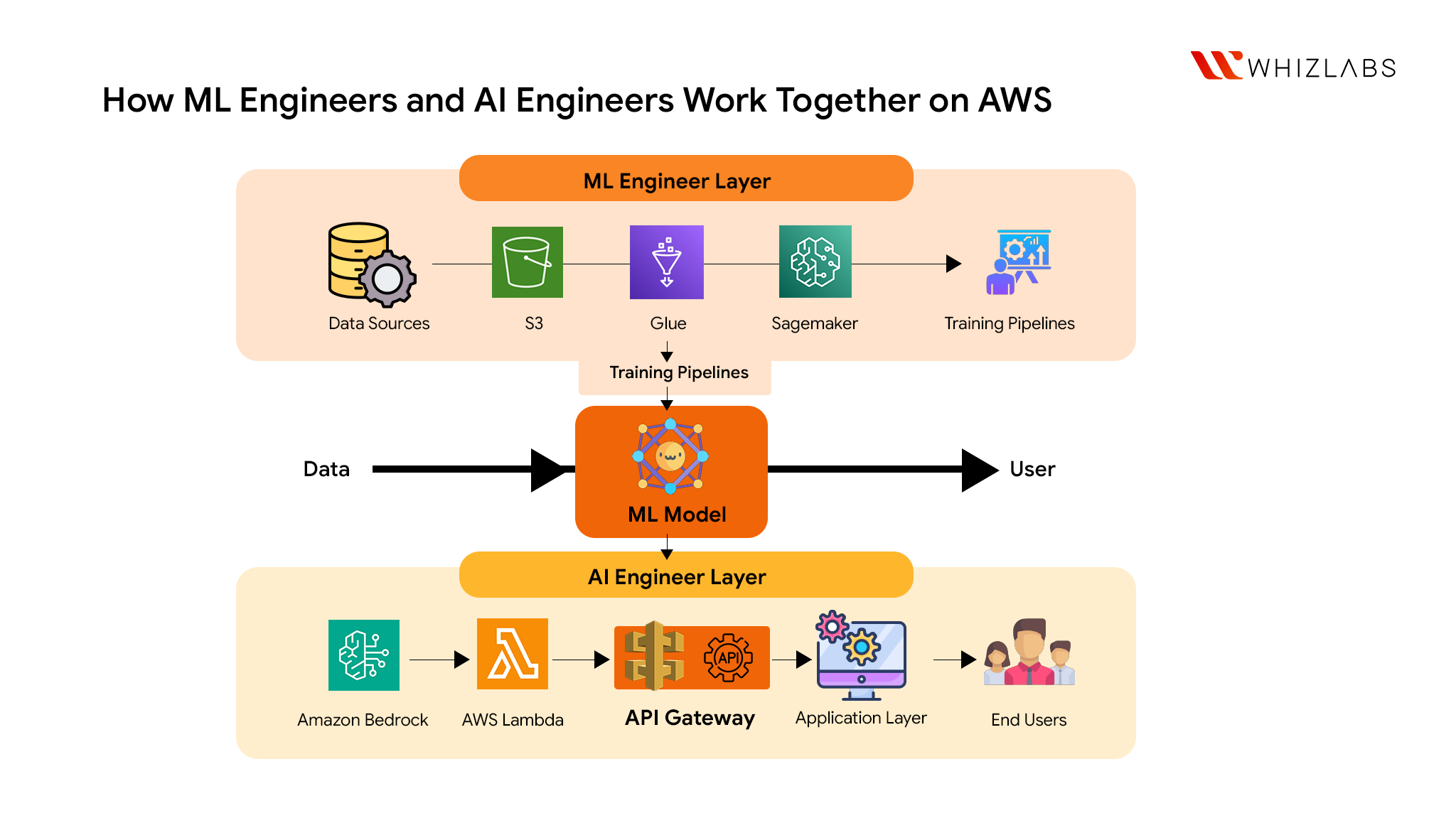
An ML engineer is a professional who trains the model, whereas an AI engineer builds the intelligent systems using that model.
It is important to break down the nuance of ML engineer vs AI engineer to head in the right direction. This is important for a professional exploring a career within the Amazon Web Services (AWS) ecosystem. Understanding the difference helps you choose the right path, hone your skills, and grow your career trajectory.
This article outlines the roles, use cases, and why one in particular might be a better fit for you. It also compares the certifications, required skills, and salary differences for both.
What Is the Difference Between an ML Engineer and an AI Engineer?
To understand how they differ, let’s start from the basics.
ML (Machine Learning) is a part of AI that makes your regular interactions easier without you even realising. For instance, Netflix recommends movies that you might like to watch, or YouTube recommends videos that you’d be interested in. That’s machine learning. It focuses on systems that learn from data.
AI (Artificial Intelligence) is a broad ecosystem that focuses on creating machines that mimic human behaviour, like recognising images and sending responses. For example, ChatGPT understands your questions, searches for relevant information, and answers queries.
An ML engineer builds and optimises models.
An AI engineer designs and deploys intelligent systems that may or may not include ML models.
Below is a list of differences to help you understand:
| Aspect | ML Engineer | AI Engineer |
| Primary Role | Improves model accuracy | Builds end-to-end intelligent solutions |
| AWS Services Used | Amazon SageMaker, AWS data storage and processing services | Amazon Bedrock, Amazon EC2, Amazon S3, AWS Lambda |
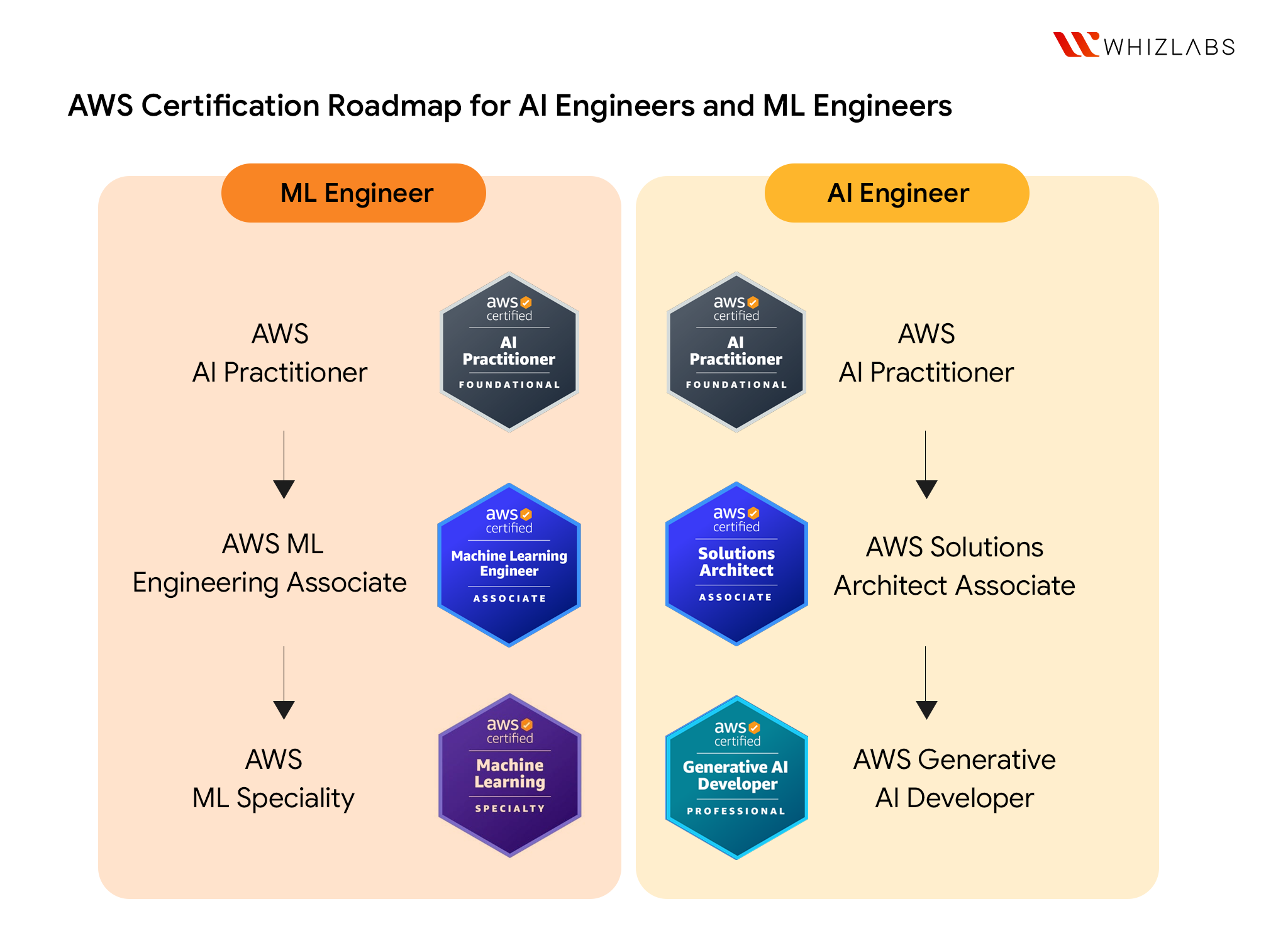
| Certification Path | AWS Certified Machine Learning Engineer – Associate | AWS Certified AI Practitioner |
| Skills Required | Understanding of ML algorithms, software engineering best practices, monitoring cloud and on-premises ML resources | Understanding of AWS Identity and Access Management, building AI pipelines and infrastructure, and conducting analysis |
| Career Direction | AWS Certified Machine Learning – Speciality | AWS Certified Solutions Architect – Associate |
| Use Cases | Data preprocessing, ML pipelines, time series analysis, and model deployment | Designing AI system, testing and validation, and continuous monitoring |
To better understand how you can contribute to the company as an AI engineer or ML engineer, it is important to know how AWS AI vs. ML roles differ.
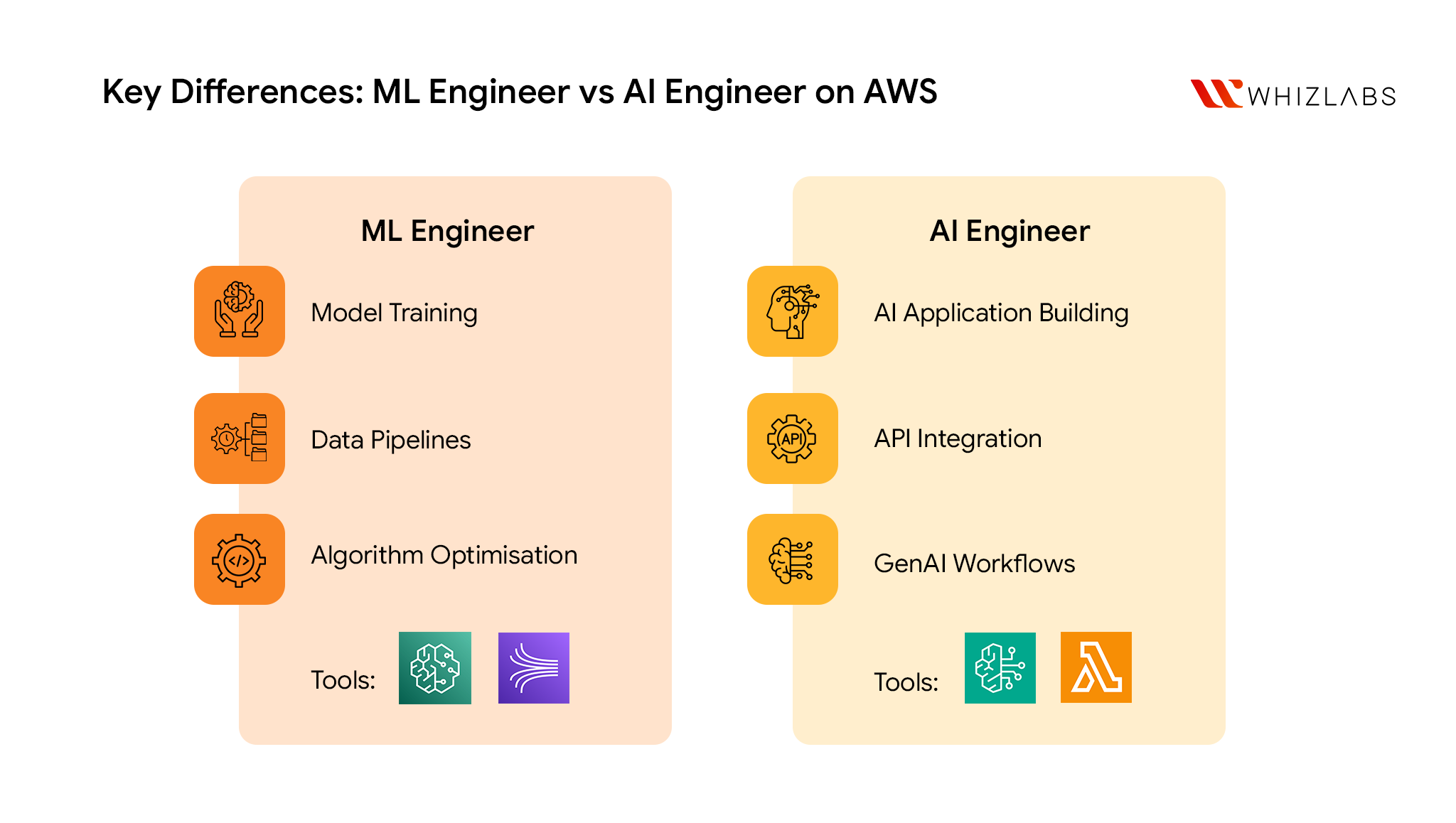
AWS AI vs ML Roles in 2026
Although both are crucial in the model designing and deployment process, the roles significantly differ when comparing an ML engineer vs. AI engineer:
1. Responsibilities
If you’re wondering what your commitments are as an AI engineer or ML engineer? Below are your scope of roles and responsibilities:
AI Engineer
As an AI engineer, your focus is on deploying models faster by using pre-existing tools. You may use Amazon Bedrock and don’t need to train the models yourself.
On AWS, you must know how to use Amazon Bedrock and related AI services to build intelligent solutions.
It reduces the workload on ML engineers substantially, as you are using pre-trained foundation models, so nothing has to be done from scratch.
Other responsibilities include:
- Focus on integration, API usage, and GenAI workflows.
- Understand project goals and stakeholder expectations.
- Customise and fine-tune models to match the company’s requirements.
- Integrate AI models into applications.
- Ensure that the systems work accurately.
- Work cohesively with teams to align AI solutions with company goals.
ML Engineer
As an ML engineer, your job is to build and maintain ML systems. You are also responsible for everything from start to finish. At first, you’ll need to find the right data, clean it up to make it usable, and then test and train models to make them more accurate.
On AWS, you must know how to use Amazon core services like SageMaker to build, train, and deploy scalable models.
You are expected to know how to transform raw information into actionable insights. The main responsibilities include:
- Structure and clean data for easy understanding.
- Assess model performance to align it with business goals.
- Integrate new models into existing applications.
- Automate workflow so existing models can be retrained with new datasets.
- Track performance to timely identify and resolve issues.
2. Tools
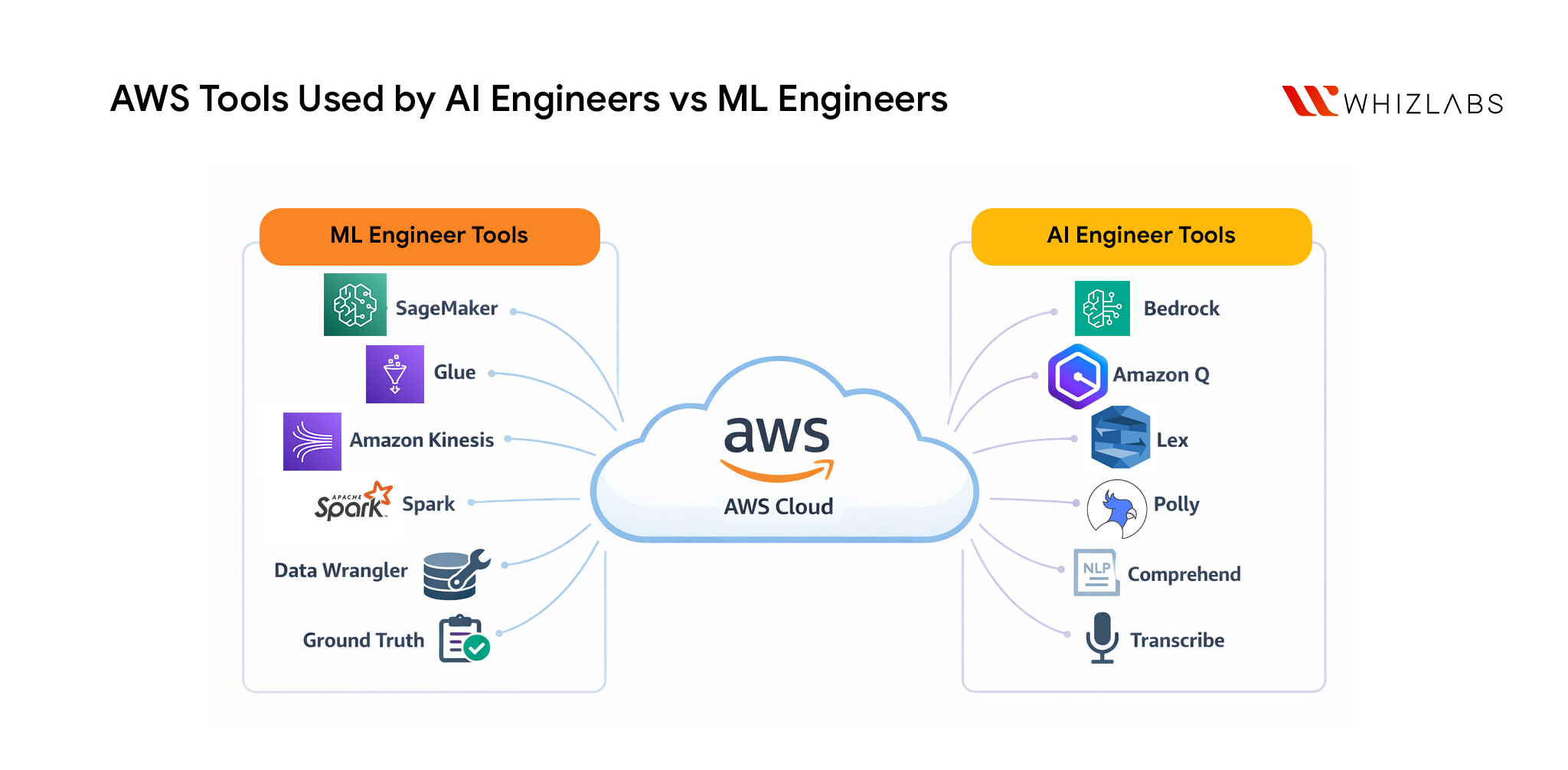
Below is a list of tools that you should be familiar with:
AI Engineer
As an AI engineering expert, you must have an understanding of the following tools:
- Programming languages like Python, C++, and Java to build scalable solutions.
- AI services like Amazon SageMaker, Transcribe, Translate, Comprehend, Lex, and Polly.
- AWS features like SageMaker JumpStart, Bedrock PartyRock, Amazon Q, and Bedrock Data Automation.
- Retrieval Augmented Generation and its business applications.
- AWS services that help in storing embeddings, such as OpenSearch Service, Amazon Aurora, Amazon Neptune, and Amazon RDS for PostgreSQL.
ML Engineer
As an AWS MLA-C01 certification holder, you are expected to have a complete understanding of the following tools:
- Data formats like Apache Parquet, JSON, CSV, Apache ORC, Apache Avro, and RecordIO.
- Core services like Amazon S3, Amazon Elastic File System [Amazon EFS], and Amazon FSx for NetApp ONTAP.
- AWS streaming data sources like Amazon Kinesis, Apache Flink, and Apache Kafka.
- Tools like SageMaker Data Wrangler, AWS Glue, and AWS Glue DataBrew explore and transform data.
- AWS Lambda and Spark to transform streaming data.
- Solve business problems by using AWS AI services like Amazon Translate, Amazon Transcribe, Amazon Rekognition, and Amazon Bedrock.
- Validate and label data via SageMaker Ground Truth and Amazon Mechanical Turk.
3. Cloud Services
The difference between an AI engineer vs. ML engineer becomes clearer if you know how to leverage cloud services in each role:
AI Engineer
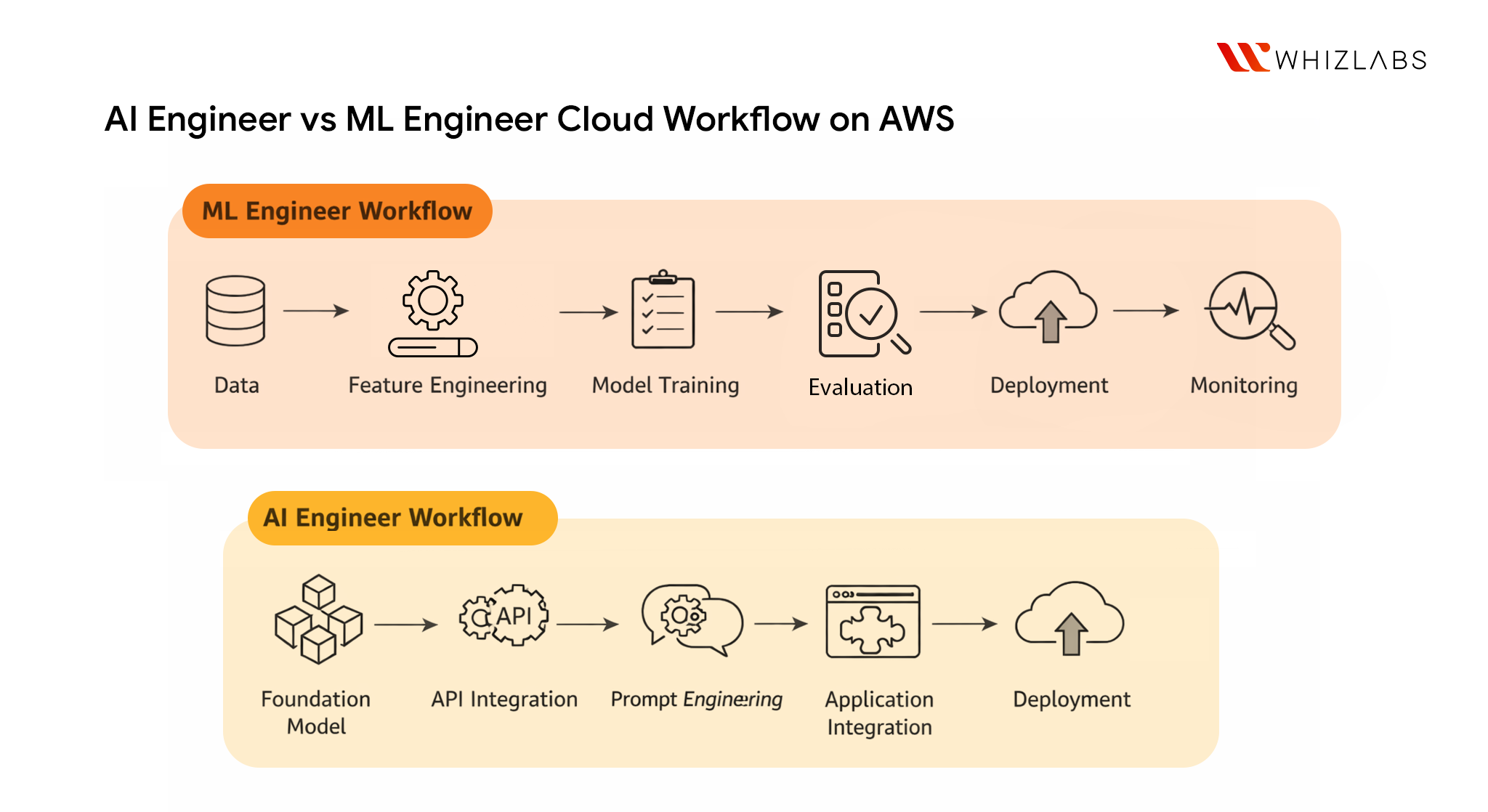
As an AI engineer, you don’t build models from scratch. Rather, the focus is on choosing, customising, and improving existing models. Your cloud use involves:
- Focus on service integration and APIs
- Minimal requirement for infrastructure management
- Quick deployment using managed and serverless AI services
- Focus on application-layer AI
ML Engineer
As a Machine Learning engineer, you will work more closely with cloud-based services to build, train, and fine-tune models at large. Here is how you would use cloud services regularly:
- Build preprocessing pipelines and data ingestion
- Manage and compute training infrastructure
- Monitor and upgrade model versions
- Optimise CPU/GPU usage for training purposes
4. Business Use Cases
To understand whether an AI engineer profession is better suited for you than an ML engineer, or vice versa, below are the practical examples that highlight how you can be of use to a company:
AI Engineer
Future-driven companies prefer AI engineers to streamline their workflow and speed up GenAI integration. Your AWS AI certification will come in handy for the following purposes:
- Creating chatbots to automate customer service. This is especially important for e-commerce platforms.
- Use sensor data to build autonomous vehicles so they can navigate themselves.
- Scan real-time transactions to identify fraud and unauthorised transactions.
- Create AI-powered tools for quicker diagnosis and patient care.
ML Engineer
ML Engineers are in huge demand and already rank among the top 10 jobs globally. Here is how you can leverage your expertise and skills in an organisation:
- Design recommendation systems, i.e., suggesting products or services for consumer convenience.
- Design data-driven solutions that can quickly detect financial fraud.
- Predict churn rate so service executives can retain customers.
AWS ML Engineer Certification vs AWS AI Certification
The AWS MLA-C01 and AIF-C01 certifications validate your knowledge and skills in building, deploying, and integrating intelligent solutions into an existing business environment. Below is a quick overview of how the two differ from each other and what skills are required to acquire your desired certification.
AWS MLA-C01
Earning the AWS ML Associate Engineer certification is the first step to being eligible for your dream job as a Machine Learning engineer. It validates your technical ability to build, operationalise, and deploy ML solutions using AWS cloud services.
Skill Depth
The exam validates your ability to:
- Absorb, validate, and prepare data for machine learning modelling.
- Choose general modelling solutions, train models, and continuously analyse performance.
- Select deployment architecture and endpoints, and configure auto-scaling as per the requirements.
- Monitor data, model, and infrastructure to identify any issues.
- Implement the best practices, access controls, and compliance to secure the ML resources and systems.
Difficulty Level
The AWS ML Engineer certification is an associate-level certification, but expects at least 1 year of experience in ML engineering or a related field. It also requires at least 1 year of hands-on experience working with AWS services.
AI Practitioner
AIF-C01 is the best AWS certification for AI engineers, validating your foundational knowledge of AI concepts and AWS tools. It focuses on whether you can practically apply AI for business applications.
Skill Depth
The certification exam also validates your ability to:
- Demonstrate conceptual understanding of AI, ML, and GenAI, along with methods and strategies to use them on AWS.
- Identify the right way of implementing AI, ML, and GenAI concepts to solve business challenges.
- Understand how to apply AI, ML, and GenAI technologies to suitable business use cases.
- Use the AI, ML, and GenAI technologies responsibly.
Difficulty Level
The ideal candidate should have up to 6 months of experience working with AI and ML on AWS. This is a foundational certification, so you don’t necessarily need to know how to build AI and ML solutions on the Amazon Web Services.
Start your journey from Developer to Engineer to boost your AWS career path in 2026.
What Skills are Required for AWS ML Engineer and AI Engineer Certification?
The AWS ML and AWS AI certification comparison is essential for assessing the right skills before you attempt the exams.
Skills required for an AWS ML engineer
The ideal candidate for the certification should have the following knowledge:
- SageMaker capabilities to build and deploy models
- AWS data storage and processing to prepare model data
- Deploying applications on AWS
- Monitoring tools to log in and troubleshoot ML systems
- Automate CI/CD pipelines
- AWS security best practices to identify and access management, data protection, and encryption
Skills required for an AI engineer
Possessing the following skills are essential to acquire the AWS AI engineer certification:
- Core AWS services and their use cases
- AWS shared responsibility for security and compliance
- AWS Identity and Access Management to secure access to AWS resources
- AWS service pricing models for 100% transparency
AI Engineer Salary vs AWS Machine Learning Salary 2026
The AI engineer salary at AWS and the ML engineer salary not only depend on the experience but also on the geographical location. Below is a quick comparison:
| Region | AI Engineer Salary | ML Engineer Salary |
| USA | $140,000 – $220,000 | $150,000 – $240,000 |
| Canada | CAD 110,000 – 180,000 | CAD 120,000 – 200,000 |
| Australia | AUD 130,000 – 210,000 | AUD 100,000 – 200,000 |
| United Kingdom | £43,000 – £77,000 | £35,000 – £80,000 |
| India | ₹6 – ₹10 LPA | ₹10 – ₹18 LPA |
AWS AI Career Path Roadmap
Both AI engineer and ML engineer job roles are in demand. While the ML engineering jobs are expected to reach $503.40 billion by 2030, the AI engineering market is also growing at a good pace. The numbers directly imply that harnessing your skills can instantly boost your career profile and credibility, making you a suitable candidate in a huge pool.
If you specialise in AI engineering skills, you can choose the following paths:
- Computer vision engineer
- NLP engineer
- Robotics engineer
- AI research scientist
- AI product manager
- AI consultant
If you are an ML enthusiast, here are the career options for you:
- Data scientist
- Data engineer
- Business intelligence developer
- NLP engineer
- Computer vision engineer
AI Engineer vs ML Engineer: Which is Better for You?
The first step towards achieving your dreams is choosing the right field for you between ML engineer vs AI engineer.
Choose the AI Engineer if:
You enjoy a fast-paced learning environment and have experience in software engineering. The field is ideal for you if you love building new applications from predefined foundation models.
Choose the ML Engineer if:
You enjoy data pipelines and building models from scratch. It will be beneficial if you have experience in data science and want to optimise AI model performance as a career.
Regardless of your choice, the first step to building a career is preparing for the examination. Enrol in a trusted digital course and fill the gaps in your knowledge and skills. You can use learning resources like online videos, practice tests, and guided labs to improve yourself and prepare to pass the examination on the first attempt.
Whizlabs offers a hands-on learning experience and the confidence required to clear the AWS certification on the first attempt. With expert-led courses, guided labs and sandbox environments, strengthen your expertise and move a step closer to becoming a certified professional. Enrol and grow your career trajectory with us.
FAQs
1. Is AWS MLA-C01 difficult?
The AWS MLA-C01 certification is considered moderately to highly challenging, as it is an associate certification. It requires a prior understanding of how the AWS cloud platform works.
2. Which role pays more?
The salary of a Machine Learning Engineer role is higher compared to that of an AI Engineer.
3. Is AWS AI certification worth it?
Yes, the AWS AI certification builds your foundational knowledge of how to use GenAI and AWS core services.
4. What are the career prospects after AWS ML engineering?
You can apply for the position of a data scientist, data engineer, business intelligence developer, or an NLP engineer after acquiring the AWS ML engineering certification.
5. How does one prepare for the AWS AI certification exam?
You can practise for the AWS AI certification exam through a reputable online course, guided labs, practice tests with exam-like questions, and AWS SimuLearn.
6. Which AWS certification is the most valuable?
The AWS Certified Solutions Architect – Associate is the most valuable certification, as it validates your ability to design scalable and secure AI systems using the best AWS practices. The AWS AI certification is the first step to reaching this associate level.

- Databricks vs AWS vs Azure: Best AI Career Platform 2026 - March 19, 2026
- How MLA-C01 Practice Tests Help You Master AWS SageMaker & MLOps? - March 17, 2026
- ML Engineer vs AI Engineer: Salary & Career Path - March 9, 2026
- Is AWS Certified Security – Specialty Worth It in 2026? - March 4, 2026
- AWS Generative AI Developer Certification 2026 Guide - February 12, 2026
- AWS CLF-C02 Cloud Practitioner Study Plan: 2 vs 4 vs 6 Weeks - January 30, 2026
- HashiCorp Terraform Associate 004 Preparation Guide 2026 - January 7, 2026
- Developer to AI Engineer: AWS AI Career Path for 2026 - December 19, 2025