Is AWS Certified Security – Specialty Worth It in 2026?
Cloud security in 2026 is a buzzing topic focused on building robust, large-scale cloud environments.
Today’s enterprises manage sprawling multi-account AWS infrastructures where identity management, encryption protocols, audit logging, and compliance frameworks must operate in perfect harmony.
The AWS Certified Security Specialty exam helps you build the same. It does not test whether you can name services. It tests whether you understand how security behaves inside AWS under real production constraints. Passing the AWS SCS-C03 exam requires architectural thinking more than memorization.
This blog will teach you how to prepare using structured learning routes and practical experience, how this certification differs from associate tests, and who it is intended for. So let’s explore it more!
What Is AWS Certified Security – Specialty (SCS-C03)?
Security skills are now baseline expectations in enterprise cloud environments. The AWS SCS-C03 certification reflects how AWS security operates in real production environments.
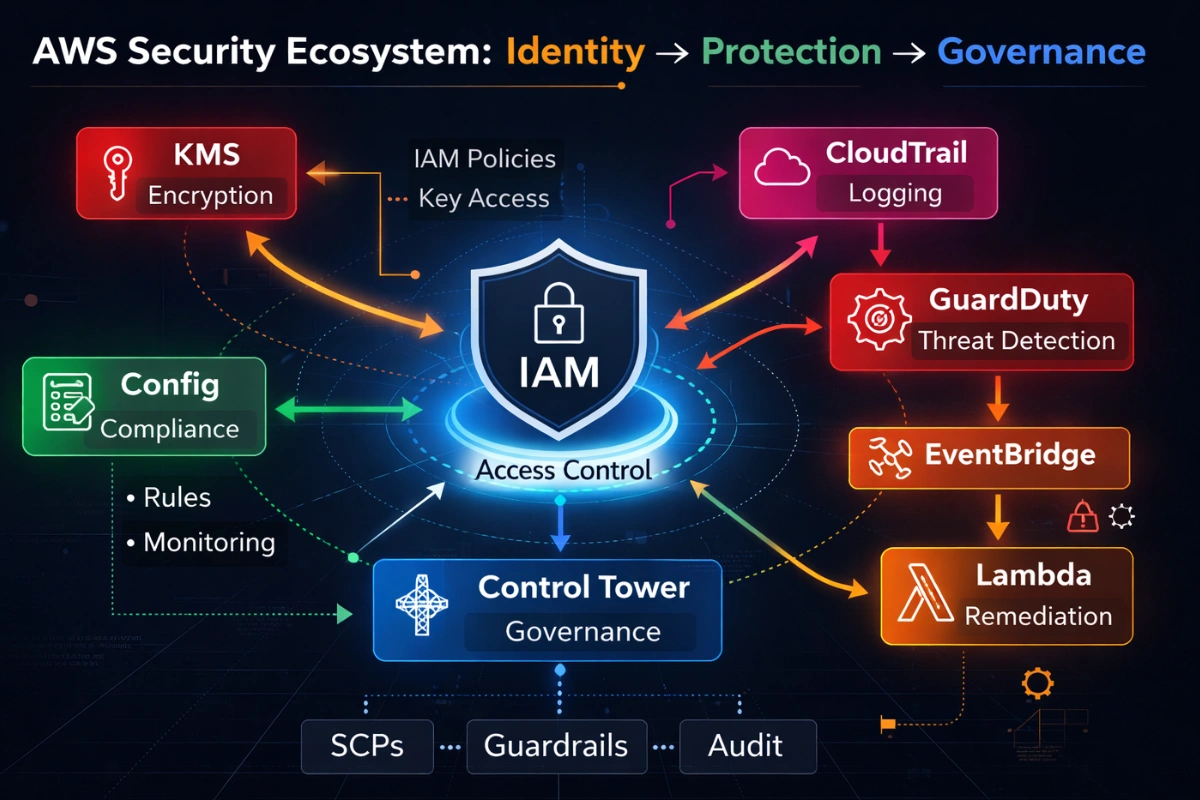
It focuses on identity, encryption, monitoring, infrastructure protection, and governance working together, not in isolation. This is an architectural thinking exam.
What Does AWS Certified Security – Specialty (SCS-C03) Validate?
The AWS Certified Security Specialty validates your ability to secure AWS workloads in real-world environments.
This certification is focused on understanding how AWS services interact from a security perspective. It measures how you are,
- Designing secure and scalable IAM policies
- Managing encryption strategies using AWS KMS
- Implementing centralized logging with CloudTrail and CloudWatch
- Configuring threat detection workflows using GuardDuty
- Enforcing compliance using AWS Config and Control Tower
It is intended for professionals with practical AWS experience and security exposure.
This certification validates that you can operate AWS security responsibly at scale, like:
- Identity and Access Management design and evaluation
- Threat detection and incident response architecture
- Centralized logging and monitoring workflows
- Encryption strategy and key management
- Infrastructure hardening and network isolation
- Multi-account governance and compliance enforcement
Why Is AWS Certified Security – Specialty in High Demand in 2026?
The AWS Certified Security Specialty isn’t just a knowledge test. It’s proof of operational excellence in real-world security implementation.
Contemporary cloud teams need professionals who can:
- Architect least-privilege IAM frameworks that balance security with usability
- Orchestrate encryption key lifecycles without operational disruption
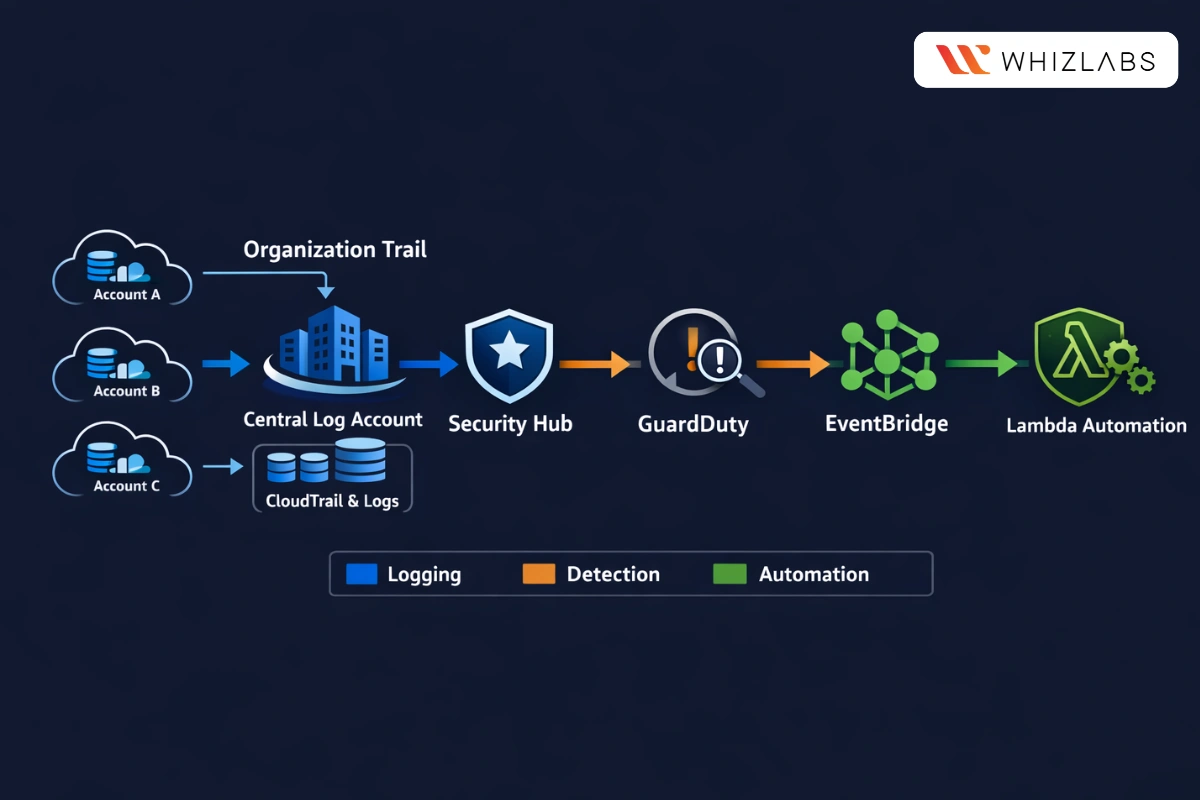
- Consolidate logging infrastructure across distributed account architectures
- Build automated incident detection and response mechanisms
This capability gap explains why security-specialized AWS professionals command premium positions across global job markets.
What exactly is the Market signalling here?
AWS Security Specialty certification is increasingly included as a desired or necessary credential for positions such as Cloud Security Engineer, DevSecOps Engineer, and Security Architect.
Instead of responding to breaches, organizations are investing in experts who can stop them. There is consistent hiring demand for specialists who understand IAM evaluation logic, KMS policies, logging pipelines, and governance at scale.
The AWS Security Specialty certification has shifted from a “nice to have” qualification to a strong credibility signal for security-focused candidates.
This matters to learners because AWS Security Specialty is one of the clearest ways to validate advanced AWS security capabilities. Production processes, multi-account governance, encryption enforcement, and automated threat detection are all directly aligned with the SCS-C03 version. If you want to work in cloud security for a long time, this certification is essential.
Key takeaway
For anyone pursuing cloud careers in 2026, security expertise isn’t an optional add-on. It’s a strategic imperative that distinguishes competitive candidates from exceptional ones.
Career Benefits After AWS Certified Security – Specialty
Earning the AWS Certified Security Specialty demonstrates mastery in several critical areas:
- Resolving complex IAM policy conflicts and permission boundaries
- Designing robust encryption architectures across AWS services
- Employing centralized log aggregation and analysis frameworks
- Developing automated systems for security response and remediation
This exam validates your ability to apply enterprise-grade security controls in AWS settings. It demonstrates your ability to manage security operations at scale and validates your proficiency in selecting appropriate architectures for production workloads.
AWS Security Specialty Salary in 2026
The AWS Certified Security Specialty continues to command a strong salary premium in 2026 due to rising demand for cloud security expertise.
- United States: $130,000 – $180,000 per year
- India: ₹12 – ₹35 LPA (architect-level roles can exceed ₹40L+)
- Australia: ~AUD 150,000 – AUD 200,000+
- United Kingdom: £36,000 – £67,000.
- Senior Security Architects (Global): $170,000+ equivalent packages
Security specialization, multi-account governance expertise, and encryption architecture skills significantly increase compensation leverage.
AWS SCS-C03 Exam Format, Cost & Passing Details (2026)
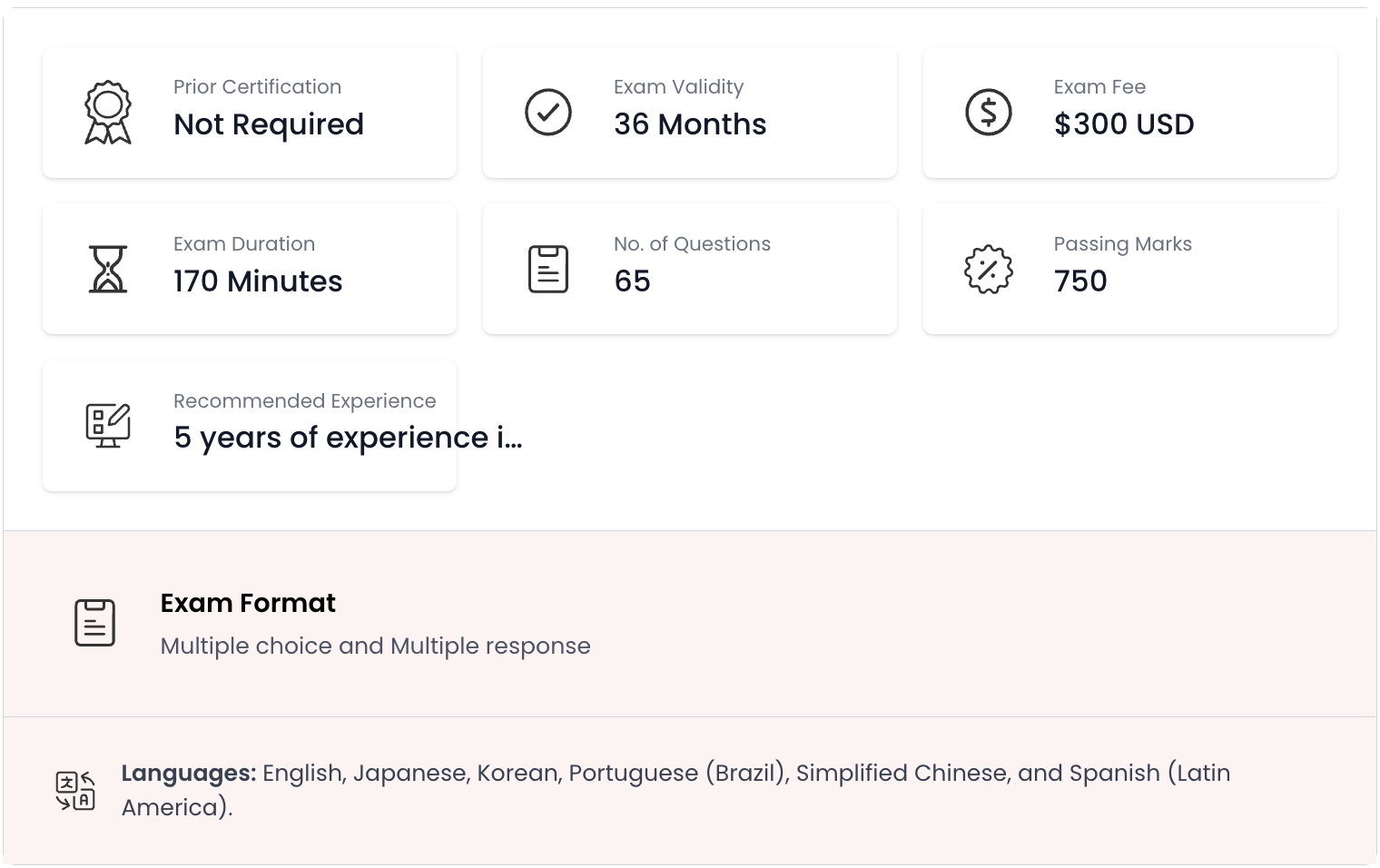
Key takeaway:
This exam is not theory-heavy. AWS SCS-C03 tests whether you understand how AWS security behaves in real environments. It validates how security controls are designed, enforced, monitored, and automated safely across accounts.
AWS SCS-C03 Exam Domains & Weightage Explained
The AWS SCS-C03 exam clusters around six core capabilities, with IAM and encryption carrying significant weight.
- Identity and Access Management: Being aware of permission boundaries, federation models, SCPs, policy evaluation logic, and cross-account roles.
- Identifying threats and responding to incidents: Utilizing EventBridge, Security Hub, GuardDuty, and automated remediation techniques to design processes.
- Logging and Monitoring: Centralized CloudTrail, log integrity validation, metric filters, and multi-account log aggregation.
- Data Protection: KMS key policies, envelope encryption, S3 encryption enforcement, and secret rotation practices.
- Infrastructure Security: VPC isolation, WAF, Shield, private connectivity models, and minimizing the attack surface.
- Governance and Compliance: AWS Config rules, Control Tower guardrails, and enterprise-scale compliance monitoring.
AWS SCS-C03 tests integrated security thinking. That is exactly how AWS security is implemented in production today.
Real-World Skills Required to Pass AWS Security Specialty
Passing SCS-C03 requires production-level thinking, not memorization.
Key real-world skills include:
- Designing least-privilege IAM frameworks
- Debugging complex permission conflicts
- Implementing KMS key policies with cross-account access
- Building centralized logging architectures
- Automating incident response using GuardDuty and EventBridge
- Enforcing compliance with AWS Config & Organizations
The exam mirrors enterprise security operations. If you can design, evaluate, and troubleshoot AWS security in real environments, you are prepared.
Who Should Take AWS Certified Security Specialty (SCS-C03)?
The AWS Certified Security Specialty targets professionals already operating within AWS ecosystems who seek to validate their security expertise through formal recognition.
Target audience includes:
- Cloud Engineers overseeing complex multi-account AWS infrastructures
- DevSecOps Engineers integrating security protocols directly into CI/CD workflows
- Security Analysts are responsible for threat detection and continuous monitoring
- Cloud Architects are building comprehensive encryption frameworks and compliance structures
Important note: This certification is not suitable for AWS beginners or those lacking practical cloud experience. It assesses advanced security implementation capabilities rather than foundational cloud knowledge.
AWS Security Specialty SCS-C03 vs Solutions Architect Professional SAP-C02
The AWS SCS-C03 and the Solutions Architect Professional (SAP-C02) certifications target different expertise tracks within AWS. While both are advanced-level certifications, one specializes in security architecture and governance, and the other focuses on large-scale system design and infrastructure strategy.
| Comparison Area | AWS SCS-C03 (Security Specialty) | Solutions Architect Professional (SAP-C02) |
| Primary Focus | Cloud security architecture | Enterprise-scale solution architecture |
| Core Domain | IAM, KMS, encryption, threat detection, governance | High availability, cost optimization, migrations, and complex integrations |
| Ideal For | Security Engineers, DevSecOps, Cloud Security Architects | Senior Solutions Architects, Infrastructure Architects |
| Skill Depth | Deep security specialization | Broad cross-service architectural mastery |
| Exam Orientation | Security integration across multi-account environments | Designing resilient, scalable, fault-tolerant systems |
| Governance Coverage | Strong focus on Organizations, SCPs, and compliance | Limited, mostly design-level considerations |
| Encryption & IAM | Heavy emphasis (high exam weight) | Moderate coverage |
| Career Path | Cloud Security Architect / DevSecOps Lead | Principal Architect / Enterprise Solutions Architect |
| Difficulty Type | Conceptually deep, policy-heavy | Architecturally complex, scenario-intensive |
| Best Choice If Your Goal Is | Specializing in cloud security | Designing large-scale AWS infrastructures |
In short, choose SCS-C03 if you want to specialize in security at scale, and choose SAP-C02 if your goal is broad enterprise architecture leadership.
Why Is AWS SCS-C03 Considered an Advanced-Level Certification?
AWS SCS-C03 certification is built around real production workflows.
- It emphasizes security integration across multiple services.
- It focuses on IAM evaluation logic rather than IAM definitions.
- It tests encryption design, not just encryption concepts.
- It mirrors enterprise governance practices instead of isolated account setups.
You can find the resources here for your easy preparation:
Best AWS SCS-C03 Study Resources (Free & Paid)
Free Resources
For foundational clarity, start with the official sources that align directly with the SCS-C03 objectives:
- Official AWS documentation aligned to SCS-C03 domains
- AWS Well-Architected Framework – Security Pillar
- AWS whitepapers on encryption, IAM, and governance
- Official AWS sample questions
These resources help you understand how AWS security services behave in theory. They are essential for building conceptual depth.
Paid Resources for Structured Learning
When you want better alignment with the exam pattern and structured progression, paid resources accelerate preparation.
- AWS SCS-C03 practice test sets mapped to exam objectives
- Hands-on labs simulating multi-account environments
- Structured AWS Security Specialty training programs
- Full-length exam simulations
Whizlabs practice tests excel at demonstrating how scenario-based questions are structured in the actual certification exam.
Also, Whizlabs hands-on labs allow you to master IAM evaluation logic, encryption enforcement mechanisms, and threat detection workflows within a safe, controlled setting before encountering production-level scenarios.
Structured learners benefit significantly from pairing official AWS documentation with these resources. This combination bridges the gap between theoretical knowledge and practical decision-making skills.
How to Prepare for AWS SCS-C03 Exam in 2026 (Step-by-Step Guide)
Your preparation needs to go beyond theory.
Understand how AWS actually evaluates policies when access is allowed or denied. Learn how key policies and IAM policies work together. Understand how findings connect to automated response workflows.
In short, focus on how services work together, not how they work alone.
To make this easier and structured, here is a practical 8-week study plan that combines official AWS resources with Whizlabs hands-on labs and practice tests, helping you build real exam confidence step by step.
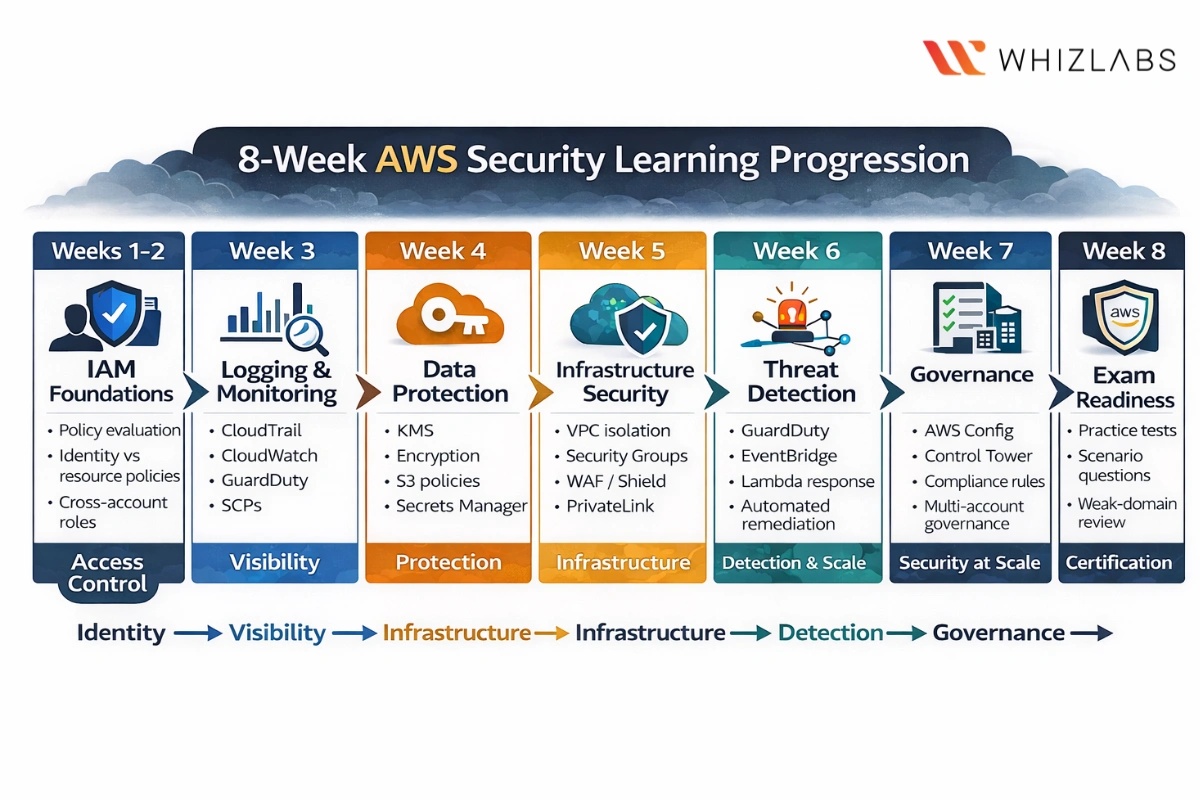
8-Week AWS Certified Security Specialty Study Plan
Structure matters more than intensity when preparing for the AWS Certified Security Specialty exam. Here is an 8-week roadmap to help you confidently clear the AWS SCS-C03 exam. It is aligned with real exam weightage and how AWS security operates in production environments.
Week 1 to 2: Identity & Access Management Foundation
Your goal in the first two weeks is to build clarity on how AWS evaluates identity and permissions. IAM is the highest-weight domain in the exam and the foundation of AWS security.
This week, you have to concentrate on the following concepts:
- IAM policy evaluation logic: explicit deny vs implicit deny
- Identity-based vs resource-based policies
- Permission boundaries and session policies
- Cross-account role assumption and trust relationships
- AWS Organizations and SCP interaction
Focus on understanding why access is allowed or denied, not just configuring policies.
Week 3: Logging & Monitoring Architecture
In the third week, shift your focus to visibility and detection workflows.
You need to understand how security events are captured, aggregated, and analyzed across accounts. This week, the goal is to understand how detection flows from event → alert → response.
You can focus on the following topics and ace them:
- CloudTrail management events vs data events
- Organization trails and centralized logging
- CloudWatch metric filters and alarms
- GuardDuty findings and severity interpretation
- Security Hub aggregation and integration
Week 4: Data Protection & Encryption
In this phase, focus on designing encryption and implementing a data protection strategy.
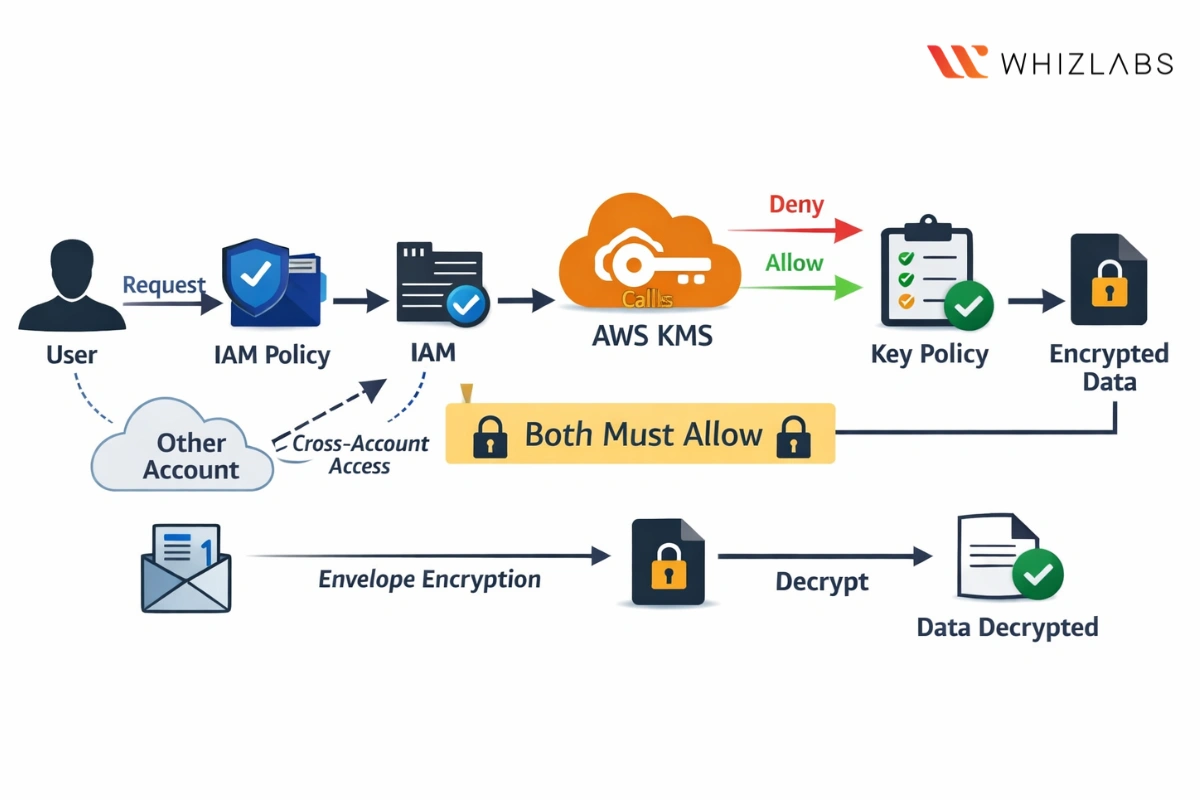
Encryption is heavily tested in AWS SCS-C03. You have to master AWS KMS key policies vs IAM policies, Customer-managed vs AWS-managed keys, Envelope encryption workflows, S3 encryption enforcement using bucket policies, and Secrets Manager vs Parameter Store. Understand how encryption interacts with identity and cross-account usage.
Week 5: Infrastructure Security
Now move into network and infrastructure protection.
The exam tests how you reduce the attack surface in real architectures.
Focus on:
- VPC security design and isolation
- Security Groups vs NACL behavior
- Private subnet architecture
- AWS WAF and Shield usage
- VPC endpoints and PrivateLink
Think in terms of minimizing exposure, not reacting to threats.
Week 6: Threat Detection & Incident Response
In this phase, concentrate on response maturity and automation.
The exam expects you to understand how AWS security services integrate.
Master:
- GuardDuty remediation strategies
- EventBridge automation rules
- Lambda-based remediation workflows
- Security Hub automated response
- Credential compromise mitigation
The focus should be on scalable and automated solutions.
Week 7: Governance & Compliance
This week is about enterprise-level security posture management. You need to understand how AWS enforces compliance across multiple accounts. Study the topics below and revise them with the practice tests. You have to start thinking organization-wide, not single account.
- AWS Config rules and remediation
- Control Tower guardrails
- Centralized logging architecture
- Multi-account governance models
- Audit monitoring strategies
Week 8: Practice Tests & Exam Readiness
In the final week, shift to exam simulation mode. Start completely focusing on:
- Full-length AWS SCS-C03 practice tests under timed conditions
- Weak-domain analysis
- Revisiting IAM and KMS scenarios
- Multi-service integration questions
- Refining scenario-based decision making
Practice interpreting complex scenarios where IAM, encryption, logging, and governance intersect.
With a structured 8-week plan, combining theory with Whizlabs hands-on labs and Whizlabs practice tests, you gain mastery in the flow:
Identity → Visibility → Protection → Automation → Governance
Tips to Pass AWS SCS-C03 Exam on First Attempt
When you combine theoretical learning with Whizlabs hands-on labs and real-world scenario practice, your preparation shifts from memorization to architectural clarity – which is exactly what the AWS SCS-C03 exam measures.
To maximize your chances of passing on the first attempt:
- Read each scenario carefully before reviewing the answer choices
- Stay calm and methodical throughout the exam
- Focus heavily on IAM configurations, encryption implementations, logging architectures, and multi-account considerations
Reading documentation alone is never enough. Always pair theory with execution. Hands-on labs significantly improve exam confidence and reduce the risk of retakes.
AWS SCS-C03 preparation works best when you study service behavior and integration rather than isolated definitions.
Common Mistakes to Avoid in AWS SCS-C03 Exam
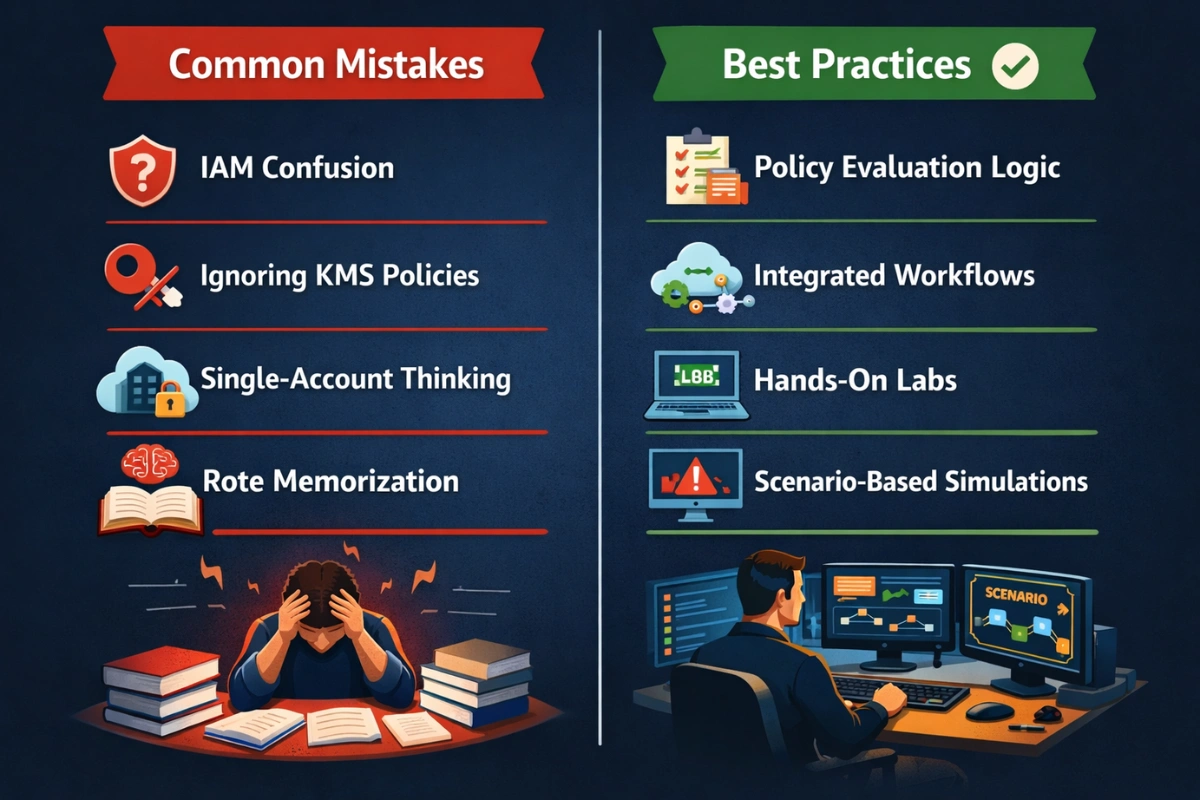
The AWS Certified Security Specialty exam teaches operational security thinking, not rote memorization.
The main reason candidates fail the AWS SCS-C03 exam is not that the exam is new or unusually difficult. It is often because their preparation mindset is misaligned with what the certification actually measures.
Ignoring IAM Policy Evaluation Depth
IAM is not about writing policies. It is about understanding how AWS evaluates a request.
You must clearly understand how identity-based policies, resource-based policies, SCPs, and permission boundaries interact. Without this clarity, access denial scenarios become guesswork instead of structured reasoning.
Underestimating KMS Key Policy Complexity
Many candidates assume IAM alone controls encryption access.
In reality, AWS KMS key policies and IAM policies work together. If you do not understand how key policies grant or restrict access across accounts, encryption-related questions become confusing and easy to misjudge.
Skipping Multi-Account Governance Scenarios
Enterprise AWS environments are multi-account by design.
Ignoring AWS Organizations, centralized logging strategies, and Control Tower governance creates blind spots in architectural thinking. The exam frequently tests security posture at the organization level, not just a single account.
Memorizing Service Definitions Instead of Understanding Integration
Knowing what GuardDuty or CloudTrail does is not enough.
You must understand how detection integrates with response automation, compliance monitoring, and cross-account aggregation. The exam tests integrated workflows, not isolated services.
Avoiding Hands-On Reasoning
Reading documentation without configuring IAM policies, enabling GuardDuty, or enforcing encryption leads to shallow preparation.
The exam expects practical reasoning under production constraints. Without hands-on exposure, scenario-based judgment becomes weak.
AWS SCS-C03 FAQs
1. How long is the AWS SCS-C03 certification valid?
The certification remains valid for 3 years. After that, you must recertify to maintain an active status.
2. Can I take AWS SCS-C03 without other AWS certifications?
Yes. There are no mandatory prerequisites. However, strong practical experience with AWS services, especially IAM and KMS, is highly recommended before attempting the exam.
3. Does AWS SCS-C03 require coding skills?
No, coding is not required. However, understanding policy structures, JSON-based IAM documents, and automation workflows improves your ability to interpret scenario-based questions.
4. What is the best way to pass AWS SCS-C03 on the first attempt?
The most effective strategy is coupling hands-on IAM and KMS practice with full-length scenario-based mock exams. Focus on policy evaluation logic, cross-account access, centralized logging, and automated threat detection workflows.
5. How many times can I retake the AWS SCS-C03 exam?
There is no strict limit on attempts, but AWS enforces a 14-day waiting period between failed attempts. Each retake requires paying the full exam fee.
Final Takeaway
Is AWS Certified Security Specialty Worth It in 2026? Yes, it is. Particularly for professionals targeting cloud security specialization and architect-level positions.
This certification strengthens your professional credibility, elevates your resume among competitors, and demonstrates operational expertise to potential employers.
Cloud security demand shows no signs of slowing in 2026. Specialization has become the key differentiator in a crowded talent market. The AWS Certified Security Specialty positions you exactly where this demand exists.
Ace Your AWS Certified Security Specialty the Right Way
AWS SCS-C03 reflects how cloud security operates in real production environments.
Security today is not just about configuration. It is identity discipline, encryption strategy, governance enforcement, and automated response working together.
With Whizlabs Practice test, Hands-on labs, and Sandboxes, you will for sure stop feeling overwhelmed by it. Now is the time to accelerate your career, which truly signals your understanding and ability to operate AWS safely, securely, and scalably.
Prepare the right way with Whizlabs and achieve your realistic AWS SCS-C03 cloud milestone confidently.

- Databricks vs AWS vs Azure: Best AI Career Platform 2026 - March 19, 2026
- How MLA-C01 Practice Tests Help You Master AWS SageMaker & MLOps? - March 17, 2026
- ML Engineer vs AI Engineer: Salary & Career Path - March 9, 2026
- Is AWS Certified Security – Specialty Worth It in 2026? - March 4, 2026
- AWS Generative AI Developer Certification 2026 Guide - February 12, 2026
- AWS CLF-C02 Cloud Practitioner Study Plan: 2 vs 4 vs 6 Weeks - January 30, 2026
- HashiCorp Terraform Associate 004 Preparation Guide 2026 - January 7, 2026
- Developer to AI Engineer: AWS AI Career Path for 2026 - December 19, 2025