

Databricks vs AWS vs Azure – Best Platform for Generative AI Careers in 2026
Databricks, AWS, and Azure power three distinct generative AI career tracks. Databricks guides Data and ML engineers building custom models; AWS suits ML engineers deploying production pipelines; while Azure is the go-to for enterprise AI architects in Microsoft-integrated environments. Your best starting point depends entirely on your target role.
Generative AI has moved from experimentation to real-world deployment, which is faster than almost any other technological shift in recent years.
In this guide, we’ll break down Databricks vs AWS vs Azure from a career perspective, helping you understand:
- How does each platform support generative AI development?
- What roles are most aligned with each ecosystem?
- The AI skills and certifications that’ll help you get started
By the end, you’ll have a clear understanding of which platform aligns best with your generative AI career path and how to start building those skills.
– Choose Databricks → If you want to work on data pipelines and custom AI models
– Choose AWS → If you want to build and deploy ML models at scale
– Choose Azure → If you want enterprise AI roles with Microsoft ecosystem
The best platform depends on your AI career path.
Why Generative AI Careers Are Growing Fast in 2026 (Salary & Demand Insights)?
The surge in generative AI careers isn’t just a speculation; it’s already reshaping the global job market. Eventually, organisations are rapidly adopting AI technologies to automate processes, analyse large datasets, and build intelligent digital products.
- AI-related job postings continue to grow even as overall tech hiring fluctuates.
- Indeed, AI Tracker hit an all-time high of 4.2% in December 2025, with nearly 45% of all data and analytics postings now containing AI-related terms.
- AI and data analytics roles are growing at 30% year-on-year, driven by the adoption of Large Language Models (LLMs) and automation.
- Productivity growth has nearly quadrupled in industries most exposed to AI since 2022.
- 78% of all information and communications technology roles now include AI technical skills. (link)
- Workers with advanced AI skills now earn 56% more than peers in the same roles without them, according to PwC’s analysis.
- According to the World Economic Forum’s Future of Jobs Report 2025, AI and automation are expected to create 78 million new jobs globally by 2030.
- Recent insights from Microsoft’s Skills Hub (2026) confirm that the AI job boom is already underway.
- Demand for professionals with AI and cloud computing skills is rising across industries as enterprises move from experimenting with AI to deploying production-ready AI systems.
As this shift accelerates, the demand for professionals who understand both AI and cloud platforms is rising sharply. As a result, three roles are becoming central to the modern AI workforce:
- AI Engineers – professionals who build and deploy generative AI applications
- Machine Learning Engineers – specialists who train, optimise, and scale ML models
- Data Engineers – experts who design the data pipelines that power AI systems
Modern AI systems rely heavily on cloud infrastructure to process massive datasets, train models, and deliver AI-powered applications at scale. In other words, becoming an AI engineer today is no longer just about understanding machine learning algorithms.
Professionals must also understand data pipelines, model deployment, and cloud platforms such as AWS, Azure, or Databricks. That’s why choosing the right platforms is the most important decision to make in a generative AI career.
For the aspiring AI engineers, data professionals, and cloud practitioners, the one question that keeps coming up is: “Which platform should you learn to build a career in generative AI?”
Top 3 Cloud Platforms for Generative AI Careers (Databricks vs AWS vs Azure)
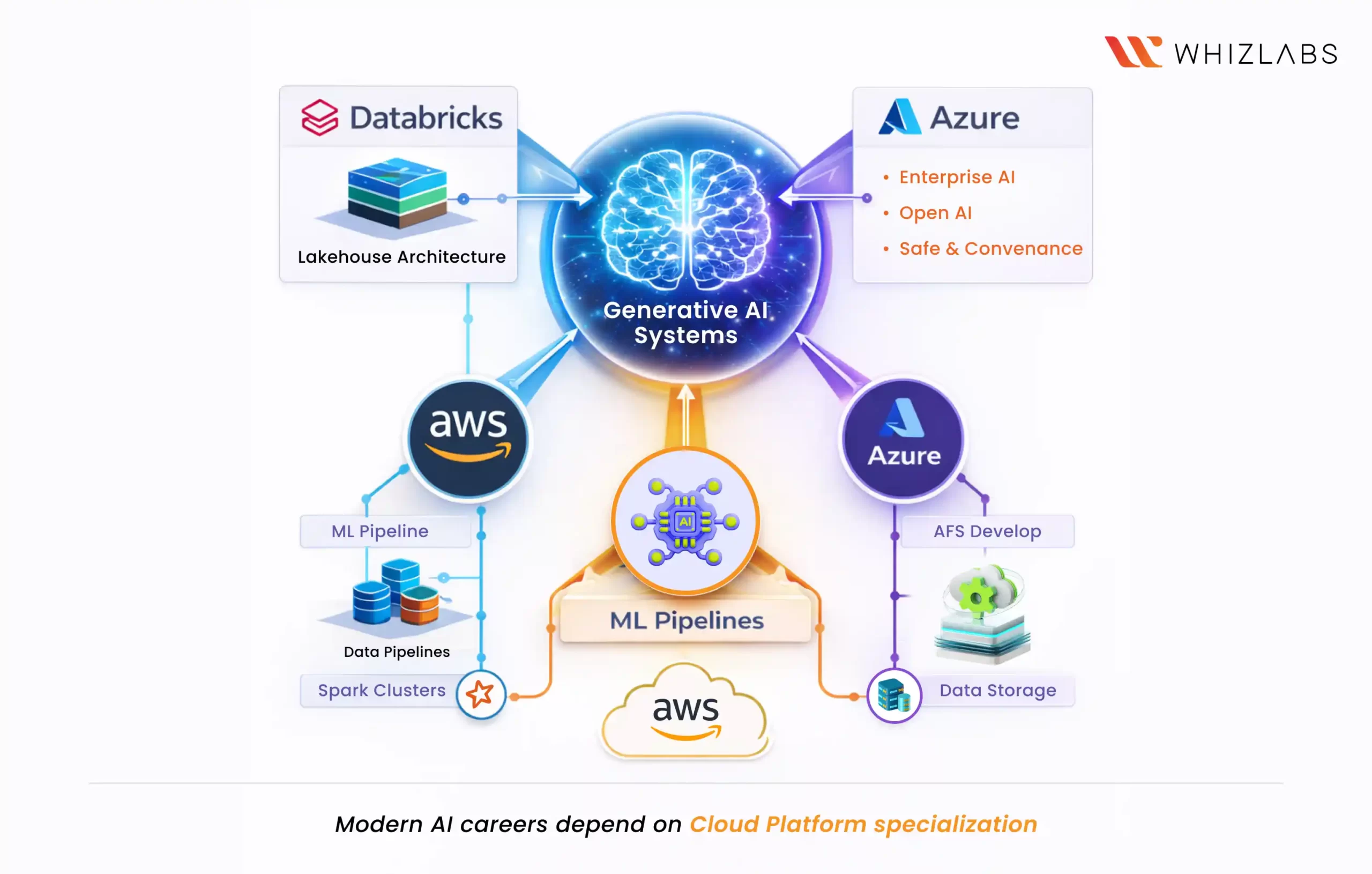
Today, three ecosystems that are dominating in the modern AI landscape are: Databricks, Amazon Web Services (AWS), and Microsoft Azure. Each of them plays a different role in how AI systems are built and deployed.
- Databricks focuses on large-scale data engineering and machine learning pipelines through its Lakehouse architecture. The platform for engineers who want to work at the intersection of data pipelines and AI model building, custom models, large-scale training, and Lakehouse architecture.
- AWS is the platform for ML engineers who want to build and ship production AI systems fast, with SageMaker, Bedrock, and the deepest cloud infrastructure on the market. They are the most mature machine learning ecosystems.
- Azure is the platform for enterprise AI professionals that combines enterprise cloud infrastructure with AI services such as Azure OpenAI and Azure AI Studio. The path into Fortune 500 AI roles, Microsoft ecosystem integrations, and the fastest-growing certification track of 2026.
| Platform | Best Career Focus |
| Databricks | Data engineers, AI platform engineers |
| AWS | ML engineers, AI application developers |
| Azure | Enterprise AI engineers, cloud architects |
The truth is, there isn’t a single “best” platform. Instead, the right choice depends on the kind of AI career you want to build – whether that means designing data pipelines for AI models, deploying machine learning systems in production, or architecting enterprise-scale AI applications.
What Are Databricks? Why Do AI Engineers Use It for Generative AI?
What Makes Databricks Different from AWS and Azure for AI?
Databricks is built around the Lakehouse architecture, which unifies data engineering, machine learning, and analytics in one single platform. Unlike traditional data warehouses and other ML tools that operate separately, Databricks allows teams to manage the entire data-to-AI lifecycle in one environment.
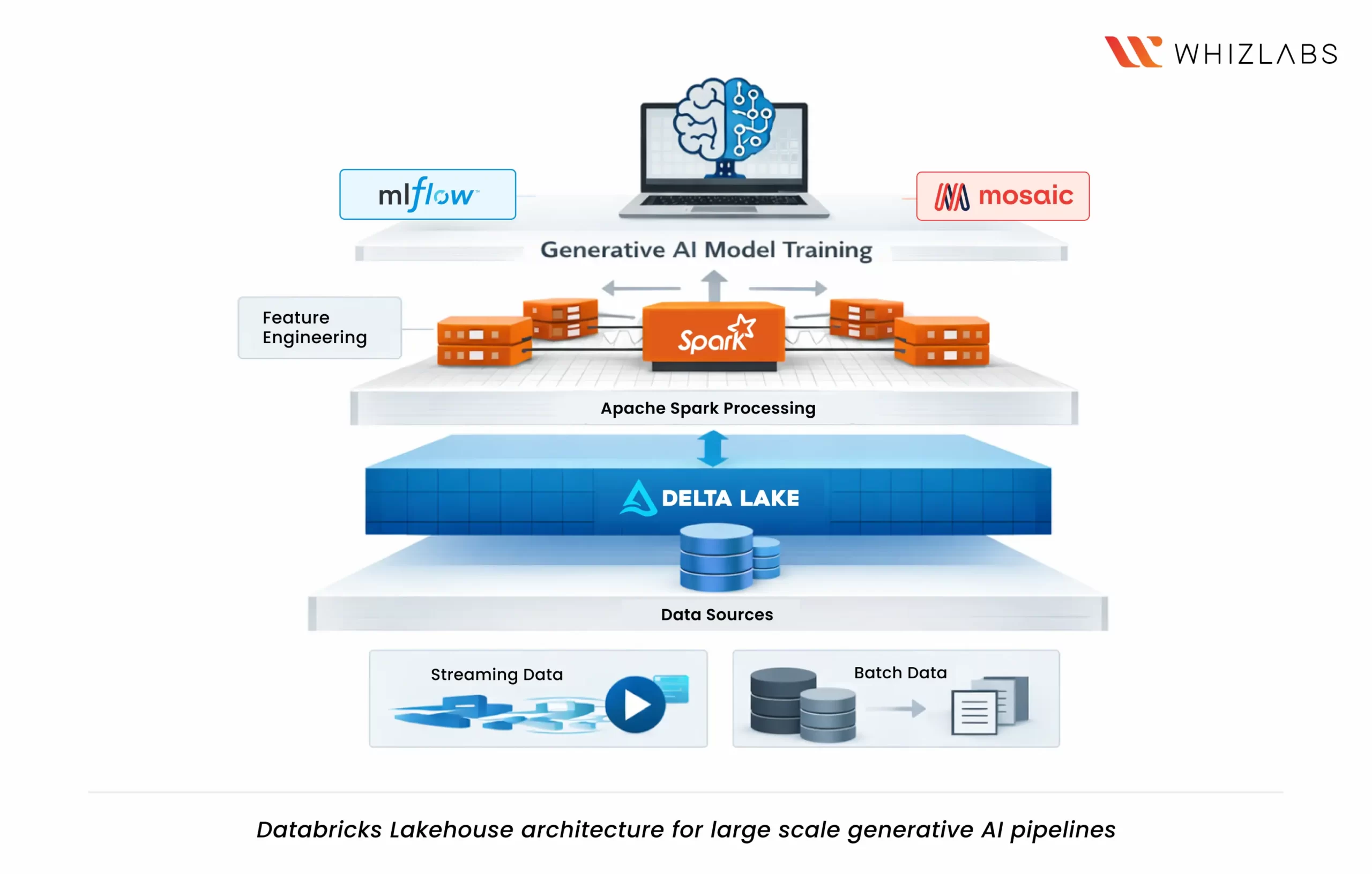
- It’s built on Apache Spark and allows distributed data processing across massive datasets.
- It also uses Delta Lake, an open storage format that improves reliability and performance for data pipelines and machine learning workloads.
- Databricks functions on a multi-cloud architecture; it can run on AWS, Azure, and Google Cloud, allowing organisations to avoid cloud lock-in while still leveraging large-scale data infrastructure.
How Databricks Supports Generative AI (LLMs, Mosaic AI & MLflow)?
Databricks expanded its AI capabilities with the Mosaic AI framework, designed to build and deploy generative AI applications. This allows teams to train custom foundation models, fine-tune open-source models, and manage AI workflows with tools like MLflow for experiment tracking. This makes Databricks particularly attractive to organisations that want to build and control their own AI models rather than relying solely on external APIs.
Generative AI Career Roles in Databricks (Skills & Job Paths)
Databricks is valuable for professionals working at the intersection of data infrastructure and machine learning.
Typical career roles include:
- Data Engineers building large-scale pipelines using Spark and Delta Lake
- Machine Learning Engineers training and optimising models using MLflow
- AI Platform Engineers managing generative AI infrastructure and LLM pipelines
These roles require strong skills in distributed computing, Python, and data engineering frameworks.
By the way, are you preparing for Databricks roles?
At Whizlabs, we offer hands-on labs and certification preparation designed to build practical experience with tools through Databricks certification courses. The courses, resources, labs and others are designed to crack
AWS for Generative AI: Tools, Career Opportunities & Certifications
What Is the AWS AI Ecosystem? (SageMaker, Bedrock & ML Tools Explained)?
Amazon Web Services (AWS) offers the most comprehensive AI ecosystems in the cloud industry.
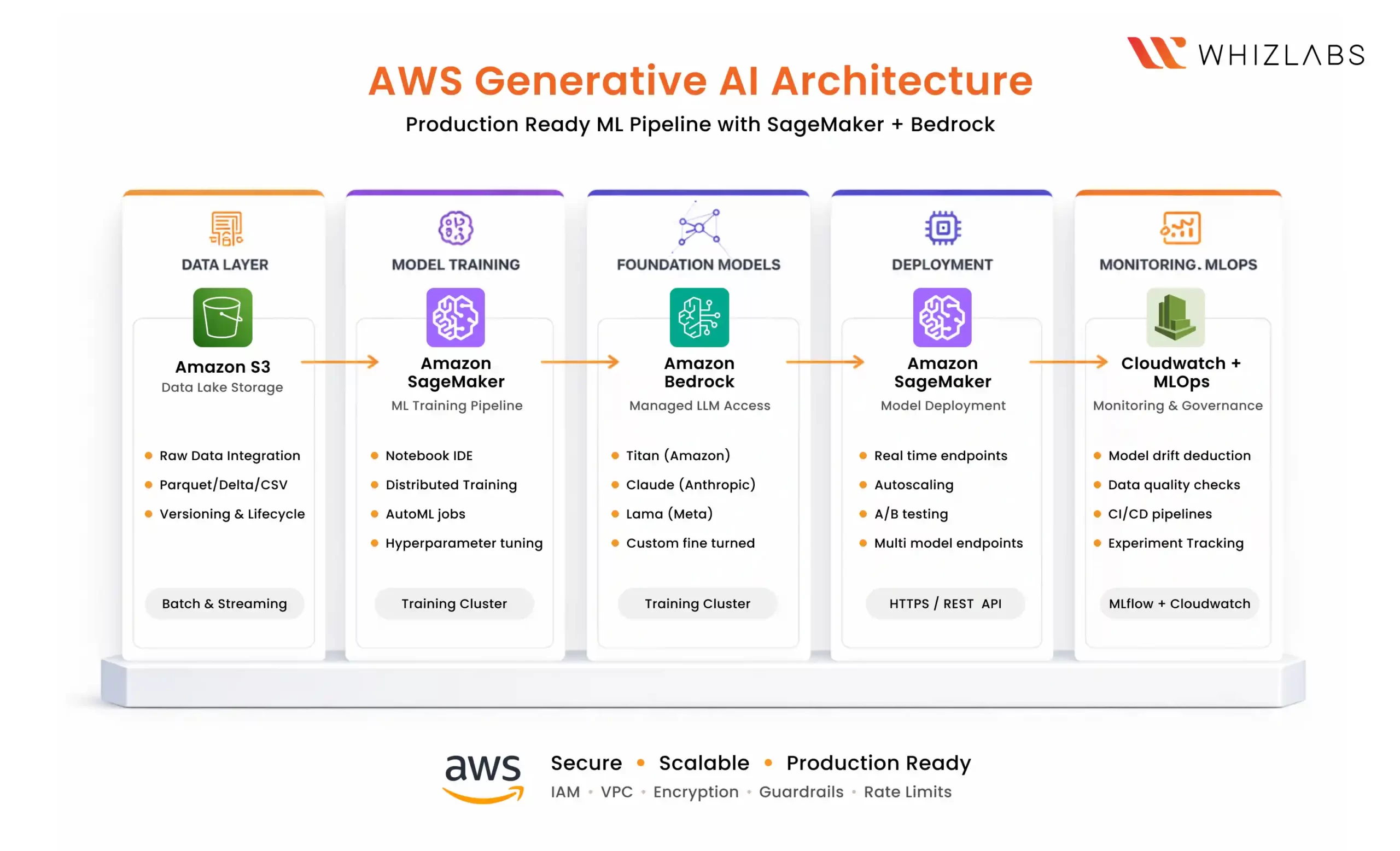
- Services like Amazon SageMaker allow developers to build, train, and deploy machine learning models.
- Amazon Bedrock provides access to multiple foundation models through a managed API platform.
- AWS also supports generative AI pipelines through the broader infrastructure ecosystem, such as S3 for data storage, Lambda for serverless compute, and Glue for data processing workflows.
How AWS Supports Generative AI (SageMaker vs Bedrock Explained)?
AWS separates machine learning into specialised layers.
- SageMaker acts as the machine learning development environment.
- Bedrock enables developers to access and integrate large language models into applications.
This architecture makes AWS ideal for organisations to build production-grade AI systems that integrate deeply with existing cloud infrastructure.
Generative AI Career Roles in AWS (ML Engineer, MLOps & AI Developer)
As AWS is widely used by startups, SaaS companies, and AI-first organisations, some common AI roles built on AWS include:
- Machine Learning Engineers building training pipelines in SageMaker
- AI Application Developers integrating models through Bedrock APIs
- MLOps Engineers managing model deployment, monitoring, and CI/CD workflows
Preparing for AWS AI certifications, such as the AWS Machine Learning Specialty?
You can explore Whizlabs practice tests and hands-on labs that will help you build exam-ready skills and pass your certification on your first attempt. The resources provided are made to match real exam requirements and understanding. The labs eventually are dedicated to easing your hands on practice with utmost understanding.
Azure for Generative AI: Enterprise AI, OpenAI & Career Paths
What Is the Azure AI Ecosystem? (Azure OpenAI, AI Studio Explained)?
Microsoft Azure has positioned itself as the leading platform for enterprise AI adoption. Services such as Azure OpenAI, Azure AI Studio, and Azure Machine Learning enable organisations to develop, deploy, and manage generative AI solutions at scale. Azure also integrates closely with Microsoft’s broader ecosystem, including Power BI, Microsoft 365, and Synapse Analytics, making it attractive for companies that are already using Microsoft cloud technologies.
Why Azure Is Best for Enterprise Generative AI (Security & Compliance)?
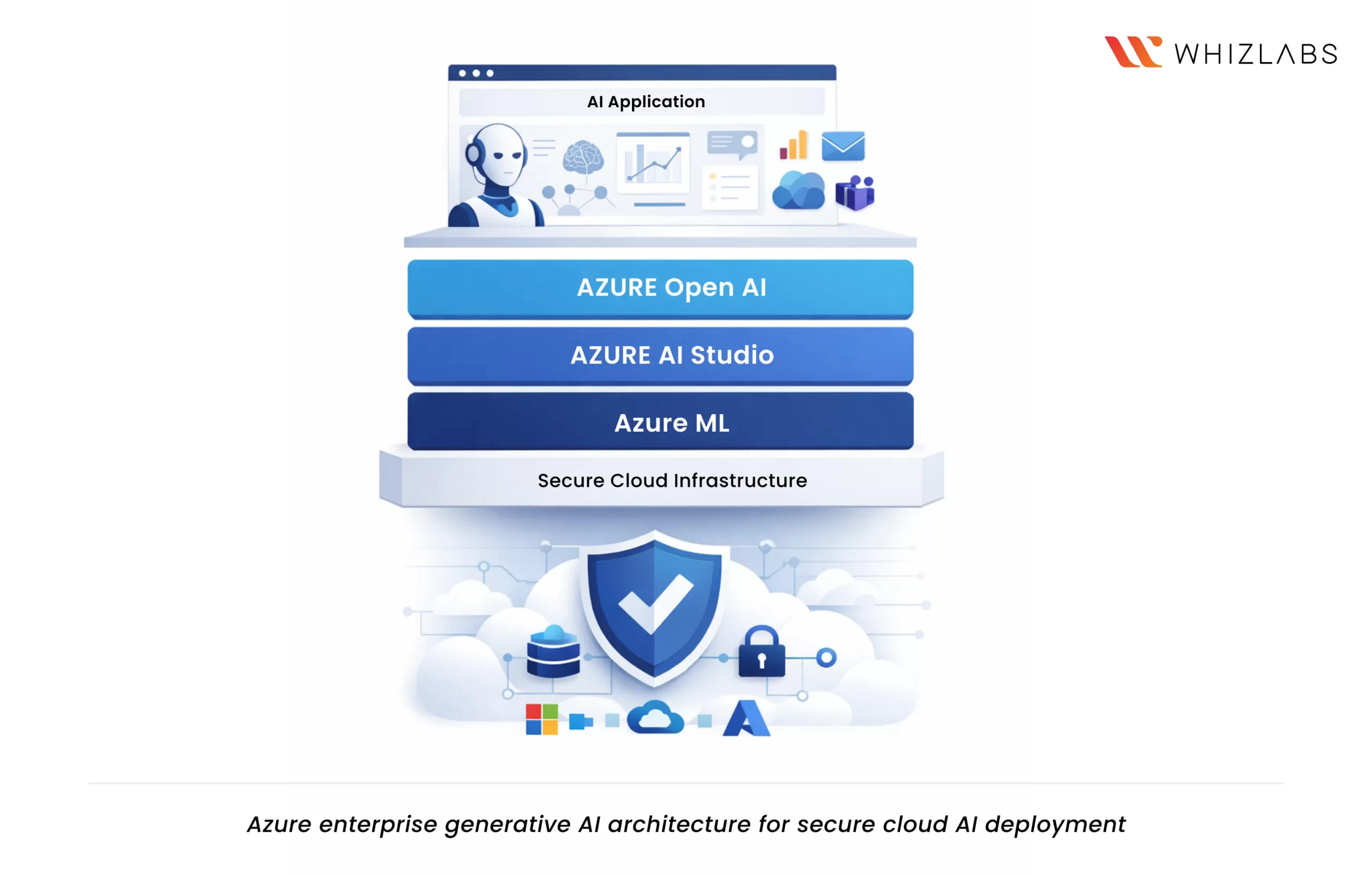
- Azure’s generative AI strategy focuses on secure enterprise deployment.
- The platform supports compliance frameworks such as HIPAA, GDPR, and ISO standards. It’s widely adopted in regulated industries like healthcare, finance, and government.
- Azure also integrates directly with Azure Databricks, combining large-scale data processing with enterprise AI services.
Generative AI Career Roles in Azure (AI Engineer & Cloud Architect Paths)
Azure’s ecosystem supports a range of enterprise-focused AI roles.
- AI Engineers building applications with Azure OpenAI and Azure AI Studio
- Cloud Architects designing enterprise AI systems
- Enterprise AI Developers are integrating AI into productivity platforms and business workflows.
The Azure AI Engineer Associate (AI-102) certification is currently one of the most demanded certifications for professionals entering this space. We provide complete Azure AI training, practice tests, and guided labs to help learners prepare for Azure AI certifications.
Databricks vs AWS vs Azure: Comparison for AI Careers
Choosing between Databricks, AWS, and Azure often depends on the type of AI systems you want to build or the role you want to pursue. While all three platforms support generative AI development, they approach the problem from different angles. The table below highlights how these platforms compare from a career perspective.
Databricks vs AWS vs Azure (AI Career Comparison)
| Factor | Databricks | AWS | Azure |
| AI focus | Data + ML pipelines | ML infrastructure | Enterprise AI apps |
| GenAI approach | Custom models + pipelines | Managed models + APIs | OpenAI integration |
| Best for the role | Data / AI engineers | ML engineers | Enterprise AI engineers |
| Ecosystem | Multi-cloud lakehouse | Largest cloud ecosystem | Microsoft Enterprise Cloud |
| Top certification | Databricks Data Engineer | AWS ML Speciality | Azure AI Engineer |
| Beginner difficulty | Medium | Medium | Beginner-friendly |
Which AI Platform Should I Learn First?
If you’re planning a career in generative AI, the best platform to start with depends on the type of work you want to do every day. You can use this quick guide to match your interests with the right ecosystem.
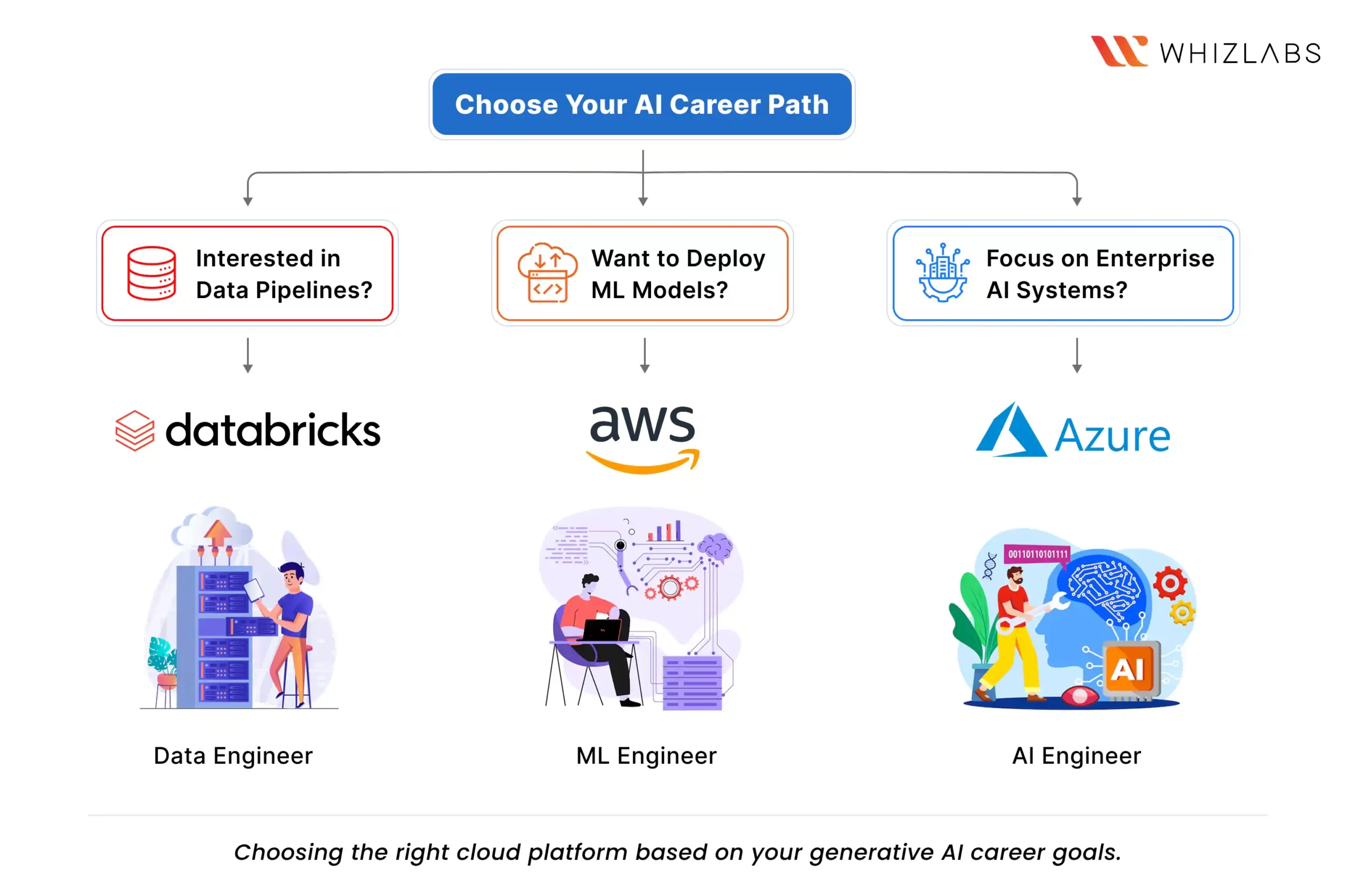
- If you enjoy working with massive datasets and data pipelines
→ Start with Databricks
Databricks is ideal for professionals who want to design data infrastructure for AI systems, manage training pipelines, and work with large-scale machine learning workflows. - If you want to build and deploy machine learning models quickly
→ Start with AWS SageMaker. AWS provides one of the most comprehensive ML ecosystems, making it popular for startups and AI-first companies building production AI applications. - If you want to work with enterprise AI systems and Microsoft tools
→ Start with Azure AI services
Azure is a widely used platform by organisations running on Microsoft technologies, making it a strong choice for enterprise AI engineers and cloud architects. - If your goal is the broadest job market reach
→ Many professionals begin with AWS, then expand into Azure or Databricks. - If salary growth is your priority
→ AI engineer salaries across these platforms are consistently strong. Industry data suggests AI engineering roles often range between $130,000 and $170,000+ globally, depending on experience and specialisation.
The platform you choose shapes the type of AI roles you qualify for, but the underlying AI and cloud skills remain transferable.
Top Generative AI Engineer Skills in 2026 (Cloud, LLMs & MLOps)
Be it Databricks, AWS, or Azure, to evolve as successful Generative AI engineers, the following are the common technical skills that lay the foundation to evolve and get ready for the real world exhibitions.
Python and Machine Learning Frameworks
Python remains the most dominant programming language for AI development. Frameworks such as PyTorch, TensorFlow, and Hugging Face Transformers are widely used in generative model building and training.
Prompt Engineering and LLM Orchestration
Modern generative AI systems often rely on orchestration frameworks like LangChain and LlamaIndex to connect language models with data sources and applications.
Distributed Data Processing
Large-scale AI training requires processing huge datasets. Technologies such as Apache Spark are heavily used in Databricks environments, which enable distributed data processing across clusters.
Cloud AI Services
AI engineers must understand how to use cloud services such as AWS SageMaker, Azure AI Studio, Databricks Mosaic AI and more. They provide infrastructural understanding for training, deploying, and managing AI models.
MLOps and AI Deployment
Producing AI systems requires monitoring, versioning, and automated deployment pipelines. Skills in experiment tracking, CI/CD pipelines, and model monitoring are increasingly essential.
Data Engineering Fundamentals
Strong AI systems depend on reliable data pipelines. Knowledge of ETL processes, feature engineering, and streaming data systems is critical.
Together, these skills allow AI engineers to step beyond experimentation and build production-ready generative AI systems.
Top Cloud AI Certifications for Generative AI Careers in 2026
Certifications validate your knowledge and demonstrate practical cloud AI skills to employers. While hands-on experience remains essential, certification paths often define and demand structured learning and career credibility. Certifications for generative AI professionals include:
Azure
AWS
Databricks
These certifications are a combination of Cloud infrastructure evolutions, machine learning concepts and data engineering skills, making them valuable for professionals building careers in AI engineering.
How to Learn Generative AI with Hands-On Practice (Beginner Guide)?
To enter generative AI is no longer just about understanding machine learning theory. Today, it’s the basic requirement for AI engineers who will need practical experience with data pipelines, model deployment, and cloud AI platforms.
The best way to build these skills is through hands-on practice environments. These spaces mirror real production systems, which means working with cloud-based AI tools, deploying models, and experimenting with data pipelines instead of only reading documentation.
Many professionals start by exploring:
- Cloud labs that simulate real AI workloads
- Sandbox environments for testing deployments safely
- Scenario-based exercises that replicate real engineering problems
To bridge the gap between theoretical AI knowledge and real-world engineering experience, you need hands-on experience with tools like Databricks Lakehouse, AWS SageMaker, Azure AI Studio, and Apache Spark pipelines.
For aspiring AI engineers like you, this hands-on approach is often the fastest method to build your production-ready AI skills.
How to Start a Generative AI Career on AWS, Azure or Databricks?
With the increasing demand for AI professionals continues to grow. Building the right mix of cloud, machine learning, and data engineering skills is becoming critical for career growth.
According to the World Economic Forum, AI and emerging technologies could create 78 million new jobs globally by 2030. This makes it one of the most significant technology career opportunities of the decade.
And if you want to start your journey in generative AI, focus on a structured certification path that can help accelerate your progress.
Here are some of the most valuable learning paths:
- Azure AI Engineer Associate (AI-102): This is ideal for professionals building enterprise AI applications using Azure OpenAI and Azure AI Studio.
- AWS Machine Learning Speciality / AWS Certified AI Practitioner: It’s designed for engineers developing machine learning pipelines with services like SageMaker.er
- Databricks Certified Associate Developer for Apache Spark: It is well-suited for data engineers building large-scale data pipelines and AI workloads.
All of these courses are available in Whizlabs to support your learning journeys with hands-on labs, practice tests, and sandbox environments designed to simulate real cloud AI scenarios.
Explore GenAI Certification Courses →
FAQ on Generative AI Careers
1. Is Databricks good for generative AI?
Yes. Databricks is a strong choice for generative AI workloads that require large-scale data processing and custom model development. Its Lakehouse architecture, combined with tools like Mosaic AI and MLflow, supports training, fine-tuning, and deploying AI models at scale. Eventually, the demand for such skilled professionals is rising, making Gen AI careers the best choice.
2. Should AI engineers learn AWS or Azure?
Both platforms offer strong career opportunities. AWS is widely used for machine learning pipelines and AI application development through tools like SageMaker and Bedrock. Azure is popular among enterprises that use Microsoft technologies and want integrated AI solutions through Azure OpenAI and Azure AI Studio.
3. Which cloud platform pays the most for AI engineers?
AI engineer salaries vary by experience and location, but roles across AWS, Azure, and Databricks ecosystems are consistently among the highest-paid technology jobs. Many AI engineering roles globally fall within the $130,000–$170,000+ range, depending on specialisation.
4. Is Azure Databricks better than AWS SageMaker?
Both tools serve different purposes.
- Azure Databricks focuses on unified data engineering and machine learning workflows using the Lakehouse architecture.
- AWS SageMaker is a dedicated platform for building, training, and deploying machine learning models within the AWS ecosystem.
One can choose the tool based on their requirement and not one over the other.
5. What are the certifications that help you build a generative AI career?
Here are a few of the most recognised certifications for Gen AI Careers:
- Azure AI Engineer Associate (AI-102)
- AWS Machine Learning Specialty
- AWS Certified AI Practitioner
- Databricks Certified Developer for Apache Spark
These certifications help validate cloud AI skills and support roles such as AI engineer, ML engineer, and data engineer
6. Which platform is best for generative AI careers?
Databricks, AWS, and Azure all support generative AI careers. Databricks excels in large-scale data pipelines and model training, AWS provides a mature machine learning ecosystem with SageMaker and Bedrock, and Azure focuses on enterprise AI applications through Azure OpenAI and integrated cloud services. Based on your niche, day-to-day activities and the growth path you choose, matters.
Databricks vs AWS vs Azure: Which Is Best for Your AI Career? (Final Verdict)
As organisations move from experimentation to production-ready AI systems, professionals who understand data pipelines, machine learning workflows, and cloud AI platforms are becoming increasingly valuable.
Databricks, AWS, and Azure each support this transformation in different ways. And the right choice ultimately depends on the role you want to grow into. Whether that’s a data engineer building AI pipelines, an ML engineer deploying models, or an enterprise AI architect designing intelligent systems.
The opportunity is clear: AI is expected to create millions of new technology roles in the coming years. Building the right combination of AI, data, and cloud skills today can position you for the next generation of AI-driven careers, and this is where your journey begins.
Get started with Whizlabs hands-on learning and set a strong example for future learners, emphasising practical learning, practical experience, and success. Connect with us for queries and certification assistance.
Want to have a personal conversation about career or certification choices, or to learn more about Databricks, AWS, Azure, or any other career or certification? Kindly email “ [email protected] “ with the subject “Clarity for AI Careers “. We shall revert and guide you through.

- Databricks vs AWS vs Azure: Best AI Career Platform 2026 - March 19, 2026
- How MLA-C01 Practice Tests Help You Master AWS SageMaker & MLOps? - March 17, 2026
- ML Engineer vs AI Engineer: Salary & Career Path - March 9, 2026
- Is AWS Certified Security – Specialty Worth It in 2026? - March 4, 2026
- AWS Generative AI Developer Certification 2026 Guide - February 12, 2026
- AWS CLF-C02 Cloud Practitioner Study Plan: 2 vs 4 vs 6 Weeks - January 30, 2026
- HashiCorp Terraform Associate 004 Preparation Guide 2026 - January 7, 2026
- Developer to AI Engineer: AWS AI Career Path for 2026 - December 19, 2025