AI is entering a new stage where systems are no longer just capable of making predictions. They are now independent, goal-oriented, and action-oriented. This change is exactly why the NVIDIA agentic AI certification, NCP-AAI, is becoming one of the most important credentials in 2026.
Agentic AI is a type of AI that can plan, reason, and carry out tasks independently over multiple steps without requiring assistance from a person. People are already using these systems for enterprise automation, smart assistants, and platforms that let people make decisions in real time.
Companies are actively looking for professionals who can design and set up these kinds of systems as they adopt this model. The NVIDIA Agentic AI Certified Professional shows that they can make these new AI solutions. Let’s dig in.
What Is Agentic AI?
Agentic AI is a type of artificial intelligence that can autonomously make decisions and perform multi-step actions to achieve a defined goal.
Unlike traditional AI systems that respond to inputs, agentic systems:
- Plan actions based on objectives
- Adapt to changing environments
- Execute tasks without step-by-step instructions
Example
A traditional chatbot answers questions. An agentic AI system can:
- Understand a business goal
- Retrieve relevant data
- Analyse options
- Execute actions (e.g., trigger workflows)
Agentic AI is an AI system capable of independently planning and executing multi-step tasks to achieve specific goals without continuous human guidance.
Why Agentic AI Is the Future of AI Careers?
AI roles are evolving rapidly as the industry moves beyond experimentation into real-world implementation. Earlier, the focus was on building models and improving accuracy. Today, companies expect production-ready systems that solve real business problems.
This shift has changed expectations. Instead of only developing models, professionals now need to deploy systems, automate workflows, ensure scalability, and continuously improve performance.
As a result, demand is growing for skills beyond traditional machine learning. Companies are adopting AI-driven automation platforms, intelligent decision systems, and autonomous workflows across industries.
This is why agentic AI certifications in 2026 are emerging as a key differentiator. They validate your ability to build systems that can act, adapt, and operate independently in real-world environments.
What is the NVIDIA Certified Professional Agentic AI Exam (NCP-AAI)?
The NVIDIA Certified Professional Agentic AI (NCP-AAI) Exam is designed to validate your ability to build and manage autonomous AI systems using modern AI frameworks and infrastructure.
Backed by NVIDIA, this certification focuses on:
- Agent-based architectures
- Multi-agent collaboration
- AI deployment pipelines
- Real-time decision systems
What Makes NCP-AAI Certification Unique?
The majority of AI certificates concentrate on data pretreatment, algorithm optimization, and model training. These fields are significant, although they mostly deal with the construction and enhancement of models separately.
The emphasis is now on system design, implementation, automation, and end-to-end workflows thanks to the NCP-AAI accreditation. This strategy is in line with modern business expectations, where the capacity to create and run entire AI systems is more important than only creating models.
Why Get NVIDIA AI Certified in 2026?
1. Industry Credibility
NVIDIA is a global leader in AI hardware and software ecosystems. Its certifications carry strong recognition.
2. Real-World Focus
The certification emphasises practical implementation, not just theory.
3. Career Differentiation
Most professionals still focus on traditional ML certifications. Agentic AI skills are still rare.
4. Future-Proof Skills
This certification prepares you for roles that will dominate the next decade.
Deep Technical Breakdown: How Agentic AI Systems Work
To truly understand the NCP-AAI study guide, you need to understand the architecture behind agentic systems.
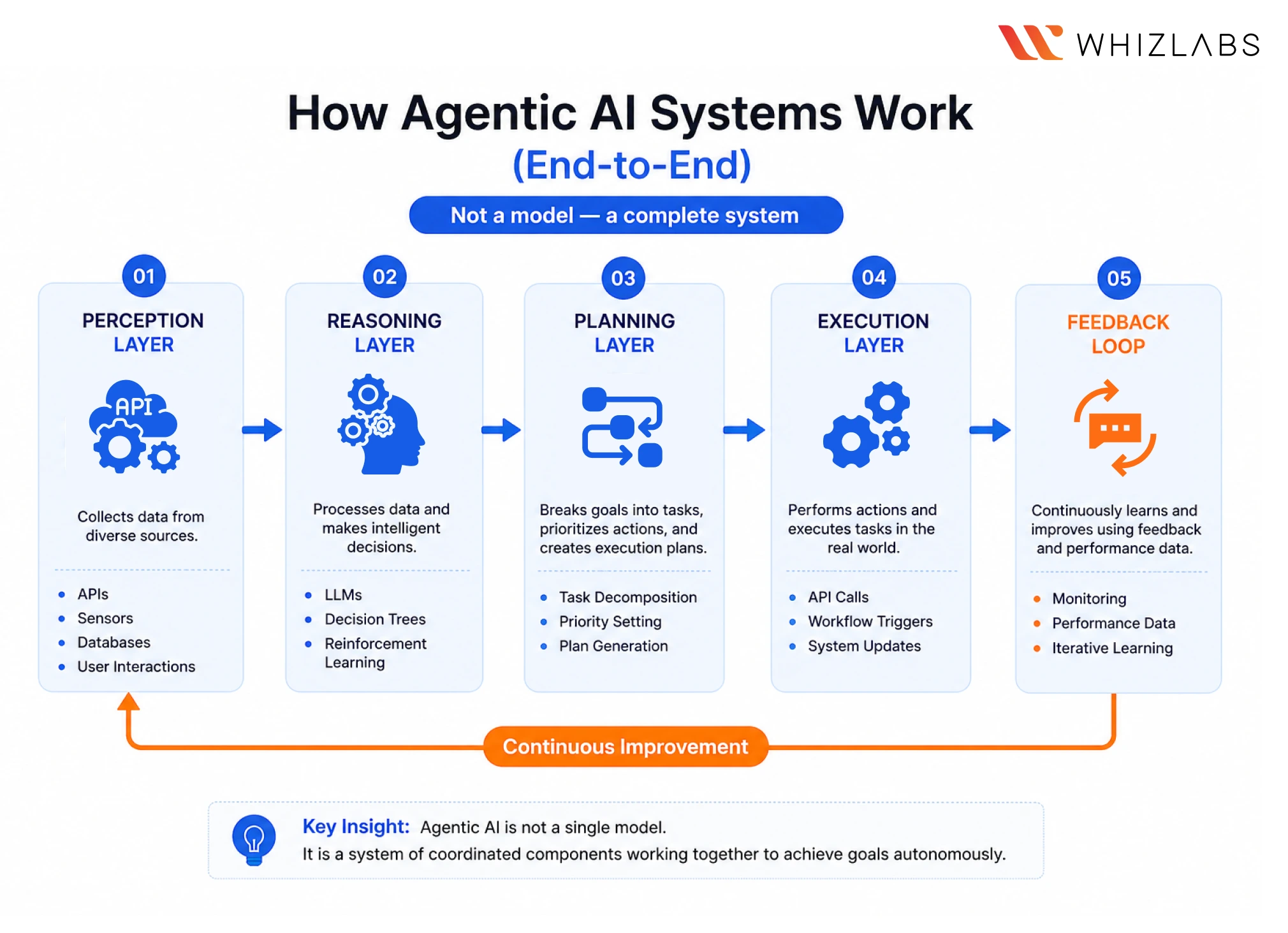
1. Perception Layer
This layer collects input data:
- APIs
- Sensors
- Databases
- User interactions
2. Reasoning Layer
The system processes data and makes decisions:
- LLMs (Large Language Models)
- Decision trees
- Reinforcement learning
3. Planning Layer
This is where agentic AI stands out. The system:
- Breaks goals into tasks
- Prioritizes actions
- Creates execution plans
4. Execution Layer
The system performs actions:
- API calls
- Workflow triggers
- System updates
5. Feedback Loop
Agentic systems continuously improve using:
- Monitoring
- Performance data
- Iterative learning
Key Insight:
Agentic AI is not a single model. It is a system of coordinated components working together.
NCP-AAI Certification Exam Overview
The NCP-AAI certification exam evaluates your ability to design, build, and implement real-world Agentic AI systems. It goes beyond theory and focuses on how well you can apply concepts in practical scenarios.
What does the exam focus on?
You will be tested on key areas such as:
- Agentic AI architecture
- Multi-agent orchestration
- AI deployment strategies
- Data pipelines and integration
- Monitoring and optimization
These topics reflect real industry use cases, not just academic concepts.
What type of exam is it?
This is not a theory-based exam. It is designed to assess problem-solving ability, System design thinking, and practical implementation skills. You need to understand how systems work end-to-end, not just individual components.
How long is the exam?
The exam typically lasts 90 to 120 minutes, depending on the certification level.
What is the passing score?
The expected passing score is around 70% to 75%, although this may vary slightly with updates.
What kind of questions can you expect?
The exam usually includes multiple-choice questions, scenario-based problem solving, and application-focused questions. You will often need to choose the best solution for real-world situations.
Step-by-Step NCP-AAI Exam Preparation Guide
Preparing for the NCP-AAI certification isn’t just about studying theory; it’s about building real, working agentic systems. Here’s a practical, step-by-step approach to help you stay focused and exam-ready.
Step 1: Learn Agentic AI Concepts
Start with a clear understanding of how Agentic AI works and why it’s different from traditional AI.
Focus on: Autonomous decision-making vs rule-based systems, Agent loops (observe → reason → act), Role of LLMs in powering intelligent agents, Real-world use cases like copilots, assistants, and automation systems
Goal: You should be able to explain how an agent thinks, acts, and interacts with its environment, not just what it does.
Step 2: Master System Design
Many candidates make the mistake of focusing only on models. The exam, however, emphasizes how systems are designed and orchestrated.
Key Areas:
- AI system architecture (modular design, pipelines)
- Tool integration (APIs, databases, retrieval systems)
- Orchestration frameworks and workflow design
- Scalability and reliability considerations
Pro Tip: Think like a system designer, not just a developer. Understand how components connect and communicate.
Step 3: Build Real Projects
This is where your learning becomes practical and memorable.
Project Ideas:
- AI Workflow Automation: Automate repetitive tasks using agent pipelines
- Intelligent Assistants: Build a chatbot that can use tools (search, APIs, etc.)
- Decision-Making Systems: Create agents that analyze inputs and recommend actions
How to Approach:
- Start with a single-agent system
- Gradually add complexity (memory, tools, multi-step reasoning)
- Focus on solving real problems, not just demos
Goal: By this stage, you should be confident in building functional agent-based systems from scratch.
Step 4: Practice with Labs
Hands-on practice is critical for reinforcing both concepts and implementation skills.
Platforms like Whizlabs help bridge the gap between theory and real-world application by offering:
- Real-world labs that simulate actual AI workflows
- Scenario-based learning to improve problem-solving
- Guided environments so you can focus on learning instead of setup
Why This Matters:
Reading alone won’t prepare you. You need to build, test, fail, and improve.
Step 5: Take Mock Tests
Mock exams are your final checkpoint before the real test.
What to Do:
- Take full-length practice exams under timed conditions
- Identify weak areas (architecture, workflows, optimization, etc.)
- Revisit those topics and strengthen your understanding
You can use practice tests from Whizlabs
6-Week Study Plan for NCP-AAI
Preparing for the NCP-AAI certification requires a structured approach that balances theory, hands-on practice, and revision. This 6-week plan is designed to help you build strong fundamentals first, then progressively move into real-world implementation and optimization.
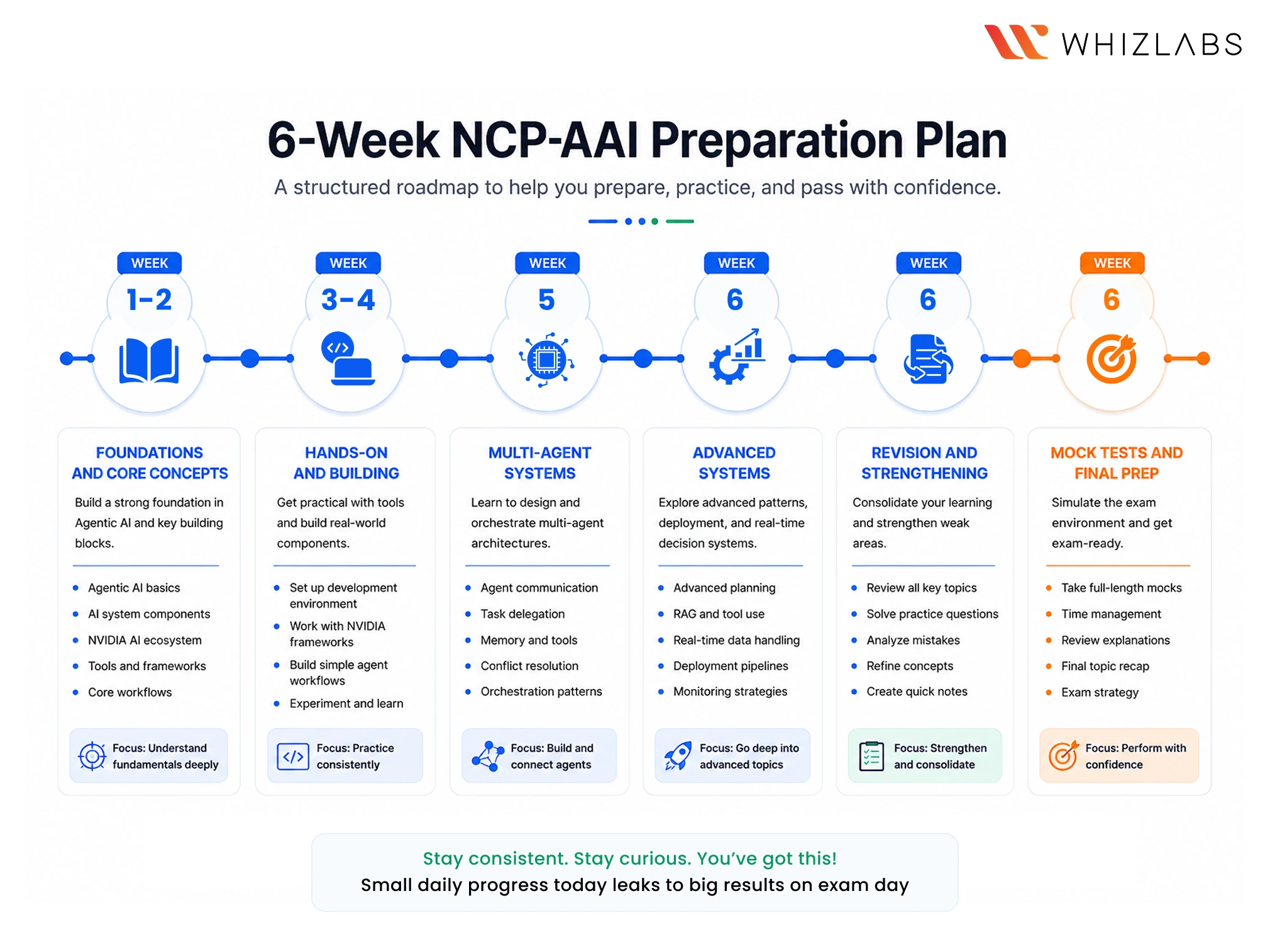
Week 1–2: Build Strong Fundamentals
Start by focusing on the core concepts that define Agentic AI systems. These two weeks set the foundation for everything that follows.
Key Areas to Cover:
- What is Agentic AI, and how does it differ from traditional AI systems
- Core components: agents, environments, goals, and decision-making loops
- AI system architecture (modular design, pipelines, orchestration layers)
- Introduction to LLM-powered agents and tool usage
How to Approach:
- Study architecture diagrams and understand how data flows through agent systems
- Break down real-world use cases (chatbots, autonomous workflows, copilots)
- Use structured learning paths from platforms like Whizlabs to simplify complex topics
Outcome:
By the end of Week 2, you should clearly understand how agent-based systems are designed and why they matter in modern AI.
Week 3–4: Hands-On Implementation
Now that your fundamentals are in place, shift your focus to building and experimenting.
Key Activities:
- Build small agent-based projects (e.g., task automation agents, Q&A bots)
- Work with frameworks like LangChain, AutoGen, or similar orchestration tools
- Implement basic workflows such as:
- Input → reasoning → action → output loops
- Tool integration (APIs, search, data retrieval)
Practice Strategy:
- Start simple: single-agent workflows
- Gradually move to slightly complex pipelines
- Replicate real-world scenarios like customer support automation or research assistants
Learning Tip:
Hands-on labs and sandbox environments from Whizlabs can help you practice without setting up everything from scratch.
Outcome:
By the end of Week 4, you should be comfortable building and testing basic agentic workflows.
Week 5: Advanced Topics & Optimization
This is where you deepen your expertise and differentiate yourself from those who are just starting.
Focus Areas:
- Multi-agent systems (collaborative and competitive agents)
- Task decomposition and agent communication
- Memory handling and context management
- Optimization strategies:
- Reducing latency
- Improving response accuracy
- Efficient resource usage
What to Practice:
- Design systems where multiple agents work together
- Experiment with prompt engineering and chaining techniques
- Analyze failures and refine agent behavior
Outcome:
You’ll gain the ability to design scalable, efficient, and production-ready Agentic AI systems.
Week 6: Revision + Practice Tests
The final week is all about reinforcing what you’ve learned and preparing for the exam environment.
Key Activities:
- Take full-length mock exams
- Identify weak areas and revisit those topics
- Review key concepts:
- Architectures
- Workflows
- Optimization techniques
Smart Preparation Approach:
- Simulate exam conditions with timed tests
- Use practice exams from Whizlabs to get familiar with question patterns
- Focus more on understanding than memorization
Outcome:
You’ll enter the exam with confidence, clarity, and strong practical knowledge.
Tip!
Consistency matters more than intensity. Even 1–2 hours daily with focused learning, hands-on practice, and periodic revision can make this 6-week plan highly effective.
Skills You Gain with NVIDIA Agentic AI(NCP-AAI) Training
With NVIDIA agentic AI training, you gain:
- Autonomous system design
- Multi-agent coordination
- Real-time decision-making
- AI deployment pipelines
- Performance monitoring
These are exactly the skills companies now expect.
Who Should Take This Certification?
- AI/ML Engineers
- Data Scientists
- Software Engineers
- Cloud Engineers
If you want to build real-world AI systems, this certification is ideal.
Real-World Use Cases of Agentic AI
Agentic AI is rapidly moving from experimentation to real-world deployment. Organisations are using intelligent agents not just to assist but to act, decide, and optimise workflows autonomously. Here are some of the most impactful use cases:
1. Enterprise Automation
AI agents are transforming how businesses operate internally by automating end-to-end workflows across departments.
What this looks like:
- HR onboarding workflows handled by AI agents
- IT support automation (ticket routing, resolution, escalation)
- Finance processes like invoice processing and approvals
Why it matters:
Instead of isolated automation scripts, agentic systems can adapt, make decisions, and coordinate tasks dynamically, reducing manual intervention significantly.
2. Customer Support Systems
Modern customer support is increasingly powered by intelligent agents that go beyond simple chatbots.
Capabilities include:
- Understanding customer queries using LLMs
- Resolving issues using integrated tools (CRM, databases)
- Escalating complex cases to human agents when needed
- Taking actions like refunds, bookings, or updates
Impact:
These systems improve response time, reduce support costs, and deliver more personalized experiences at scale.
3. Financial Decision Systems
In finance, Agentic AI is used to analyse data, assess risk, and even execute decisions in real time.
Use cases:
- Fraud detection and prevention
- Algorithmic trading and portfolio management
- Credit risk evaluation and loan approvals
Key advantage:
Agents can continuously monitor data streams and act instantly, making them highly valuable in time-sensitive financial environments.
4. Healthcare AI
Healthcare is seeing early but powerful adoption of agentic systems to support both clinical and operational workflows.
Applications:
- Assisting doctors with diagnostics and recommendations
- Automating patient workflows (appointments, records, follow-ups)
- Supporting clinical decision-making with data-driven insights
Why it’s transformative:
Agentic AI can reduce workload for healthcare professionals while improving accuracy and efficiency in patient care.
Where to Practice These Use Cases
Understanding these scenarios conceptually is important, but building them is what truly prepares you.
Platforms like Whizlabs help you simulate these real-world environments through:
- Hands-on labs based on enterprise and AI workflows
- Scenario-based exercises aligned with industry use cases
- Practice tests that mirror certification exam patterns
AWS vs Azure vs Google Cloud vs NVIDIA AI
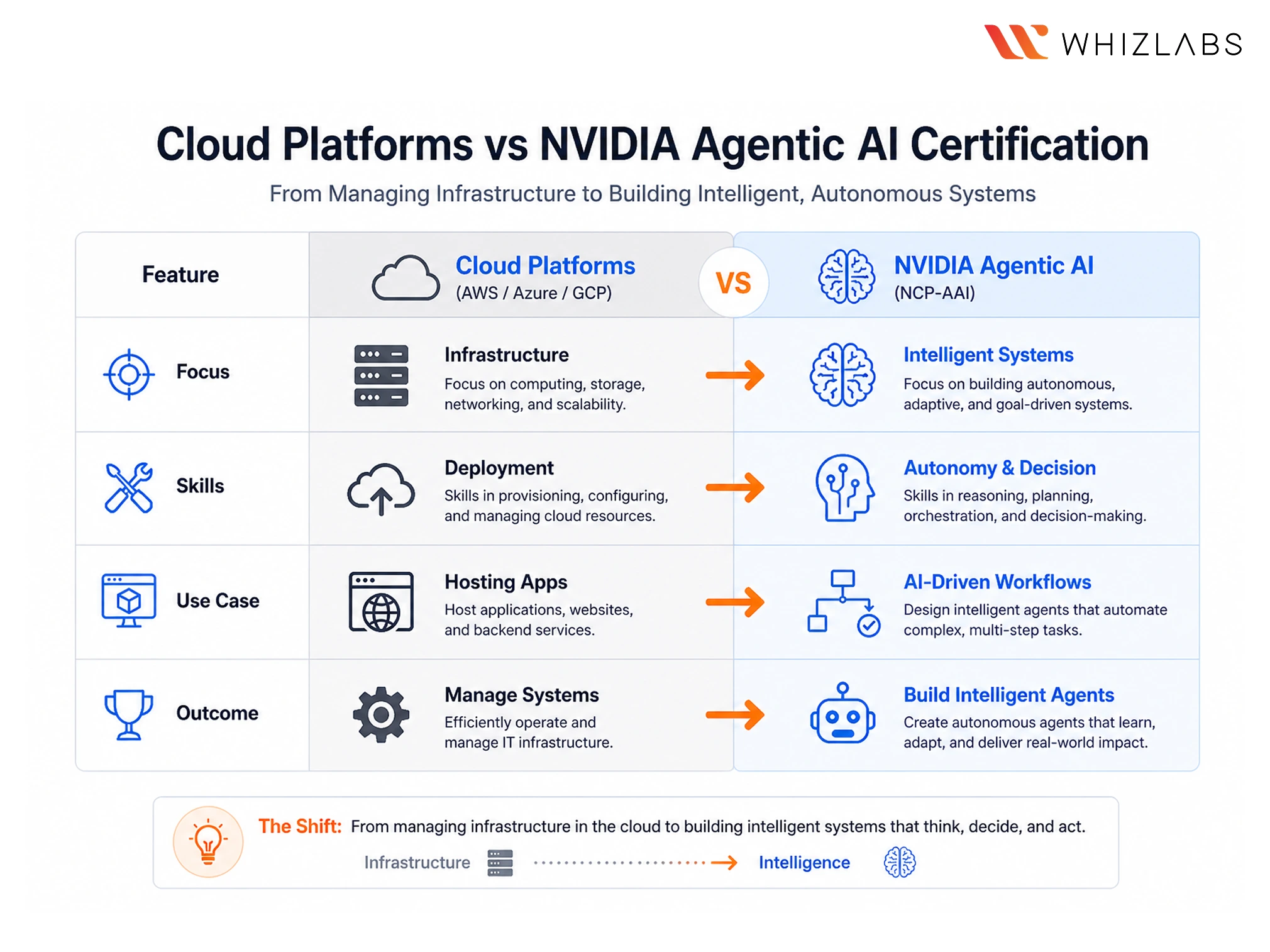
Cloud platforms like Amazon Web Services, Microsoft Azure, and Google Cloud Platform are primarily infrastructure-focused. They offer broad use cases across industries and continue to have strong job demand due to their role in powering modern applications and services.
In contrast, NVIDIA AI certification is more specialized and focuses on building intelligent systems. It emphasizes autonomy, advanced AI use cases, and the ability to design systems that can act and make decisions independently.
In simple terms, cloud platforms teach you how to deploy and manage environments, while NVIDIA teaches you how to create intelligent systems that operate within those environments.
Is NVIDIA Agentic AI Certification(NCP-AAI) Worth It?
Yes, especially in 2026. AI is rapidly shifting toward autonomy, where systems are expected to act, decide, and execute tasks independently rather than just generate outputs.
Companies are increasingly looking for professionals who can build complete systems, not just models. With rising demand for automation and intelligent workflows, this certification helps you stand out by validating those in-demand skills.
FAQ: NVIDIA Agentic AI Certification NCP-AAI
- What is the NVIDIA Agentic AI certification NCP-AAI?
It validates your ability to build and operate agentic AI systems in real-world environments.
The focus is on system-level design, multi-step workflows, and autonomous execution. - How hard is the NCP-AAI certification exam?
The exam tests system thinking, not just theory or models.
If you understand workflows, orchestration, and real-world behavior, it becomes manageable. - Do I need hands-on labs for NCP-AAI preparation?
Labs are not mandatory but are essential for real understanding. They help you build, test, and debug agentic systems in practical scenarios. - Do I need coding experience for NCP-AAI?
Yes, basic programming and AI knowledge are recommended. You should be comfortable with APIs, simple scripts, and system workflows. - What is the best preparation strategy for NCP-AAI?
Focus on system design, real projects, and hands-on labs.Combine concept clarity with practice tests and workflow-level understanding.
Conclusion
AI is no longer about models; it is transforming into systems that can think, act, and improve independently.
The NVIDIA agentic AI certification NCP-AAI prepares you for this shift by focusing on real-world, production-ready skills.
If you want to stay ahead in AI, now is the time to build expertise in agentic systems. Start your preparation with hands-on learning through Whizlabs and position yourself for the future of AI.

- GCP vs AWS vs Azure Architect Certification 2026 - May 22, 2026
- Best Cloud Certifications for Beginners in 2026 - May 13, 2026
- NVIDIA Agentic AI Certification NCP-AAI Guide 2026 - April 28, 2026
- How to Prepare for Microsoft AB-100 Certification? - April 7, 2026
- How to Become an AI Engineer in 2026: Roadmap, Skills, Salary & Certifications - March 23, 2026
- Generative AI LLM Career Paths in 2026: Roles & Certification - February 24, 2026
- Microsoft AB-900 Copilot Exam Guide 2026 - February 18, 2026
- Google Cloud Generative AI Leader Certification Guide 2026 - February 6, 2026