AI Fundamentals certifications, such as Microsoft AI-900 and AWS AI Practitioner, are ideal for beginners. While certifications like AB-731 are better suited for business leaders, they focus on AI strategy, adoption, and governance rather than technical implementation.
So the real question is:
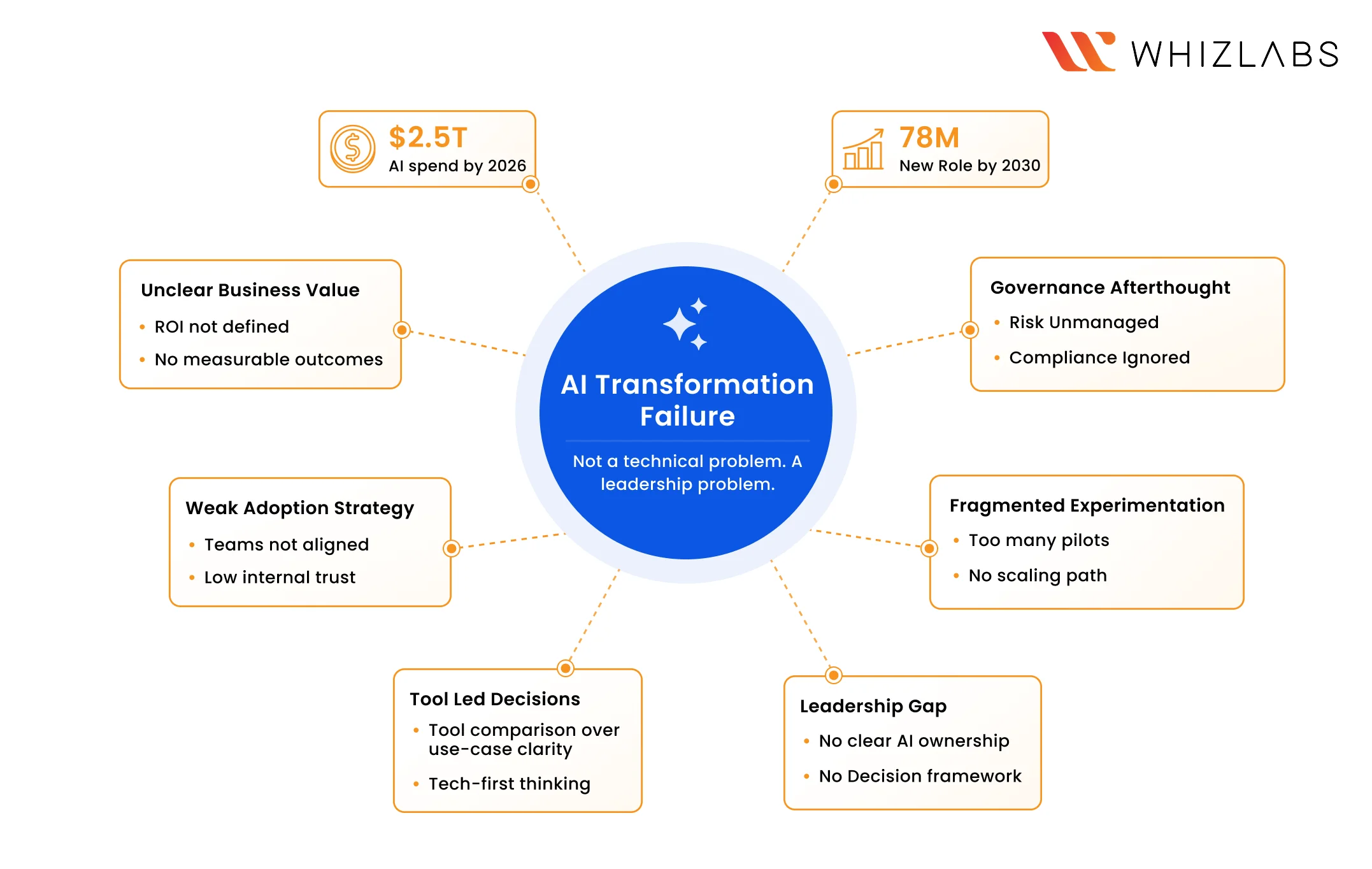
Why do most AI initiatives fail before scaling?
Across industries, organisations are investing heavily in AI—but very few are seeing consistent, scalable outcomes. The issue is not a lack of intent. It is a lack of clarity.
Despite global AI spending projected to reach $2.5 trillion in 2026, many initiatives remain stuck in pilot stages. Even where adoption begins, it often fails to extend across functions due to unclear ROI, fragmented ownership, and internal resistance.
At the same time, macro signals are accelerating:
- The World Economic Forum projects 78 million new roles driven by AI and automation by 2030
- Governments are investing in long-term infrastructure, with India positioning itself as a global AI hub through data centre expansion and tax incentives extending to 2047
- Enterprises are shifting from experimentation to production-grade AI systems
This creates a visible gap. But not between organisations that invest in AI and those that do not. Instead, it’s between those who can operationalise AI effectively and those who cannot.
And in most cases, failure is not technical. It is strategic. And AI initiatives stall because:
- Business value is not clearly defined
- Adoption is not actively managed
- Governance is treated as an afterthought
The result is a pattern of growing investment, limited scale, and uncertain outcomes.
Why do AI strategies feel unclear even with significant tools and investments?
Organisations today have access to an extensive AI ecosystem, like enterprise copilots, foundation model platforms, low-code AI tools and cloud-native AI services. From a capability standpoint, technology is not the constraint.
However, access to tools has not translated into clarity of direction. A common assumption persists: “More tools will lead to better outcomes.”
In practice, the opposite is often true. Without a clear strategic framework, increased tooling leads to:
- Fragmented experimentation
- Duplicated efforts across teams
- Inconsistent evaluation of success metrics
There is also a structural confusion that affects decision-making:
| Technical capability |
Strategic application |
Teams frequently focus on:
|
While overlooking:
|
As a result, organisations invest in AI capabilities without aligning them to business priorities.
This leads to a critical insight:
AI strategies do not fail because technology is insufficient. They fail because the entry point into AI is not clearly defined at a leadership level.
What should executives evaluate before investing in AI skills or certifications?
As AI becomes a strategic priority, leaders are increasingly expected to build internal capability not only through hiring but also through structured upskilling.
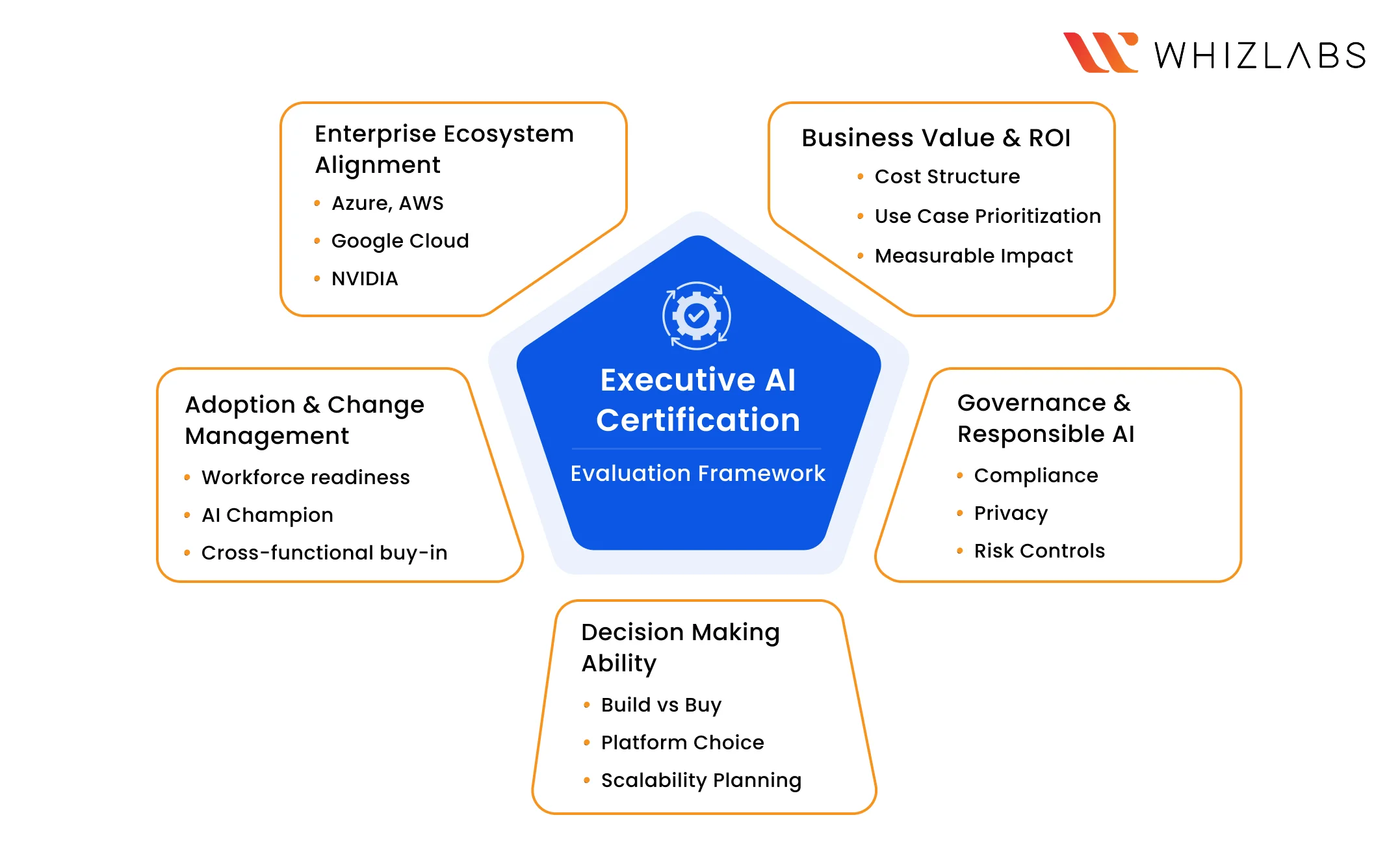
However, not all certifications or learning paths are aligned with executive-level requirements. The following criteria can help evaluate whether an AI transformation certification is relevant from a leadership perspective:
Alignment with Enterprise Ecosystems
Certifications should be tied to widely adopted platforms such as:
- Microsoft Azure
- AWS
- Google Cloud
- NVIDIA
This ensures alignment with real-world enterprise environments where AI solutions are deployed.
Focus on Business Value and ROI
An effective certification should enable leaders to:
- Identify high-impact AI use cases
- Evaluate cost structures (e.g., token usage, infrastructure costs)
- Justify investments in measurable terms
Understanding AI without understanding its economic impact limits its strategic value.
Emphasis on Adoption and Change Management
AI implementation is not only a technical process. It is an organizational shift.
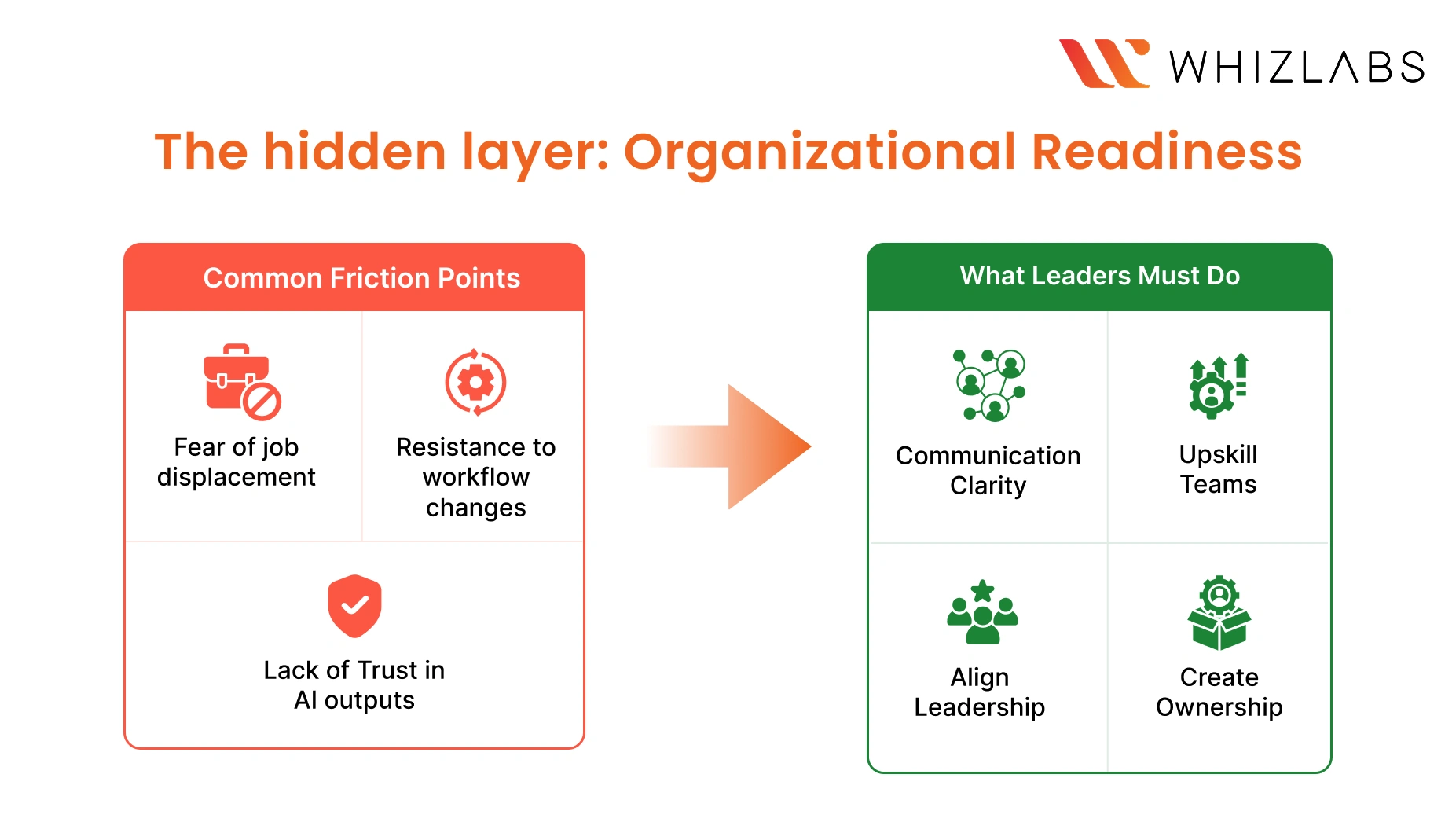
Leaders must be equipped to:
- Manage workforce concerns
- Drive cross-functional alignment
- Establish roles such as AI champions and governance bodies
Certifications that address adoption dynamics are significantly more relevant at the executive level.
Governance, Risk, and Responsible AI
With increasing regulatory and reputational risks, AI initiatives must be designed with:
- Compliance frameworks
- Ethical considerations
- Risk mitigation strategies
This includes understanding concepts such as:
- Responsible AI principles
- Adversarial testing (red teaming)
- Data privacy and security
Decision-Making Over Tool Familiarity
At the executive level, the objective is not to operate tools, but to make informed decisions regarding:
- Build vs buy strategies
- Platform selection
- Scalability and long-term impact
Certifications that emphasise decision frameworks over technical execution provide greater strategic value.
Key Takeaway
For executives, the value of an AI certification lies in its ability to translate AI capabilities into business outcomes, support informed decision-making, and enable structured and responsible adoption. Certifications that meet these criteria are more aligned with leadership roles than purely technical credentials.
Is AI a technical skill or a leadership and decision-making capability?
The perception of AI as a purely technical domain is increasingly outdated. While technical expertise remains essential, the success of AI initiatives within organisations is determined primarily by leadership decisions.
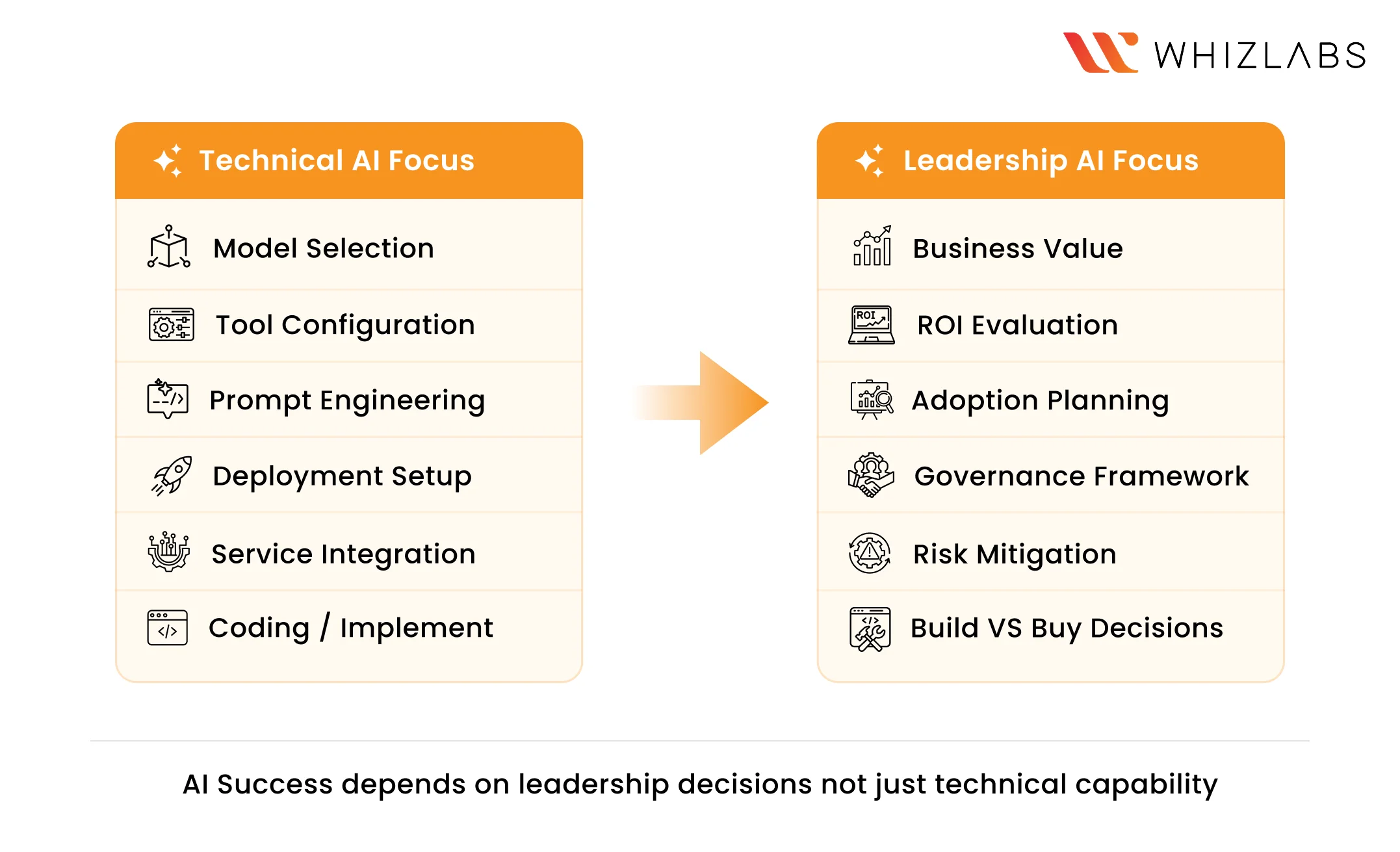
Across enterprises, AI is now influencing:
- Strategic planning
- Operational workflows
- Customer experience
- Risk management
This shifts the focus from how AI is built to how AI is applied and governed.
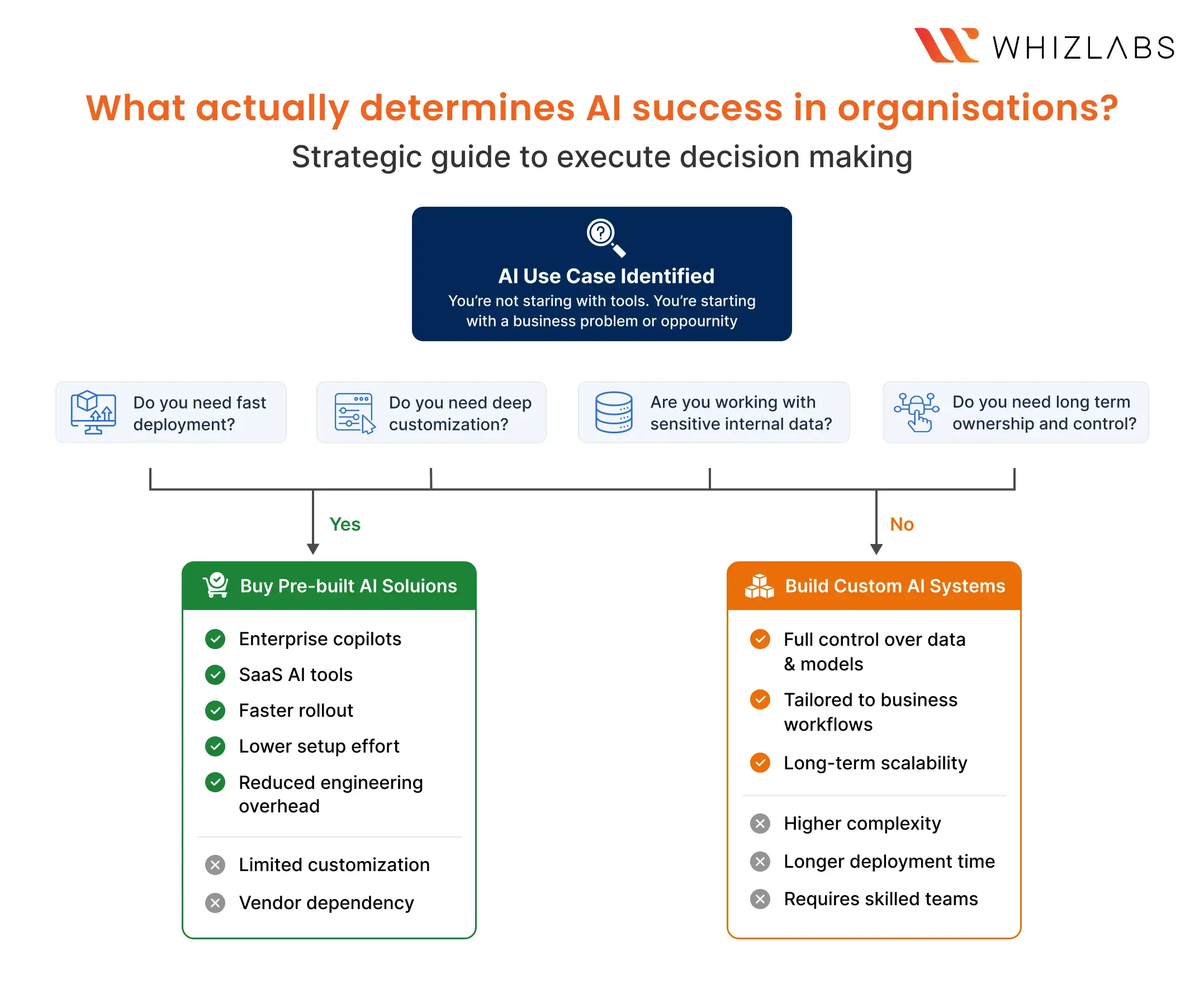
What actually determines AI success in organisations?
It’s not the choice of model. Not the sophistication of tools. But three core factors:
Clarity of Business Value
AI initiatives must be linked to measurable outcomes, such as:
- Cost reduction
- Productivity gains
- Revenue impact
Structured Adoption Strategy
Even well-designed solutions fail if:
- Employees do not trust them
- Teams are not trained to use them
- Workflows are not adapted
Adoption is a leadership responsibility, not a technical one.
Governance and Risk Management
AI introduces new categories of risk, including:
- Hallucinations
- Bias
- Data exposure
Organisations must establish governance frameworks to ensure compliance, accountability and transparency.
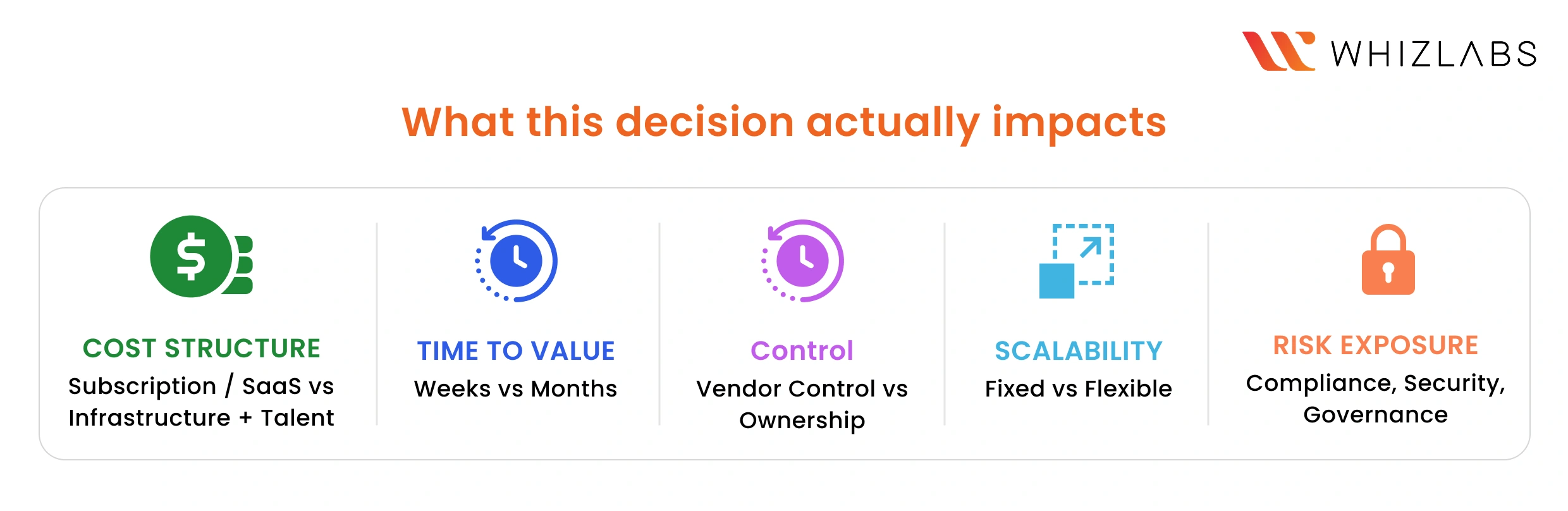
AI is no longer just a technical skill. It is a leadership capability involving decision-making, ROI evaluation, governance, and adoption strategy. Organisations succeed not by building AI, but by aligning it with business outcomes and scaling it responsibly.
|
The “Build vs Buy” Decision |
Managing Organisational Readiness |
A recurring executive-level decision involves choosing between:
This decision impacts:
|
AI adoption also introduces cultural challenges:
Addressing these requires:
|
Such decisions require strategic evaluation, not technical execution alone. Therefore, AI is no longer just a technical capability. It is a leadership discipline. So you’re not configuring AI. You’re justifying it.
What is AB-731 Certification, and why are leaders quietly paying attention to it?
If AI is now a leadership discipline, the next question is:
Where do executives actually learn to lead AI transformation?
This is where the AB-731: Microsoft Certified – AI Transformation Leader certification comes into the scene. You can explore the official certification details on Microsoft Learn.Unlike other traditional AI certifications that focus on tools, models, or implementation, the AB-731 is designed around a different objective: Enabling leaders to make informed, responsible, and high-impact AI decisions. It does not position AI as a technical skill but as a strategic capability to be governed, scaled, and aligned with business outcomes.
What skills AB-731 Exam Certification test?
At its core, the certification focuses on three interconnected dimensions of AI leadership certification 2026
Business Value and ROI Orientation: Leaders are expected to evaluate:
- Where AI creates measurable impact
- How to assess cost structures (including usage-based pricing models)
- How to align AI investments with organisational priorities
This shifts AI from experimentation to value-driven execution.
Adoption Strategy and Change Management:
Successful AI initiatives depend on adoption, not deployment. The certification emphasises:
- Identifying organisational barriers to AI adoption
- Building internal advocacy through AI champions
- Aligning stakeholders across business, legal, and operational teams
This reflects the reality that AI transformation is as much cultural as it is technical.
Governance and Responsible AI
With increasing regulatory and reputational risks, governance becomes critical. AB-731 builds understanding of:
- Responsible AI principles (fairness, transparency, accountability)
- Risk mitigation strategies, such as adversarial testing
- Frameworks for safe and compliant AI deployment
This ensures AI systems are not only effective but also trustworthy and scalable.
Who is AB 731 – AI Transformation Leader Certification Designer For?
AB-731 is not intended for entry-level learners or purely technical roles. It is structured for professionals who are already involved in decision-making, including:
- Directors and Vice Presidents
- Strategy and transformation leaders
- Product and innovation heads
- Business leaders responsible for AI adoption
It is particularly relevant for individuals who participate in AI-related decision forums, evaluate AI investments and oversee cross-functional implementation.
What makes AB-731 fundamentally different?
Several aspects distinguish this certification from conventional AI credentials.
- No coding requirement – Focus remains on strategy, not implementation
- Scenario-based evaluation – Questions reflect real-world decision contexts
- Leadership-oriented thinking – Emphasis on judgment, trade-offs, and outcomes
The most important shift is that this exam rewards judgment, not memorisation. Candidates are evaluated on how they think through ROI justification, risk management and stakeholder alignment, rather than how well they recall technical details.
Why does AB-731 Certification matter in the current AI landscape?
The primary challenge organisations face is not building AI but scaling it responsibly and effectively. AB-731 AI Transformation Leader certification addresses this gap directly and equips leaders with:
- A structured understanding of AI decision-making
- Frameworks for adoption and governance
- Provide the ability to translate AI capabilities into business value
It is less a technical certification and more a capability signal for AI leadership readiness.
Why are certifications like AB-731 becoming relevant now?
The rising importance of certifications like AB-731 directly benefits how the AI ecosystem is evolving at a global level.
AI is now an infrastructure priority, not a side initiative
Governments and enterprises are investing in AI at a foundational level.
- India has announced investments of $70-90 billion in AI and data centre infrastructure.
- Policy frameworks now include tax incentives for AI-related cloud services, extending to 2047
These initiatives signal a long-term commitment to building AI capabilities at scale.
Global AI spending is accelerating rapidly.y
According to Gartner, worldwide AI spending is expected to reach $2.5 trillion in 2026, representing a significant year-over-year increase.e
A substantial portion of this growth is driven by AI infrastructure, data platforms and enterprise AI services. It indicates a shift from experimentation to operational deployment.
AI infrastructure is the fastest-growing investment area
The largest share of AI spending is now concentrated in AI-optimised servers, cloud infrastructure and data processing systems. It reflects a critical transition:
- AI is no longer confined to models or prototypes.
- It is being embedded into enterprise systems and workflows.
The nature of AI roles is evolving.
As AI adoption scales, the demand is shifting from building isolated models to managing end-to-end AI systems. This requires professionals who can
- Connect AI capabilities to business objectives
- Manage cost, risk, and compliance
- Lead cross-functional implementation
AI careers are no longer defined by the ability to build models. They are defined by the ability to scale and govern AI systems effectively.
If you ask where AB-731 fits into this shift?
AB-731 aligns directly with emerging market needs. It prepares professionals to:
- Operate at the intersection of technology and business
- Lead AI initiatives beyond pilot stages
- Ensure AI systems deliver sustainable value
As organisations move from AI experimentation to AI transformation, the demand for structured leadership capability continues to grow.
Which AI transformation certification is actually worth your time right now?
At this point, the goal isn’t to explore everything. It’s to choose a direction that aligns with how you want to work with AI. Here’s a breakdown of certifications that are relevant right now across technical, foundational, and leadership roles.
- AWS Certified AI Practitioner (AIF-C01) – An entry-level certification focused on AI concepts, use cases, and AWS AI services like Bedrock.
- AWS Machine Learning Engineer Associate – A role-based certification focused on building, training, and deploying machine learning models using AWS tools like SageMaker.
- Microsoft Azure AI Fundamentals (AI-900 / AI-901) – A foundational certification covering AI concepts, responsible AI, and Azure AI services.
- Azure AI App & Agent Developer Associate (AI-103) – An advanced certification focused on building AI-powered applications, including agent-based systems and integrations.
- Google Cloud Digital Leader – A non-technical certification that introduces cloud and AI concepts from a business perspective.
- Google Cloud Professional Machine Learning Engineer – An advanced certification focused on designing and managing ML models at scale.
- NVIDIA Generative AI Certification (NCA-GENL) – A certification focused on generative AI concepts, large language models, and AI application development.
Where AB-731 fits in this landscape?
While the above certifications focus on building or understanding AI systems, AB-731 operates at a different layer:
- Aligning AI with business outcomes
- Managing adoption and risk
- Making strategic decisions
It complements technical certifications by addressing the leadership gap in AI transformation.
Which certification should you actually start with?
At this stage, the decision should be based on your role, not the trend.
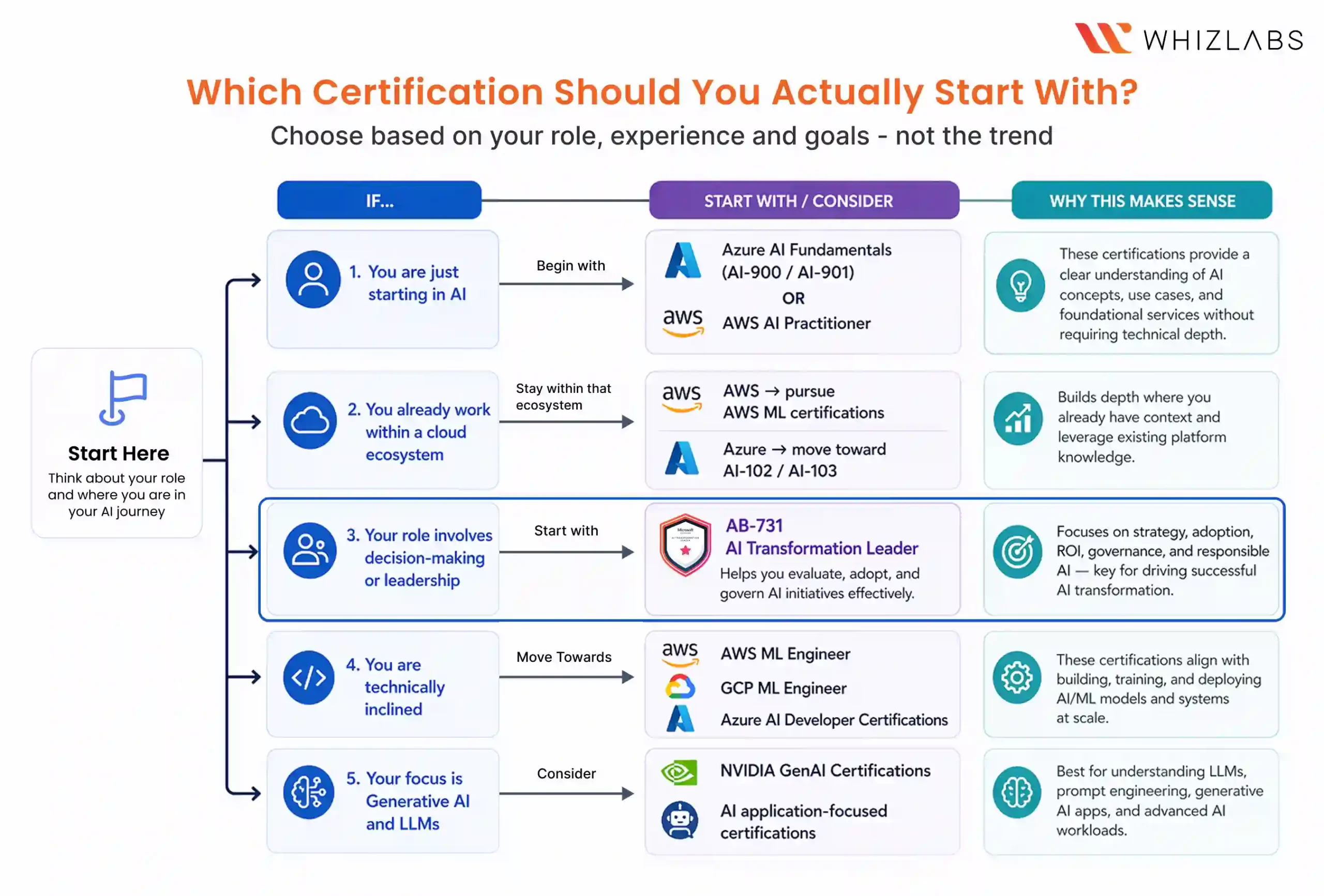
If you are just starting in AI, → Begin with
Azure AI Fundamentals (AI-900 / AI-901) or AWS AI Practitioner
They provide a clear understanding of AI concepts without requiring technical depth.
If you already work within a cloud ecosystem, → Stay within that ecosystem
- AWS → pursue AWS ML certifications
- Azure → move toward AI-102 / AI-103.
This builds depth where you already have context.
If your role involves decision-making or leadership, start with
AB-731 (AI Transformation Leader), it will help you understand how to evaluate, adopt, and govern AI initiatives effectively.
If you are technically inclined, you can move towards
- AWS ML Engineer
- GCP ML Engineer
- Azure AI Developer certifications
These align with building and deploying AI systems.
If your focus is generative AI and LLMs → Consider
- NVIDIA GenAI certifications
- AI application-focused certifications
Hope you got clarity, and how AB-731 Certification would complement your career with other AI transformation certifications, let’s go further to deep dive into how we could prepare for AB-731 AI Transformation Leader Certification.
How to Prepare for AB-731: A Practical Guide for AI Transformation Leaders
Preparing for the AB-731 certification isn’t about memorising tools or configuration; it’s about learning how to think like a decision-maker driving AI adoption. The exam tests your ability to evaluate business value, manage organisational change, and ensure responsible AI implementation.
1. Start with the official Microsoft Learn path, focusing deeply on Responsible AI principles, ROI evaluation, and adoption strategies. They aren’t just theoretical concepts; you’ll face scenario-based questions where you must choose the most ethical, scalable, and business-aligned decision.
2. Next, shift your preparation from “learning features” to understanding frameworks:
- When to build vs. buy AI solutions (Copilot vs custom AI)
- How to justify AI investments to leadership
- How to design AI governance structures like AI councils
This is where practice becomes critical. With Whizlabs, you can prepare through Scenario-based practice tests that mirror real exam thinking.
- Detailed explanations to understand decision logic, not just answers
- Hands-on labs and guided learning paths to connect strategy with real-world implementation
- Don’t skip areas like management, stakeholder alignment, and risk mitigation, which are heavily tested and often overlooked.
3. Most importantly, approach every question with this mindset:
“Which decision makes this AI initiative more responsible, scalable, and valuable for the business?”
FAQ
- Is AI certification worth it in 2026?
Yes. AI certifications provide structured learning aligned with real-world tools and platforms. As AI adoption increases across industries, certifications help demonstrate relevant knowledge and improve credibility in hiring processes.
- Which AI certification is best for beginners?
Microsoft Azure AI Fundamentals (AI-900) and AWS AI Practitioner are widely recommended for beginners. They introduce core AI concepts, use cases, and cloud integration without requiring prior technical experience. - Do AI certifications require coding?
Not always. Foundational certifications focus on concepts and applications, while advanced certifications may require programming knowledge depending on the role (e.g., ML engineering or AI development). - Is AB-731 a technical certification?
No. AB-731 is designed for business leaders and focuses on AI strategy, adoption, governance, and decision-making rather than technical implementation.
Final Take: Why AB-731 Matters for Executive Decision-Making?
AB-731 reflects a shift in how AI is understood at the leadership level. As organisations move from experimentation to scaled adoption, the real challenge is no longer building AI systems, but deciding where, why, and how they should be used responsibly and profitably.
This AB 731 certification is designed for that exact gap, as it equips executives to:
- Evaluate AI investments with clarity, balancing ROI, cost models, and long-term value
- Lead adoption across teams, addressing resistance, building alignment, and driving change
- Establish governance frameworks ensuring AI is ethical, compliant, and secure
- Make a build vs. buy decision,s choosing between tools like Copilot and custom AI solutions
- Translate AI into business outcomes, es not just a technical capability
In short, AB-731 helps leaders move candidates from “AI curiosity” to “AI accountability.” And that’s what organisations are actively looking for.
And this kind of thinking doesn’t come from reading alone. It comes from practice, exposure, and decision-based learning. That’s where Whizlabs fits in with scenario-based practice tests, real-world case-driven questions and structured learning paths.
Here, you don’t just prepare for the certification, you build the mindset the role demands. Because in 2026, the advantage doesn’t come from knowing AI exists. It comes from knowing how to lead it.
Explore AB-731 preparation with Whizlabs, where you practice and build with intent.
Still have questions? Drop us an email at [email protected]. We will sort it out.

- AWS Certified AI Business Strategist AIB-C01 Exam Overview - September 10, 2026
- How does FinOps Certified Practitioner Scale Financial & Tech Careers? - July 20, 2026
- What Is Generative AI for Azure Cloud Engineers? - July 13, 2026
- From Cloud Certification Ready To Building Real Capabilities - July 2, 2026
- How to Pass AWS SOA-C03 CloudOps Engineer Associate Exam? - June 12, 2026
- Claude Certified Architect – Foundations CCA-F Exam Guide - June 4, 2026
- DP-700 Master Content Guide Microsoft Fabric Explained for Data Engineers - May 28, 2026
- DP-700 Microsoft Fabric Data Engineer Career Roadmap - May 19, 2026