AWS Certified Generative AI Developer is easily one of the toughest Professional-level certifications AWS has released, and I say that having cleared a few of them.
I have been wanting to add it to my cert list for a long time now and I finally gave it a try last month. And, I passed it. On my first attempt!
So in this blog I will be sharing my 3-week study plan, hands-on prep strategy, exam experience, and tips. If you are wondering how to pass AIP-C01 exam, my preparation approach might work for you too.
Why I Decided to Take AIP-C01
Generative AI started showing up in almost every architecture discussion I was part of. I was definitely interested, but I was slightly uncomfortable taking part in those discussions.
Because I realised I could talk about LLMs and I understood concepts like RAG, embeddings, and foundation models well enough. But whenever the discussion moved from concepts to actual implementation on AWS, I realized I was still speaking more from theory than experience.
Questions like:
- How would you build this on AWS?
- Which service would you use?
- How to deploy secure and scalable AI applications?
Those were the places where I felt the gap.
That’s what pushed me toward the AWS Generative AI Developer certification.
I liked that this certification helps you move beyond theory and actually build working generative AI solutions. You’ll learn how foundation models behave, how RAG systems are designed, how embeddings work in retrieval pipelines, and how to deploy AI applications on AWS.
That felt much closer to the kind of learning I actually wanted.
So I scheduled the exam. Before the preparation even began, I already knew this would push me into areas I hadn’t really worked through before.
My Professional Background Going Into the Exam
I’ve been working in cloud engineering for about 5 years now, designing cloud infrastructure, managing security, and more recently, working with AI services across platforms.
That gave me a solid foundation going into the exam.
For me, this was more about extending that experience into the generative AI space.
What the Exam Actually Focuses On
AIP-C01 is an AWS Generative AI professional exam. AWS released it in late 2025, and it sits at the top tier of their AI certification stack for professionals.
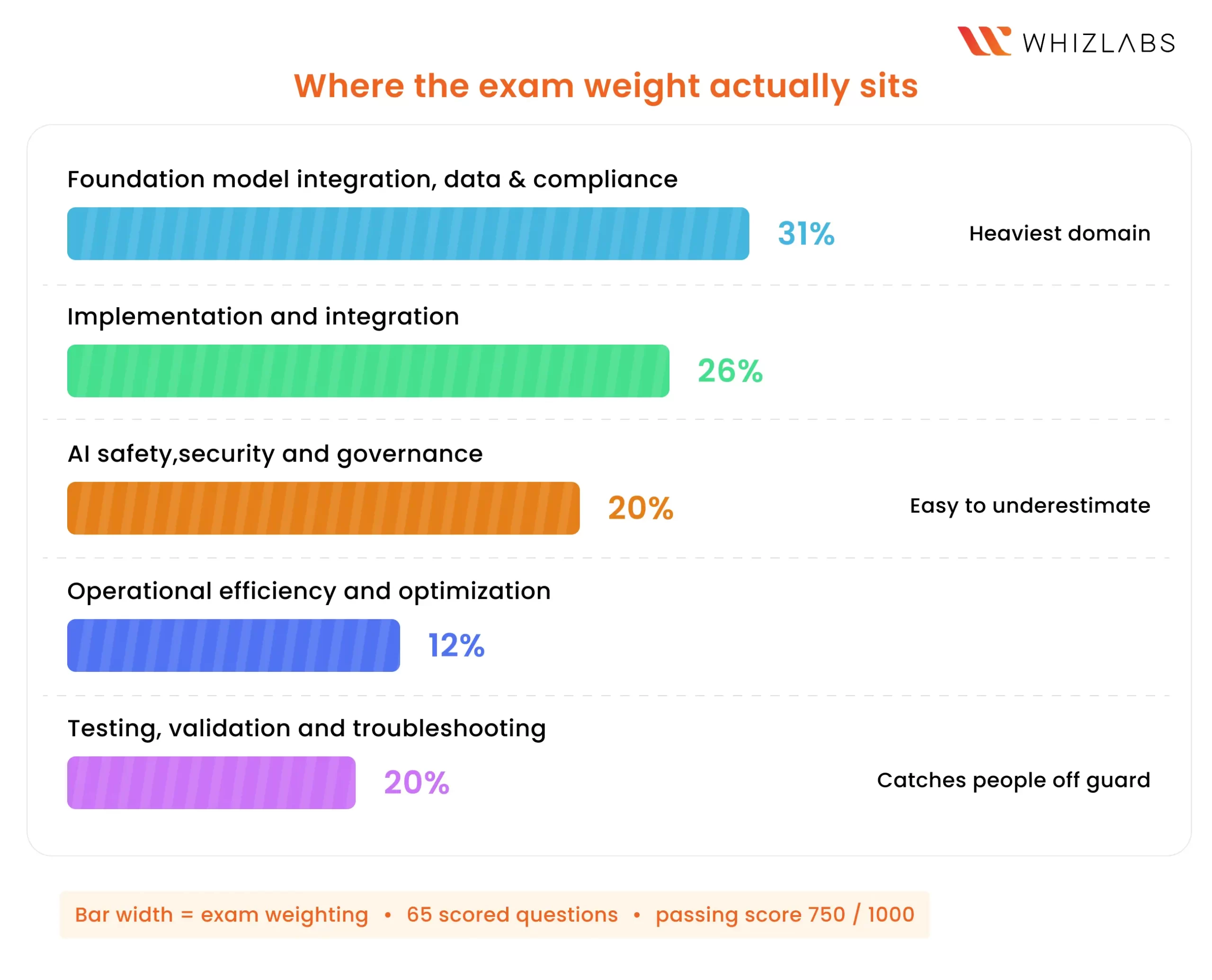
The exam is divided into five domains:
- Foundation Model Integration, Data Management, and Compliance – 31%
- Implementation and Integration – 26%
- AI Safety, Security, and Governance – 20%
- Operational Efficiency and Optimization – 12%
- Testing, Validation, and Troubleshooting – 11%
This is not a recall-based exam.
It does not ask simple questions like what RAG is or what embeddings mean. The questions are usually scenario-based and you have to decide what makes the most sense in that setup.
Example: A company needs a customer support chatbot that pulls from frequently updated internal documents and can trace responses back to a source. Which Bedrock setup and retrieval configuration fits best?
All four options will look reasonable. That is how the exam thinks. The situation gives you the constraints. The wrong options each violate one of them. Your job is to spot which constraint each option fails.
Foundation Model Integration, Data Management, and Compliance – 31%
Most of the weight sits in Domain 1, and that felt accurate while preparing.
A lot of the exam revolves around foundation model selection, RAG design, vector search, and how these pieces work together in practice. Bedrock shows up a lot here, so it is hard to do well without being comfortable with it.
Implementation and Integration – 26%
Domain 2 moves more into implementation and it feels much more practical.
This is where prompt design, integration patterns, agent workflows, and API-level decisions started showing up clearly.
A lot of the questions here made me think through how different AWS services would work together in an actual application flow. If Domain 1 is about what to use, Domain 2 is about how to make it work in a real application.
AI Safety, Security, and Governance – 20%
Domain 3 is easy to underestimate.
On paper, it can look softer than the others. In reality, it is quite specific. It is not enough to know that guardrails or safety controls exist. You need to understand what they help with and where their limits are.
Operational Efficiency and Optimization – 12%
Domain 4 is where the practical trade-offs start to show up.
This section focuses on things like latency, response time, throughput, token consumption, and overall cost management. A lot of the thinking here is around making AI applications production-ready at scale.
Testing, Validation, and Troubleshooting – 11%
The area that stood out to me was Domain 5.
This is where the exam starts feeling very real, because generative AI systems fail in ways that are different from normal software. You need to think about issues like hallucinations, prompt injection, poor retrieval, or context limits, and then work out what is actually causing the problem.
My 3-Week Preparation Strategy
I gave myself three weeks for the exam.
My preparation was fairly straightforward. I used practice tests to figure out where I was getting things wrong, hands-on labs to work through those areas, and AWS documentation whenever I needed more clarity.
Before getting into the week-by-week part, this is really how my prep looked.
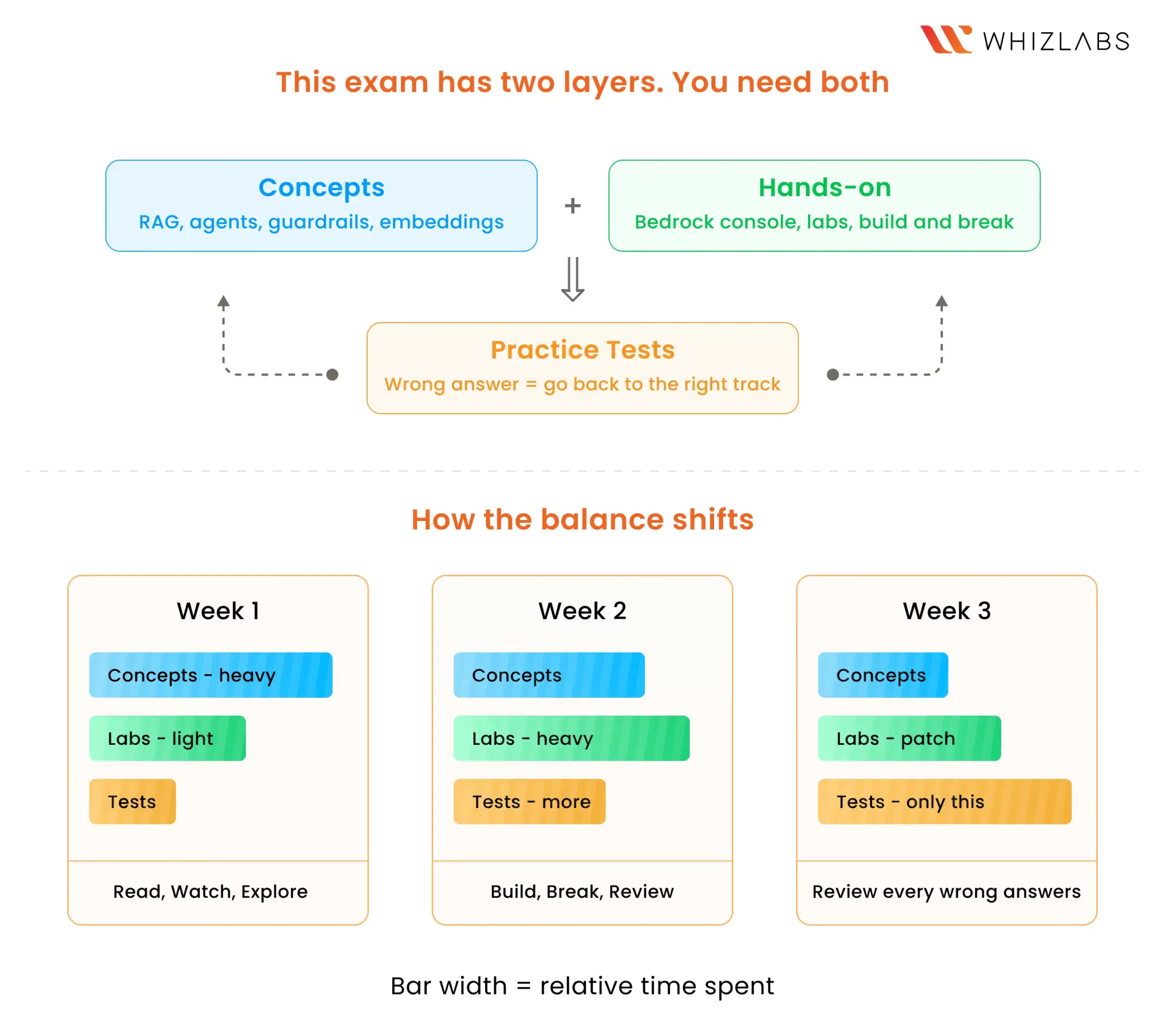
I was doing two things at the same time. One was understanding the concepts properly. The other was actually building and testing things in the console. Practice tests helped me connect the two. If I got something wrong, it usually told me whether I needed to revisit the concept or spend more time doing it hands-on.
I already had a Whizlabs Premium subscription, so I used their practice tests and hands-on labs throughout all three weeks.
Week 1: Reality Check
The first thing I did was take a AIP-C01 Practice tests on Whizlabs before starting my preparation.
I wanted a real score, not a false sense of confidence. The result came back decent. Not great. But that was enough to tell me what I needed to know: I was not as ready as I had assumed.
There were entire areas where I was choosing answers based on instinct rather than actual understanding. That is a harder gap to fix, because you don’t immediately realize it is a gap.
Week 1 became about fixing that shallow knowledge.
I spent most of that week going deeper into the AWS documentation and the Bedrock console, especially around foundation models, knowledge bases, chunking, and retrieval. AWS Skill Builder also helped during this stage and I was using the Udemy course by Stephane Maarek. This mix helped a lot.
By the end of week 1, I had a much clearer picture of where I actually stood.
Week 2: I Hit a Wall
Week 2 was the harder one.
I had a couple of good study sessions early in the week and got a little overconfident. Then I lost momentum.
I would sit down, open a practice test, and just not really be present for it. I lost two days to half-hearted studying that honestly did not count for much.
What helped me turn week 2 around was going back to hands-on labs. Actually going through the setup, configuring the data source, watching chunking happen, and running queries through the retrieval pipeline. Something about doing it rather than reading about it connected things that had been sitting separately in my head.
Week 3: More Coffee and Practice Tests
For week 3, I had one rule. No new material, and I mostly stuck to it.
I took a lot of practice tests.
Every wrong answer was properly reviewed. I didn’t just note the mistake and move on. I wanted to understand why the correct answer worked better and why my choice fell short.
I also went back to hands-on labs for AI safety controls and the testing and troubleshooting domain, because I hadn’t spent enough time there earlier.
This week was all about practice tests and hands-on labs. I created a few quizzes on my weak areas and practiced them separately. There is an option inside Whizlabs practice tests to create custom-timed quizzes.
Hardest Topics for Me
Not everything fully clicked by exam day.
These were the topics that took me the longest:
- Bedrock guardrails
It was not enough to know they exist. I had to understand how to set them up and where they stop being enough. - RAG pipeline architecture
I knew the concept. What took time was understanding chunking, model choice, and how retrieval decisions affect the output. - Bedrock agent workflows
I understood what agents do. The AWS-specific way of building them took longer. - Testing and troubleshooting
This was the hardest for me. Figuring out why the output was wrong felt very different from studying concepts.
If I were doing this again, I would spend more time on guardrails and agent workflows from week 1 itself.
The Night Before Exam
I told myself I would stop studying by 8 pm but I stopped at 10. I did one last practice set and got a few questions wrong that I really should have got right.
Honestly, that is one of the worst feelings the night before an exam.
At around 10:30 pm, I almost opened the Bedrock docs again. But I stopped myself and went out for dinner instead.
The truth is, I still did not feel ready. But at some point, you just have to close the laptop and accept that what you have put in over the last few weeks is what you have to go with.
My AWS Gen AI Developer – Professional Exam Experience
65 questions. 120 minutes.
The passing score is 750 out of 1000. There are 65 scored questions and 10 unscored ones, though you never know which ones are unscored.
On paper, that gives you roughly two minutes per question, which feels comfortable until you hit a long scenario where all four options seem reasonable.
This is my AWS AI professional exam review, and what I would like to share with anyone preparing for it:
- The questions are dense.
Almost every question sets up a real-world situation before asking what you would do. Reading carefully mattered far more than answering quickly. - Multiple-response questions are unforgiving.
If the question asks you to select two or more answers, every choice needs to be right. There is no partial credit. - Bedrock is everywhere.
Domain 1 definitely felt the heaviest, which made sense given its 31% weightage. Most architectural decisions in the exam ran through Bedrock in some form. - Flag and move.
This helped me a lot. Anything I was unsure about, I flagged and came back to at the end. I still finished with about fifteen minutes to spare.
The Result Moment
AWS does not show your result immediately at the end of the test. The pass or fail status comes through your certification account within five business days after the exam.
That wait feels longer than the exam itself.
I checked my certification account twice that night and found nothing. The next morning, I opened it without expecting much, and there it was. Pass.
That felt greatly satisfying for all the work I put in the past few weeks. Uffff…
My Tips for Anyone Taking the AWS GenAI Exam
A few things I would tell anyone starting preparation today:
- Take a practice test before studying anything
Start with an honest baseline, not an assumed one. Let the score tell you where to begin. - Do not skip the hands-on labs
Reading about Bedrock is very different from actually configuring it. - Treat wrong answers as your study plan
Every incorrect practice question usually points to a specific gap. Attempt 2-3 practice tests and analyse them deeply. - Do not leave Domain 5 until the end
I made that mistake. Testing and troubleshooting GenAI failures need time for thinking. If you don’t practice enough, it will consume a lot of your exam time.
Is the AWS GenAI Cert Worth It in 2026?
Yes, it does.
Right now, AI engineering and GenAI roles are paying noticeably more than traditional software roles. In many markets, the package is around 20–25% higher, with mid to senior roles often crossing $150K–$200K+ in the US.
The market demand is moving beyond prompt engineering into implementation-heavy skills like:
- RAG architecture
- agent workflows
- vector stores
- production deployment
- security and governance
That is exactly where AIP-C01 sits.
Who is this for?
- cloud engineers with 3+ years of experience
- professionals whose work is already moving into GenAI
- engineers targeting senior or architecture roles
- AWS professionals who want to formalize hands-on GenAI experience
The certification alone will not change your salary.
But when it sits on top of real hands-on experience, it makes that experience easier for the market to understand and value.
For me, it was absolutely worth it.
Resources I Used
- Whizlabs practice tests and hands-on labs
- Official AWS Documentation
- AWS Skill Builder – generative AI developer training courses on AWS
- Udemy Course by Stephane Maarek
FAQ
Do I need prior AWS certifications to take AIP-C01?
No, AIP-C01 has no formal prerequisite certification.
That said, AWS recommends prior hands-on experience with its services and some exposure to generative AI implementation. If you are new to AWS, starting with the AWS AI Practitioner can make the journey much smoother.
How long does it take to prepare for AIP-C01?
I completed it in three weeks, but I already had the AWS AI Practitioner certification and was studying consistently. If you are new to AWS, give yourself more time. It can take up to 6 weeks.
Are practice tests enough to pass AIP-C01?
No, practice tests alone are not enough. They help you identify weak areas, but this exam requires hands-on familiarity with AWS services, especially Bedrock, retrieval pipelines, and security controls.
Practice tests + labs is the stronger combination.